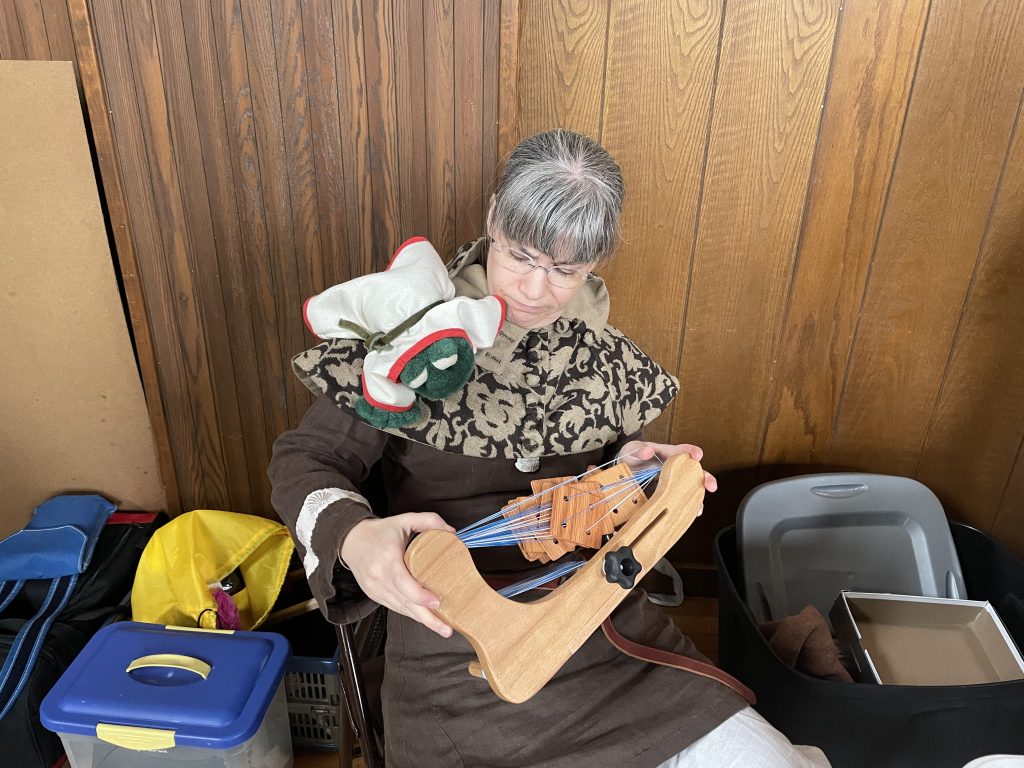
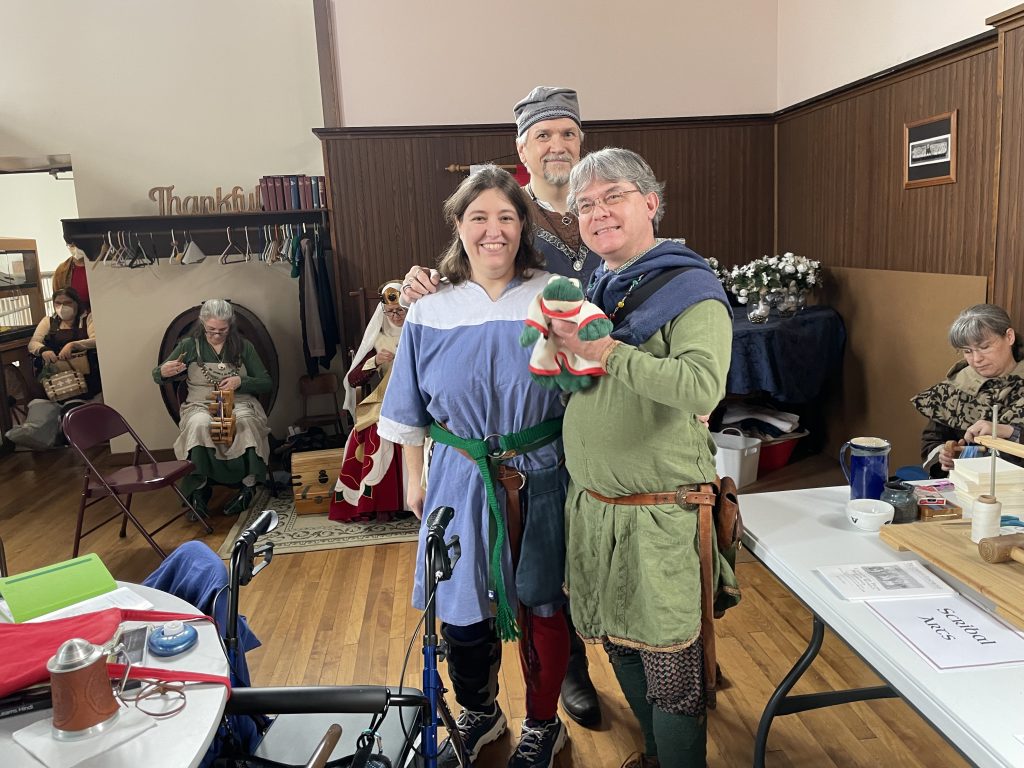
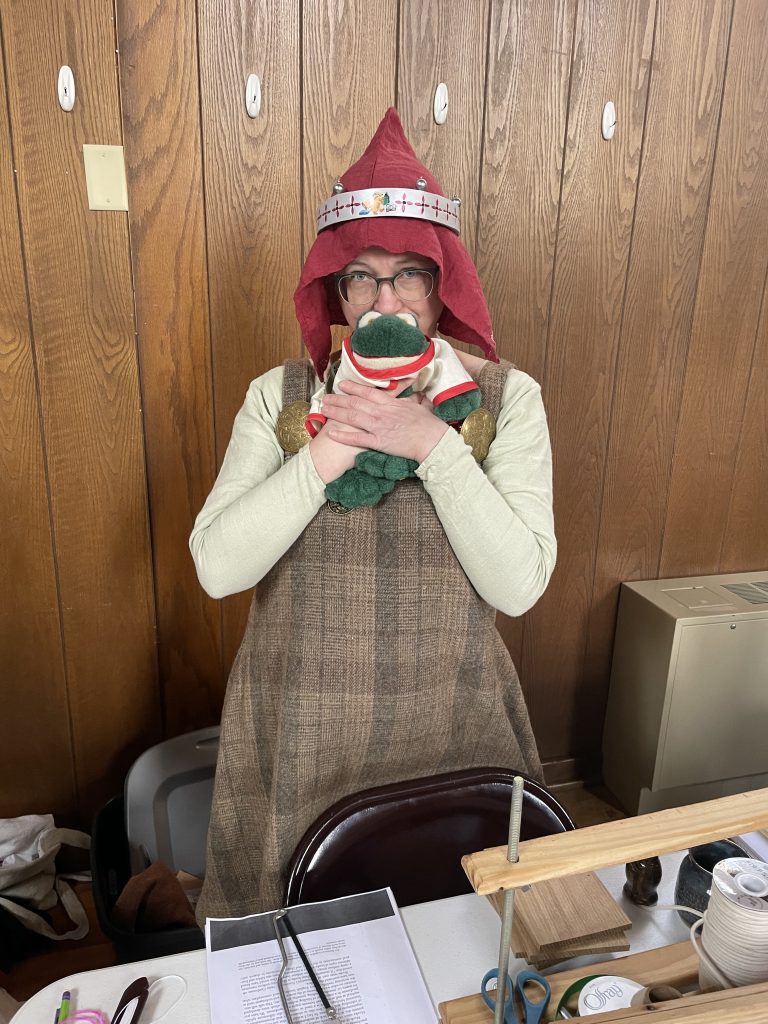
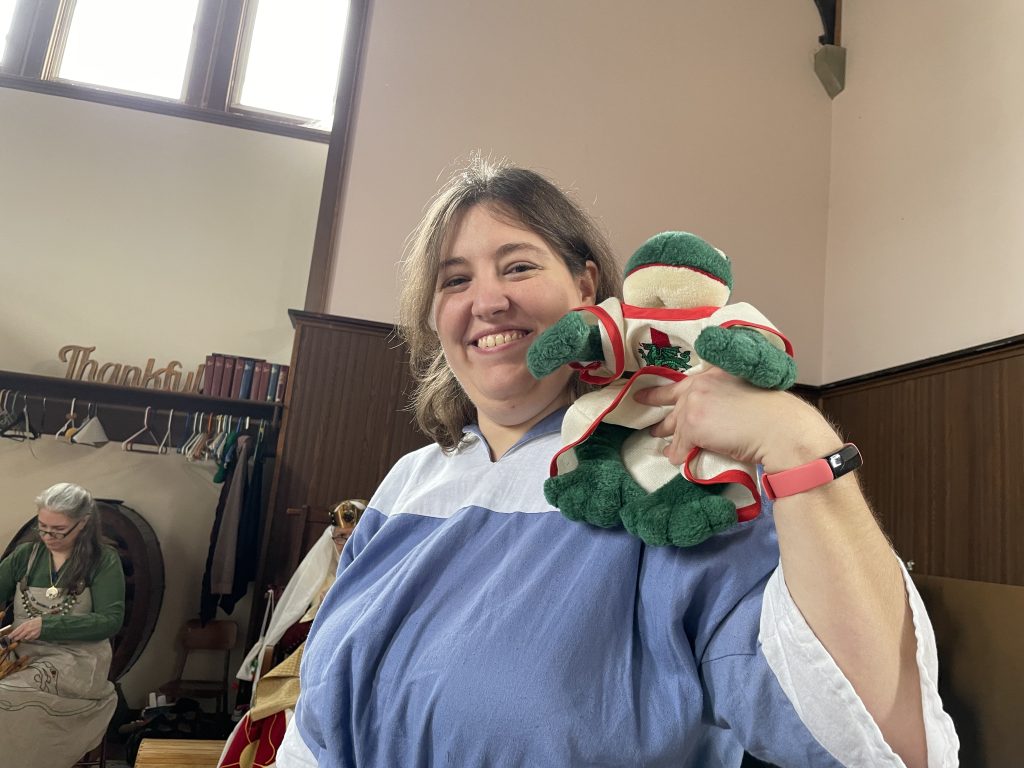
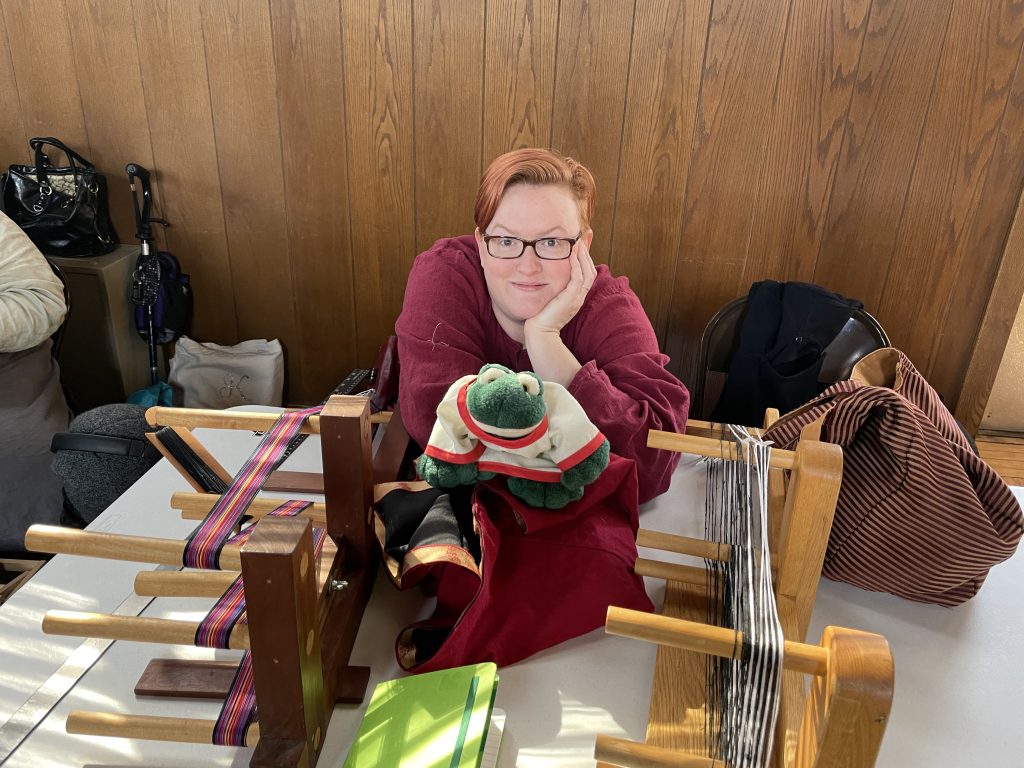
I referred to myself this way recently in a post. One of the things that is definitely missing from vigil advice and any onboarding documents for peerage is reference to the amount of peer (small p) pressure to attend certain events.
For instance, there is pressure to attend Crown and Coronation because as a Peer, you should show support for how the Crown is selected and be there to swear fealty. You should be at Kingdom A&S to judge, all of the Tournaments of Art to give advice to artisans, and The Royal University to teach and evaluate the teaching skills of others. That is 8 events per year right there (2 Crowns, 2 Coronations, 2 ToA). Add a potential regional A&S and maybe the regional A&S of the region next door, that is 10 events. Now add the pressure to attend any significant regional events and any events your group does, you have passed the 1 event per month threshold.
You are told that real life comes first and unless you do something really nasty, no one is going to take the Laurel away from you. But the pressure is there. For someone like me, that pressure can be bad.
Before real life made its own demands, I tried to attend one event per month. Some of those events were standard ones that I expected to go to : Maidens, Baroness Wars, Better War Through Archery. Some because I liked to go to them and they were supportive of my Art: Chieftains, Boars Head, Midlands Green. It was hard enough to add in other events to that roster. Now, it is impossible.
The obvious answer and the answer I chose is to go to the events I want to go to. As my real life allows, I go to what I can. But I already feel imposter syndrome and I have also been a person who feels that if you aren’t doing something, you are just a slug. The pressure can be too much.
On the whole, I am trying not let it bother me. I have higher obligations and those take priority. If that means I can’t go to a ToA, I can’t go and hopefully the order understands. If not, well, there is nothing they can do about it. I am very aware of what is important to me and while there is some importance to the SCA and being a Laurel, it is not top of the list.
Crown and RUM are next on my list. We will just have to see after that.
It is nearly one year since I was put on vigil to be a Laurel. I did a small number of events up until Crystal Ball that year then I had a bunch of other things that needed my attention. I do still have some things that need my attention, like Gertie’s upcoming surgery, but seeing everyone at Pennsic has my Took side looking to emerge.
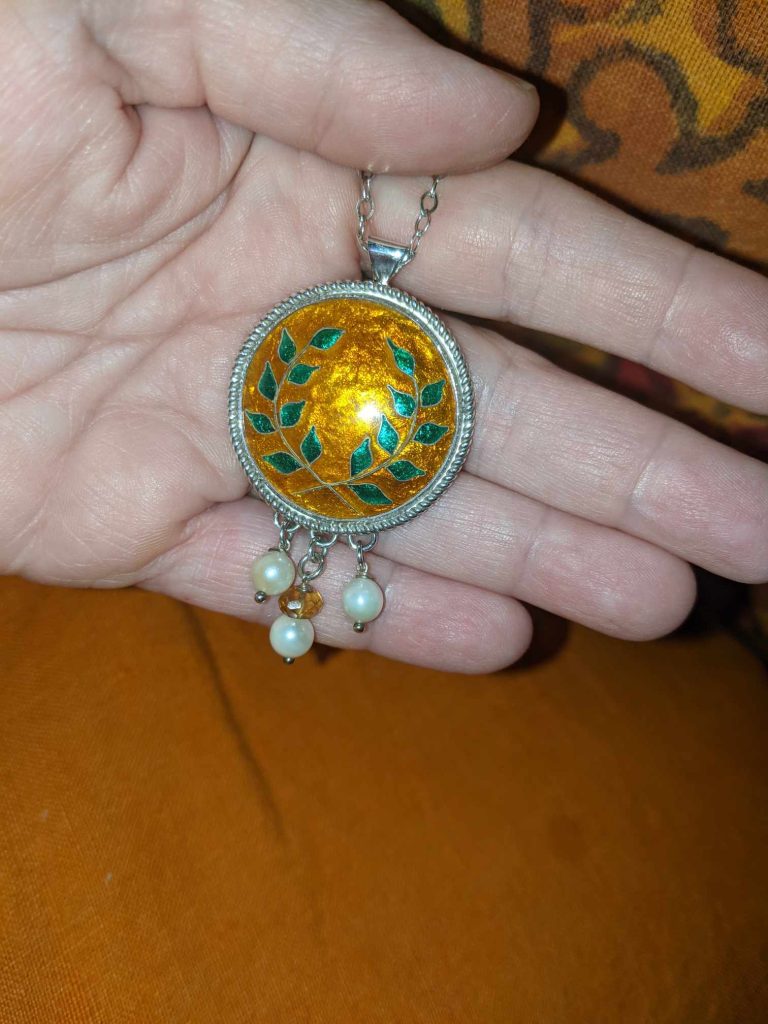
One thing I dearly missed was my friend’s vigil and elevation to the Laurelate in Atlantia. Sophia the Orange had her vigil at Pennsic 50 and I dearly wanted to be there but my other obligations took all my money and vacation time. I had Parvati make this medallion for her though and it is now in her hands.
I hope it brings her joy. I know I have several medallions so I will not be upset if she doesn’t wear it.
Rambling aside: I have sometimes been accused of fake generosity. That somehow my desire to give a gift is meant to be more than a gift. I am not really sure what is meant by this criticism. I am not sure how much stock I put in “love language” but it is clear to me that gifting is one of my love languages. If I feel like I should give you a gift, it means you are important to me. Acts of service are also a love language (doing something for someone is just a different kind of gift). Now, all human interaction is ultimately a desire for reciprocity. It is how we as social animals build bonds and a society. That said, I have been burned when someone has said they would do something for me but then didn’t. That doesn’t change my desire to gift; it just refines who is on that list.
I reminded myself of a question Master John asked me at Pennsic last year, after I was put on vigil, “What is your next big thing?” It has taken a year but I think I have it.
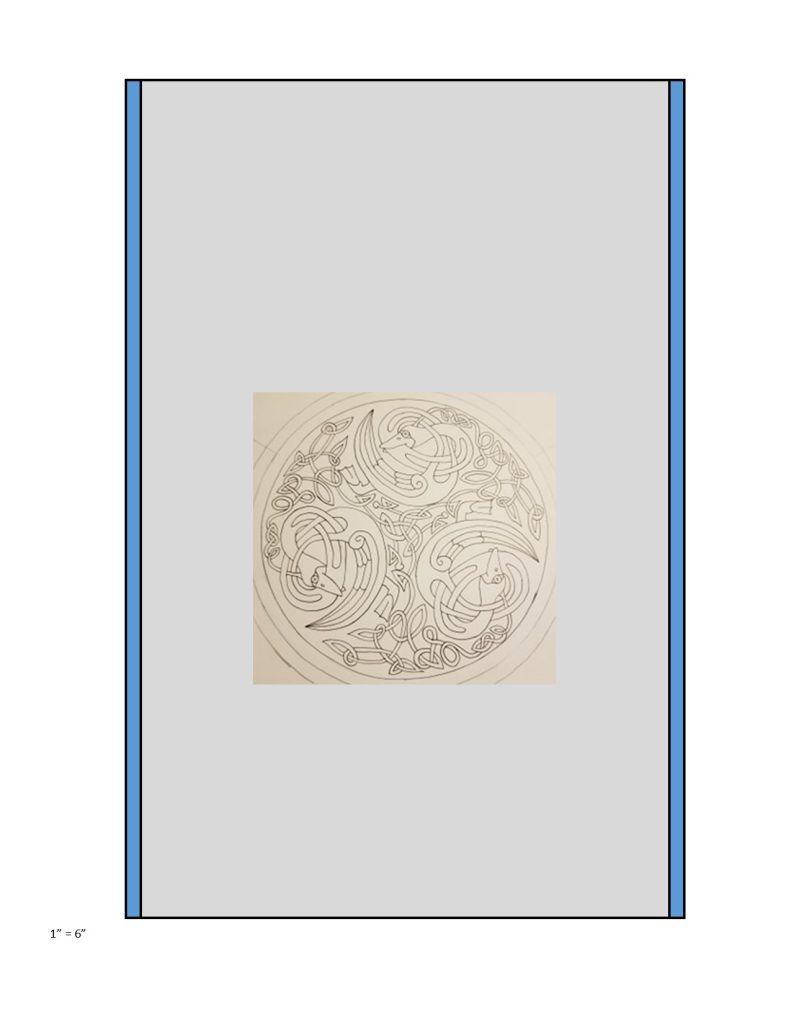
I have mentioned the Apple Tunic before. I have started on it FINALLY. It is intended to be FANCY. First, we will start with the under tunic, then the over tunic, then pants and a hood. I have the pattern for the tunic skirt (the tiny ones; sorry). I will tablet weave more trim. I will add beaded flowers to the hood, and probably laurel leaves, and a cloak, with the knotwork swans that Astrid made me. It will be a lot of work.
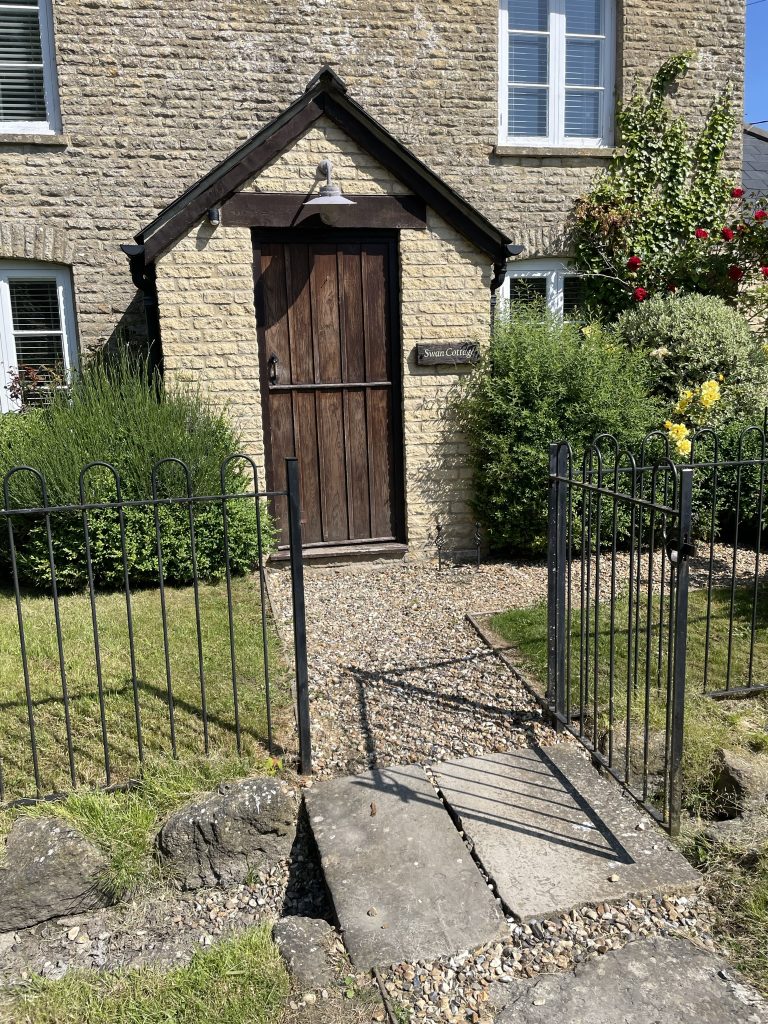
That said, who is Oswyn of Baðon still escapes me. I am weird in that my personae need to be someone who could have existed. I need a backstory. Oswyn Swann existed before the vinegrier but once I learned more about vinegar and vinigriers, the personae came into being. But who is my original persona? Cider is really not in period for him but it could be. The stained glass and fused glass I do are decidedly modern.
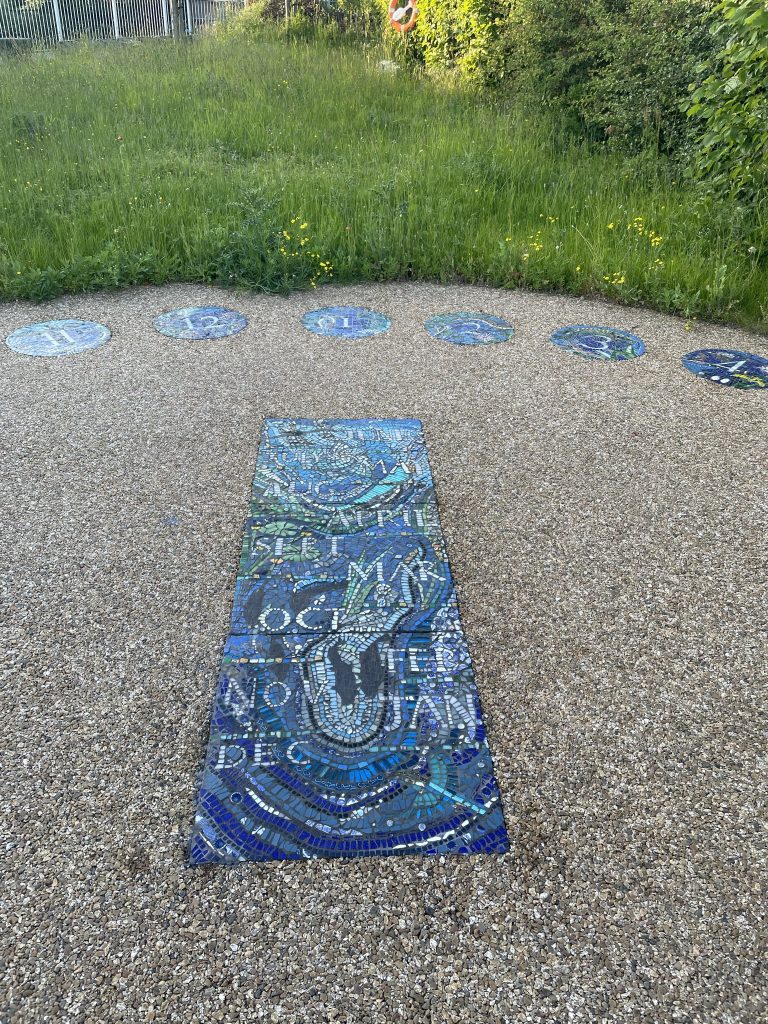
My glass work has suffered lately. The glass shop I had gone to is mostly closed now. I don’t have a kiln for fused glass and given my personal circumstance it is unlikely to be happen. I had made a few mosaics in the past. Why not focus more on that?
I know when I am serious about a project when I have a grand idea for it. What if I redid my deck as a huge mosaic? What if I did the knotwork swans as that huge thing? There is the hook. I will work towards that.
I also wanted a project that I could take to Crafter’s Greens, etc. I can’t really bring vinegars or ciders. Sometimes the site doesn’t allow alcohol and really, it is the yeast or bacteria doing the work so it is kind of boring to watch. I tablet weave because I need to, not because I love it. And my sewing/embroidery will have to get better to do the Apple Tunic but I don’t feel it is who Oswyn is.
But a mosaic artist? Maybe. I don’t think there is any evidence that Anglo Saxons did much mosaic. They would have known about them from Roman ruins and notable Anglo Saxons travelled and so would have seen them. There was even a section of Rome, the Schola Anglorum, that was established by English for English pilgrims. Perhaps this is what Oswyn of Nova Londini (my third persona) would have done. Travel the world as a mosaic artist.
In any case, I have several projects I would like to do with mosaics. The deck is one. Adding mosaic to my vinegar cart is another. And just making pretty things for my house with the scrap glass I have.
We ate breakfast at Sammy’s at about 10 am– corned beef beef hash omelet w/hashbrowns on side, coffee for me; Sean got a Denver or western omelet. We didn’t need to leave just yet for our 7 pm flight but we were bored and restless and the bags were already in the car. So we left for O’Hare.
Traffic to O’Hare was light; it was around noon-ish and so there was no rush hour. We went up 294 to avoid the city traffic. Only delay was bridge construction on 57 pretty far north.
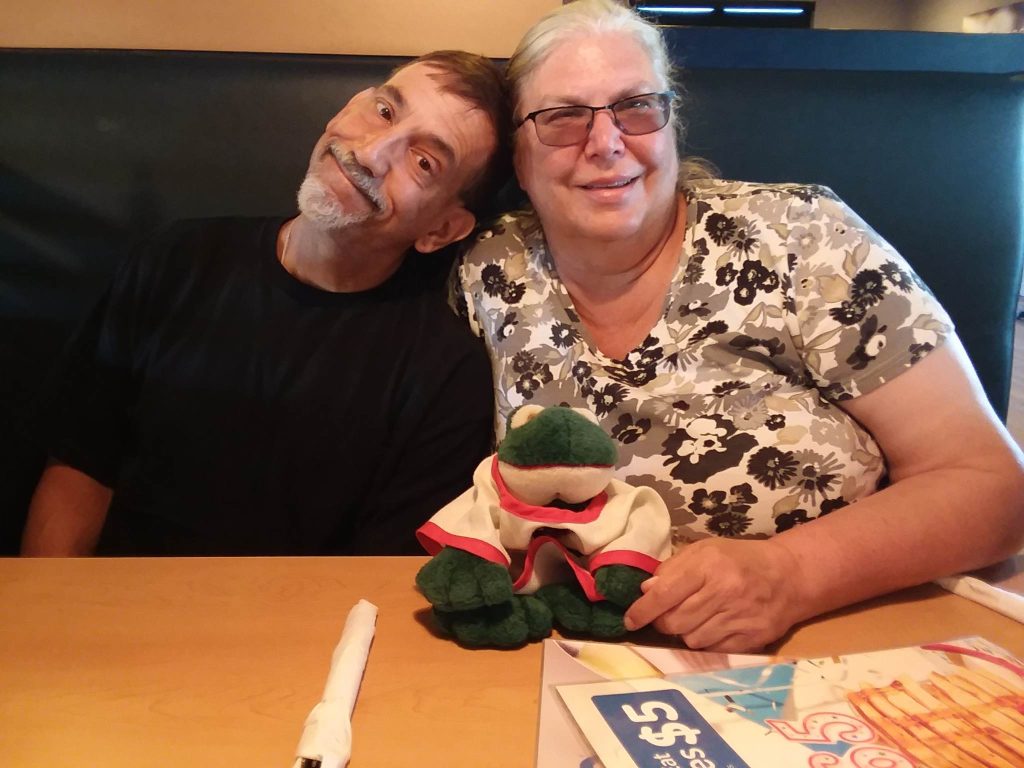
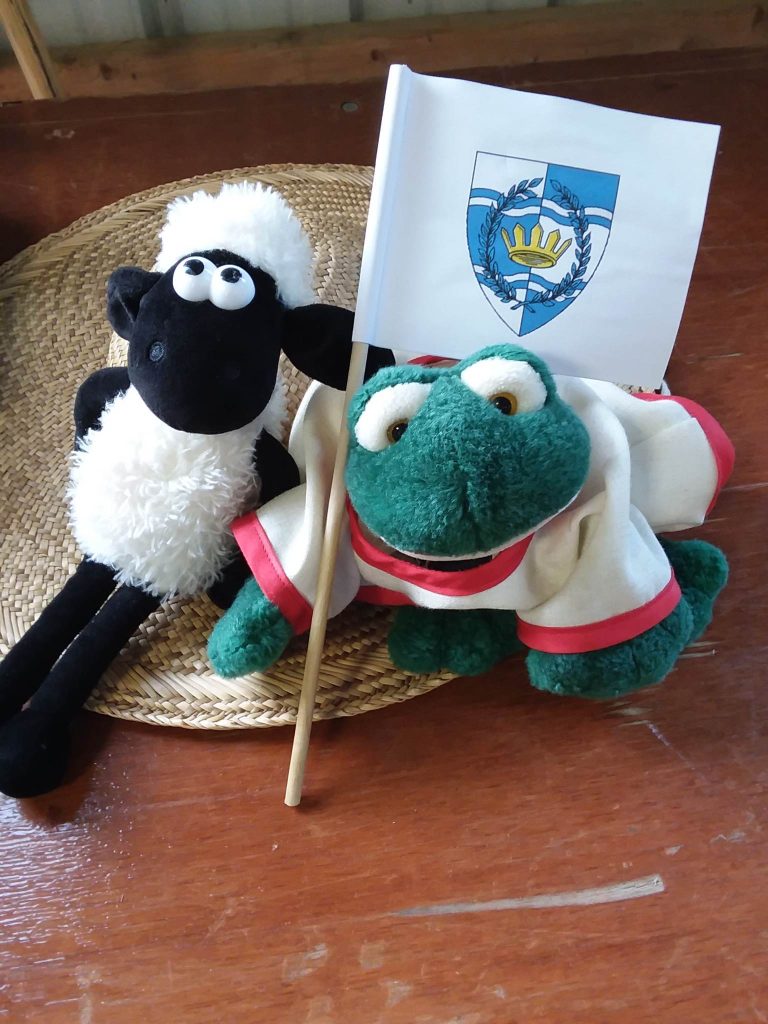
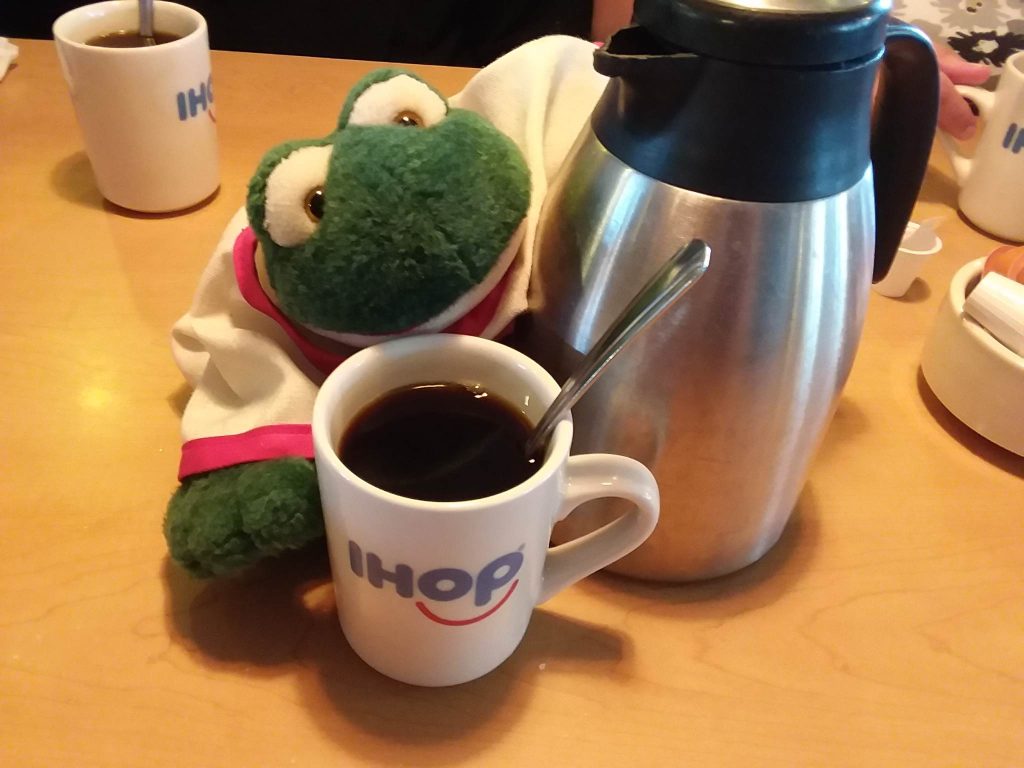
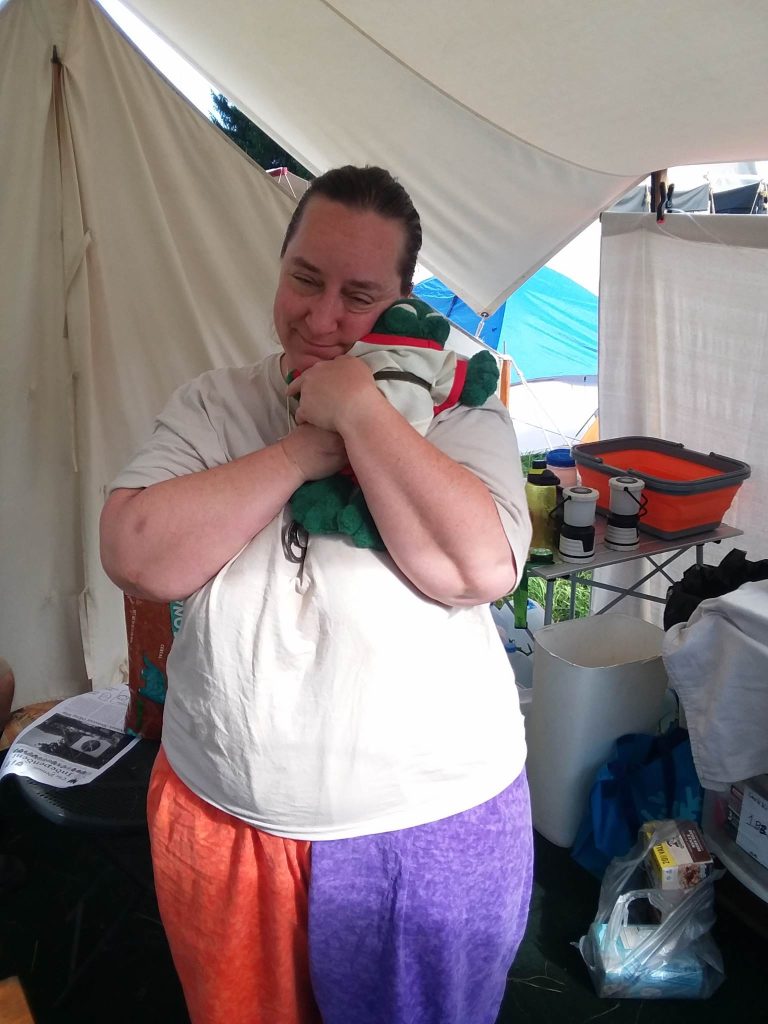
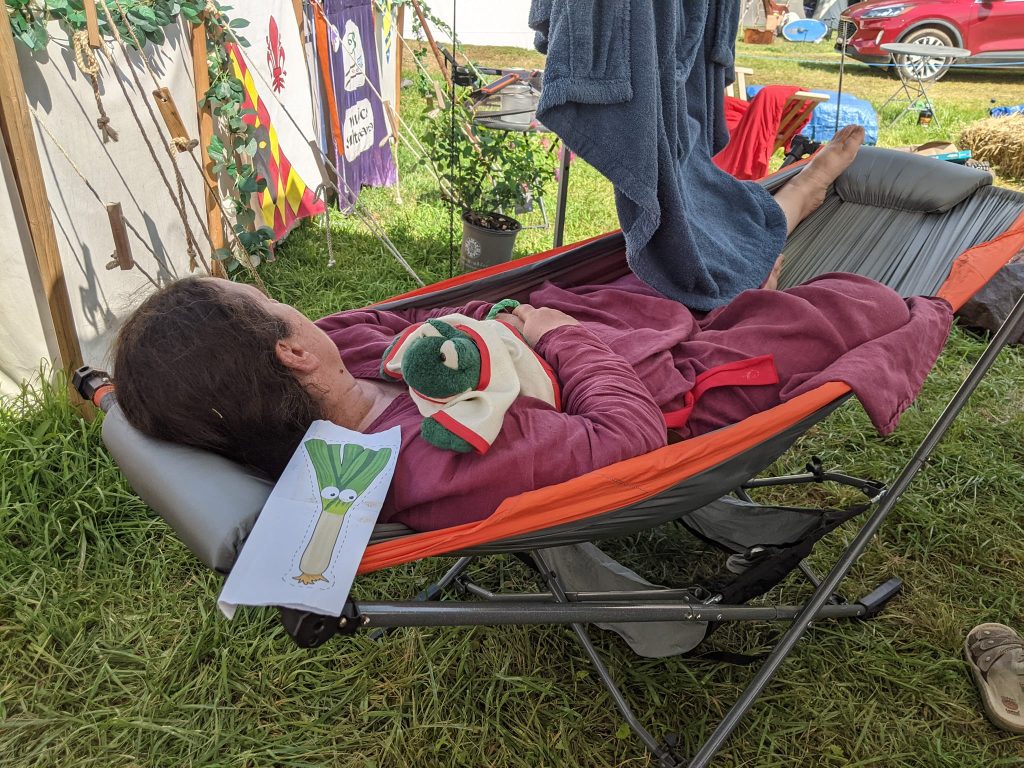
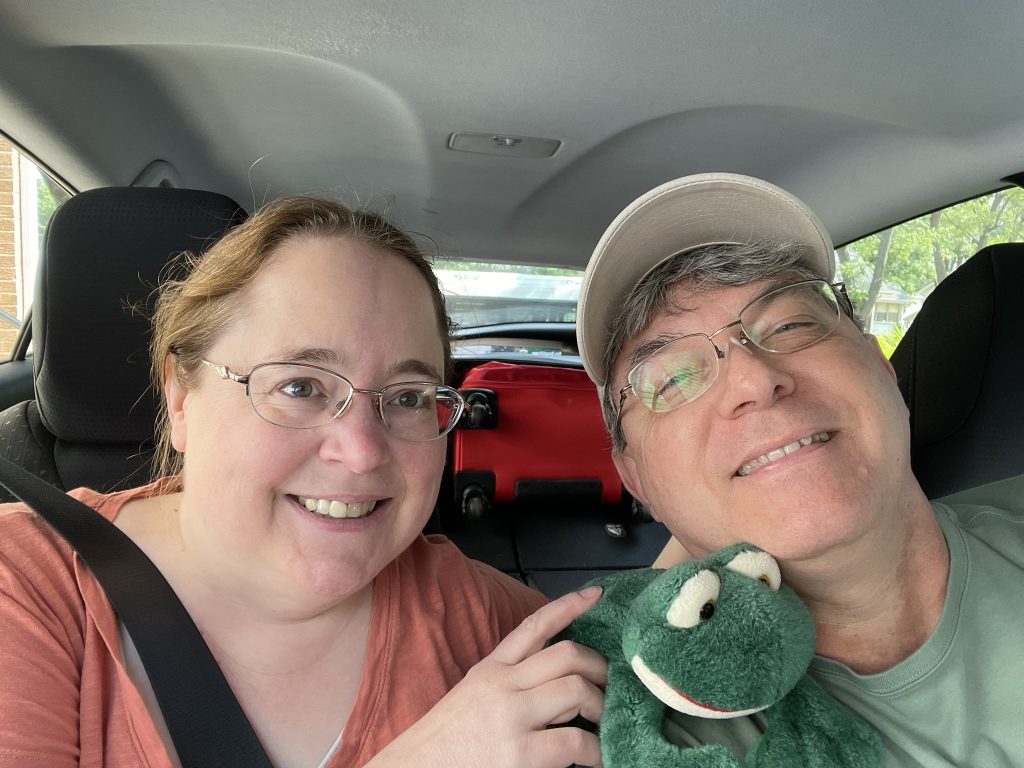
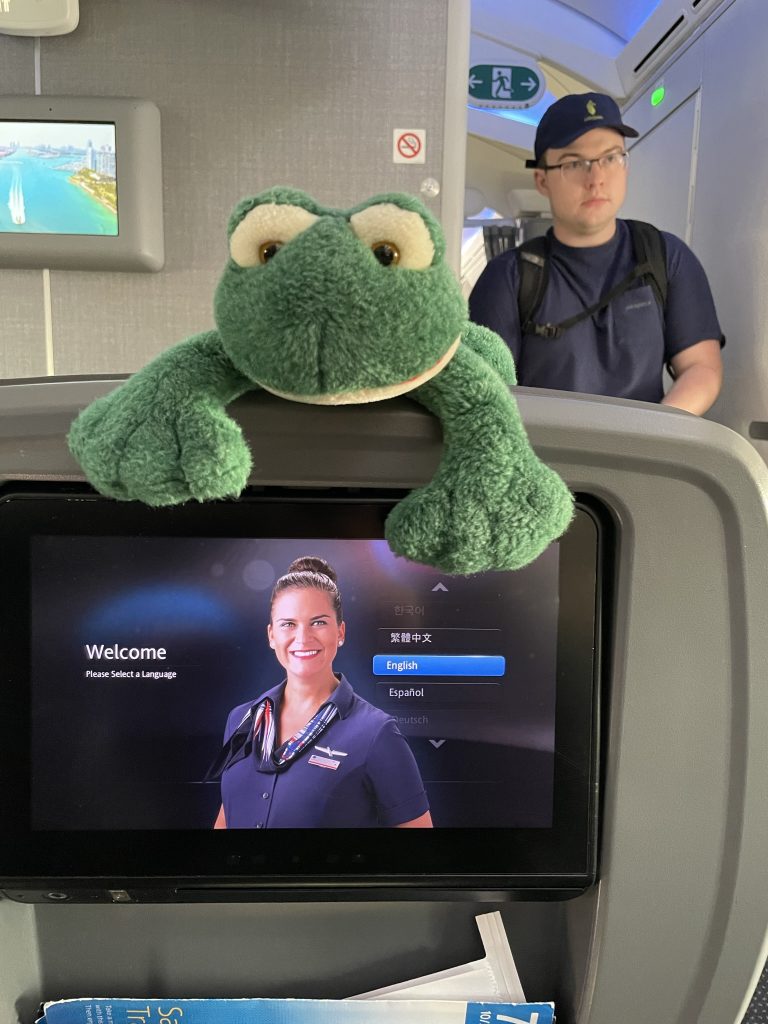
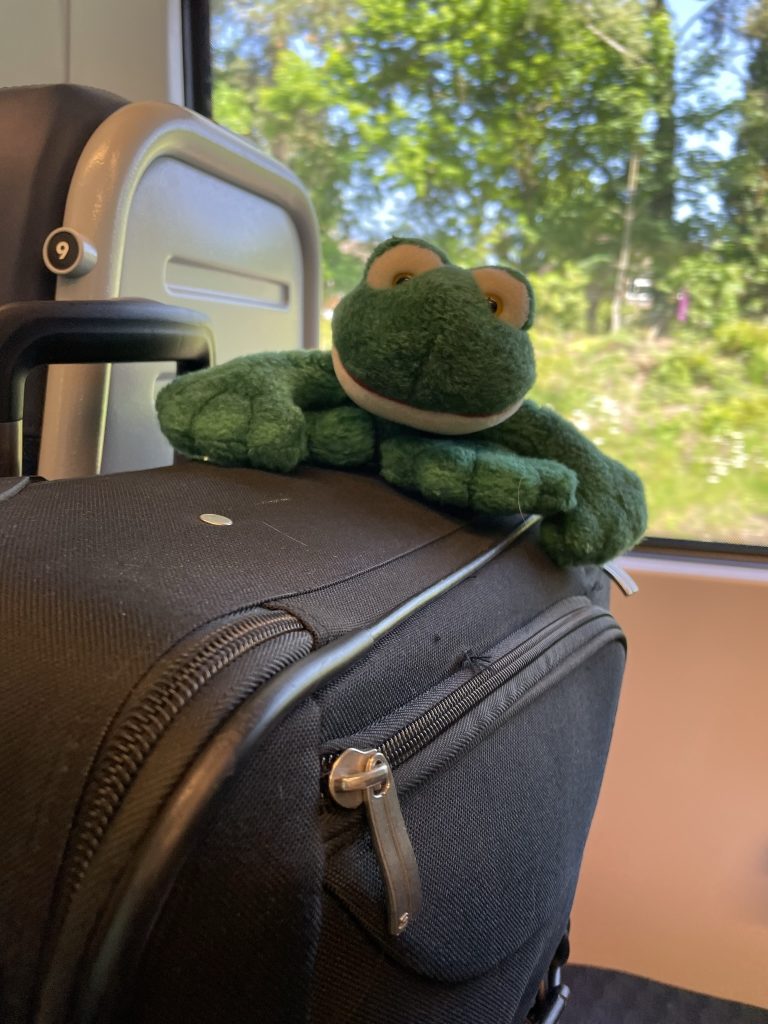
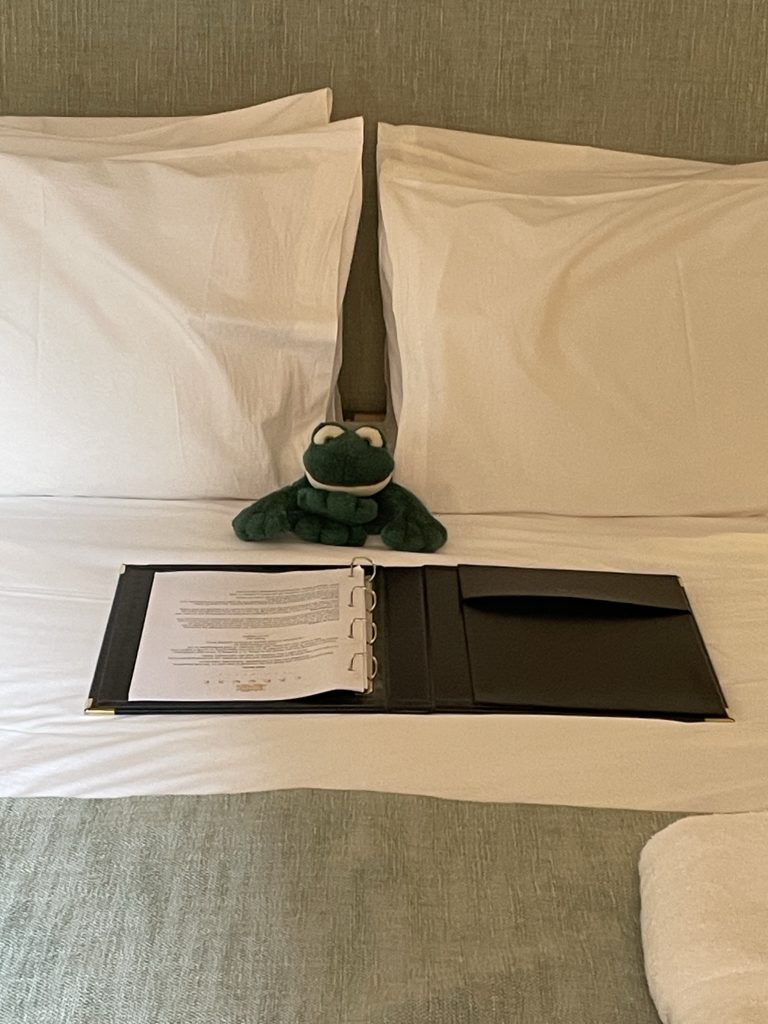
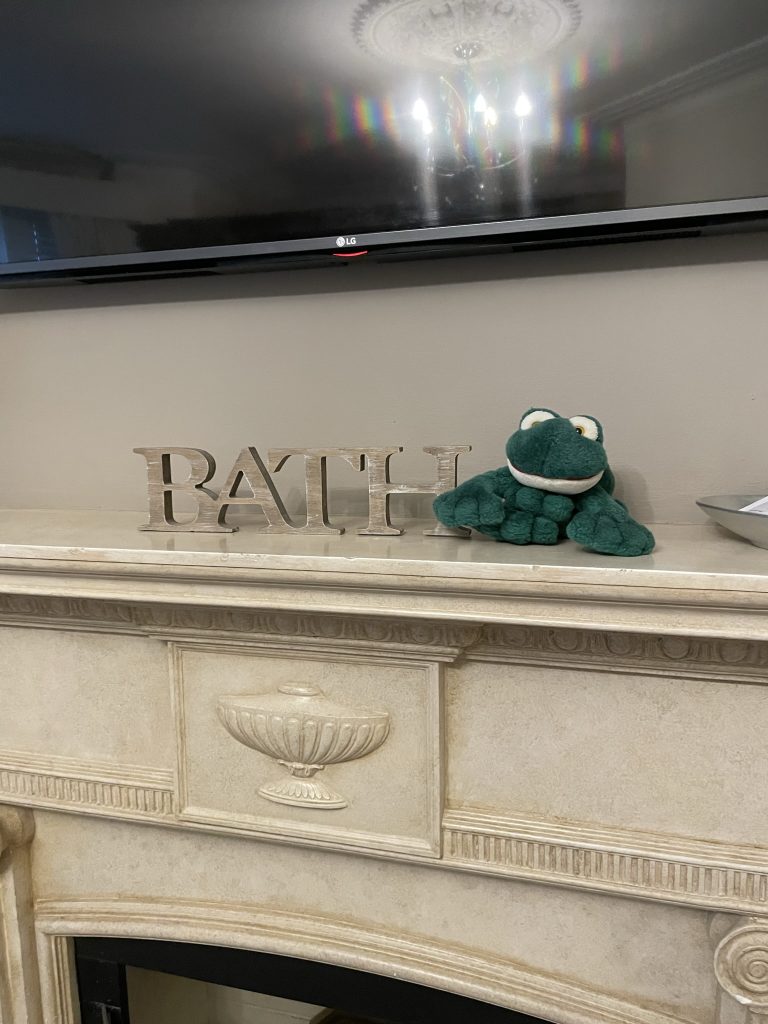
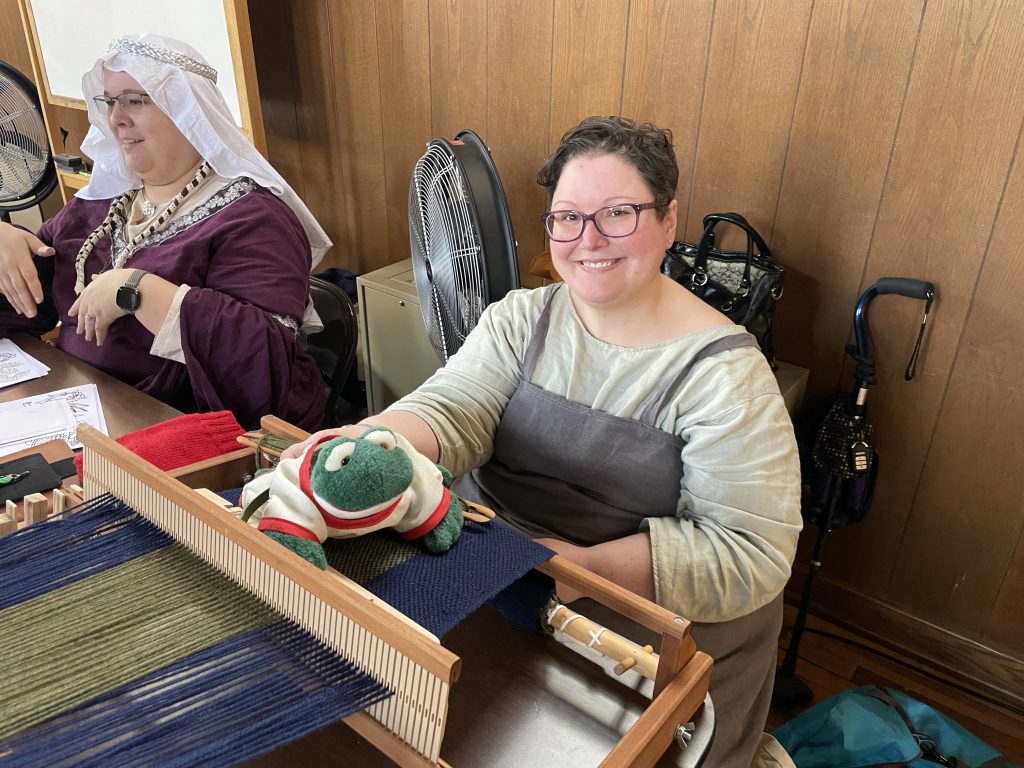
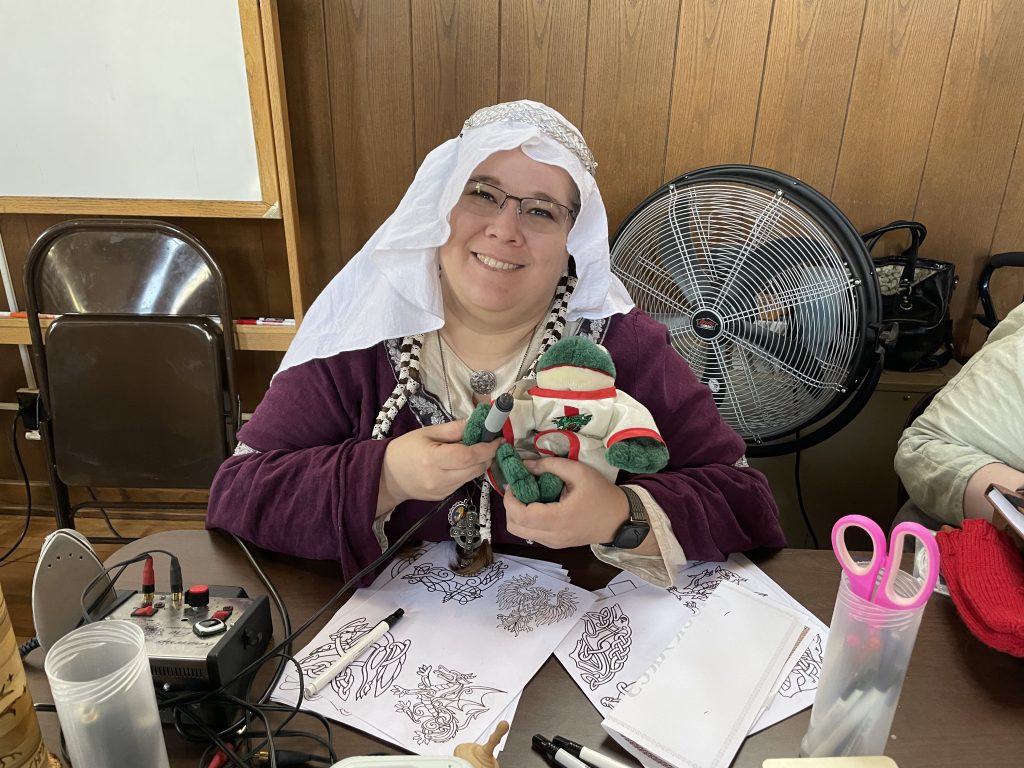
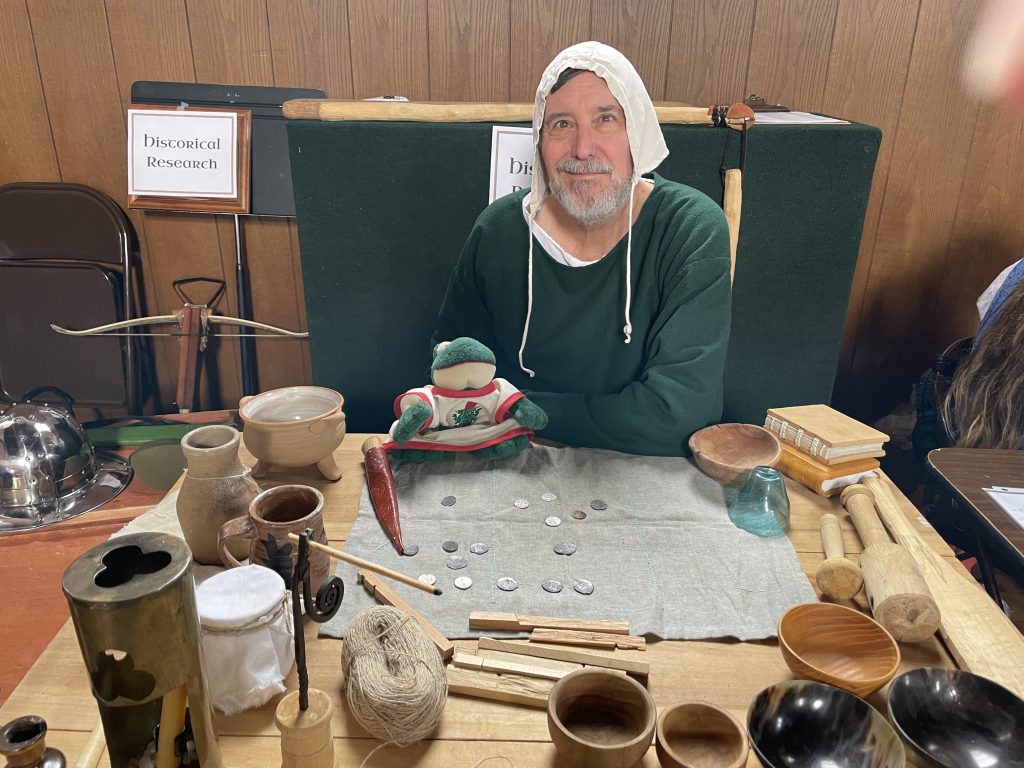
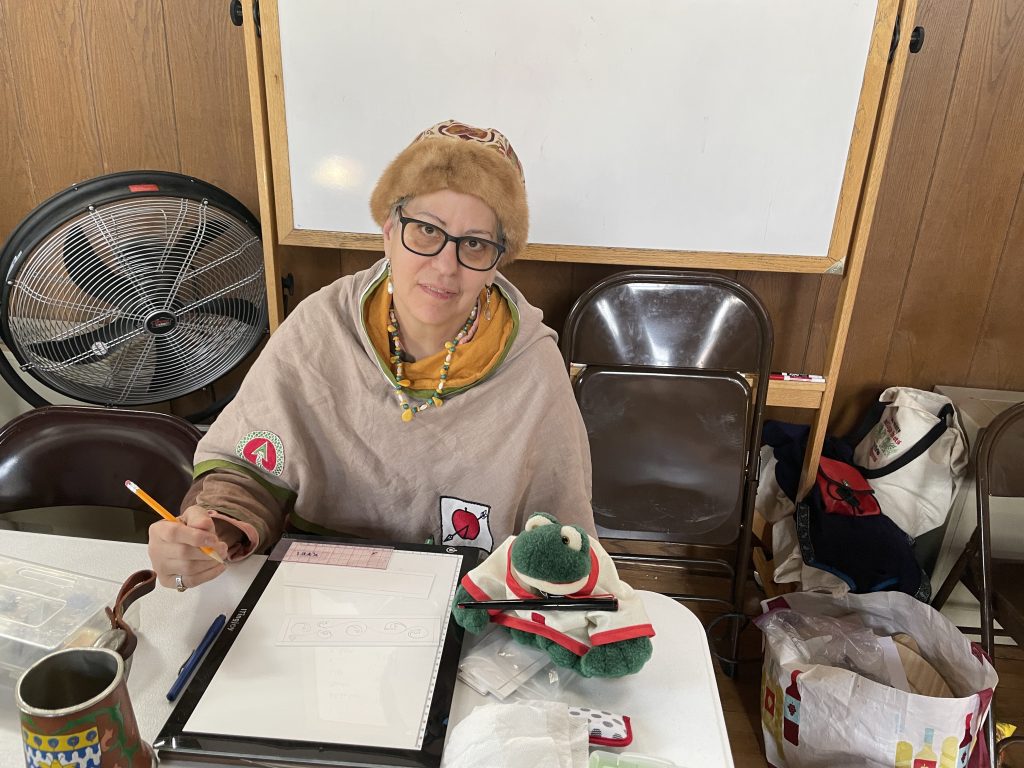
We had anticipated lengthy delays processing into O’Hare as we had not been able to go get Global Re-entry as we would have had to go to Detroit six months ago for just the chance at doing it, no guarantees. Check-in of the luggage and processing thru security took less than 5 minutes total. That left us at O’Hare at 2 pm-ish for a 7 pm flight. We killed time near our gate by looking for phone charging points. I wandered through the mini food court and the stores but did not find anything interesting– and deeply regretted not having a book stuffed in the carry-on. We had brought one big square carry-on bag with us. Sean brought his work messenger bag, and I had bought a travel purse– the kind with zippers that clip shut and strap-cutting/RFID protection. (This was massively overkill, but I was in a rush when we were buying last-minute travel accessories at TJ Maxx.) I didn’t bring a carry-on as I find it difficult to handle big bags. In our carry-on, I had packed a number of emergency items that turned out not to be necessary– shirts, underthings, and socks for us to change into if need be, a cleanup kit, and raincoats/rain ponchos and umbrellas. We also put our medications into the carryon and brought with us the OTC meds we thought we would need. I didn’t bring any of my PRN meds except for a muscle relaxer. We didn’t bother with our vitamins. None of the items in the big carryon except the meds proved to be useful, and in retrospect we could have eliminated that bag altogether– as we were due to land in London during a time when all shops would be open. Sean had his ipad, frog, powerblocks, and power cables in his shoulder bag, along with a book or two. Froderick the frog accompanied us along the way, but we did not bring him out sightseeing with us as he is kind of bulky. Perhaps next time we will bring one of the Matildas, as they are finger puppet-sized. We could also have gotten by with only one power block. I can fit the smallest in my purse.
We paid a whopping 8.64 for a Diet Pepsi and a water; and I feared the worst when ordering lunch, but it turned out that the pizza margarita at Wolfgang Puck’s was only 15; the waters brought it to 23.73.
Our flight was completely uneventful, though we had messed up on the seating plan and I ended up sitting behind Sean. The couple next to me was chatty– they were Americans visiting their son who lived in London, and said they made the trip every year or so. I watched the flight simulator for a long time and then watched Wakanda Forever. The costuming was just as good as the first movie, though I felt that the plot was not as good. I didn’t realize that all the Marvel movies were on the streaming service. I stayed awake through most of the flight as I didn’t have anywhere safe to put my glasses. I put them in my purse and then wore a blackout shade for a little while, but it made me nervous for my glasses to be like that, so I gave up. Something was wrong with my footrest, so I couldn’t put my feet up properly and it was seriously uncomfortable. One thing I did learn about Premium Economy is that the stewards will give you as much wine as you want. The people next to me said the red wine (a rioja) was not good, so I had the white, which was an indifferent (but not unpleasant) Trebbiano. I had the pasta, which proved to be a cheese ravioli with a tomato sauce w/diced eggplant, zucchini, and mushroom. There was also a salad w/ balsamic dressing, a roll with a pat of butter and a spreadable brie-type cheese; a package of plain crackers and a dessert, a sort of key lime or lemon meringue pie. It was bland, but I ate it, figuring that we would not be getting breakfast. I was wrong– about an hour before landing we were given yogurt, granola, and fruit.
The flight was smooth and fast– no weather– we went to 39000 feet almost immediately and maintained full cruising speed for the 787 throughout, with a small tailwind. We landed a little early and it was a perfectly smooth landing.
5-26
It only took a few minutes to process thru Heathrow, most of which we spent trying to find our baggage as we went to the wrong carousel first. Their security staff was thorough and professional but very quick, and we were cleared through almost as fast as we walked up. As usual, nothing scanned well for me and I had to be waved through.
We were very tired at Heathrow and were struggling trying to figure out the trains. Now I know that we should have taken the (in airport) Elizabeth line to Paddington and then transferred to the Southwestern from either Paddington or one of the other London stations. We ended up taking a cab ride to the Woking train station, and that cost about 100 pounds.
We arrived in Portsmouth and took a cab to Somerset House, our B & B, which was about 10 pounds. None of our B & B’s on this trip were Air B & B’s as we didn’t want to deal with their unreliability or abusive business model. Instead, we stayed at the equivalent of tiny boutique hotels. All of them were very good to us and held our bags if we were early or wanted to do things in town post-checkout.
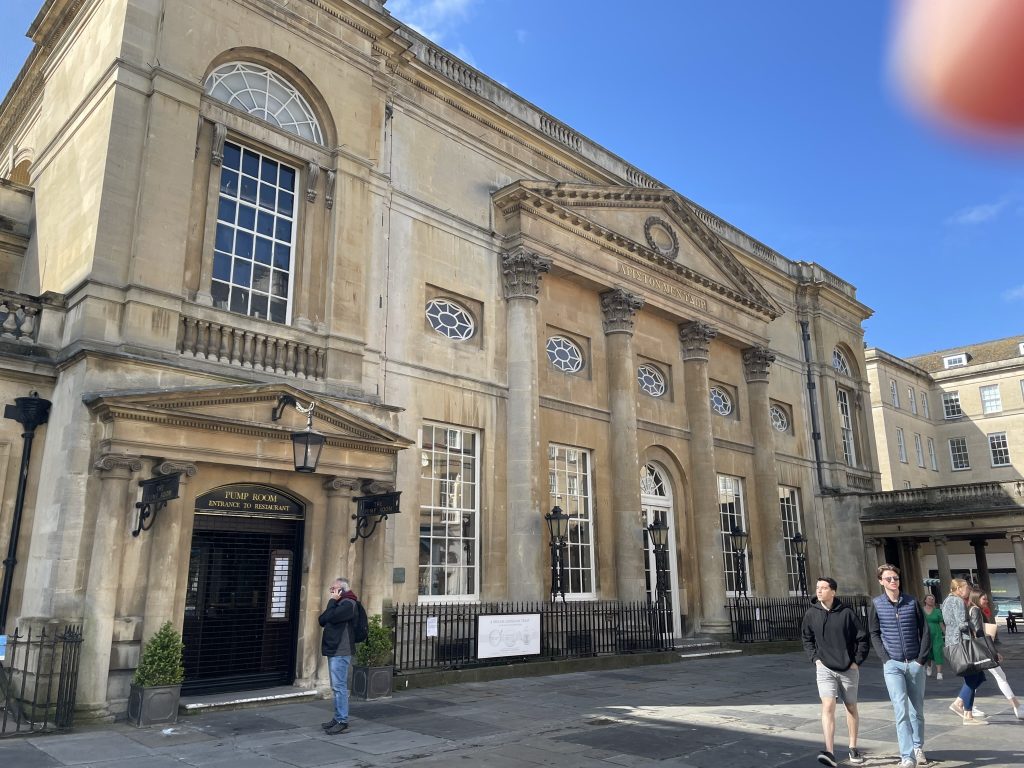
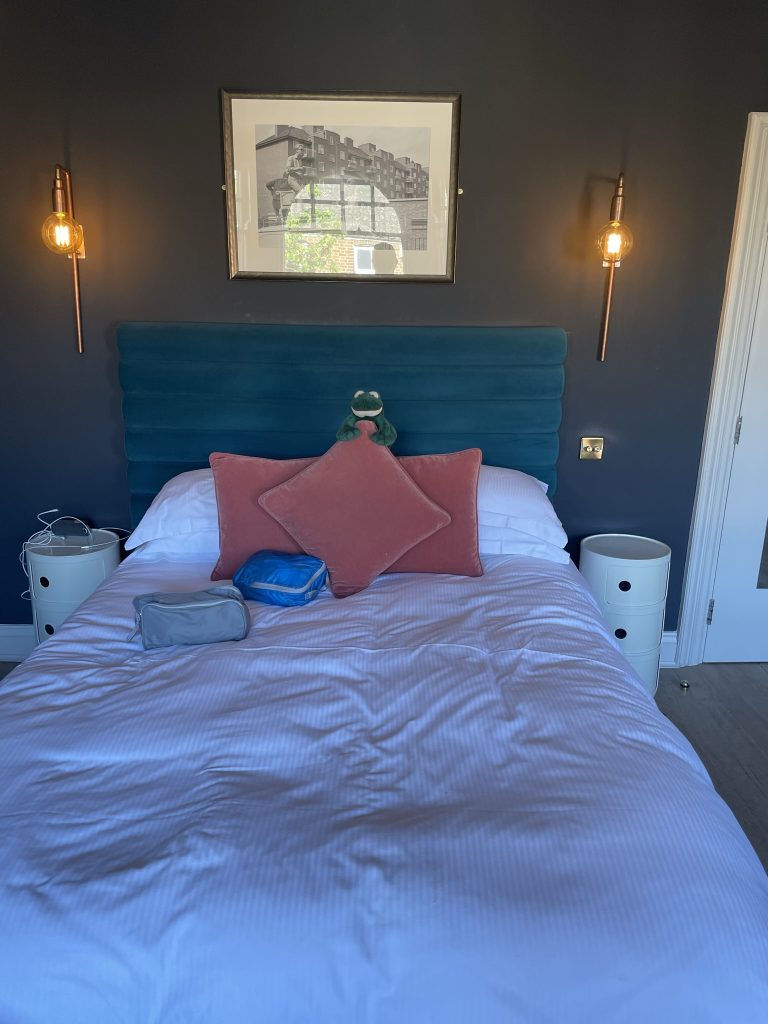
Somerset House is one of three houses with rooms owned by Mercer Collection in Portsmouth. The others are Florence, Stattons, and Clarence. We had a large- possibly king-sized by British standards– bed, two upholstered sitting chairs, a freestanding wardrobe, and a tiny dressing table/ chair set. The bath was a shower/sink/toilet three-quarter bath style; and this is what we experienced in every room we stayed in. We were on the first floor right by the door to the outside. I noticed a sign requesting that visitors not slam the exterior door or be loud in the hallway at night. It was a historic house and the door was very slammable and loud. Somerset House had the most restrictions of all the places we stayed at, including the rule that takeaway food not be brought into the rooms. This was not a hardship though, as the restaurant owned by the Mercer Collection, the Garden Restaurant, was only a few steps away around the corner and has fairly extended hours.
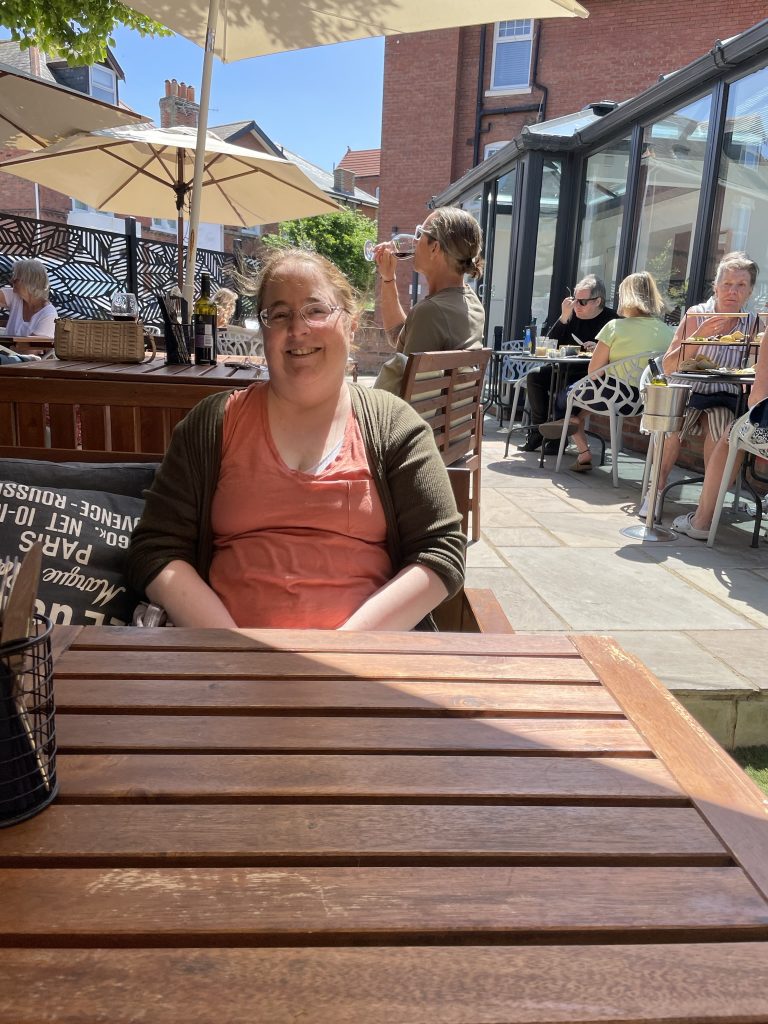
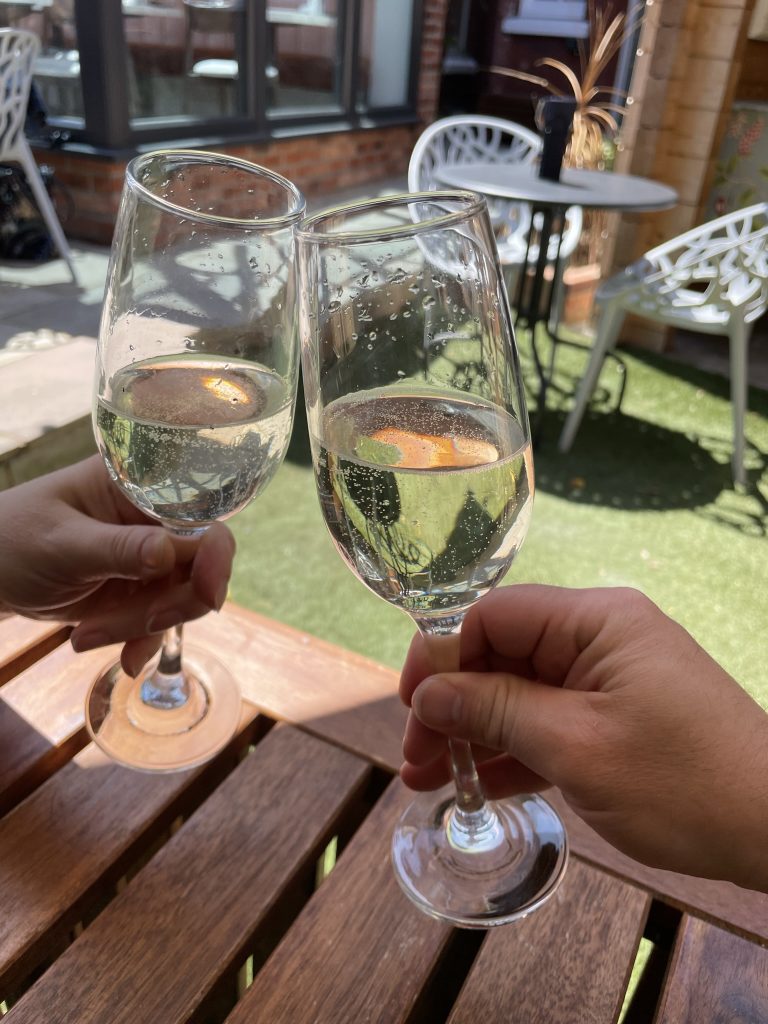
We were allowed to check in early (about 12:30 versus a check-in time of 3 pm) so got our bags situated and went down to the restaurant. It was a beautiful day, 65-70 degrees and blue skies, so we sat outside in the garden area and ordered the charcuterie and cheese grazing board for lunch. It had local cheddar, blue, and goat cheese (brie-type); prosciutto, Spanish Chorizo (the large-diameter salami-like chorizo) and shredded ham hock; there were pickles, olives, and chutney (the chutney and pickles were house-made) and rustic bread (I believe this was also house-made and baked in their wood-fired outdoor pizza oven). We split a small bottle of Prosecco and toasted each other happy anniversary. (Shortly afterwards we accidentally dropped the grazing board from its stand onto the table, but were able to rescue the food with no harm done.)
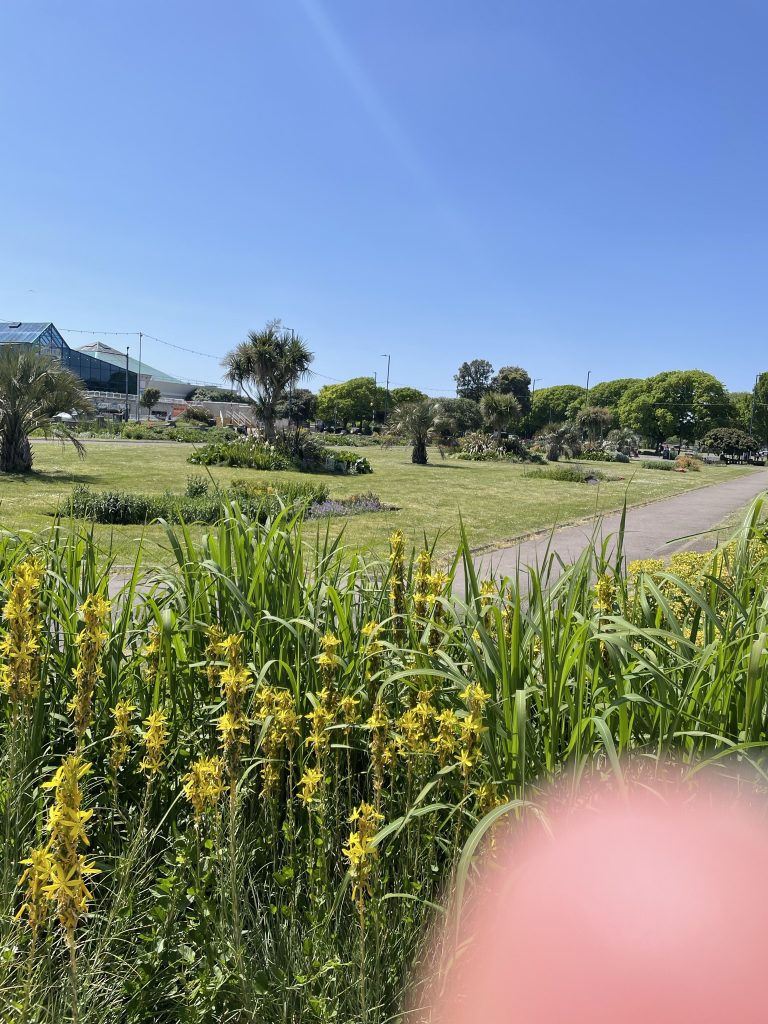
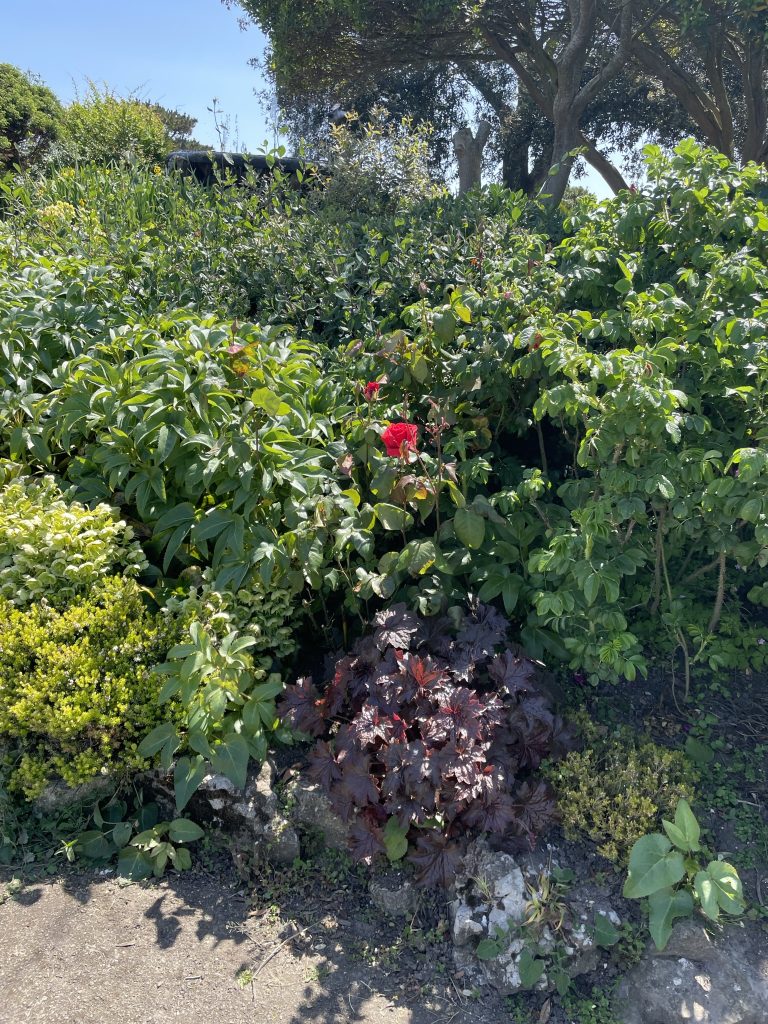
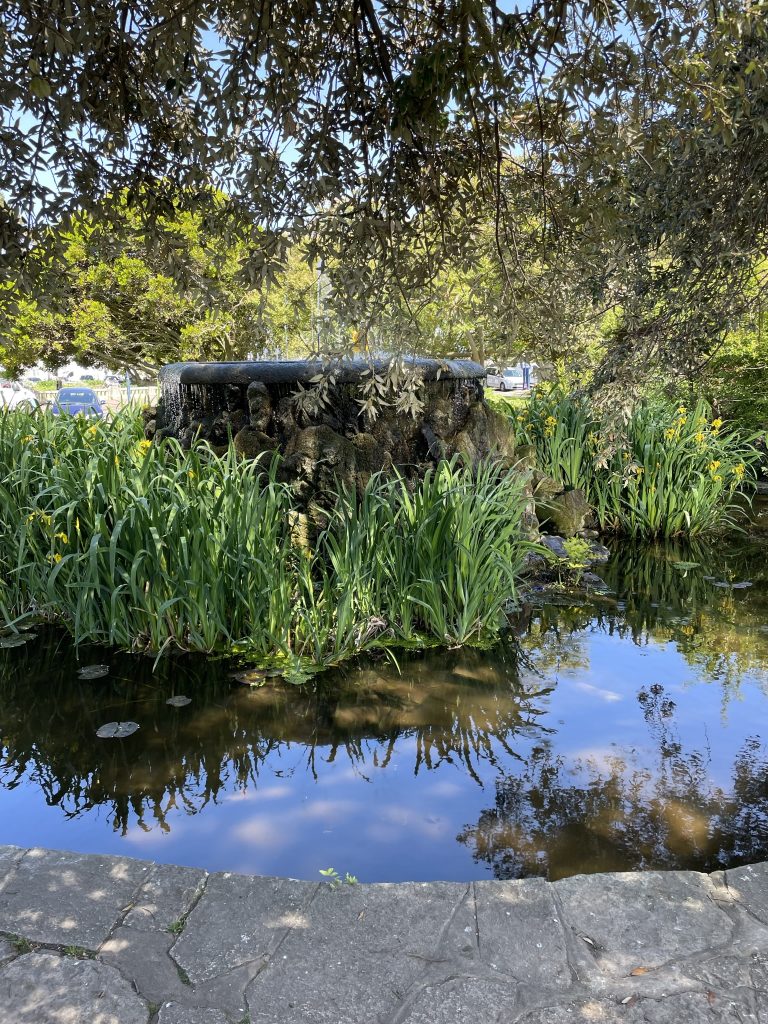
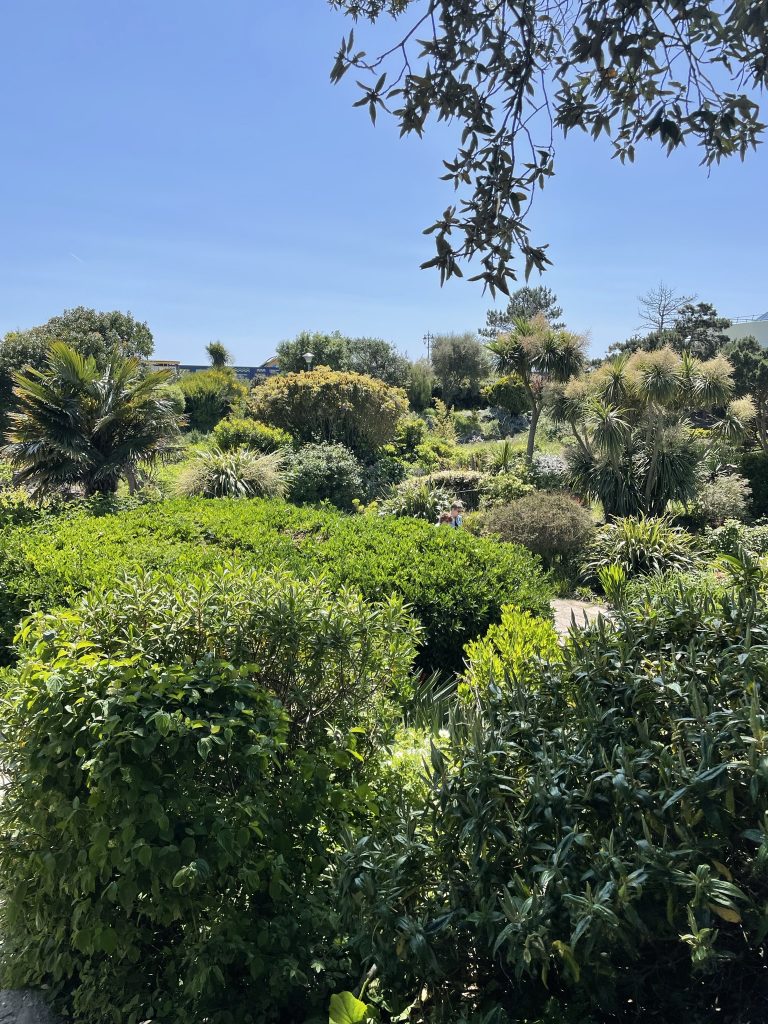
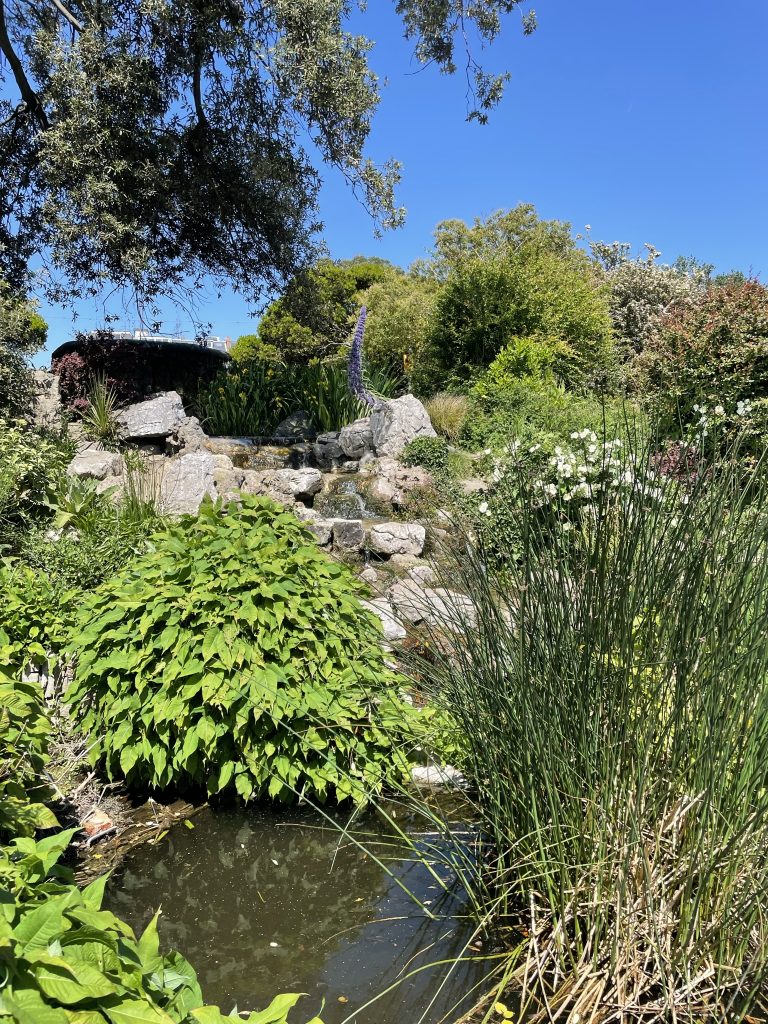
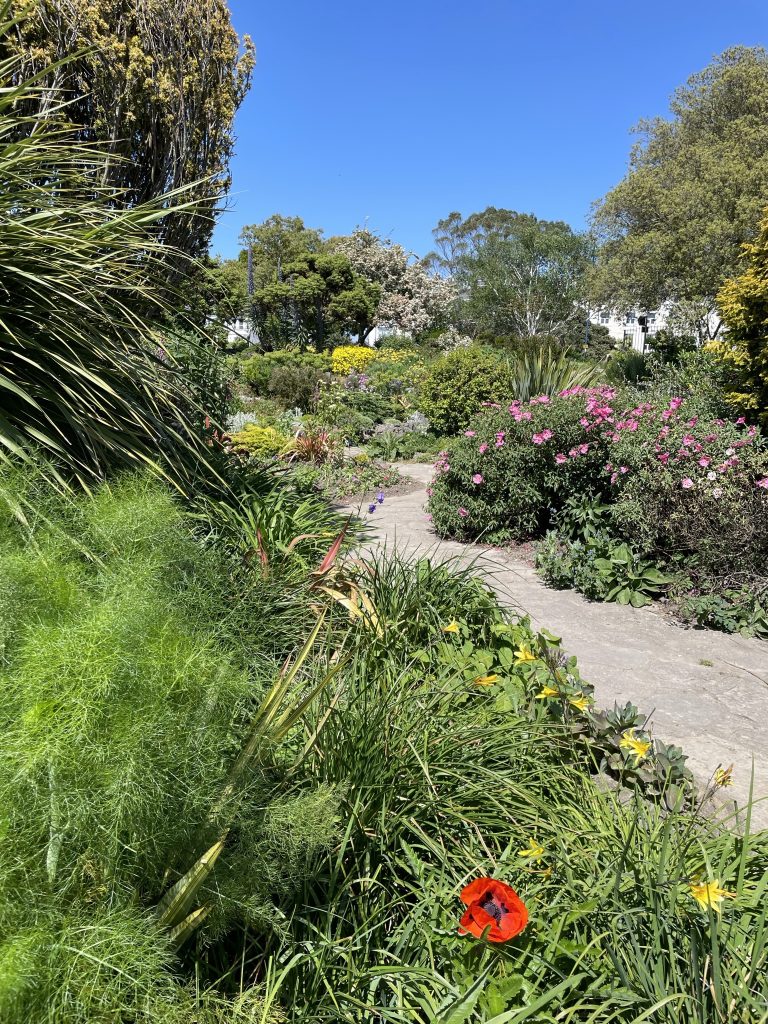
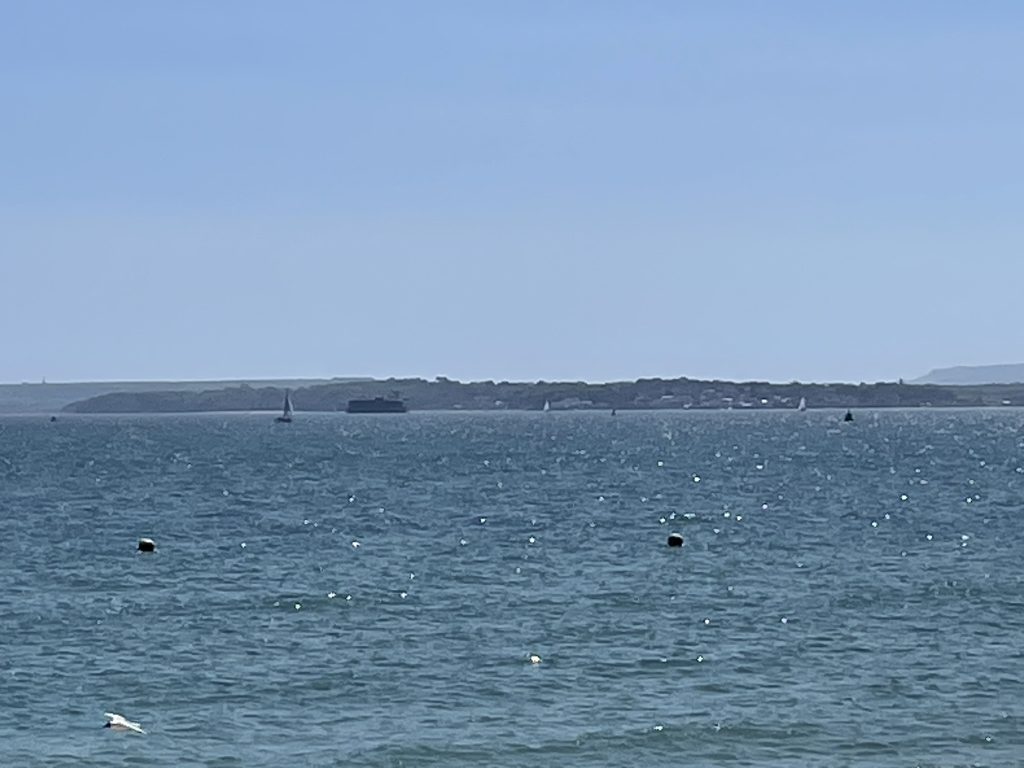
After lunch we went for a walk. We went towards the ocean and discovered a large park with extensive floral gardens and water features. We could hear music, so kept going. Once we got to the beach, there were a few buskers. The oceanside restaurant was crowded, but the beach was sparse, as there was still a cool breeze. Some brave souls were wading in and out of the water. I ran down and put my hand into it, and it was about as warm as you would expect the Atlantic to be in May, with temperatures still dropping into the 40s at night. We could see the gray smudge of the Isle of Wight on the horizon.
We walked down to get a good view of the carnival area that was at a nearby dock, and it was busy with families. We didn’t get close enough to see the rides. We walked back up to the sidewalk fronting the park area, and saw an interesting and possibly historic docks area about a mile in front of us, but my legs were too tired to go on.
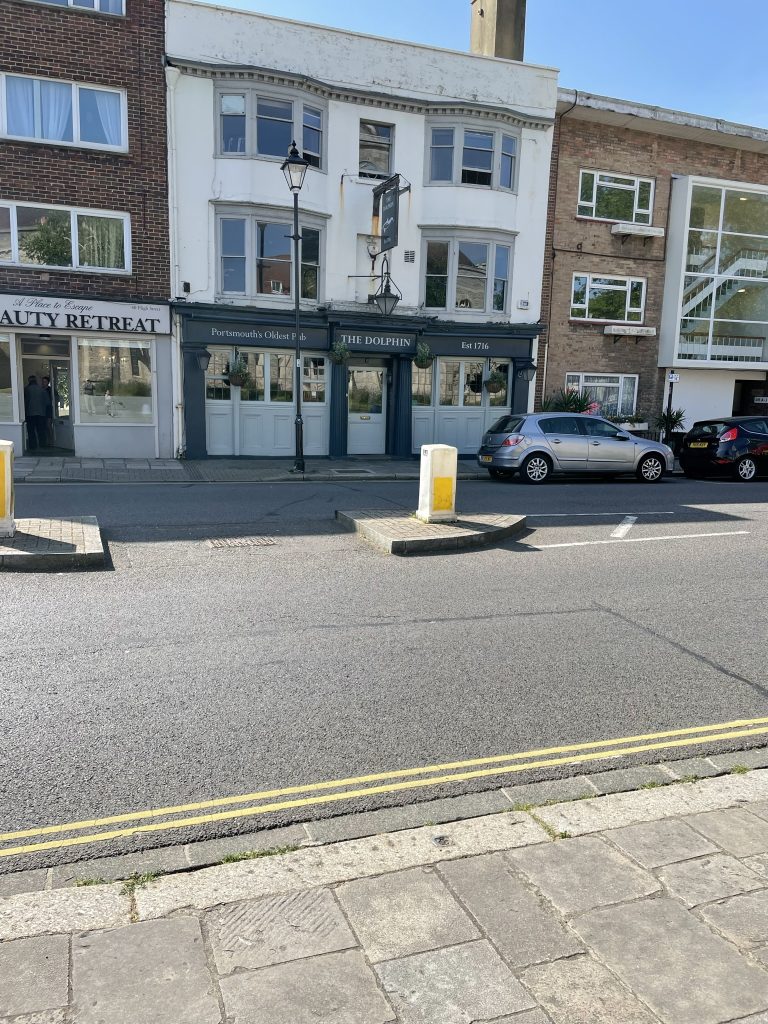
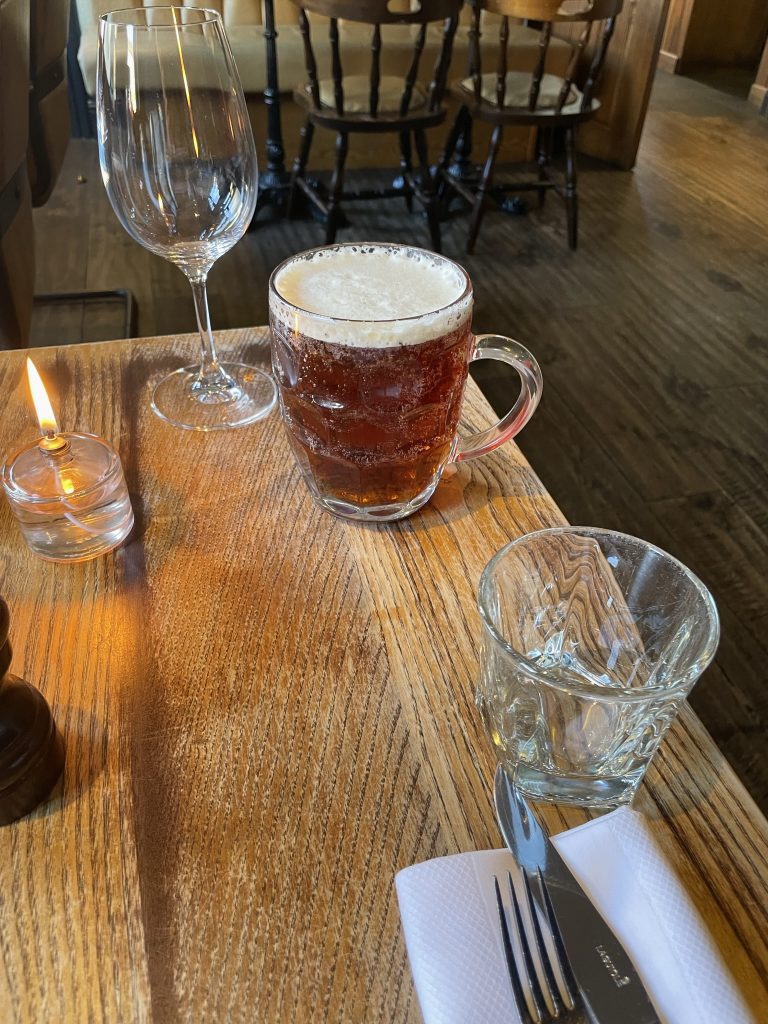
We weren’t especially hungry for supper, so we stopped by a local pub to see if we could find some beer or ale. The bartender had no idea when we asked for local beers, suggested Blue Moon. (We were a little taken aback, but she explained it was mostly a wine bar.) Some friendly locals intervened, and the gentleman made a couple of beer suggestions which were very welcome. I had a Sharps Offshore Pilsner and a Sharps Doom Bar, which was more of a brown. Sean had a Thatcher’s Berry Infusion Cider– a special cider that was way too sweet even for him. We had fish gougons (fish fingers of fried haddock) with salad/pickled vegetables and fried calamari served with the same salad and lemon mayo. Both of these small plates were so good we ordered them for another round– the fish was incredibly fresh and sweet.
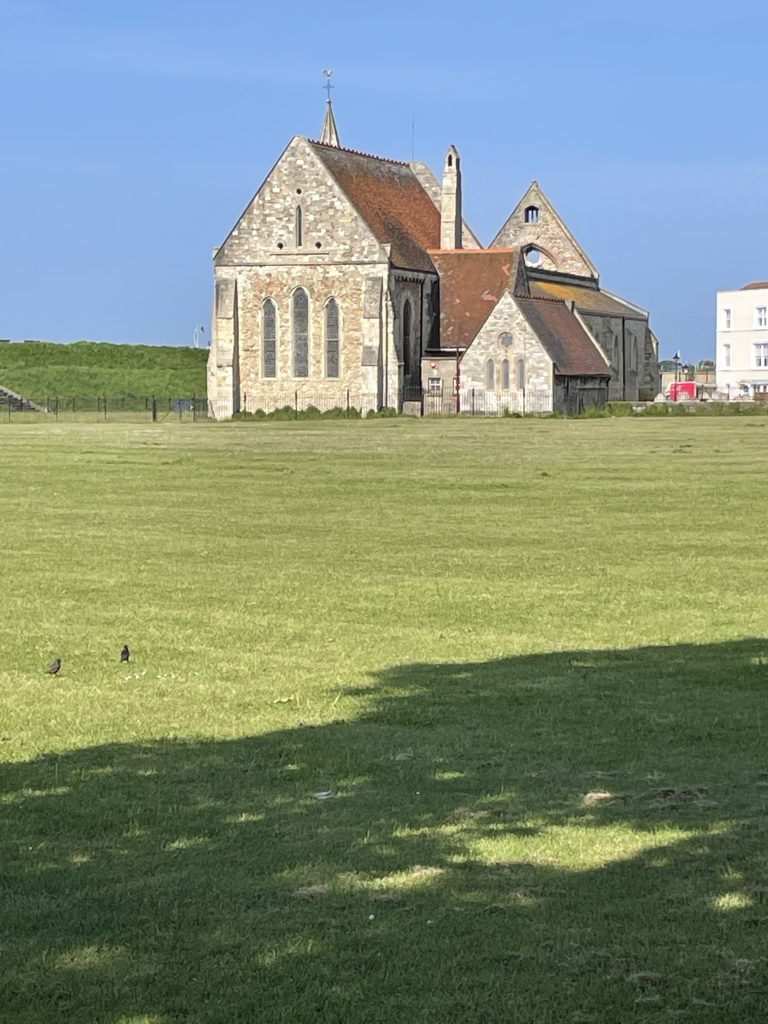
We then walked around some more while we had the light and got some pictures of the houses in the coastal area, which is called Southsea. We then returned to the Garden Restaurant and had fruit brulee (creme brulee with a layer of cooked strawberries/raspberries below the custard) with a shortbread cookie (me) and a chocolate brownie with salted caramel ice cream (Sean). We felt a little dehydrated and sunburned, so washed down dessert with sparkling water.
We went to sleep before 7pm, totally exhausted.
5-27
We got up and ready for the day and were down to the restaurant by 8:15. Breakfast was not actually included at this hotel, but was only 21 pounds for everything we ate I had cappuccino and Sean had the more appropriate pot of tea. It was still a little chilly, so we sat inside in the beautiful conservatory part of the restaurant. I ordered the full English breakfast, which they served with egg, big thick hash brown (like an inch-thick mcdonalds hash brown), shredded ham hock (i got this extra), english bacon, a banger, grilled tomato and grilled portobello cap; and a big dollop of British-style baked beans, with their tinny tomato taste. I ate most of this but gave up on the beans pretty fast. American-style molasses-flavored baked beans would have done better with all the pork. The banger was made with oatmeal in it. Sean had the same breakfast, and we also ordered the pork hock crumpet, which came with more shredded hock and cheddar cheese melted over it.
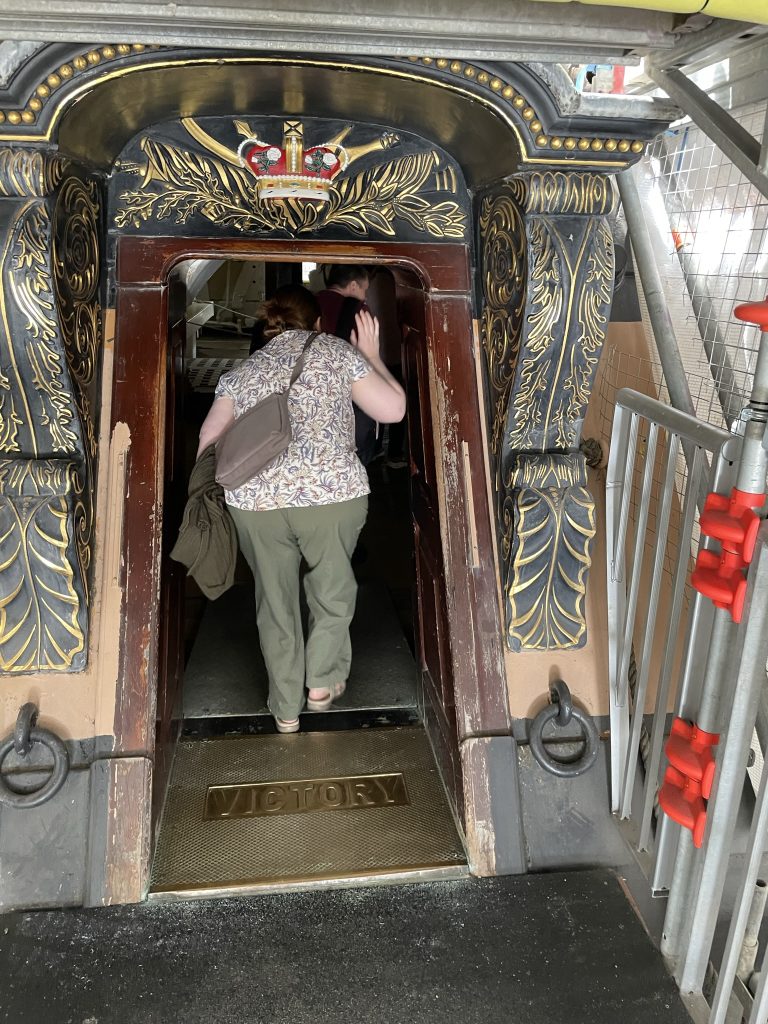
Eventually we gave up on this and moved on to our morning activity. I saw a thrift store that was open and we stopped in and bought a postcard and a lapel pin (less than 5 pounds); it was a charity shop geared towards funding parents’ stays near hospitals where their children were being treated for cancer. (Thrift stores seemed very focused throughout the places we visited. We then walked down to the Portsmouth Historic Dockyard, which houses many naval exhibits, as well as being next door to a British naval base. We had purchased a three-exhibit pass, which allowed us to visit three attractions; and the pass was good for those three attractions for twelve months, so in theory we could go back for another few viewings. We saw the Tudor warship Mary Rose, and the famous HMS Victory, which was Admiral Nelson’s flagship during the Battle of Trafalgar. We did not go to a third exhibit, because we were exhausted and needed to move on towards Salisbury.
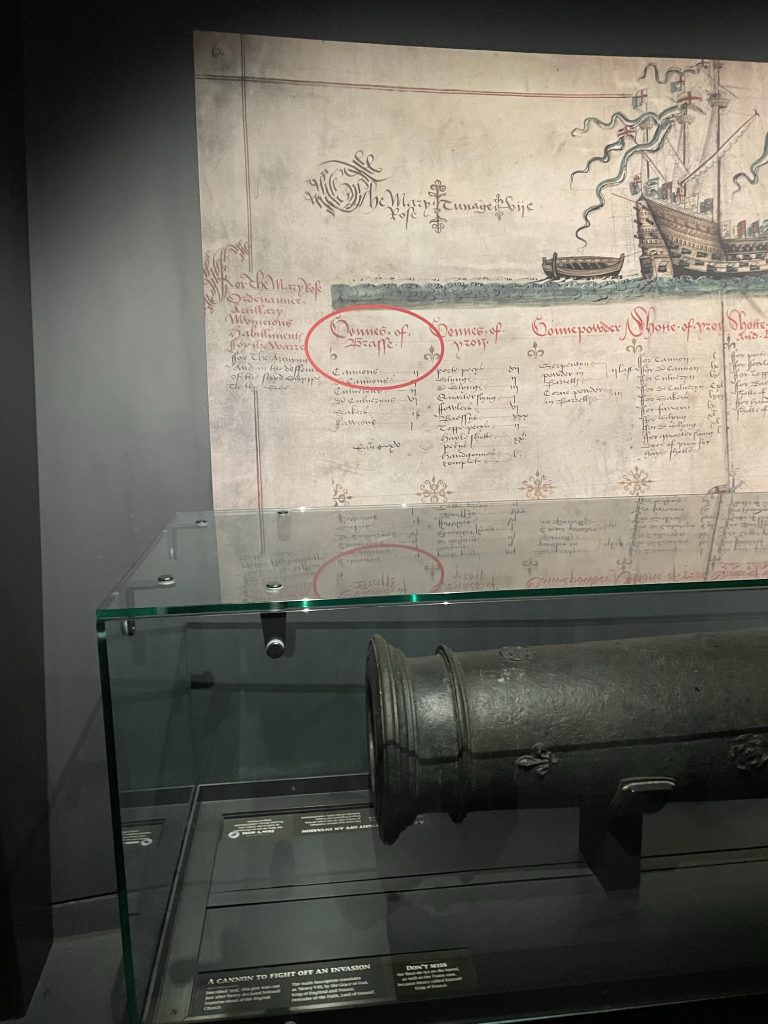
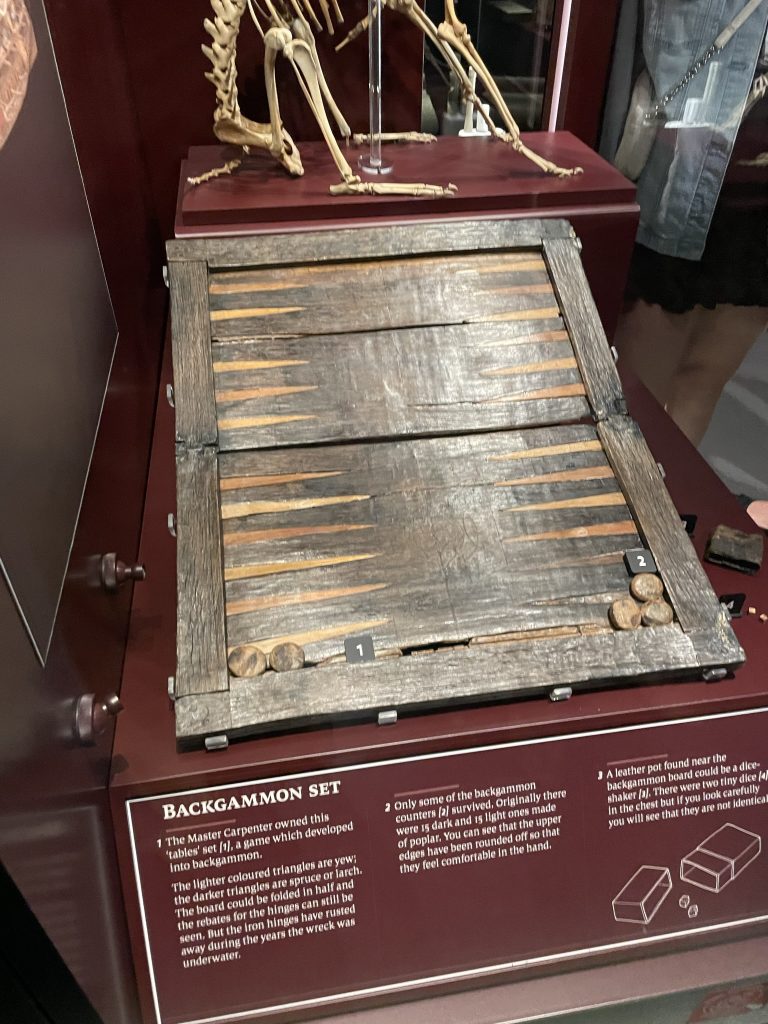
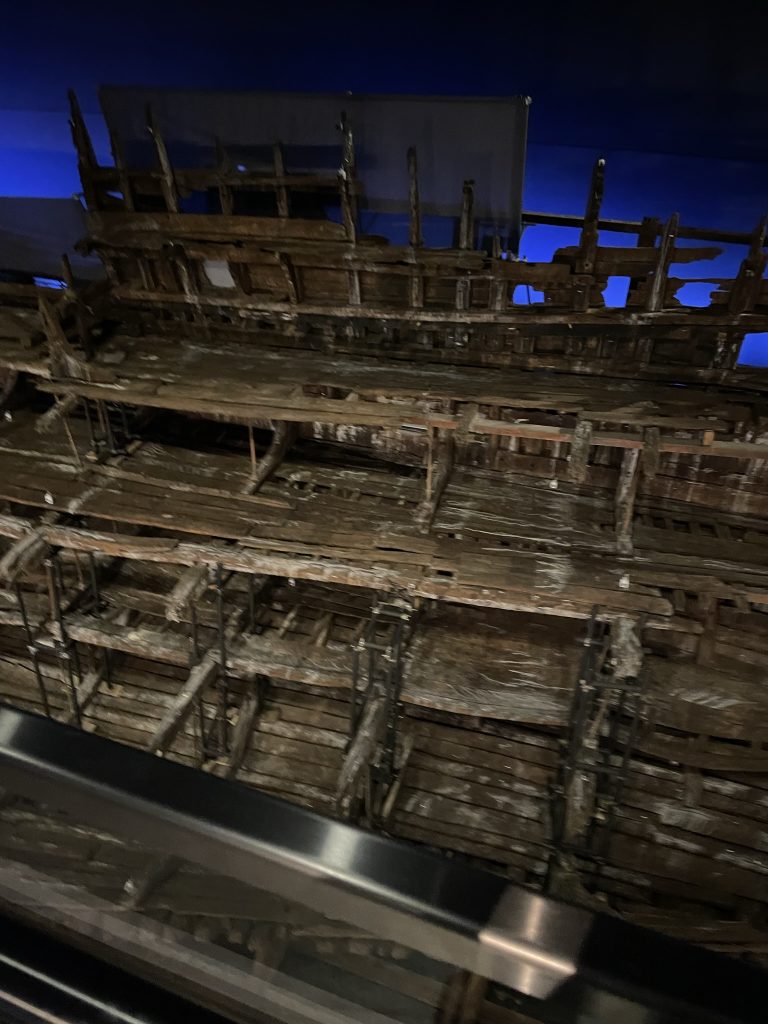
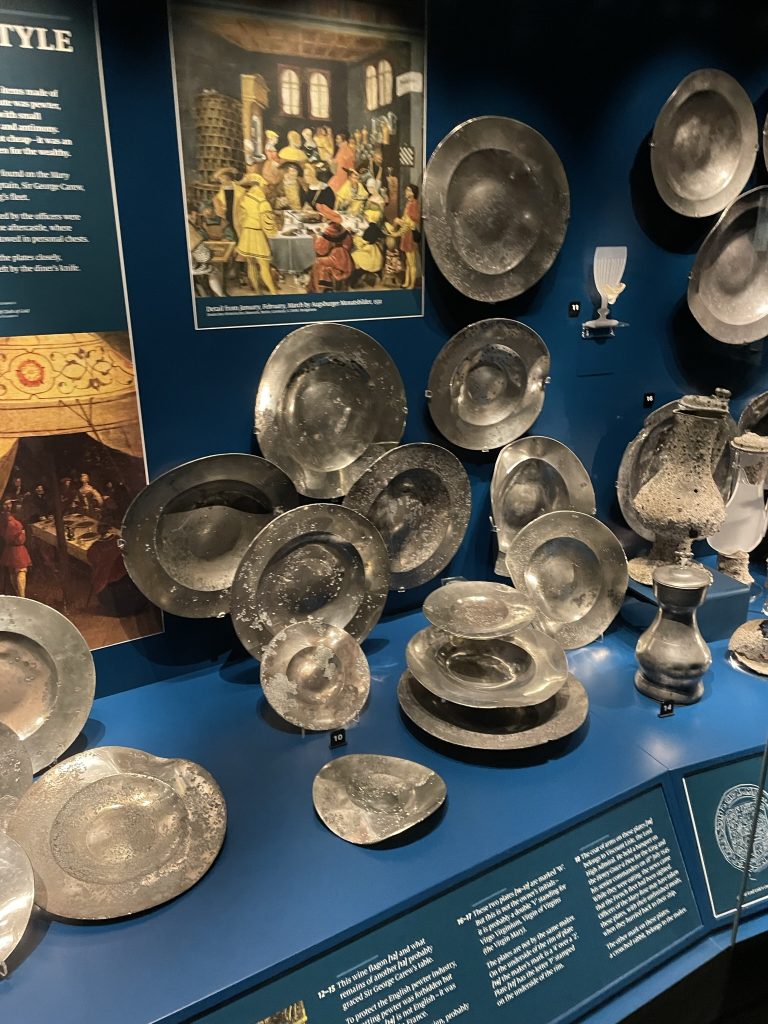
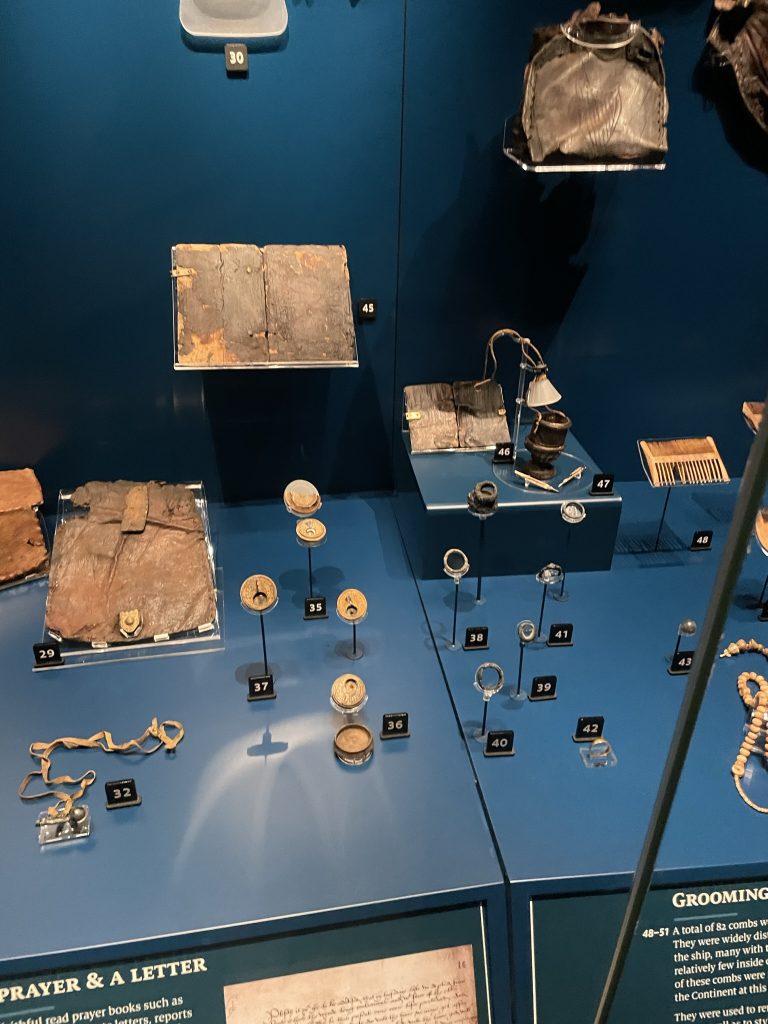
The Mary Rose exhibit was slated at 120 minutes and probably took at least that time, as there were quite a number of artifact exhibits as well as a couple of videos. This exhibit would be fine for someone with difficulty moving as there were elevators and staff designated for assistance. You initially see the ship itself behind glass as you move through the exhibits, and I thought we would only get to see it via the glass– but I was wrong. Towards the end of the exhibit, you get to walk through an airlock, and there you are in the same giant room with the remnants of the great ship, and get to experience the sights and smells of it. It has a very strong smell of rotting wood and preservatives, and is inside the temperature and humidity-controlled airlock to protect it from further deterioration. The ship itself was first launched in 1511, paid for out of the pocket money of the young Henry VIII. It sank in battle in 1545 defending England from a French invasion. The ship itself was re-discovered in 1971 and divers recovered numerous artifacts from it, all of which were carefully cataloged to preserve the information about where they had come from on the ship. There are projected images onto the ship, to show what each area of the ship was used for, from the cooks’ galley deep in the hold, to the armorer/weaponsmith; the ship’s surgeon etc. We also saw a 4D video about the recovery process and what was done to raise the ship in 1982. We at first referred to this exhibit as medieval but were immediately corrected– the British view the medieval period as ending with the first Henry Tudor, in 1485; and refer to the following time period as Tudor.
After we saw this exhibit, we exited through the gift shop. Great Britain has upped its souvenir game since we first visited in 2003; and there was a wide variety of items to purchase. Within about two minutes the shop manager intercepted us and showed us a variety of interesting and author-signed books about the cataloging of the various items and the raising of the ship. I also bought a replica Tudor spoon and leather drinking jack. Sean got a poster of the signing of the charter for the Mary Rose, which unfortunately I later sat on while packing. We also got a number of other minor items. Both this exhibit and its gift shop were more than worth the entrance fee. We left at 12.52 pm and had spent about 237 pounds. Not including the 10 pounds or so of water etc at the cafe.
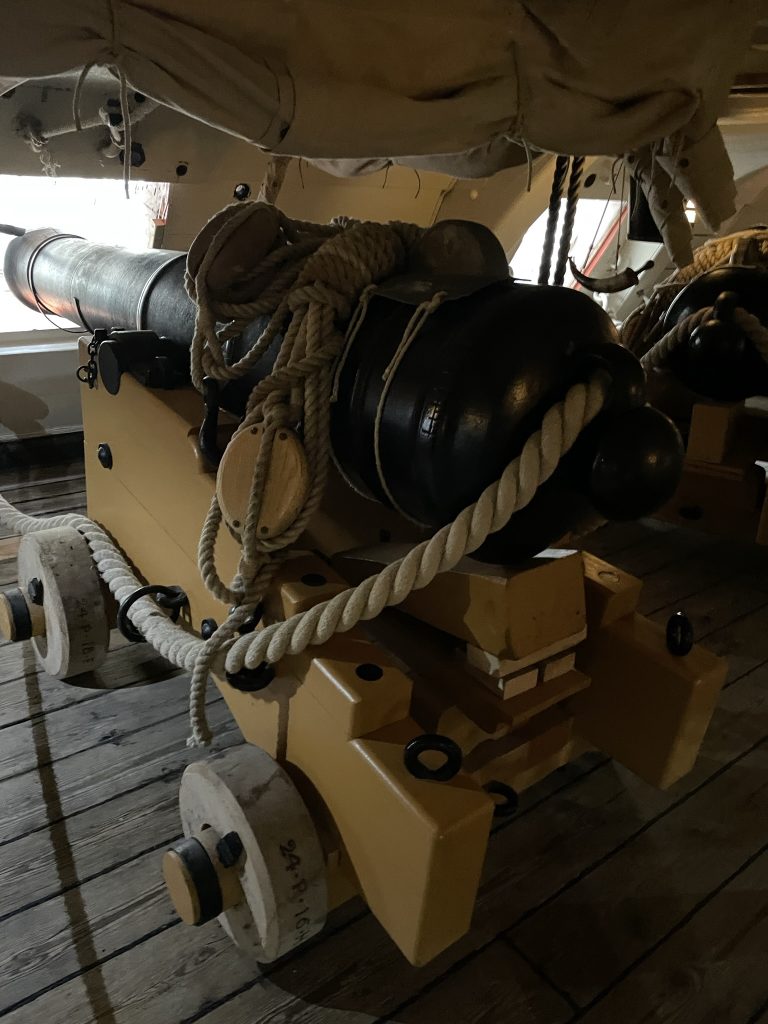
We left our purchases with staff and went on to see the HMS Victory. There are signs up warning visitors that they will have to contend with steep stair/ladders, tight passageways and low ceilings, and they were not exaggerating. There were numerous openings that had to be reached up and down ladder; some of them at about 4 ft in height, and the ship itself had low-slung timbers and an overall ceiling height just at about 5’6”. Long-legged visitors were clearly struggling, and I definitely aggravated my back via some of the contortions we had to undergo to go to various levels. The ship itself was more elegant than I expected and had enormous armament compared to its size– 25 pounder cannons. During combat all non-essential to combat items are either brought below and clipped to out of the way places like the ceiling– or immediately jettisoned overboard, including expensive items like glass windows and furniture. A lot of the administrative overhead of the fleet was being done on the ship itself. The various areas of the ship were well-labelled and there were many staff members on board to answer questions. We saw the ships’ surgeon exhibit and the docent was very knowledgable about all of the tools on the table and described typical procedures. We talked about the differences between medical treatment on board ship at this time; and later typical treatment in WWI for those injuries. Typically, penetrating wounds on board ship were treated via amputation if it were in a limb, and the mortality rate was very high; but it was much higher for body/head injuries. In WWI, limb-affecting injuries were often simply casted and left alone. The docent explained that due to the size of the cannonballs, penetrating injuries were almost always catastrophically large, so amputation was almost always the only way to survive such an injury. We saw the spot where Admiral Nelson died, having suffered a chest injury (from the description, probably a crush injury to his chest/abdomen as it took him a number of hours to die and he was mostly lucid.)
As we were close to Veteran’s Day, there were red poppy wreaths all over everything, including some recent dedications from the British Navy thanking Nelson for his service.
We did notice on our way out, that the harbor guards (in sharp contrast to other security we saw) were in full combat gear with large chest-holstered automatic weapons. They came out to respond to some tourist who was shouting, but very quickly stood down as the staff explained that the man was only shouting happily. They were very cheery and traded jokes with the harbor staff.
We had arrived at the exhibition about 10:30 am and left at around 2pm or so. There were at least six or seven other exhibits at Portsmouth Harbor to look at; so if we were going to see it all we would have had to allow for at least a day. We also thought about going to the Isle of Wight; but the tour itself takes 9 hours. We were not sure how long the ferry and/or whatever water taxi service they had would take, so elected to skip it.
As my legs were hurting badly, we took a cab from Portsmouth Harbor back to Somerset House, grabbed our bags, and cabbed to the station (17 pounds plus 10 pound tip as the gentleman waited for an extended period of time for our bags and did a lot of bag-wrangling). We then boarded the Southwestern from Portsmouth to Salisbury.
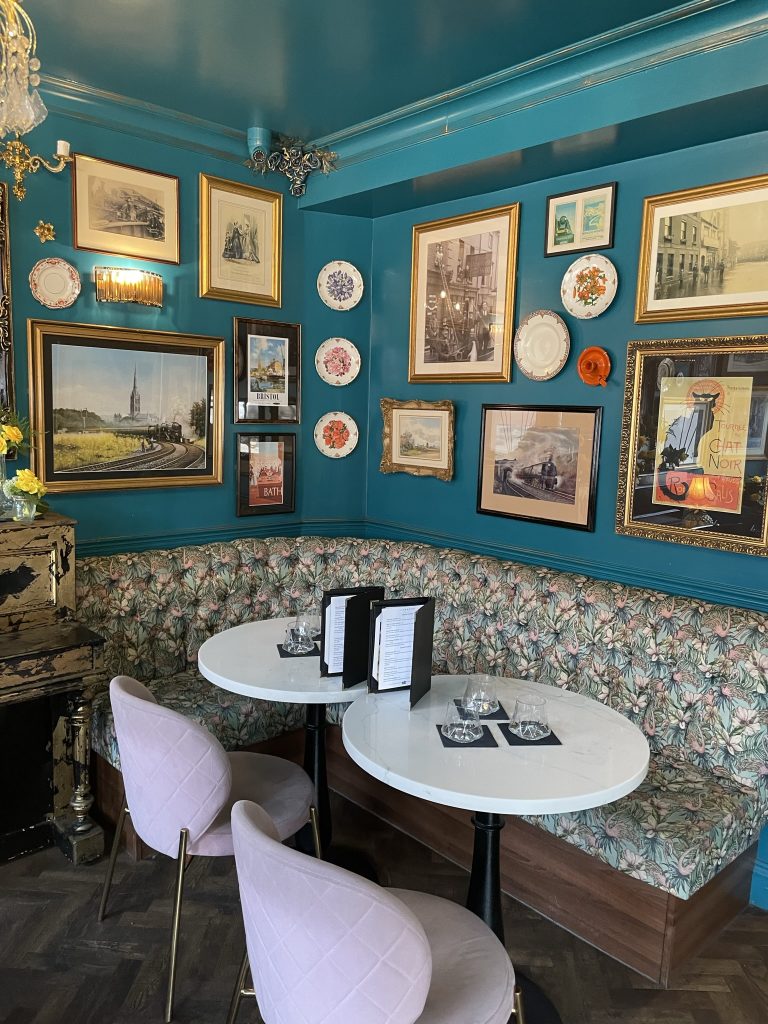
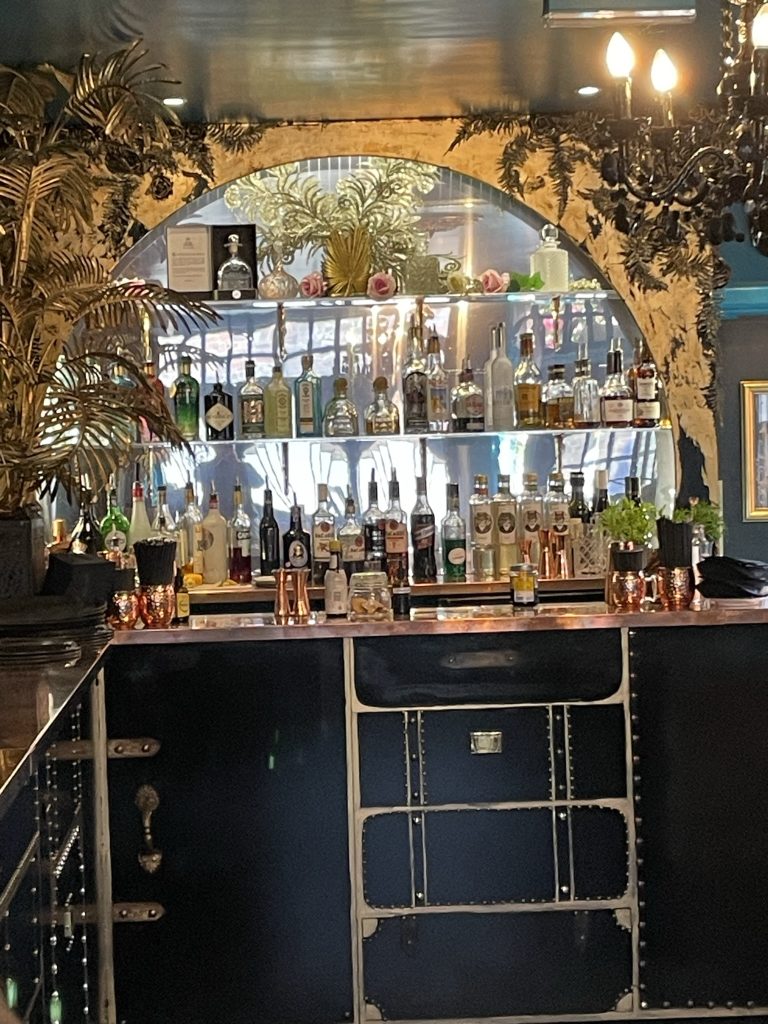
We arrived in Salisbury at around 4:45 pm and checked into our room at the Caboose, a tiny boutique hotel that was within a block of the train station. Our room was beautiful. The bar/restaurant area of the Caboose is also the sitting room for guests, and it is a glorious teal-and-gilt tribute to 1920s-era maximalist rococo. It is stunning beautiful and the pictures do not do it justice. The room itself was under 200 usd and that seemed a bargain. It was up a steep set of stairs, but the staff brought our bags up for us. It also had a pretty little in-room tea service, with biscuits and shelf-stable milk.
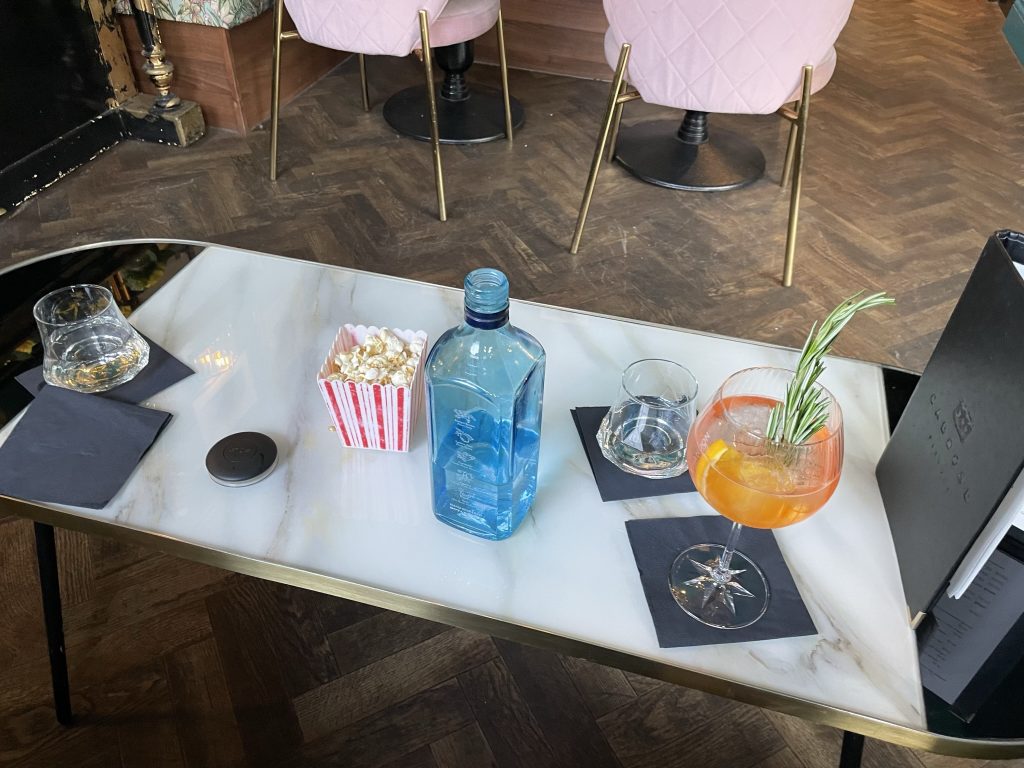
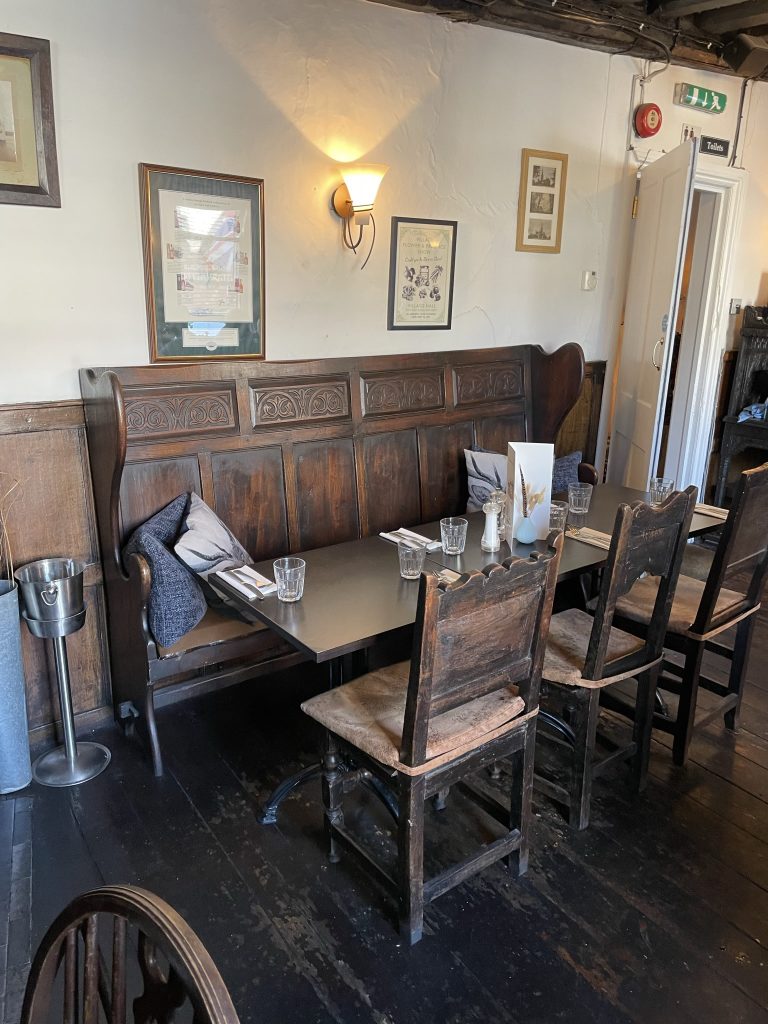
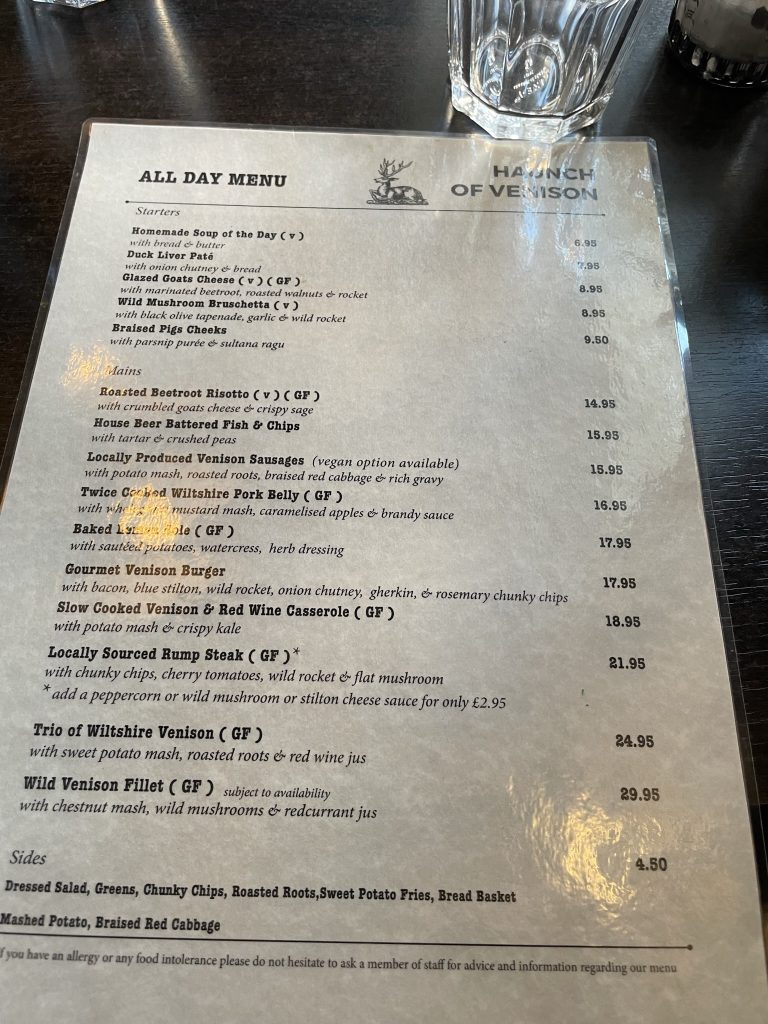
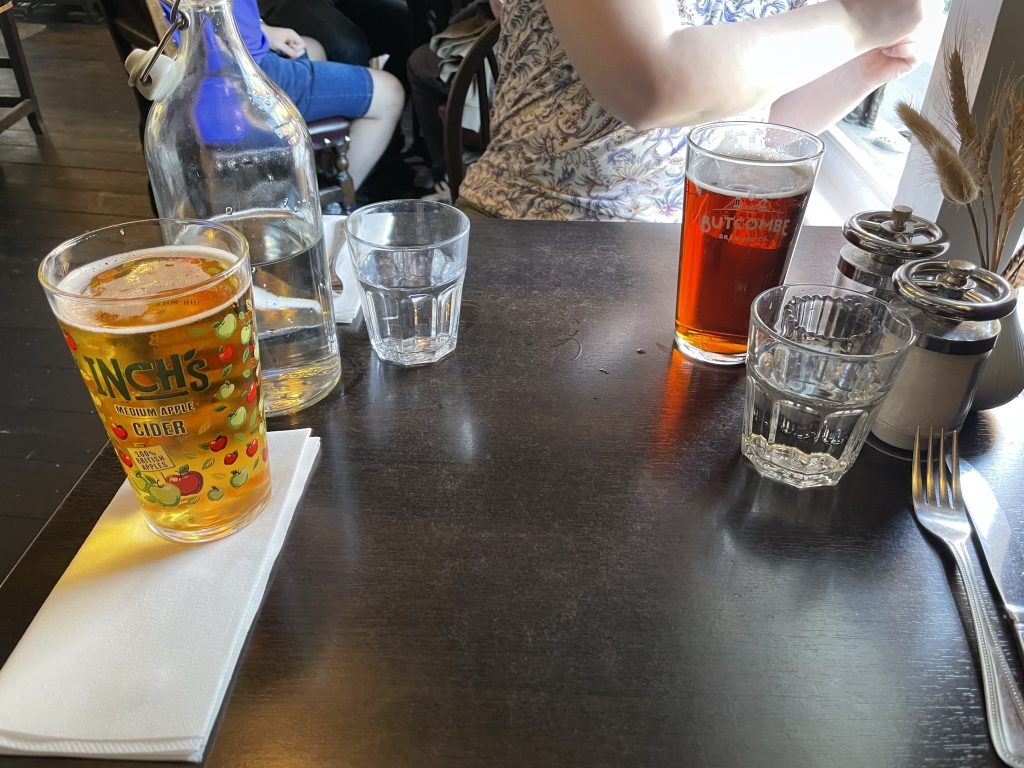
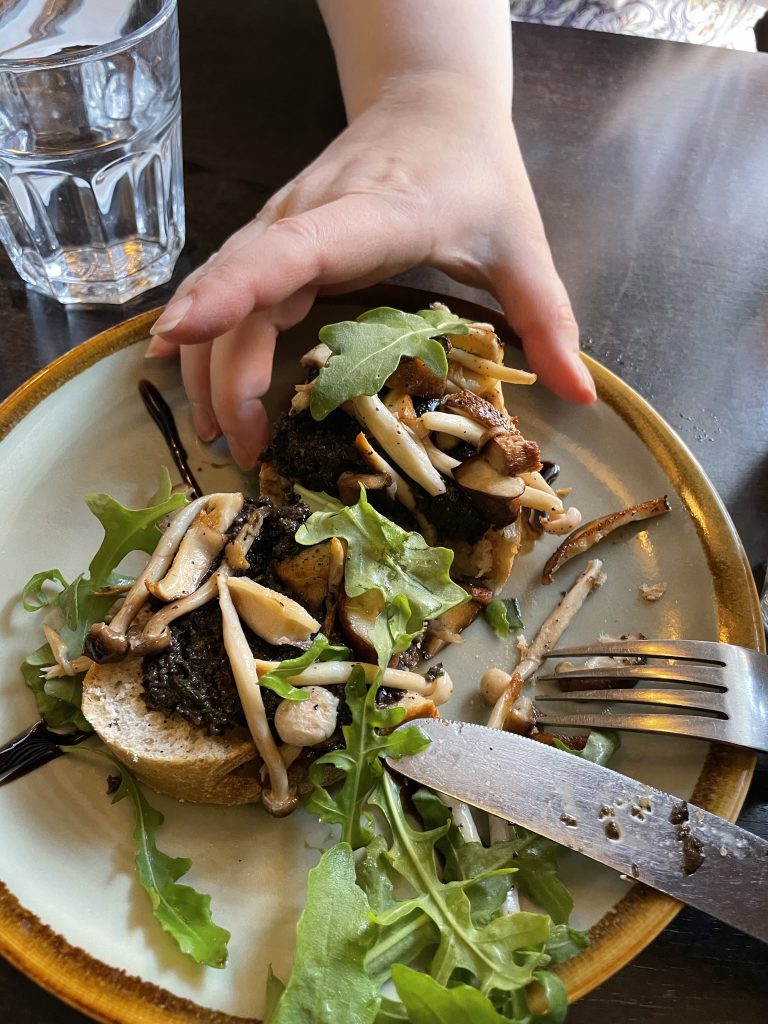
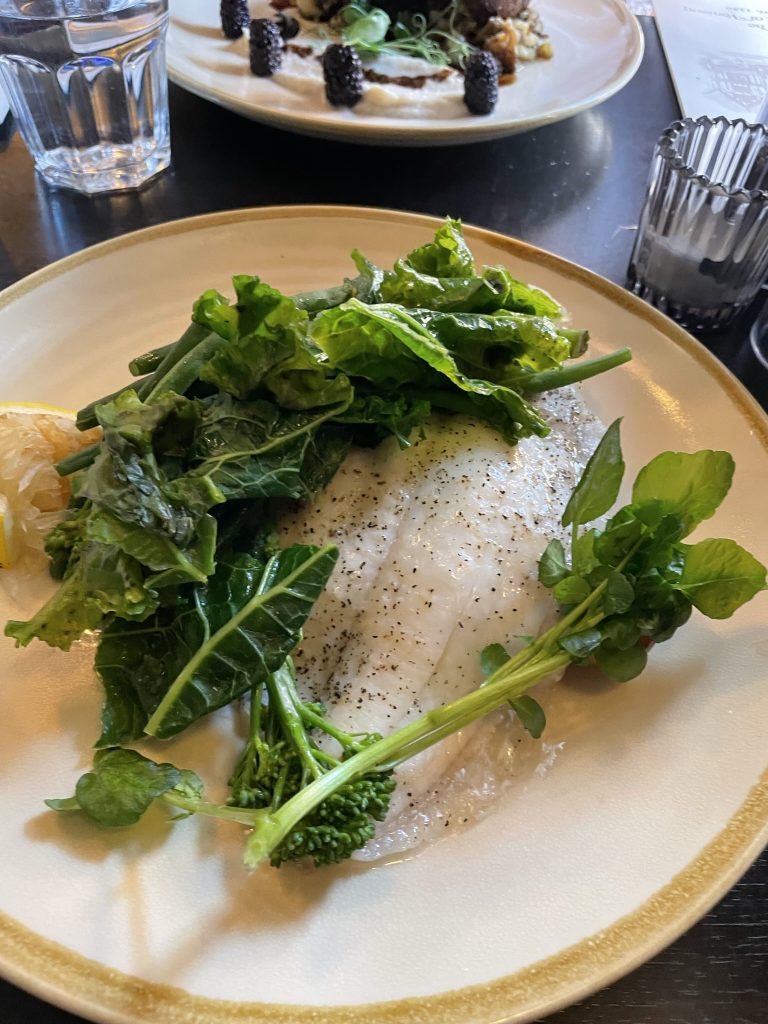
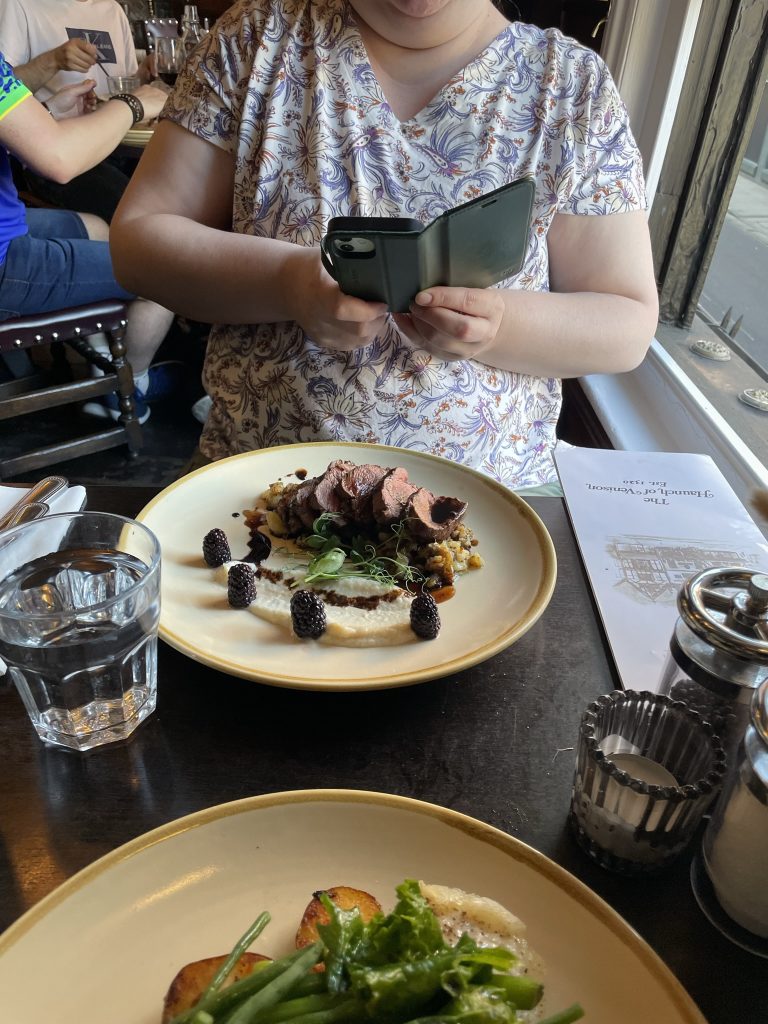
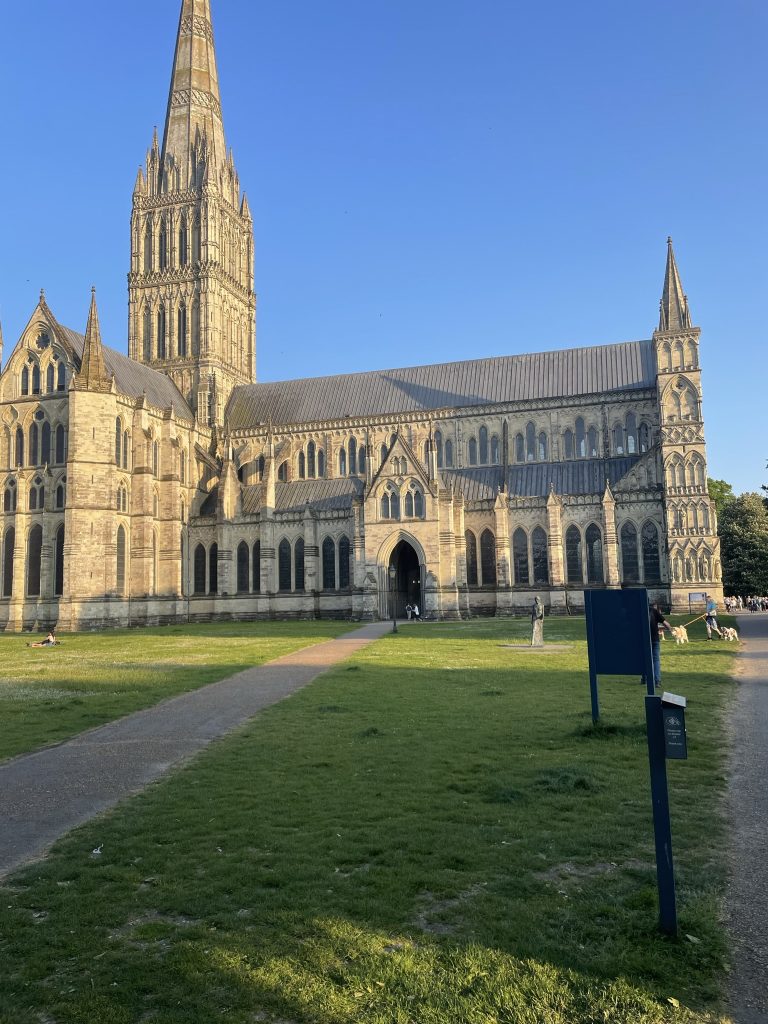
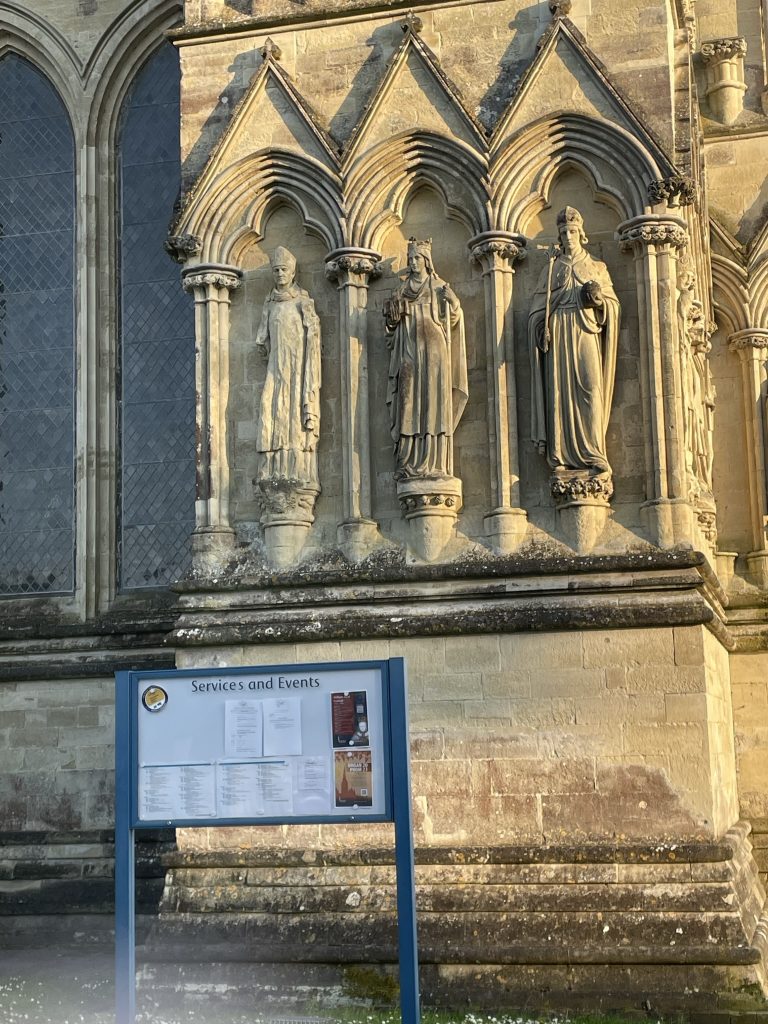
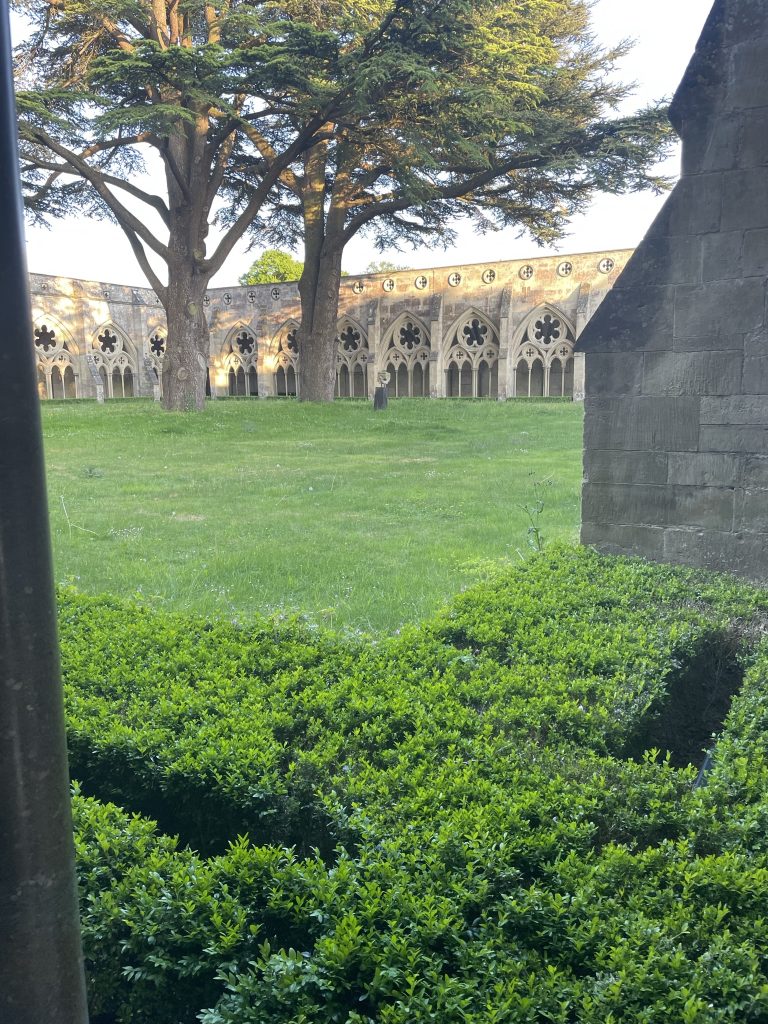
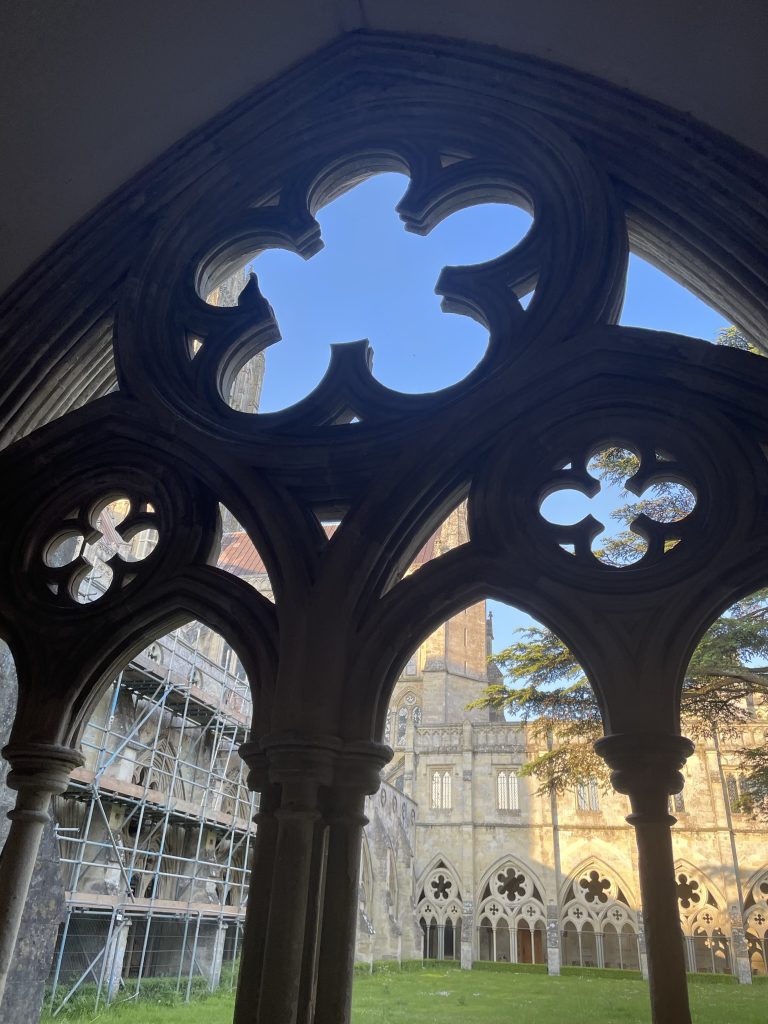
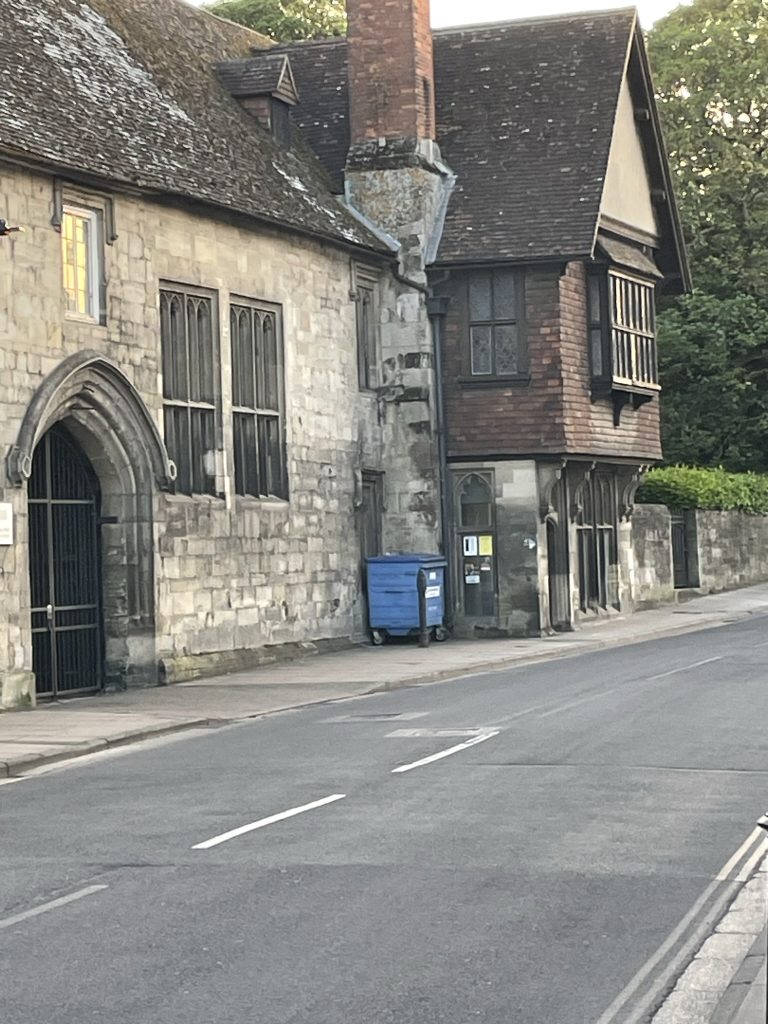
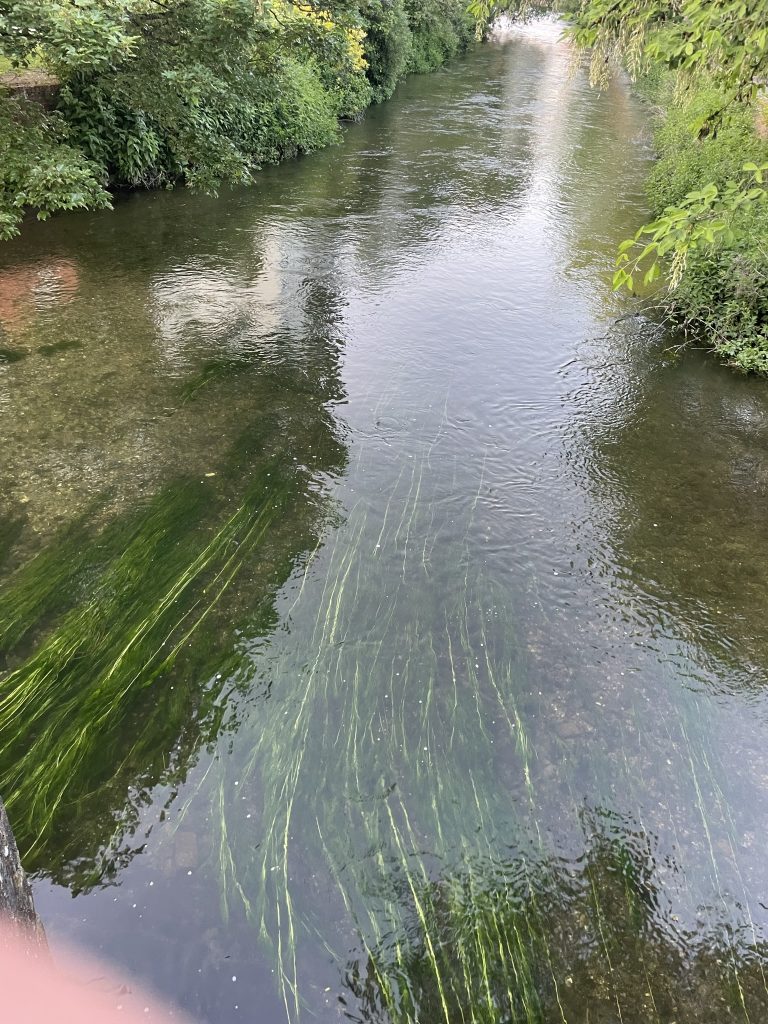
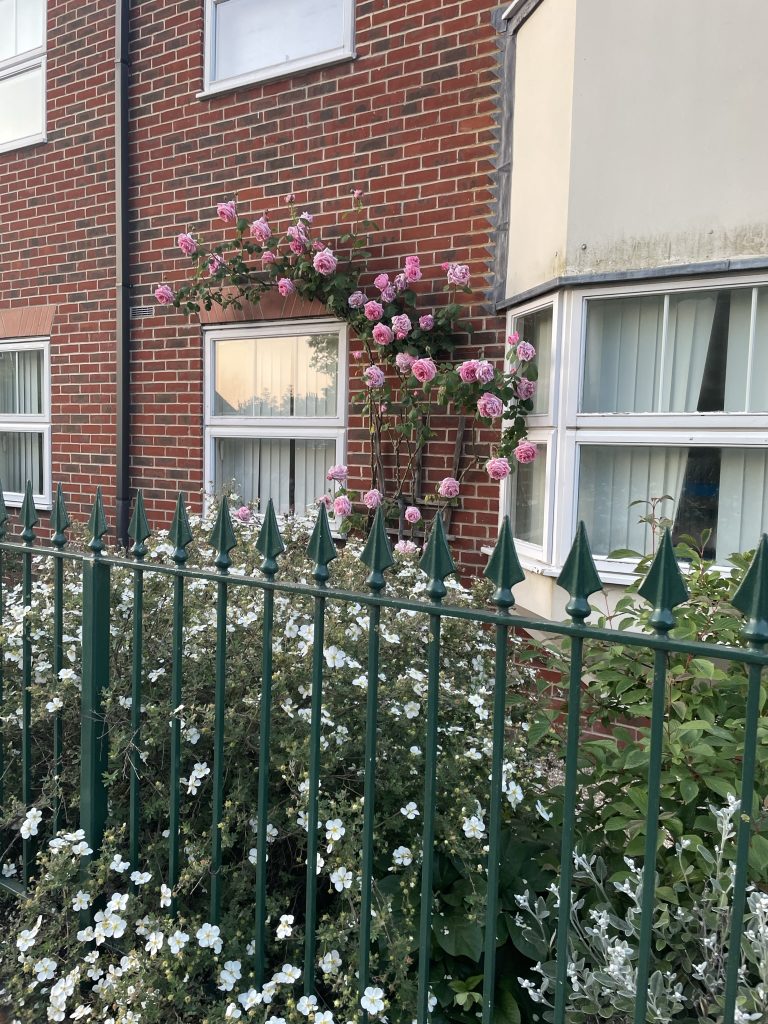
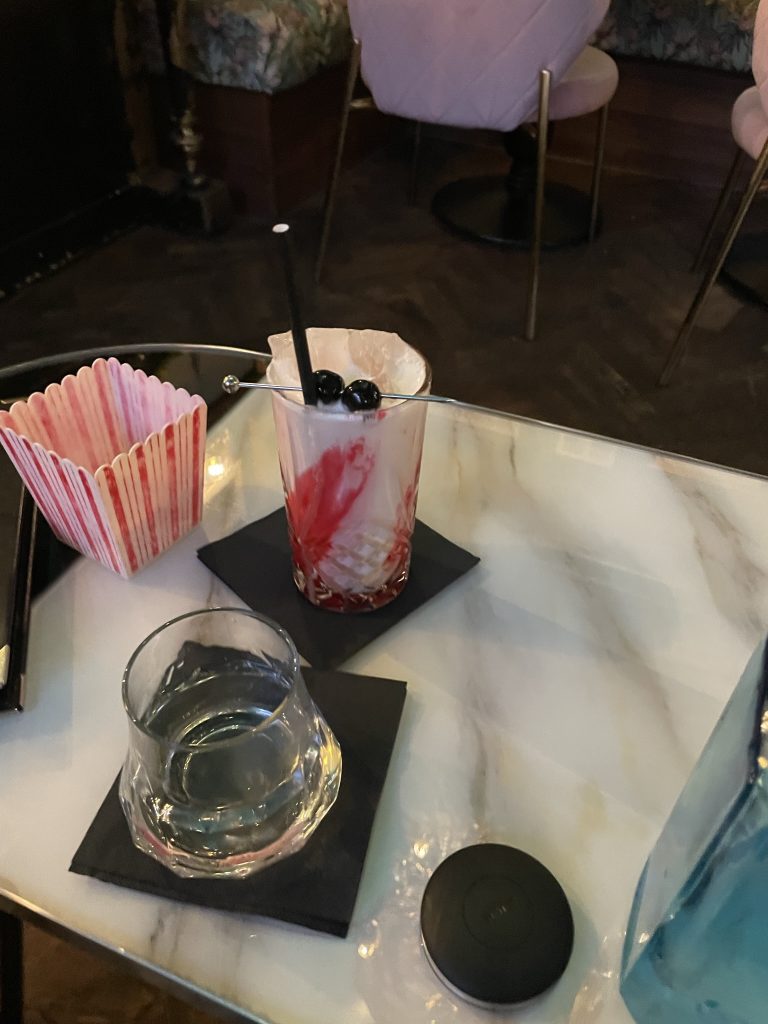
We celebrated our easy train ride with drinks– I had a Chandon Garden Spritz, featuring a sprig of rosemary; a housemade liquor made with spices and orange peel; and prosecco. Sean had water. There was also some complimentary popcorn offered. After we settled in, we walked around town and took pictures of the beautiful Avon River (note: this is ‘river river’ and there are many “Avon Rivers” in England. We also got pictures of the lovely Salisbury Cathedral but unfortunately it was not open to visitors during the times we were there. For dinner, we went to The Haunch of Venison, a restaurant that has been in business since 1320. It has a very twisty narrow stairway and the restrooms are on a stairway landing, which I saw several times in old pubs. I had beer, though I can’t remember what kind and the menu is not visible. It was probably a bitter. Sean had a local cider that was on draft. We had a mushroom bruschetta to start, which was more English than it sounds because it was local wild mushrooms on a grilled slab of rustic bread, topped with rocket (arugula). The black olive tapenade was not English. Sean had a baked lemon sole with potatoes, watercress, and herb dressing. (Potatoes meant ‘one new potato, cut in half and seared’ and this was typical of entrees containing potatoes. The herb dressing was a variety of green vegetables, including haricot vert, peas, and asparagus and the light lemon sauce was delicious.) I had a special; a venison filet steak served with artichoke puree, blackberries, red wine gravy, and a relatively small amount of crushed potato. I also had watercress on my plate. All of this was amazingly delicious. I then had a sticky toffee pudding, served warm with vanilla ice cream. Sean had the special dessert, a strawberry and prosecco cheesecake, which was good but not a standout. In total this dinner was less than 110 dollars and was extremely good for the price. The protein and starch portions of the entrees were smaller than we would have predicted; but the vegetables were numerous, almost exactly the opposite of American portions; and this was true for nearly every restaurant. All restaurant menus had the kcal of each item listed; along with designations as to whether it was vegetarian, vegan, or gluten-free. This would have made it very easy to eat healthy, had we cared about that. All vegetables we had were handled well- perfectly steamed or sauteed; and most of the time various vegetables were served all together as above, giving a variety of flavors.
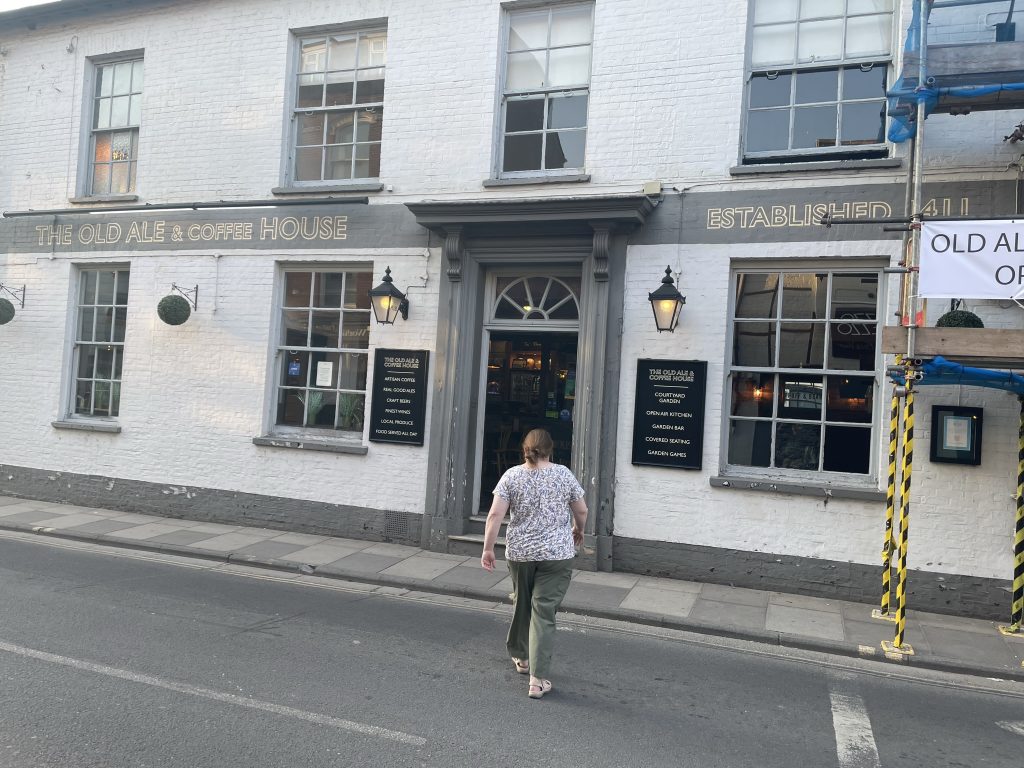
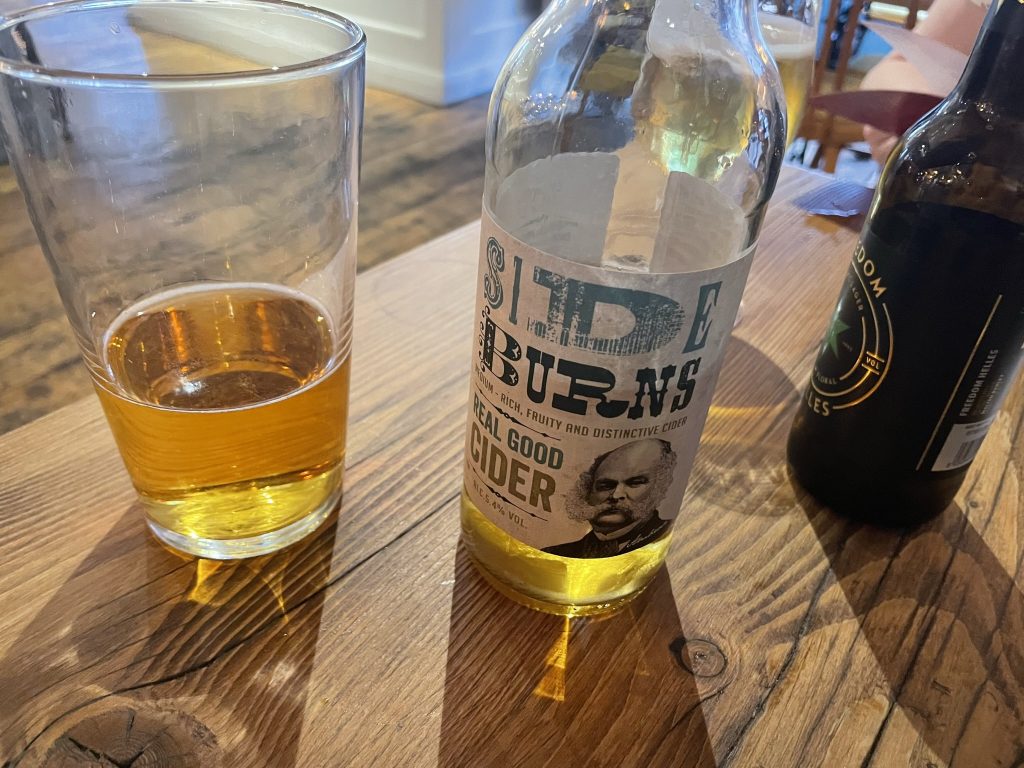
After dinner, we wandered around town for awhile, and stopped in the local Tesco (730 pm, 24 pounds) where I picked up some home magazines to browse. As we were so far north, we still had good light for photos quite late. We went to another pub, the Old Ale and Coffeehouse, and had more beer and cider. I had a Freedom Organic Helles Lager from Staffordshiret and Sean had Cotswold Sideburns Cider, both in the bottle. This place also had an impressive food menu, but we were full up from dinner.
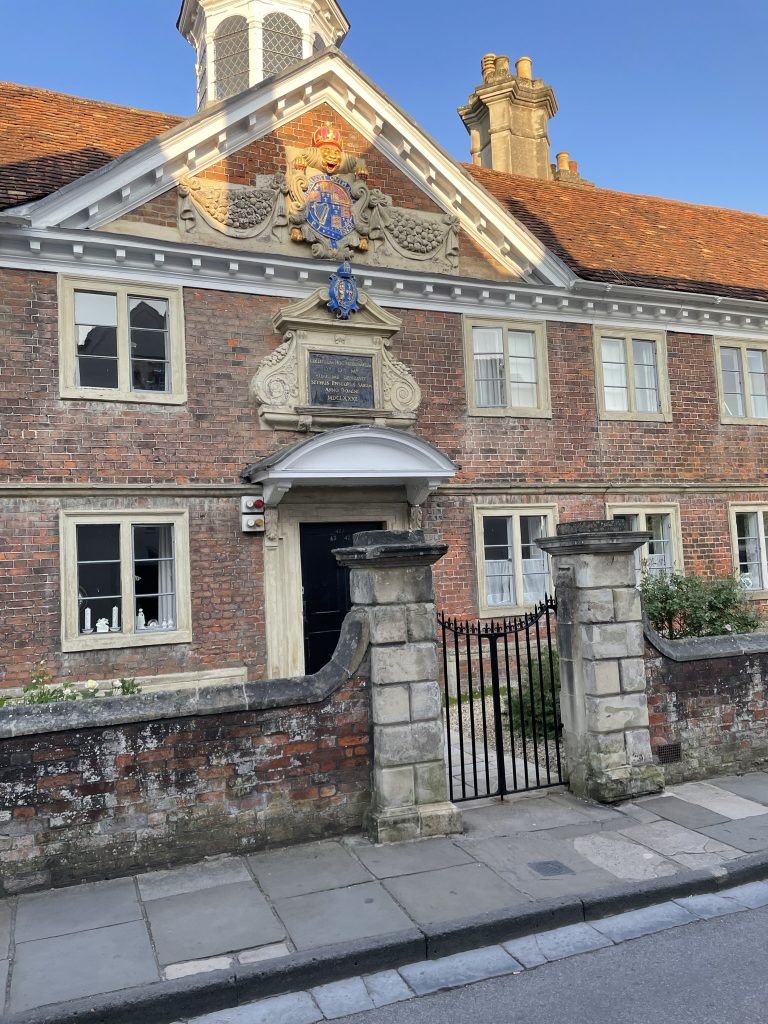
We walked around some more– Salisbury is pretty with its old storefronts and the cathedral outshining everything else. We were sad to not get to tour it, and we also regretted not having time to do Old Sarum. We would definitely recommend more time in Salisbury over seeing Stonehenge.
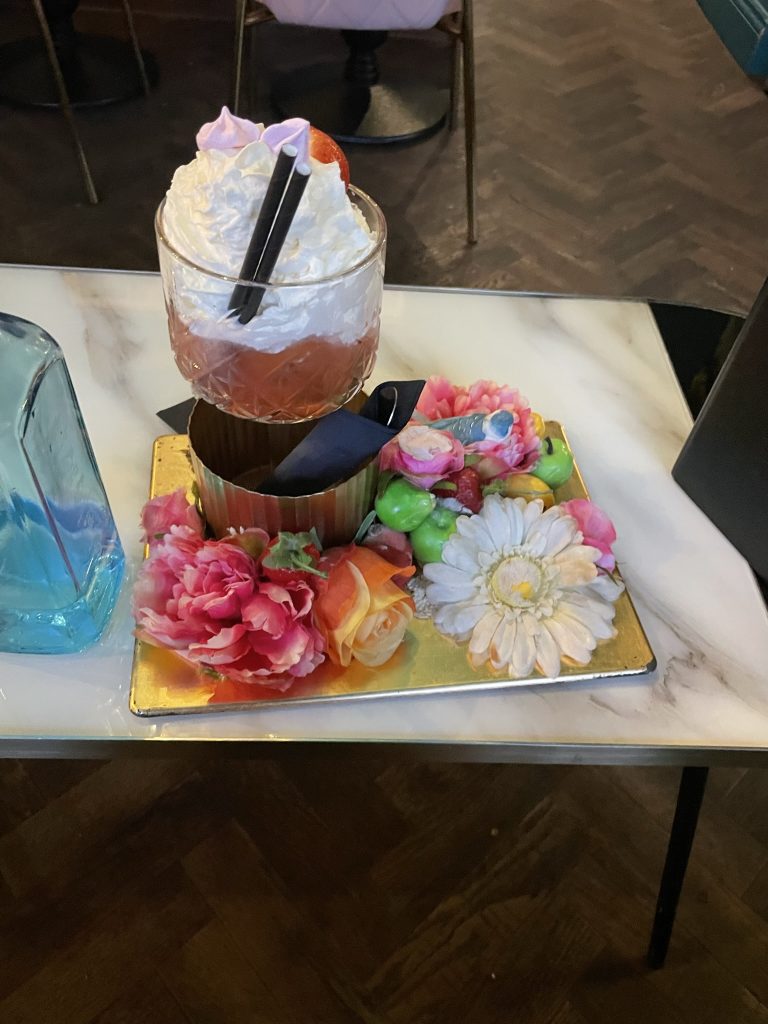
We went back to the Caboose, where we ordered some supremely fancy drinks. I immediately knocked mine on the floor, but they were very gracious about cleaning it up and bringing me another one. I had a Rhubarb-and-Custard, a low-alcohol drink with rhubarb syrup, vanilla syrup, cranberry juice, cream, and vodka. Sean had a Sweet Nothings– a black raspberry and strawberry floofy drink that came with its own flower garden and was topped with whipped cream– stunning. Usually you have to book a high tea well ahead of time, but the staff told us about a cancellation, so we were able to schedule one for 2:30 the following day, which put us under some time pressure.
5-28
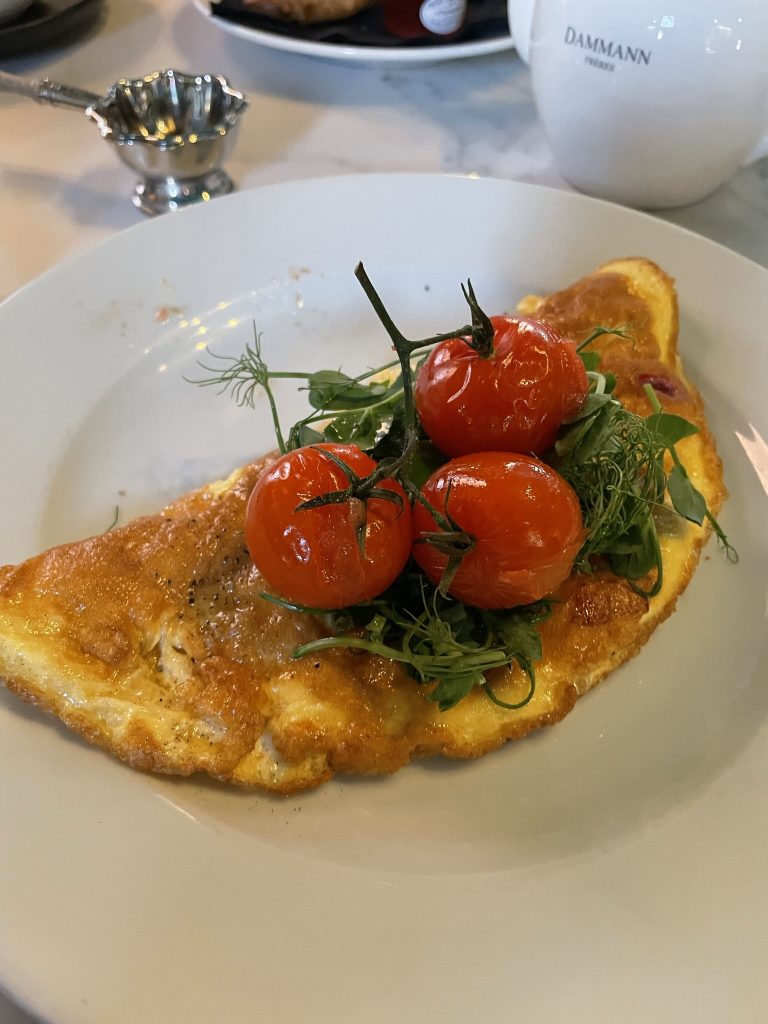
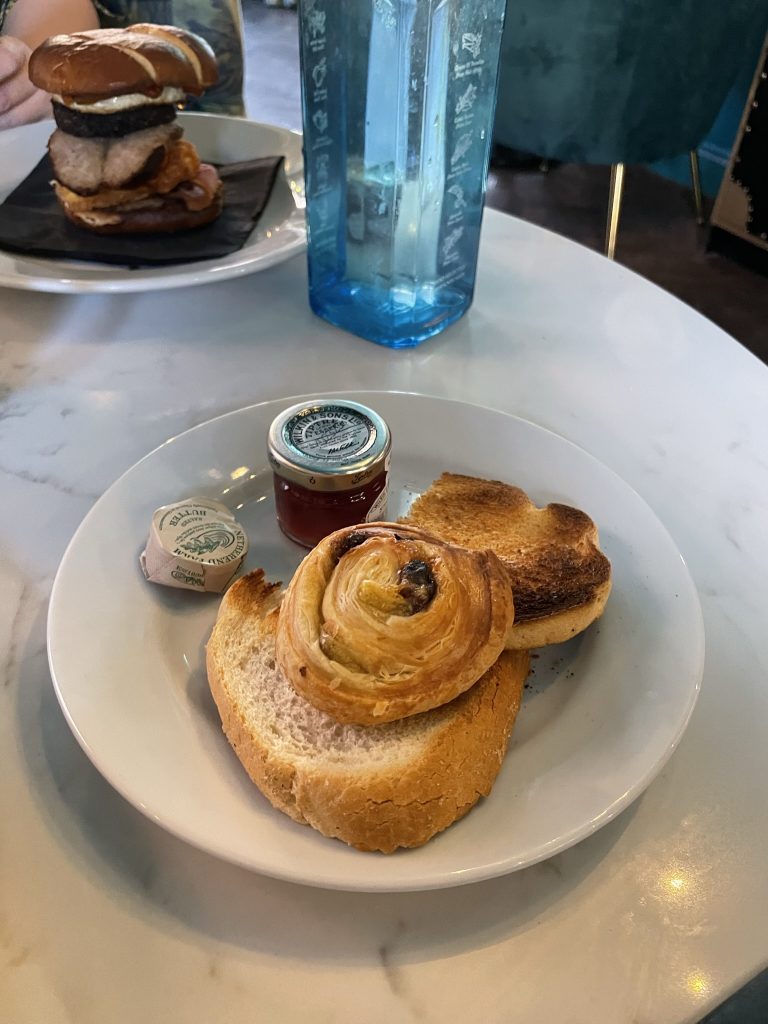
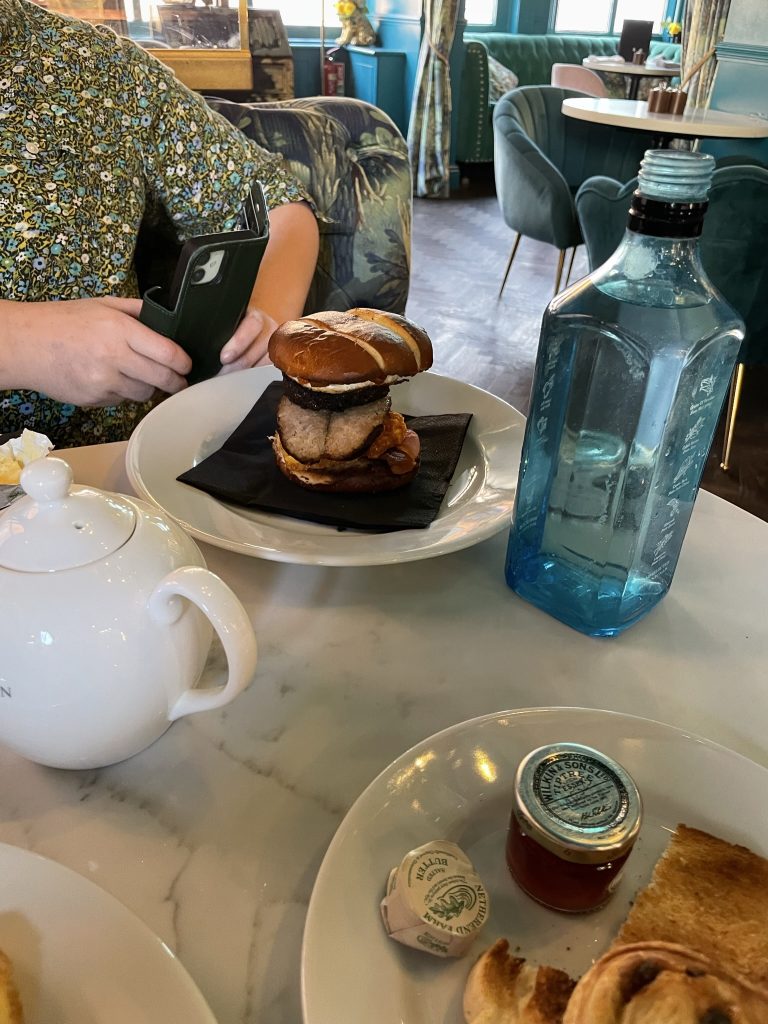
We got up and ate our inclusive breakfast, which was amazing– we had breakfast tea; and I ordered a Caboose Breakfast burger, which was an English breakfast on a bap (roll)– it was a fried egg, bacon, sausage, black pudding, tomato jam and wild rocket on ciabatta (though really it was a pretzel roll). This was mammoth and tasty. I ate all of it except for the bread, and sampled the tomato jam (we would call it a spicy tomato chutney). We also ordered some small pastries– a tiny croissant and pan au chocolate. (We noticed that in most places rich pastries were about a third of the size that we would see here.) Sean had an omelet with cheese, peppers and onions, topped with cherry tomatoes and rocket.
We needed fortification to drag ourselves out to Stonehenge. This was an ordeal and in retrospect if we were determined to see it, we should have signed up for a private tour. These are always before or after normal operating hours there, and would involve a driver. We did not look into it in time to book one, and we had checked about three months before the trip. There was a shuttle bus at the train station. Stonehenge did not open till 10, so we made an effort to get onto the bus early enough to get out there right at 10. Our high tea was scheduled for 2:30, so we thought we would have plenty of time. We were wrong.
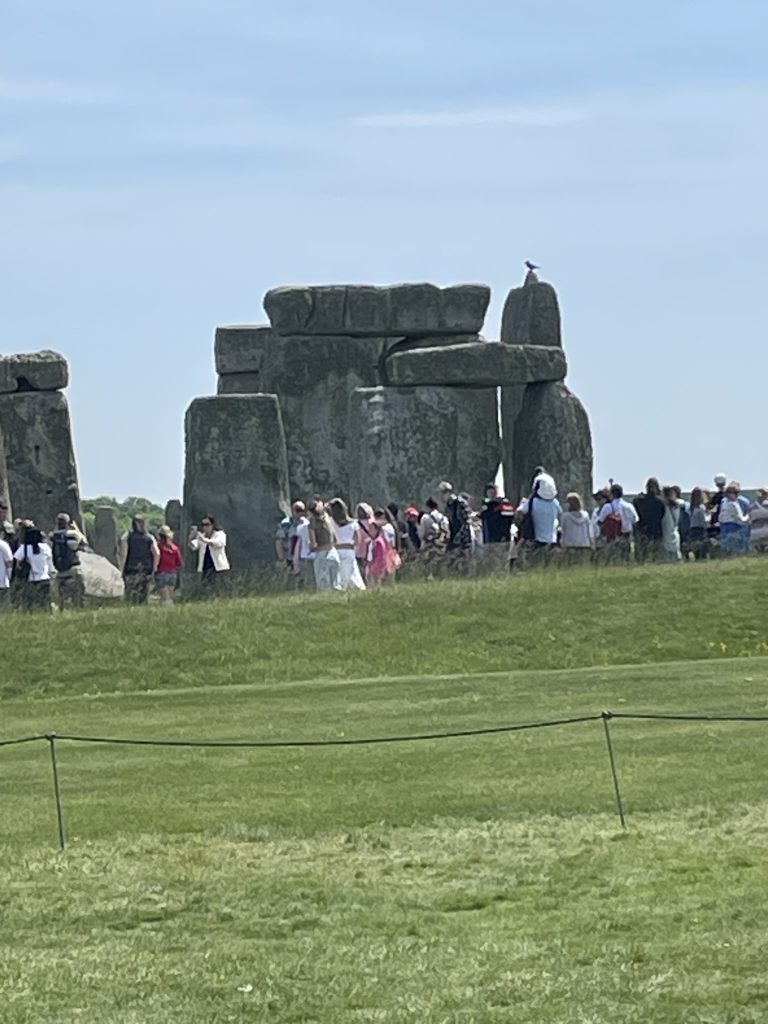
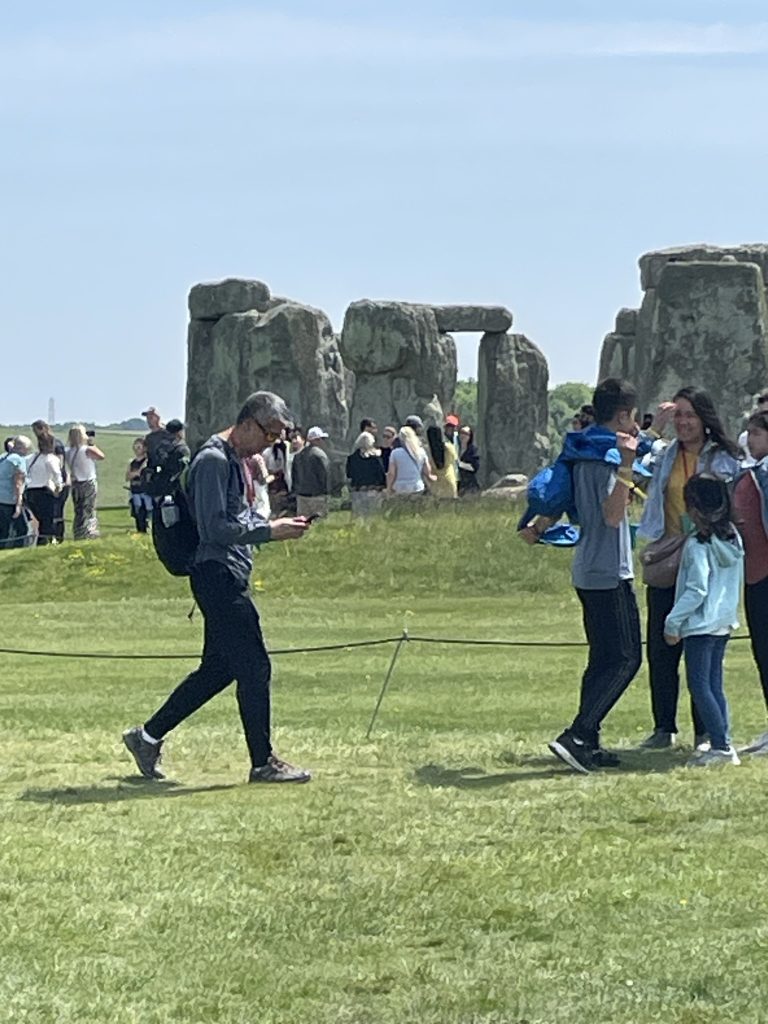
This was a wasted effort. There were hundreds of tour buses and tens of thousands of people present in the crowd waiting to get in. Even though we had pre-paid tickets, this was more or less worthless as we had to shuffle through the same incredibly long line. The crowd was comparable to the size of a professional sports arena crowd, and it was intensely uncomfortable. That day was quite warm and there was no breeze and no clouds, so everyone was overheated even early in the day. There were no benches or other accommodations for people with poor mobility. Either you were in a wheelchair or on your own to manage it. It is a very very long walk from the shuttle bus area to the visitor center where you are shuffled through for your passes. Once you get your passes, you exit the building. At this point you have a choice– an extremely lengthy walk from the visitors center to the stones (at least a 45 minute to an hour walk) or a wait for the shuttle bus to run you up to about half a mile away from the stones. We got close enough to get a good view, but there were so many people in front of us and behind us that it was impossible to pause even for a moment, as you would be continually bumped into by other visitors.
By the time we got near the stones, it was clear that getting up to the closest approach at the roped-off area would take at least another 45 minutes, and we were already worried about running late for tea. At that point we left, and skipped the neolithic village exhibit at the visitor center in favor of taking the bus back to Salisbury.
We had taken this deviation from our schedule to visit Stonehenge in order to fulfill a promise to Sean’s mother, who had very much wanted to come to England to see it; but sadly passed away before she could do so. I think she would have enjoyed the stones but probably not have been able to cope well with the long walks.
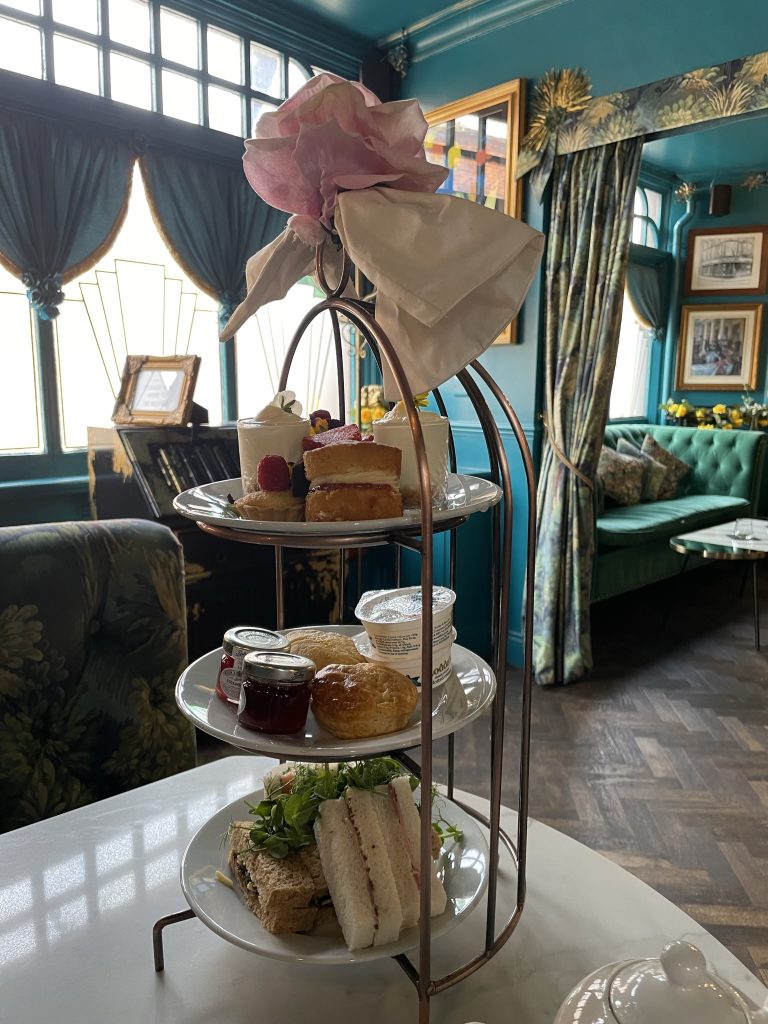
We got back to Salisbury in time for our cream tea, and it was worth the wait. We had another pot of breakfast tea– the caffeine sorely needed– and we each had another Chandon garden spritz. We weren’t sure what to expect, but received a large three-tiered platter.
On the bottom tier were finger sandwiches. We ate these first (probably the wrong thing to do as I learned I like my scones hot). There were four sandwiches total, cut into slender fingers; two each. Ham, mustard, and butter on white bread; Egg salad and watercress on white bread; Chutney and flaked old Cheddar on whole wheat and Smoked salmon, watercress, and cream cheese on whole wheat.
On the middle tier there were two hot scones, which are indistinguishable from the traditional shortcakes served with strawberry shortcake here– biscuit dough enriched with sugar; baked and then dusted with powdered sugar. These were supposed to be split open and spread with clotted cream and strawberry jelly. These were fantastic, but would have been better if we had got to them first.
On the top tier were the desserts– two Victoria sponges with buttercream and raspberry jam (fantastic); cheesecake cups (pretty good); treacle tarts (sweet and kind of bland, almost like a chess pie but more crumbly) and brownies (I gave up before the brownies).
Thus fortified, we went on to wheel our bags down the block to the train station, and catch the train to Bath.
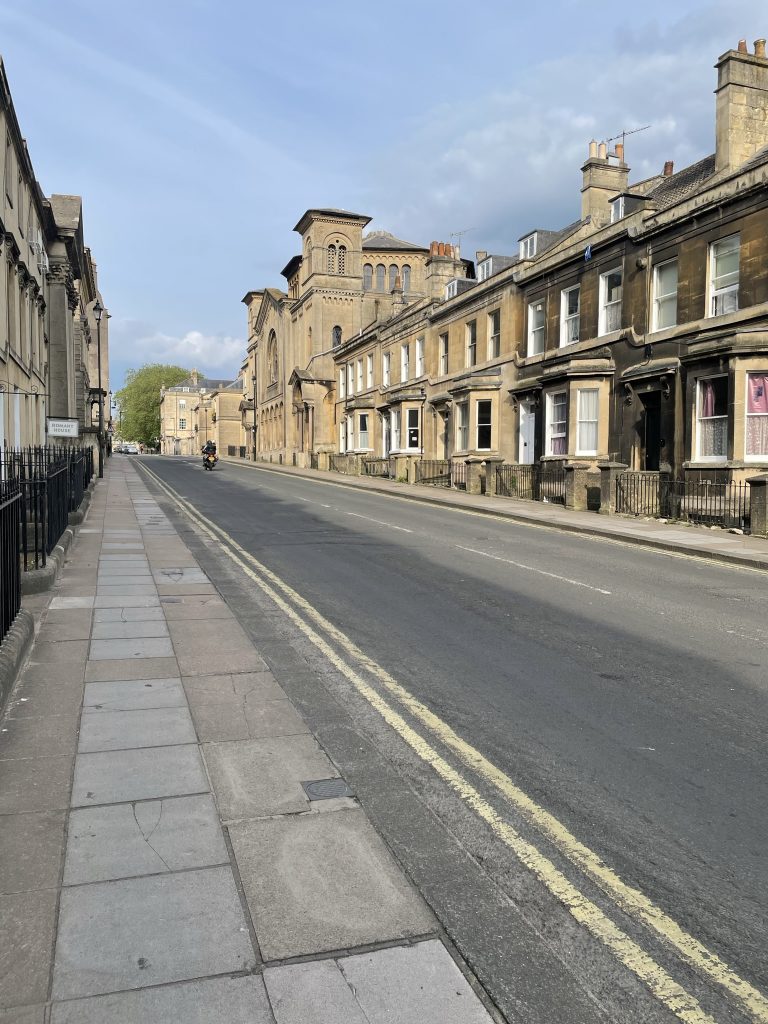
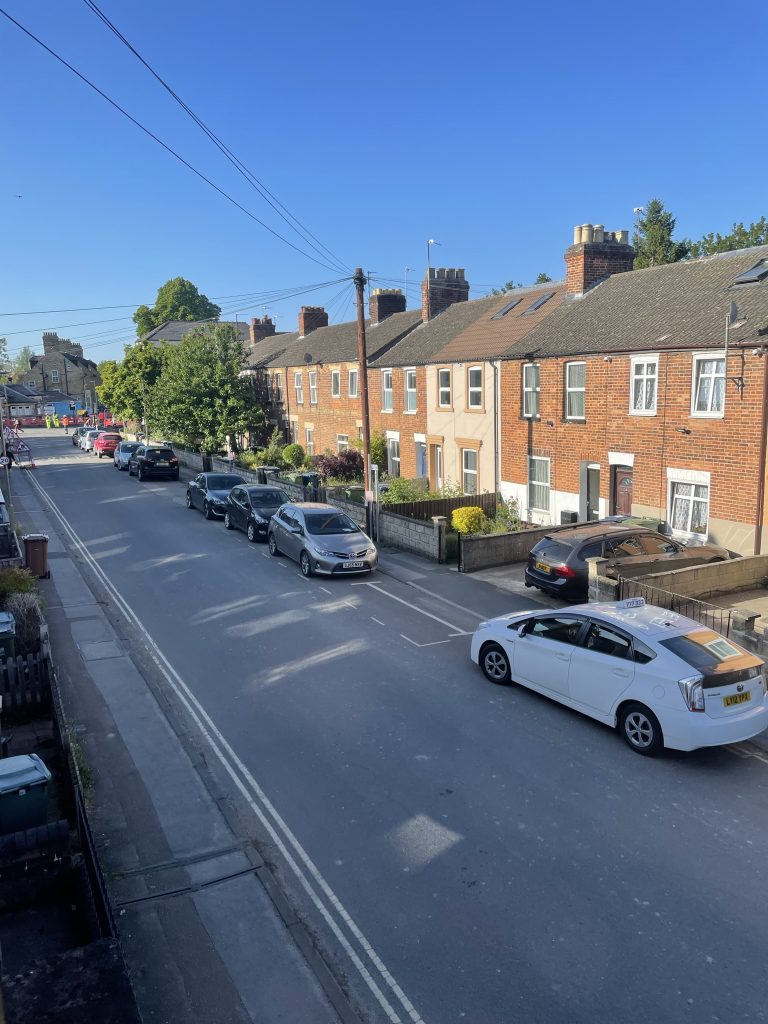
We checked in at the Bath House, a bed-and-breakfast recommended to us by friends. It is a few blocks outside of the tourist area of Bath, in a place which seems to be mostly short-term accommodations and (relatively nice) student housing. We had a ground floor room, and windows that opened out onto the street. Our room had a big four-poster bed; a tea table and chairs, a small armchair with a hassock (much appreciated) and a storage area that included a tiny refrigerator as well as a tea-making setup. In the fridge was milk, cookies, and a pitcher of filtered water. (Unnecessary to filter it as the tap water was fantastic; it was good everywhere we went.)
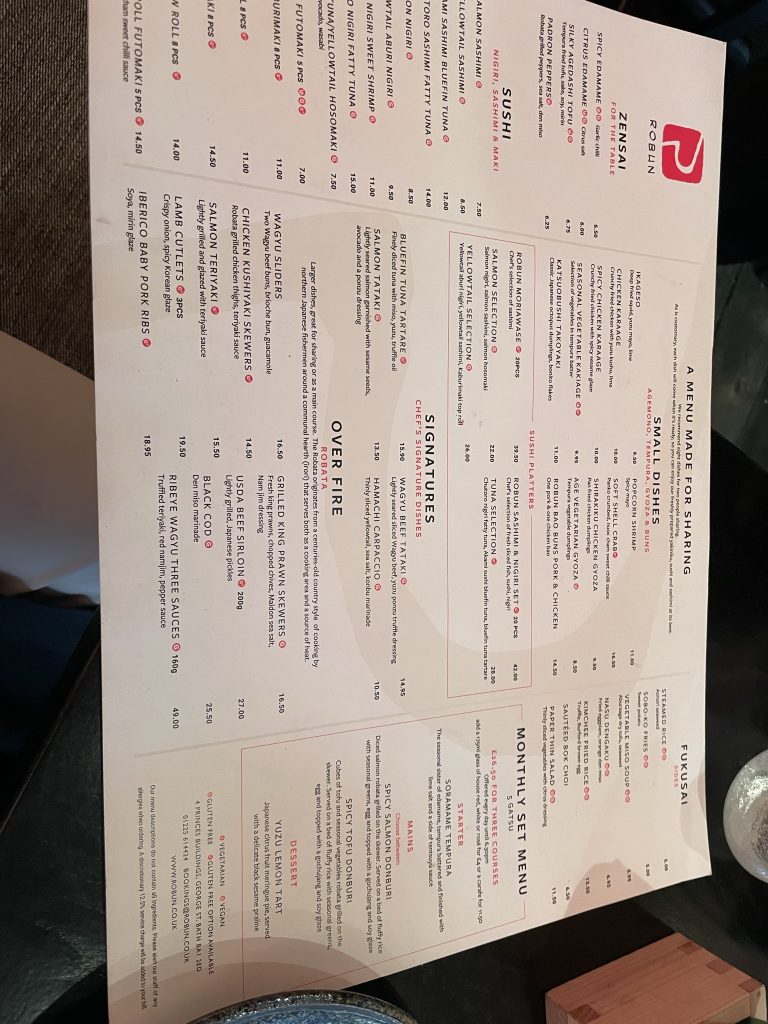
We had got an anniversary add-on of prosecco and chocolates; but the ice had melted by the time we arrived. So, we put the prosecco in the fridge for later, and unpacked our clothes, as we were going to be in Bath for a few days. We went out to explore and get our bearings. We were staying about three blocks off Queen Square. We were very tired, so did not do much; and ended up eating dinner at Robun, a Japanese restaurant with a wood-fired grill; this was easily one of the best meals of the trip.
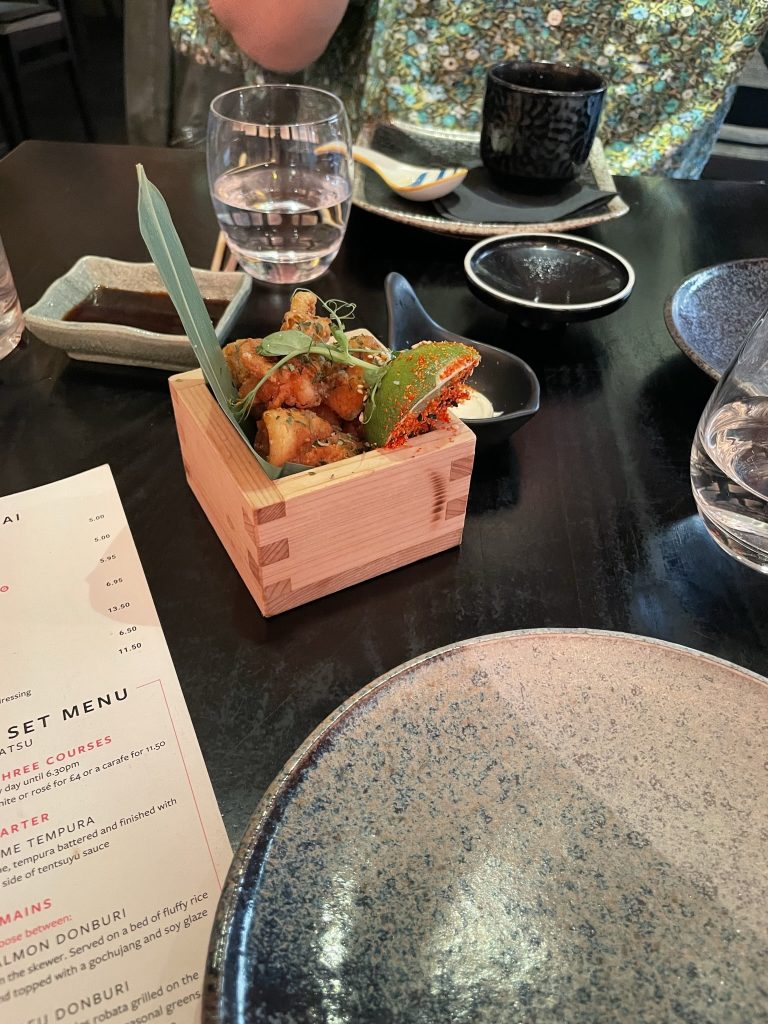
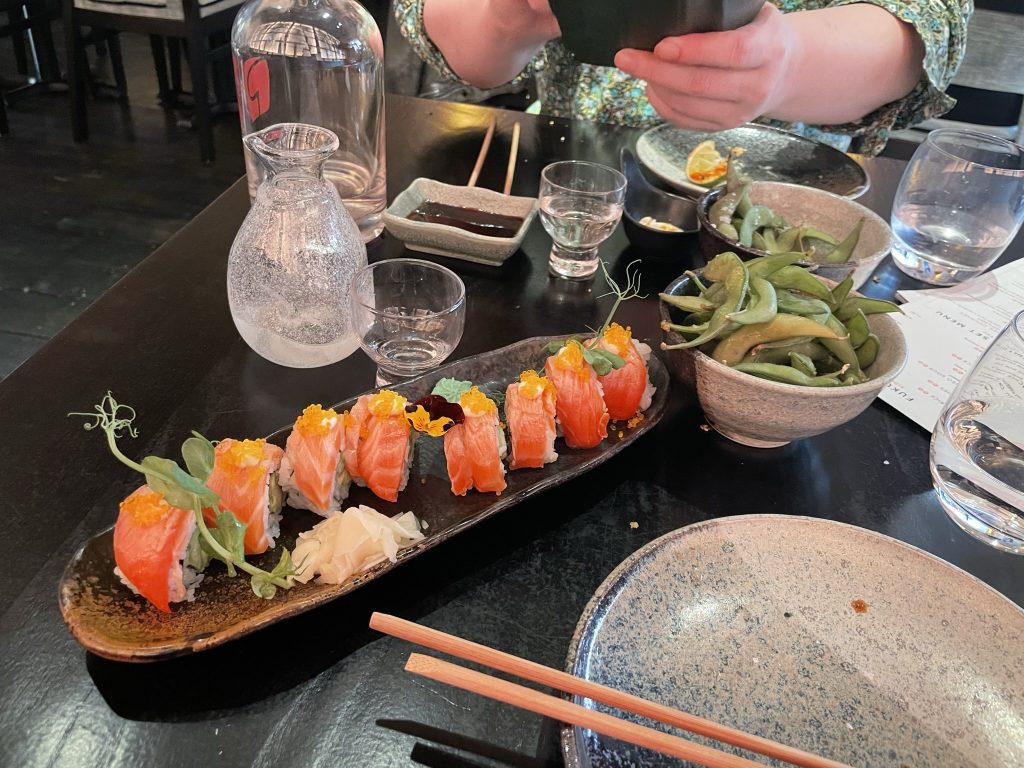
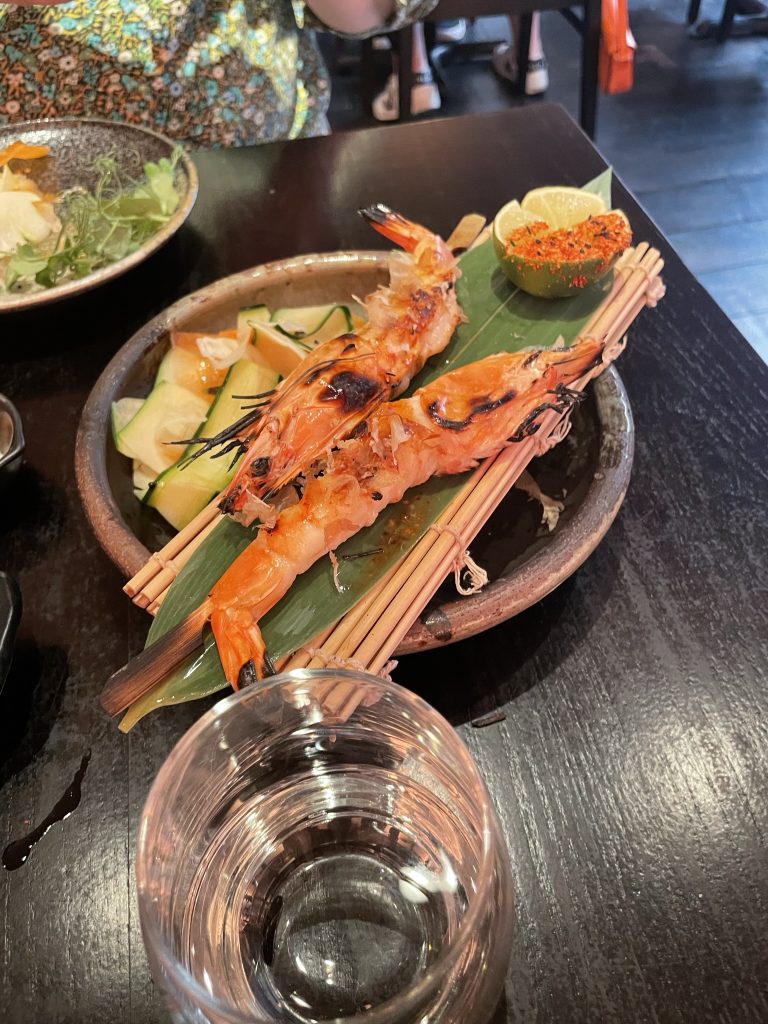
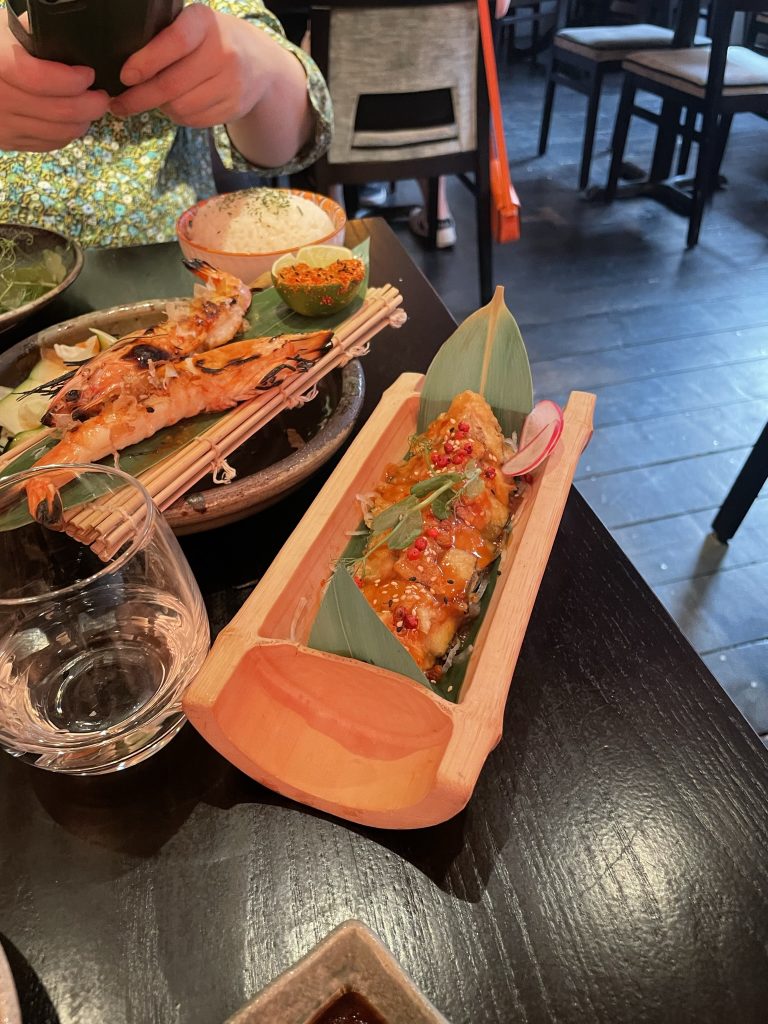
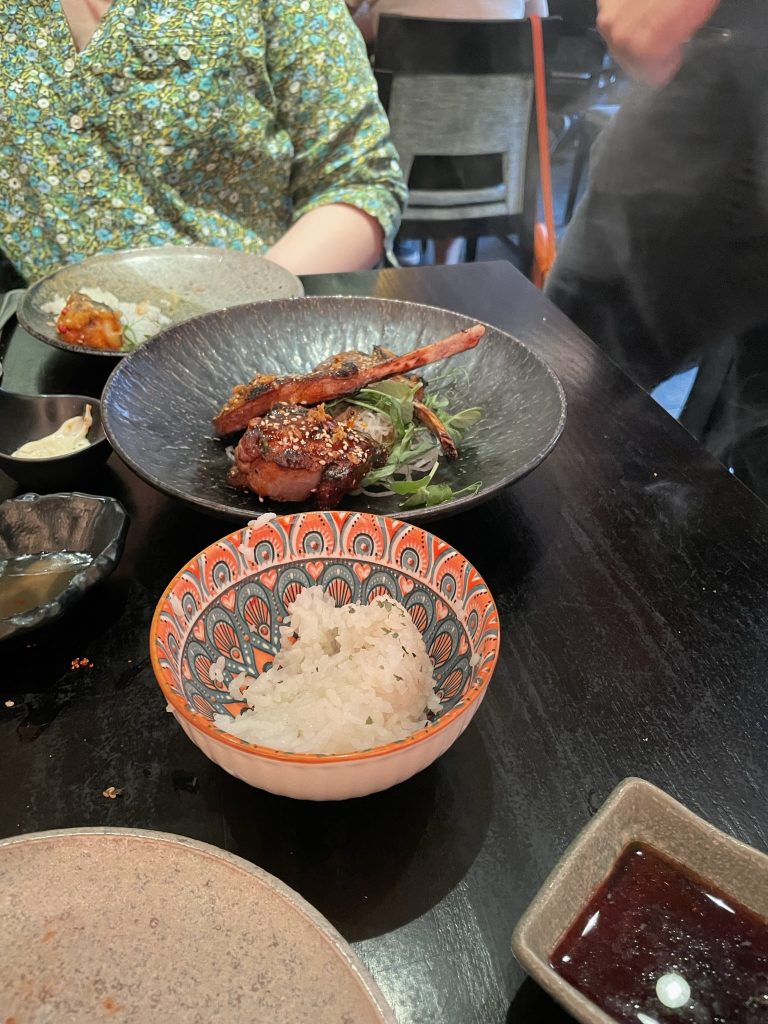
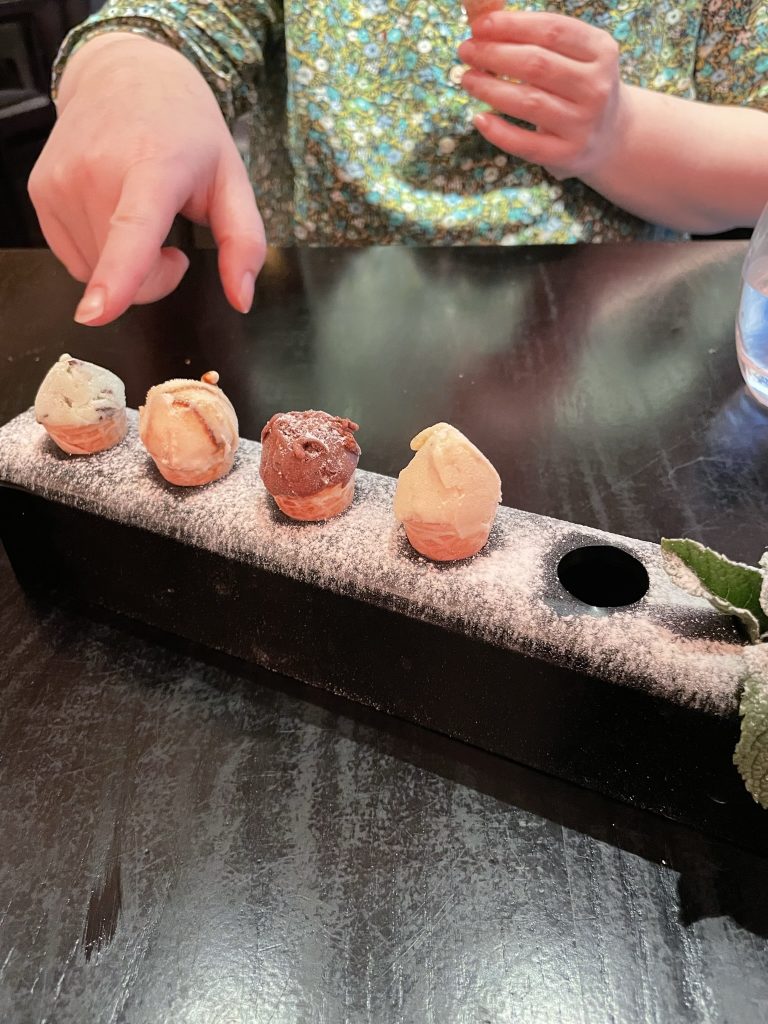
We were extremely early for dinner– it was about 6:30– so we were seated right away. I had miso; it came with a bit of fried tofu skin in it and was amazing. Sean had edamame with citrus salt. We then had a ikageso squid which was deep fried with a sesame-chili dipped lime wedge to squeeze on it. We got a salmon kaburi maki– a very nice maki; and eggplant nasu dengaku, which was a seared eggplant with a sweet miso glaze. We got rice with seaweed and grilled king prawn skewers… and then the highlight of the meal, lamb chops that were grilled and then smoke-infused; served under a clear dome so we could watch the smoke curl out. These were the highlight of the meal. The dessert was the only low point– mini ice cream cones which were clever but ordinary. There was chocolate, vanilla, pistachio, and chocolate mint. I just ate the vanilla one.
We then crawled back to the room and went to sleep. I had horrible leg cramps all night from the several days of walking/lugging/bus and train riding.
5-29
The Bath House does not have any common areas for guests– I would say this was its one shortcoming as it would’ve been nice to have a garden seat or something– so they serve all breakfast in-room, with a signup sheet you fill out the evening before. This morning, we had bacon sandwiches which were comprised of…well… bread and bacon, nothing else… and tea and orange juice. (We had kind of expected eggs on the sandwiches, but bacon and toasted bread was just fine.)
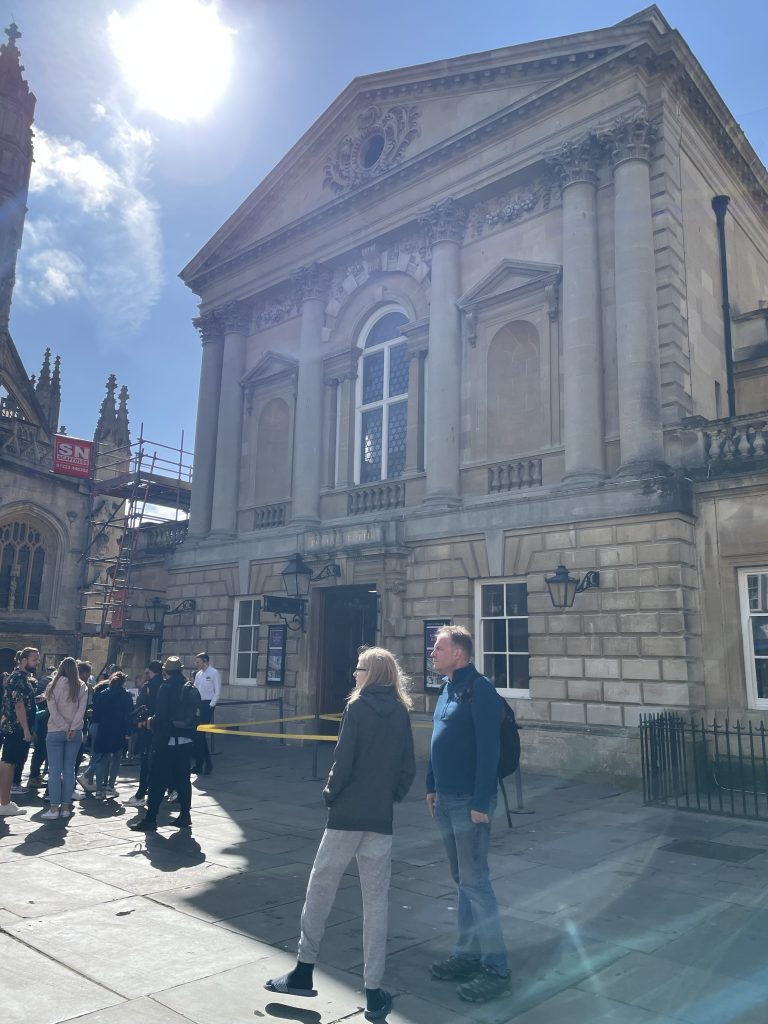
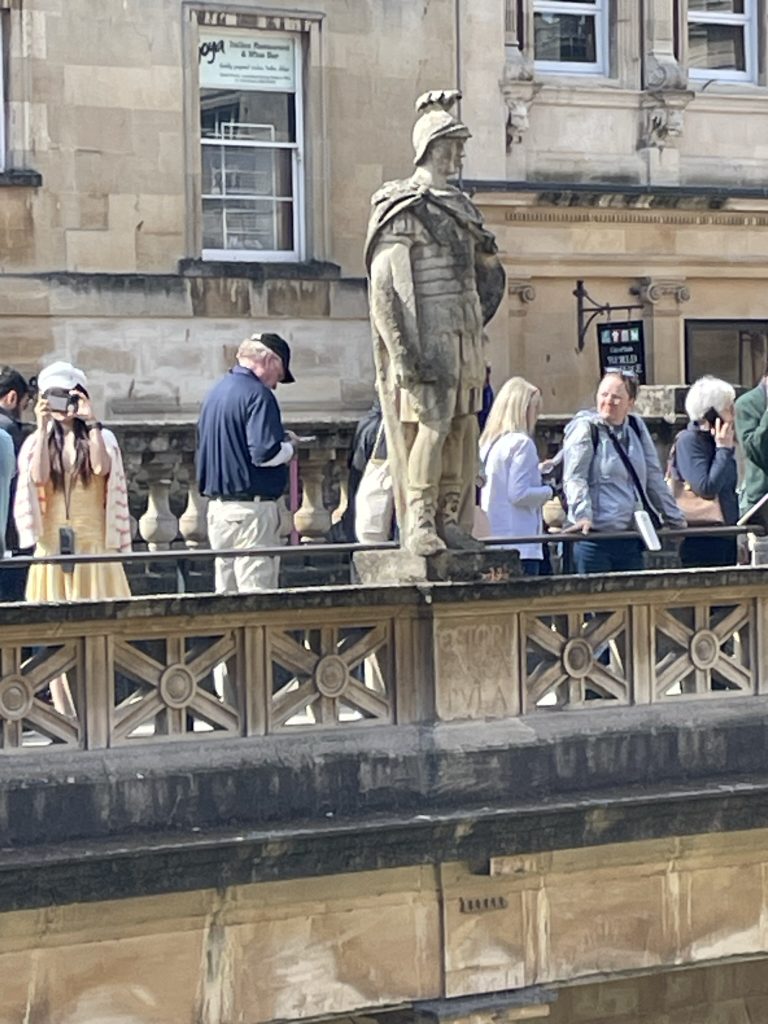
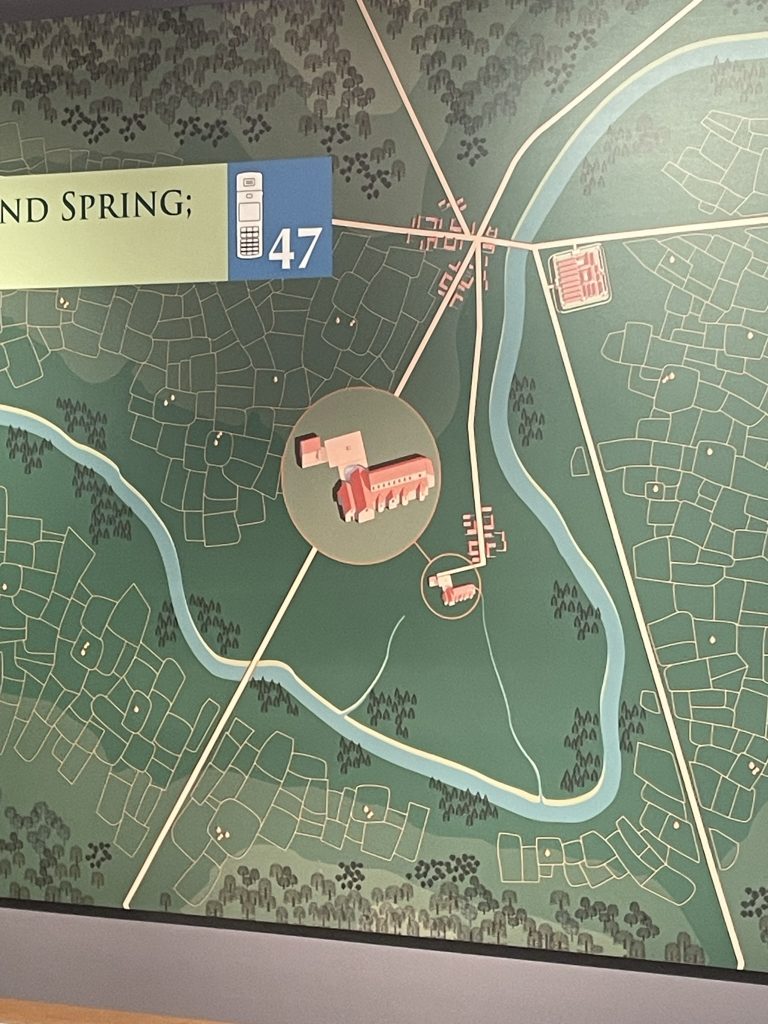
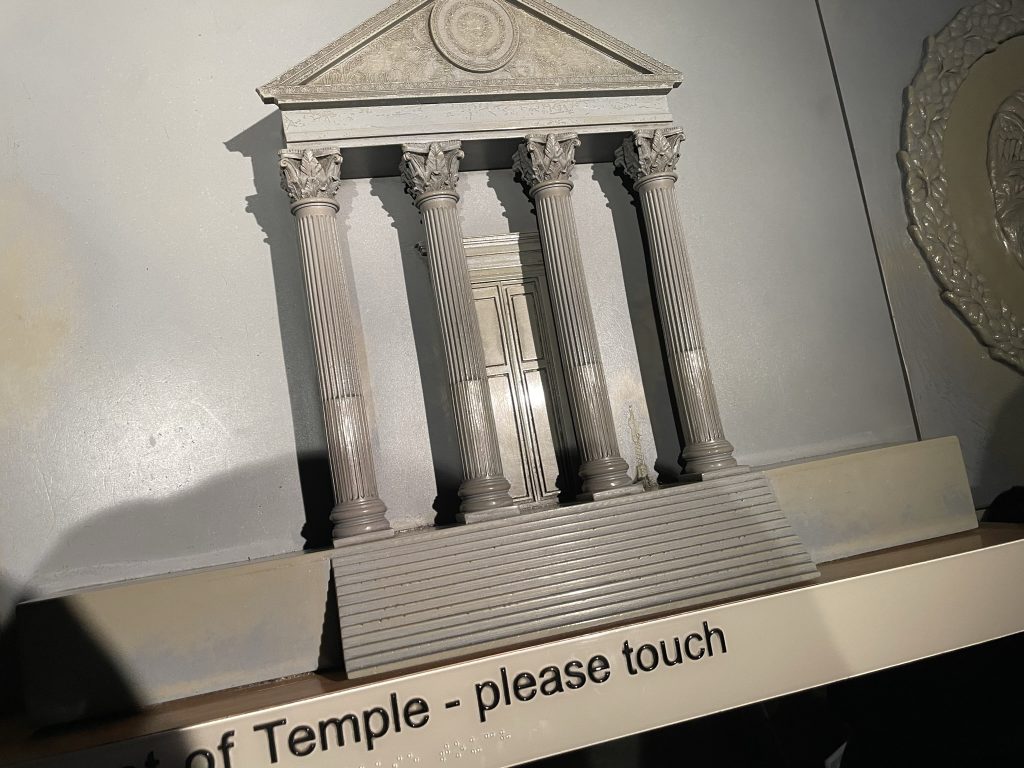
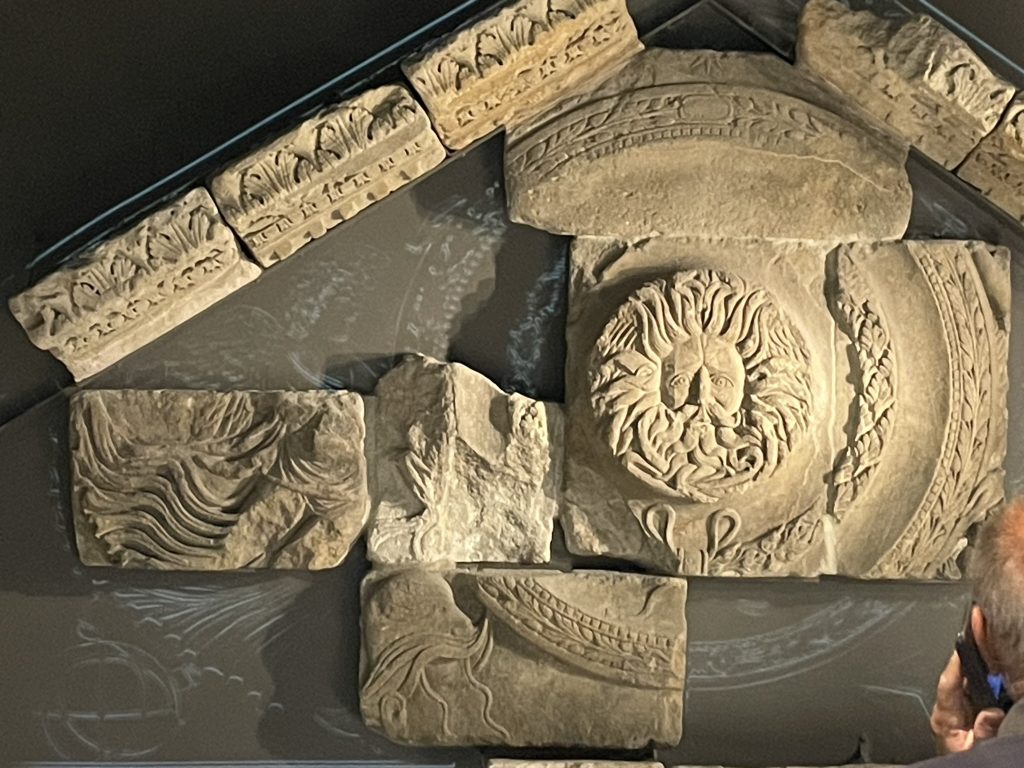
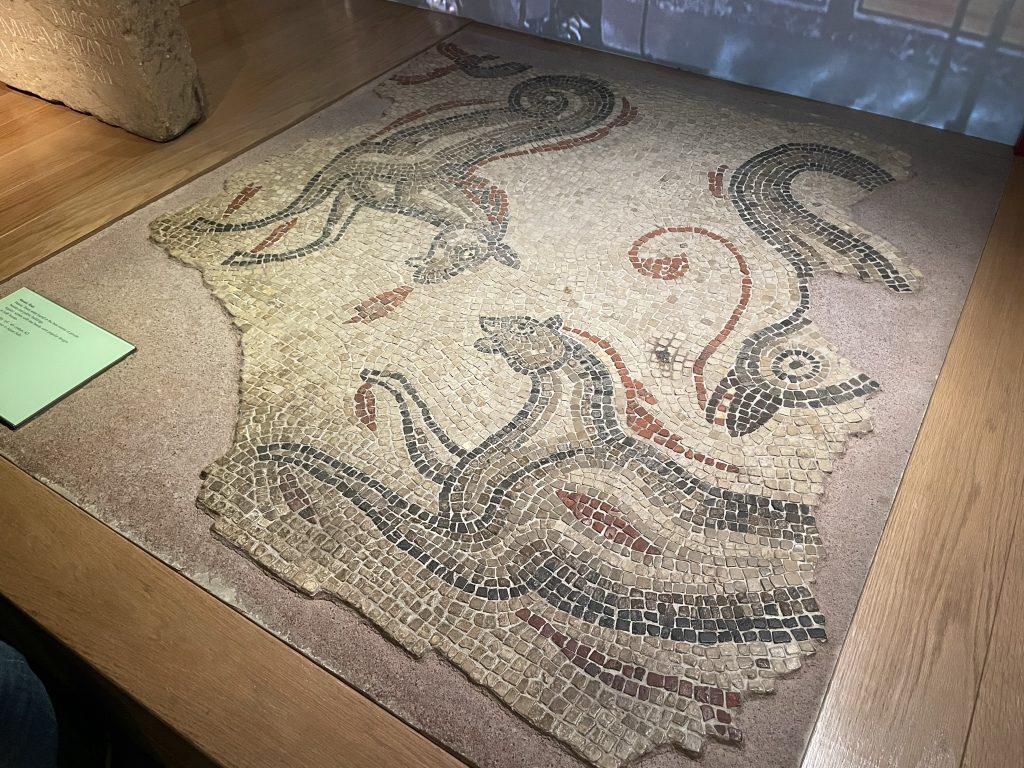
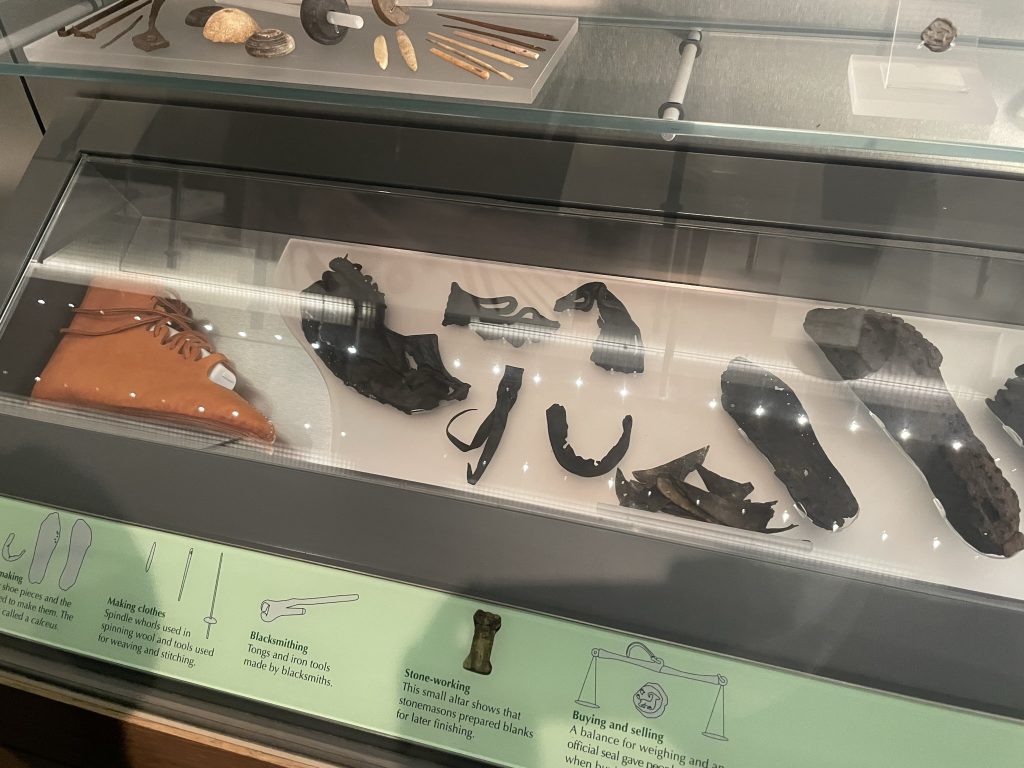
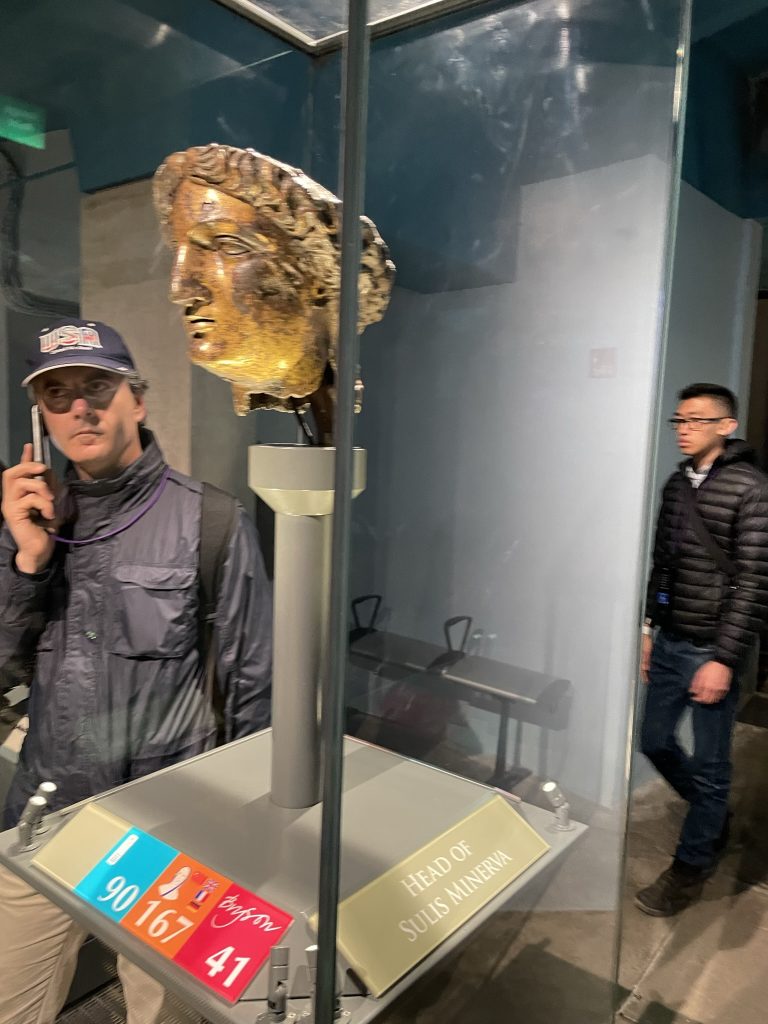
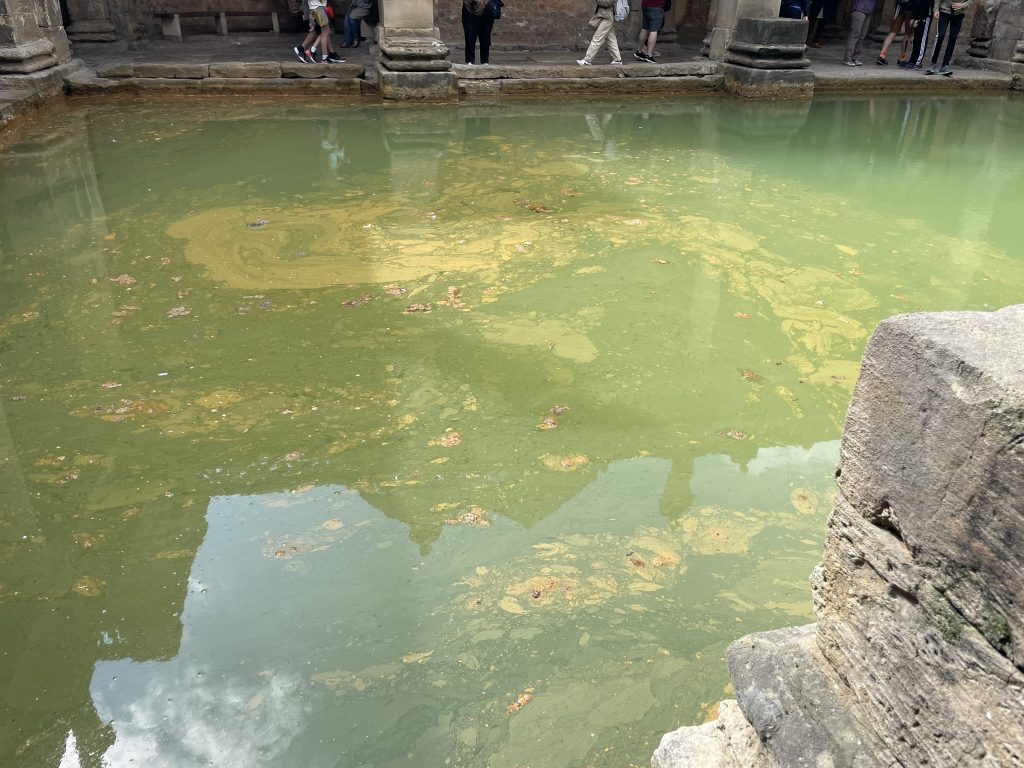
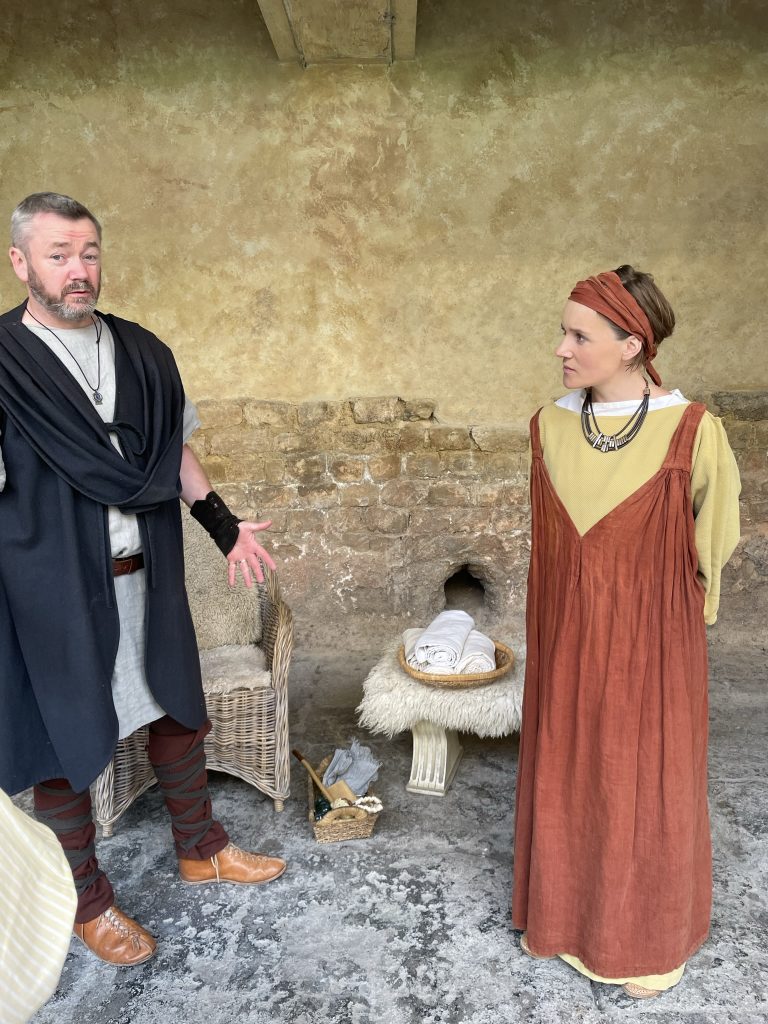
We then wandered around Bath itself for awhile, as we had a pre-paid timed entrance to the Roman Baths. We later learned that this may have been more of a suggestion than a hard-and-fast time, as we were let in at 945 and our tickets were for 10. We saw many people turned away who did not have pre-booked tickets– the entire day had clearly been pre-sold, so definitely buy tickets well before arriving. In 2003, we had seen the Roman Baths, but since that time the museum had a huge upgrade done, and many of the areas were now glassed-in, had explanatory signs, and so on. I felt a bit more isolated from the experience, and it was not as compelling an experience as it had been the first time– when you could walk up and put your hand in the original spring– but it was very much made comfortable and safe for people with young children or who have mobility limitations. There were a couple of docents in Roman garb down by the pool answering questions, and there were many more artifacts on display than I remember seeing the first time. It took about an hour or so.
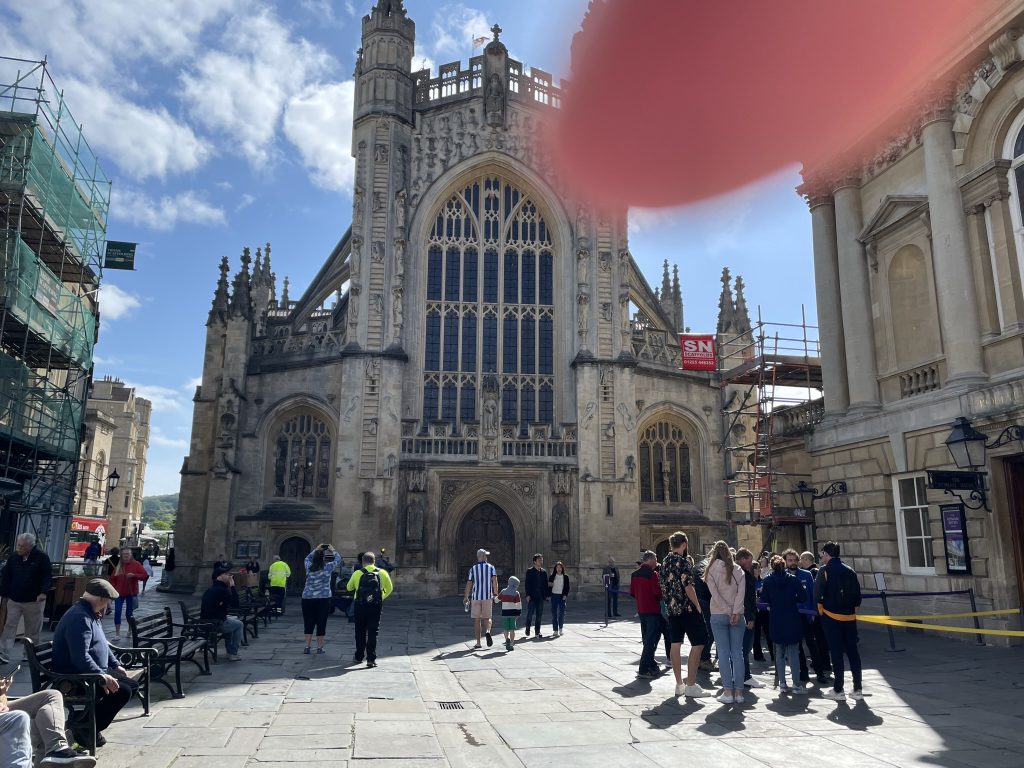
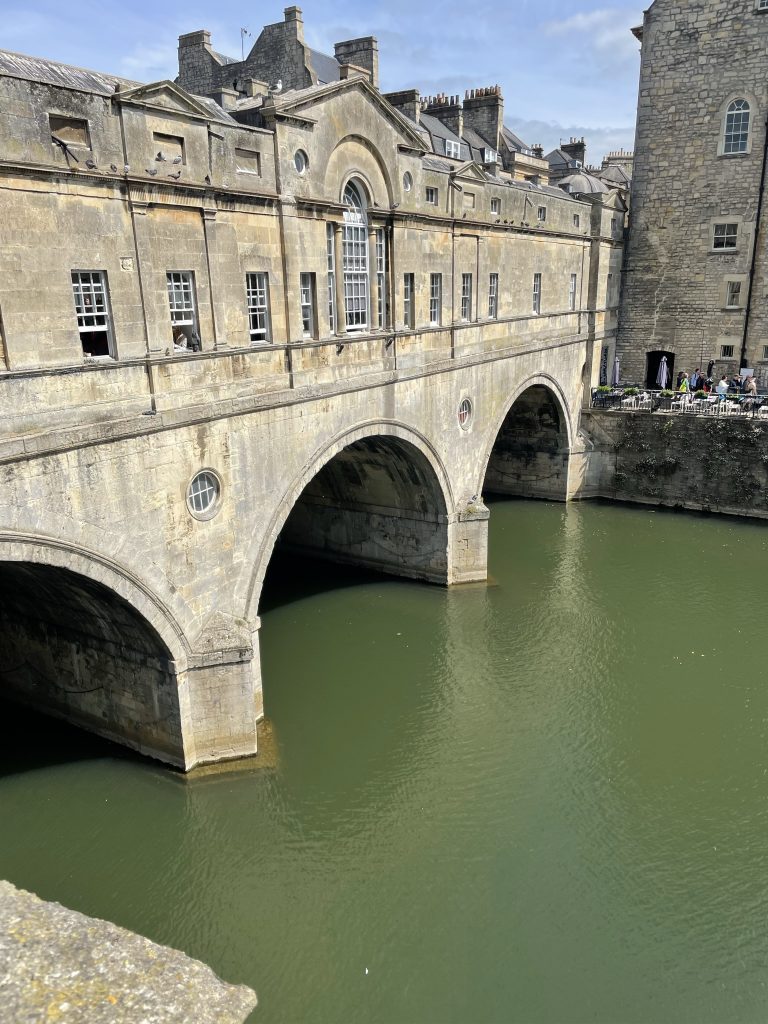
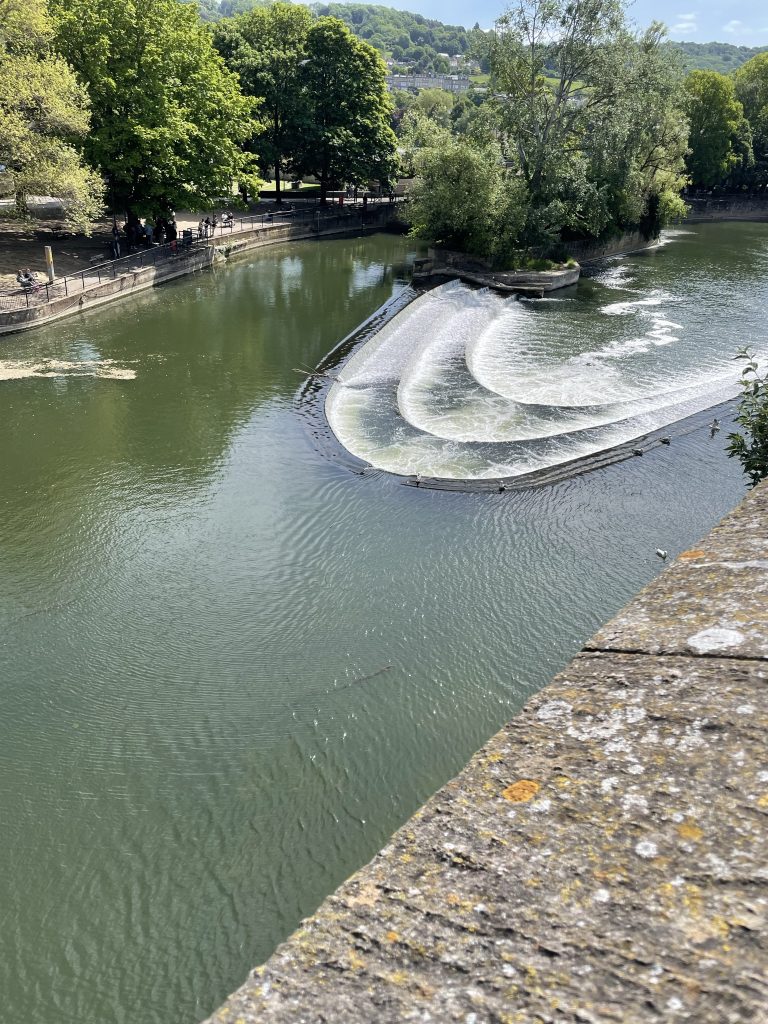
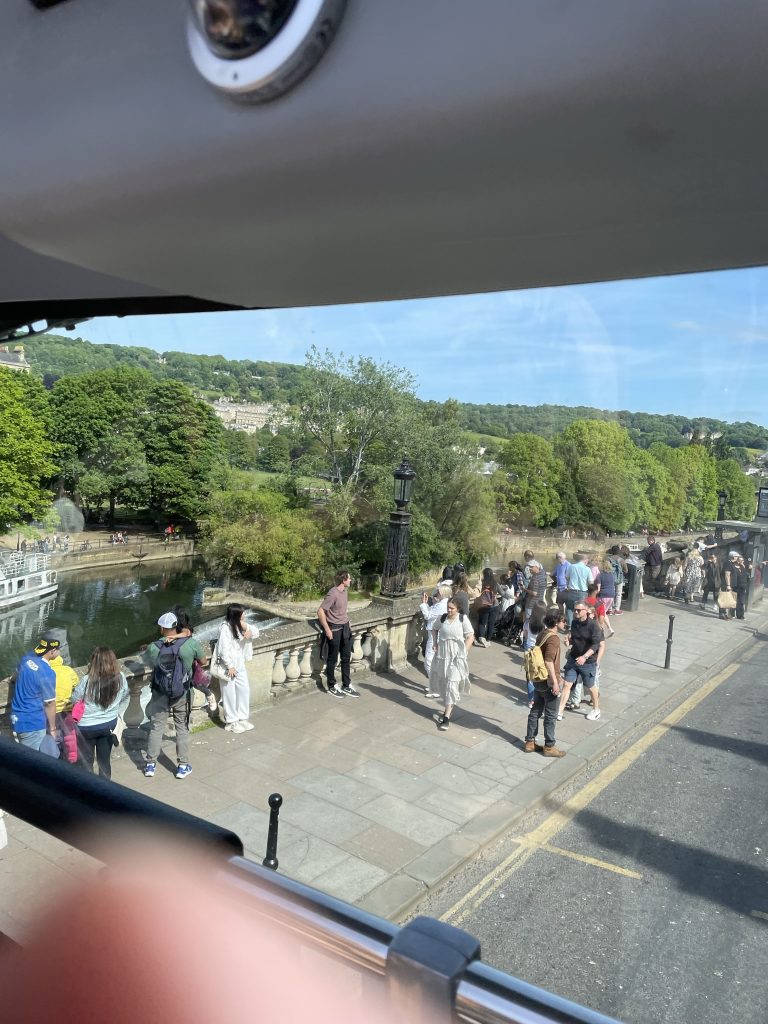
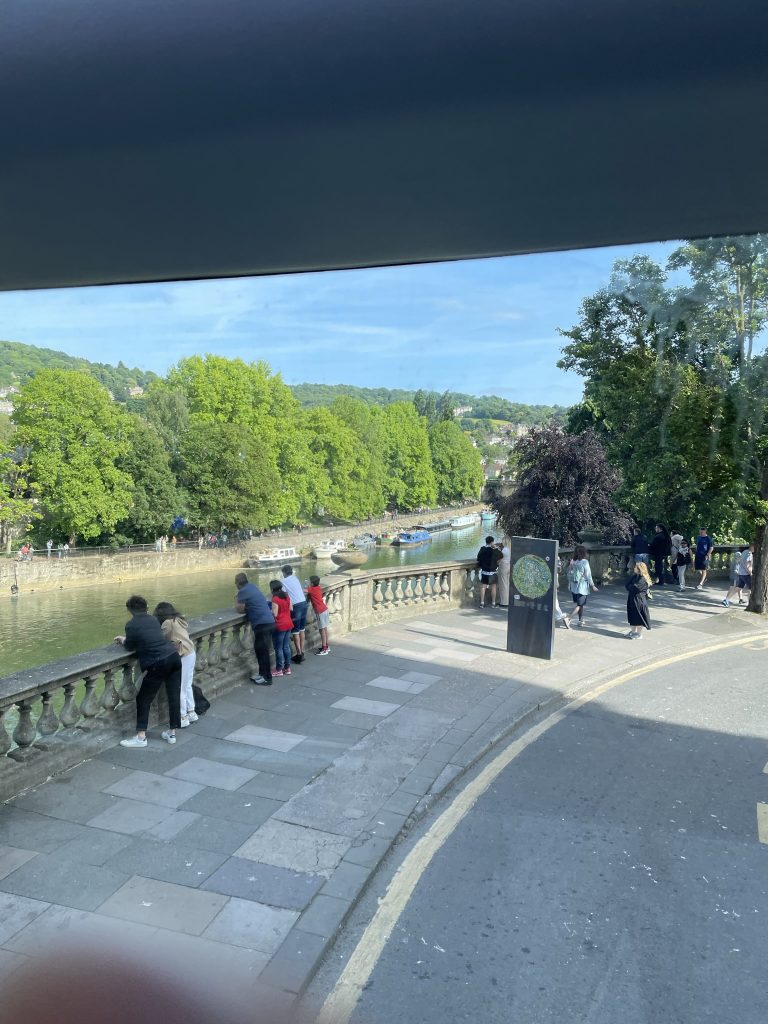
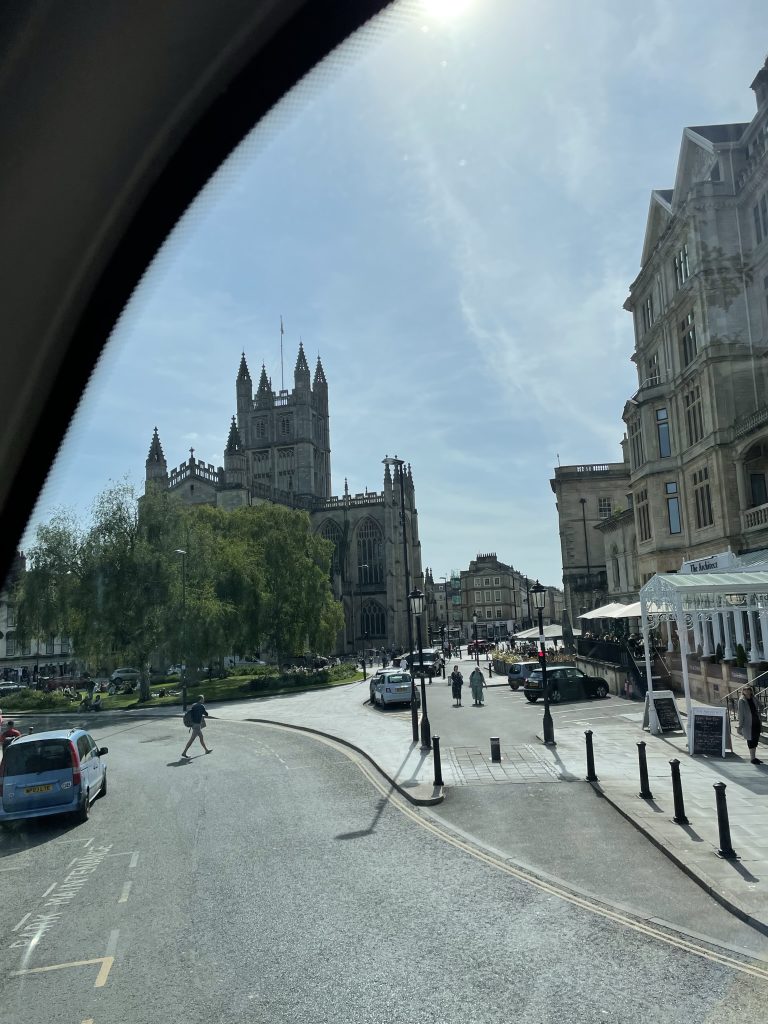
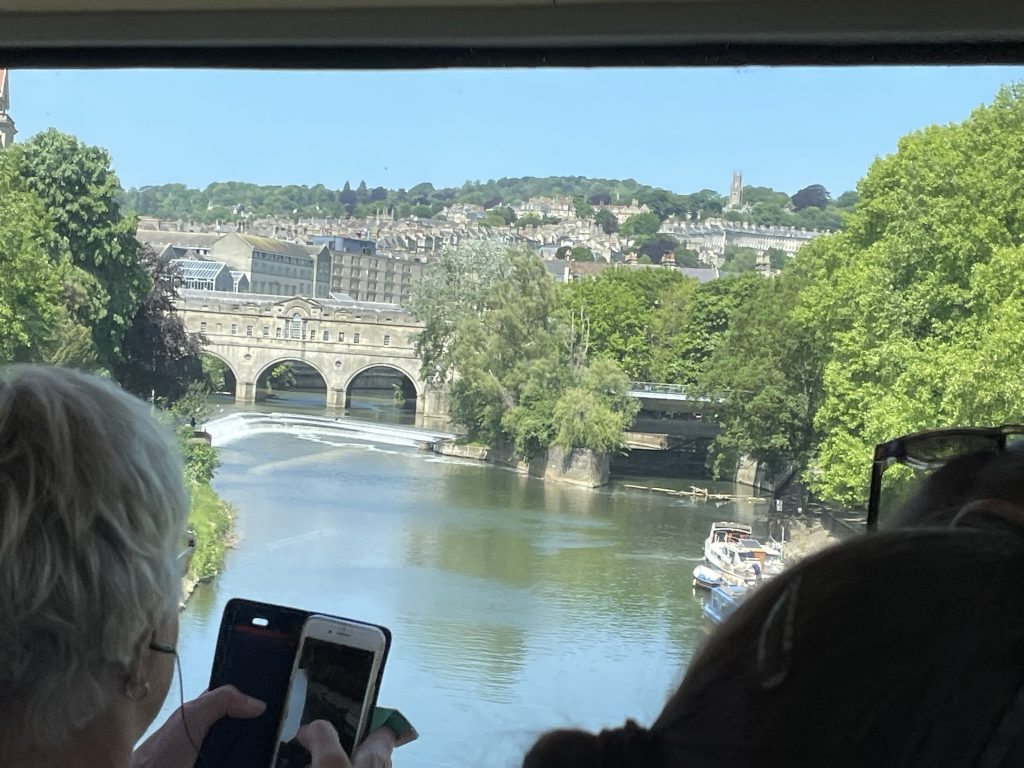
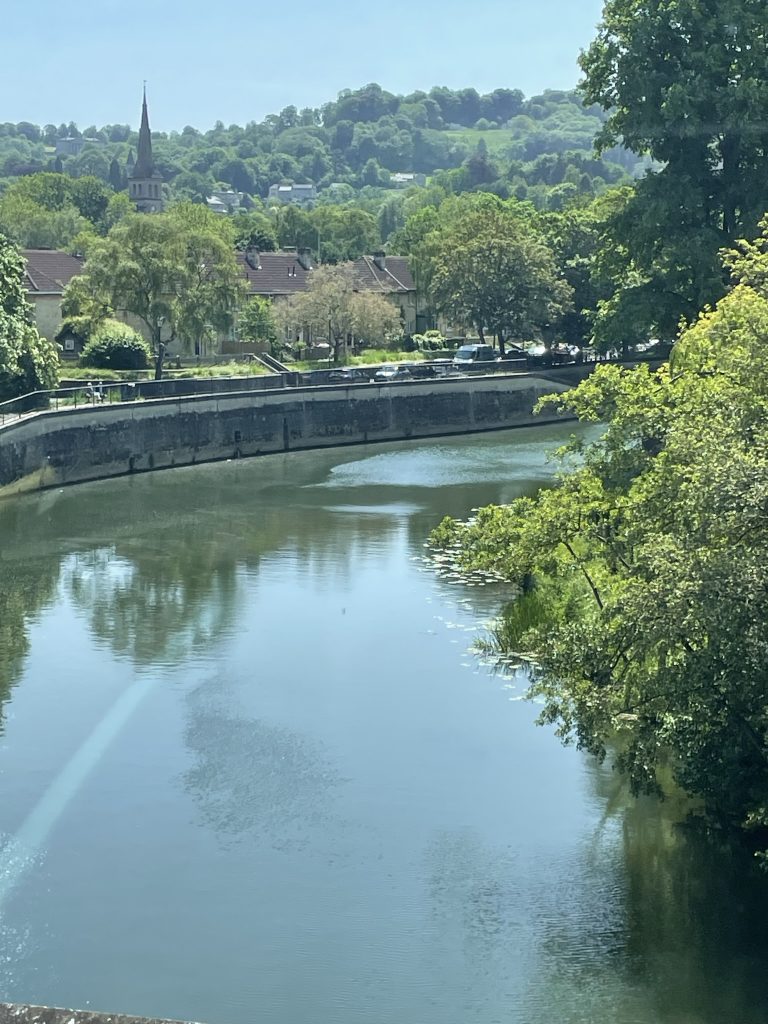
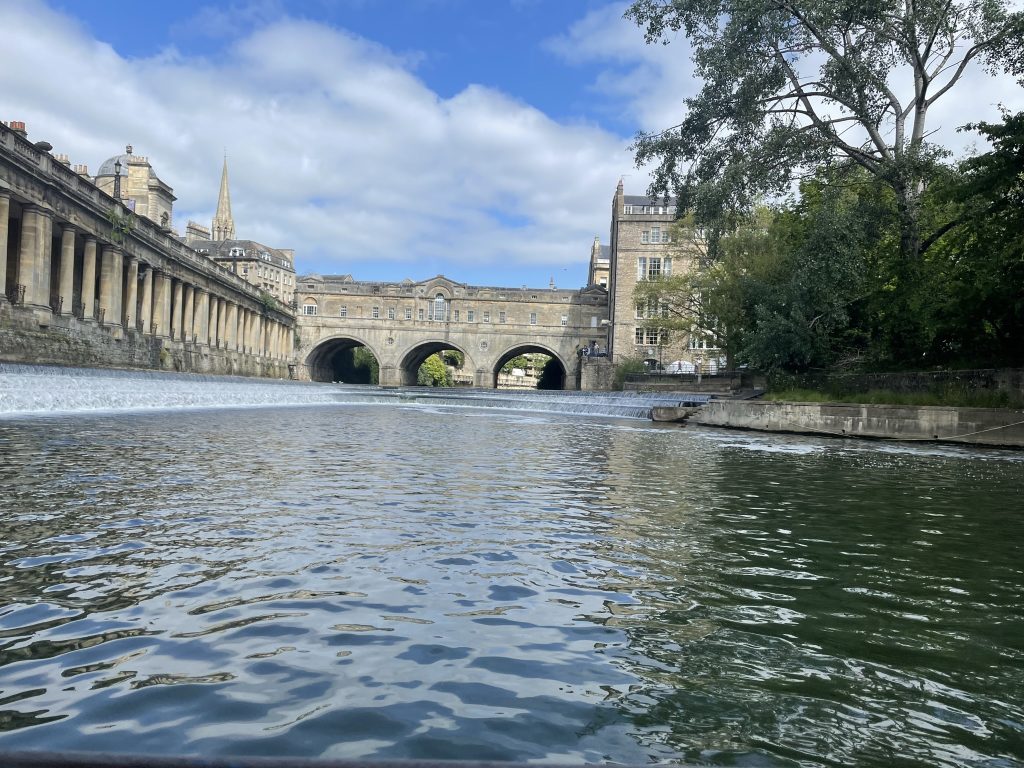
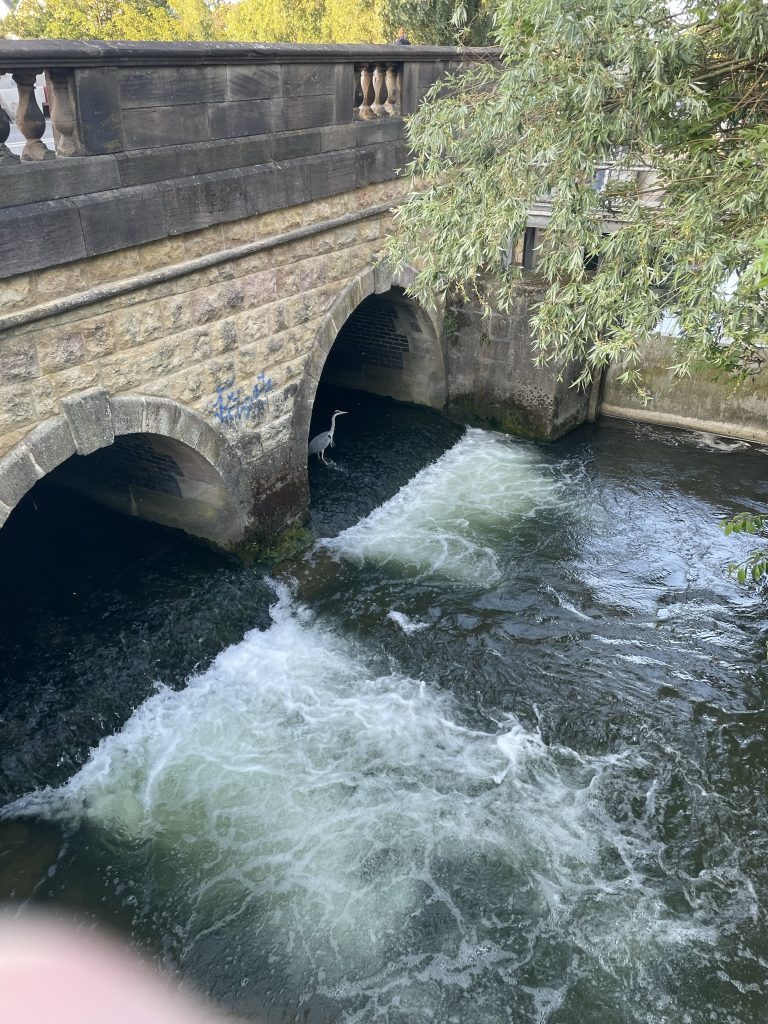
Because it was very crowded, we didn’t stay as long as planned, so we stopped off at the bookstore and bought some gifts and books– we left at about 11:10 and spent 195 pounds– and then went to see the city. It happened to be both a bank holiday (this same day, Monday off) weekend as well as half-term (school out for kids) so it was busy. We got some pictures of the cathedral from the outside and walked down to the River Avon (the same one? Another one? *Oswyn note: different one. There are at least two Rivers Avon as the Romans didn’t understand the Welsh word for ‘river’ was ‘avon’*) to see Pulteney Bridge, which is one of only four bridges in the world that are fully lined with shops on both sides. There is a weir on one side of it to add visual interest to the river, which ripples prettily.
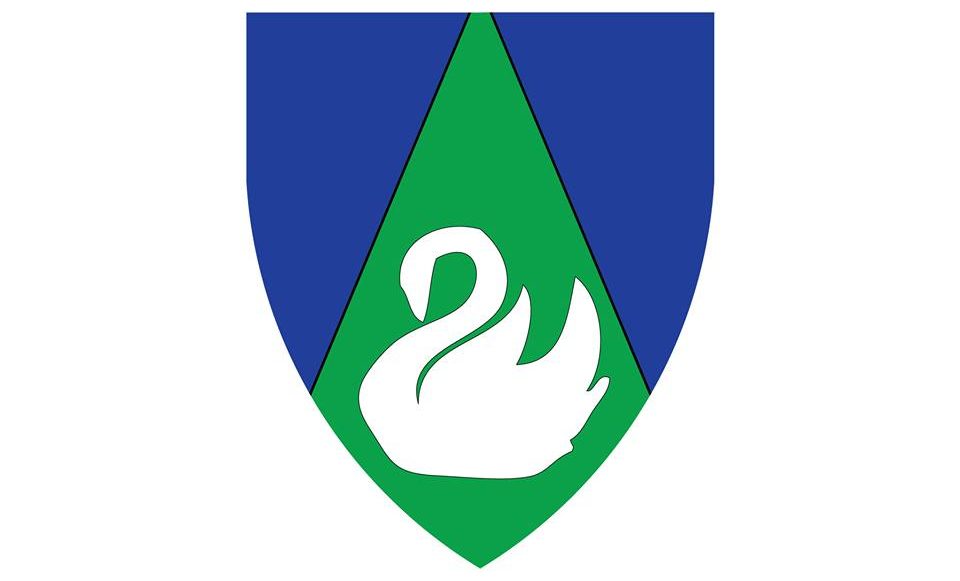
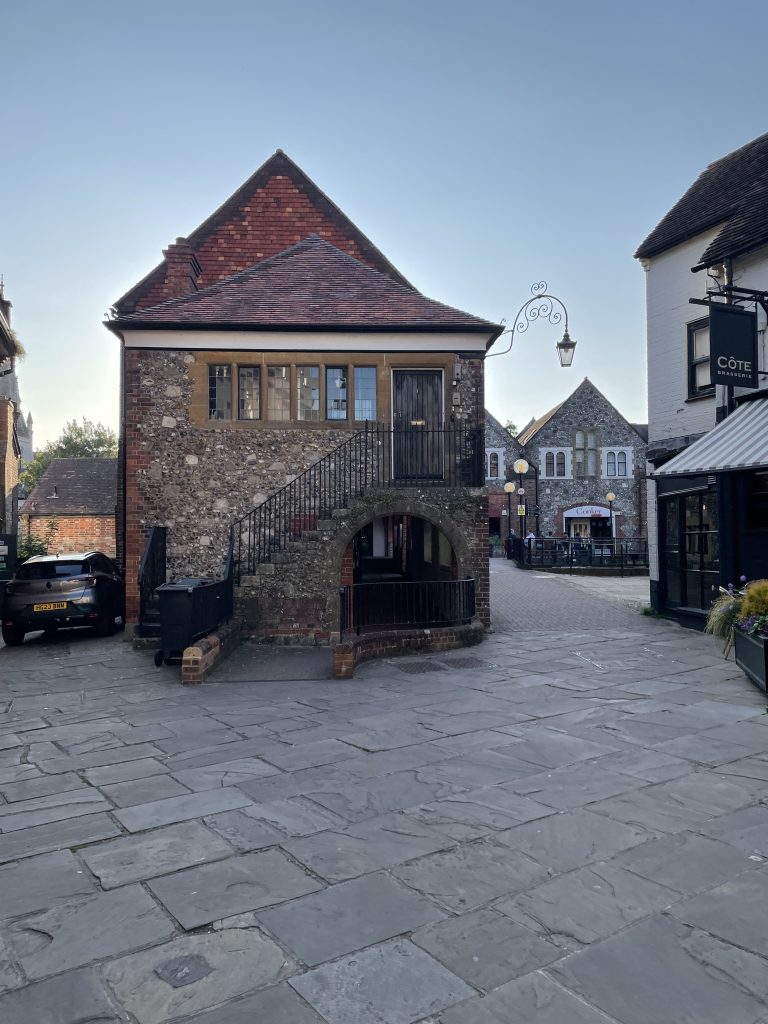
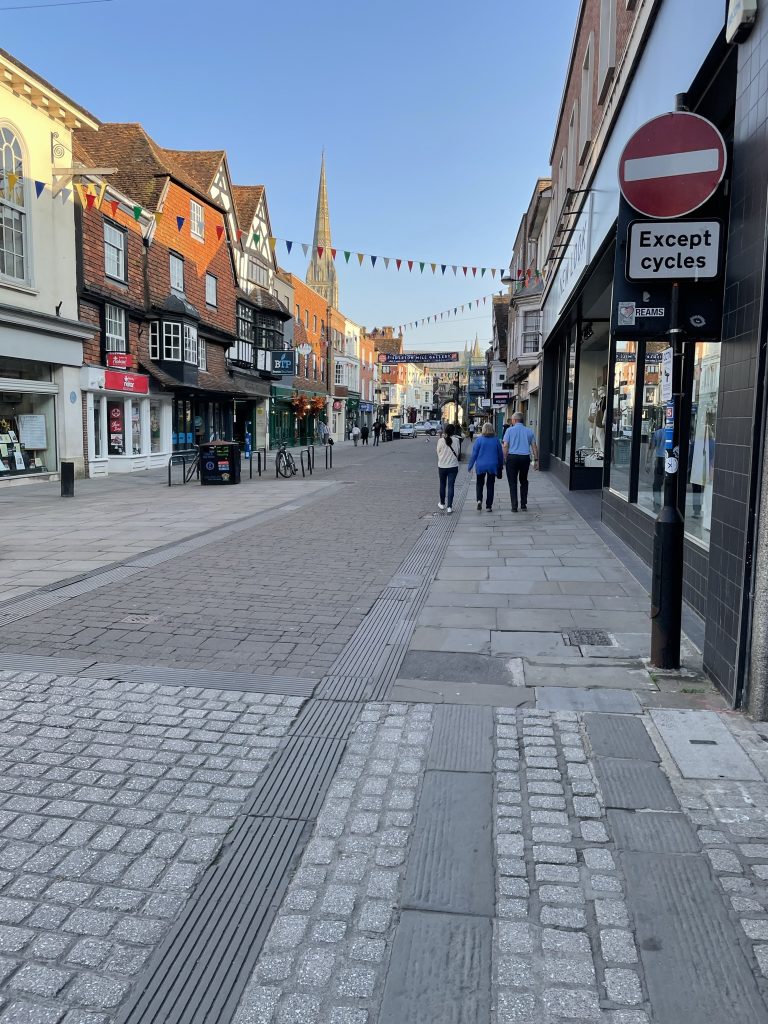
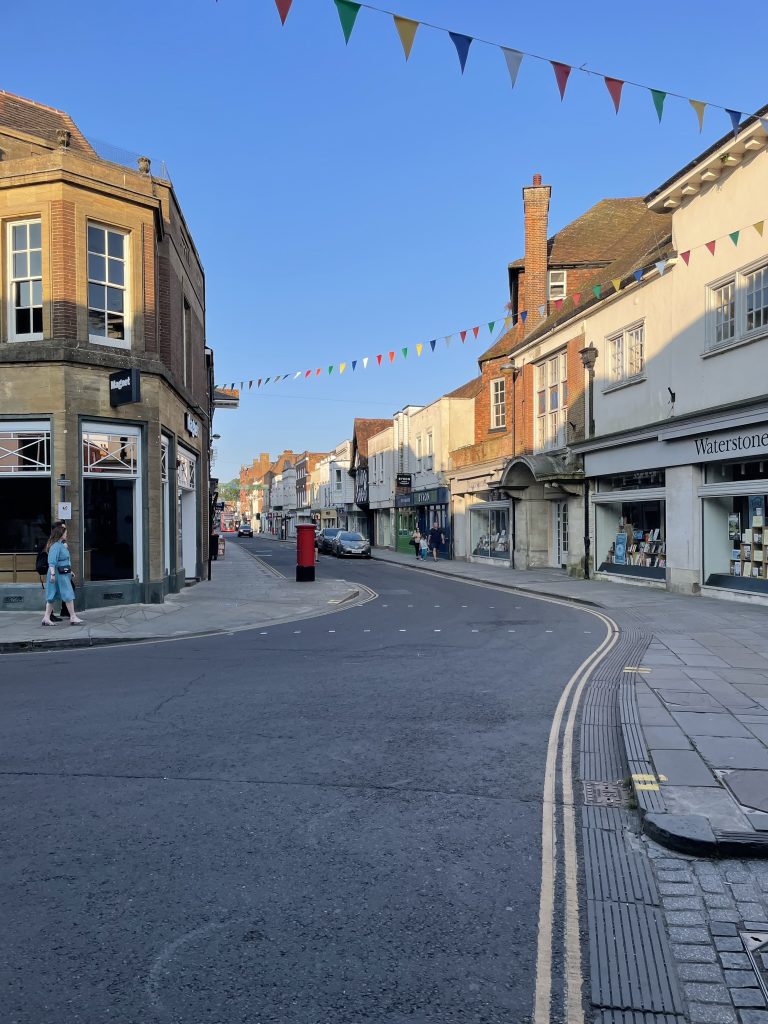
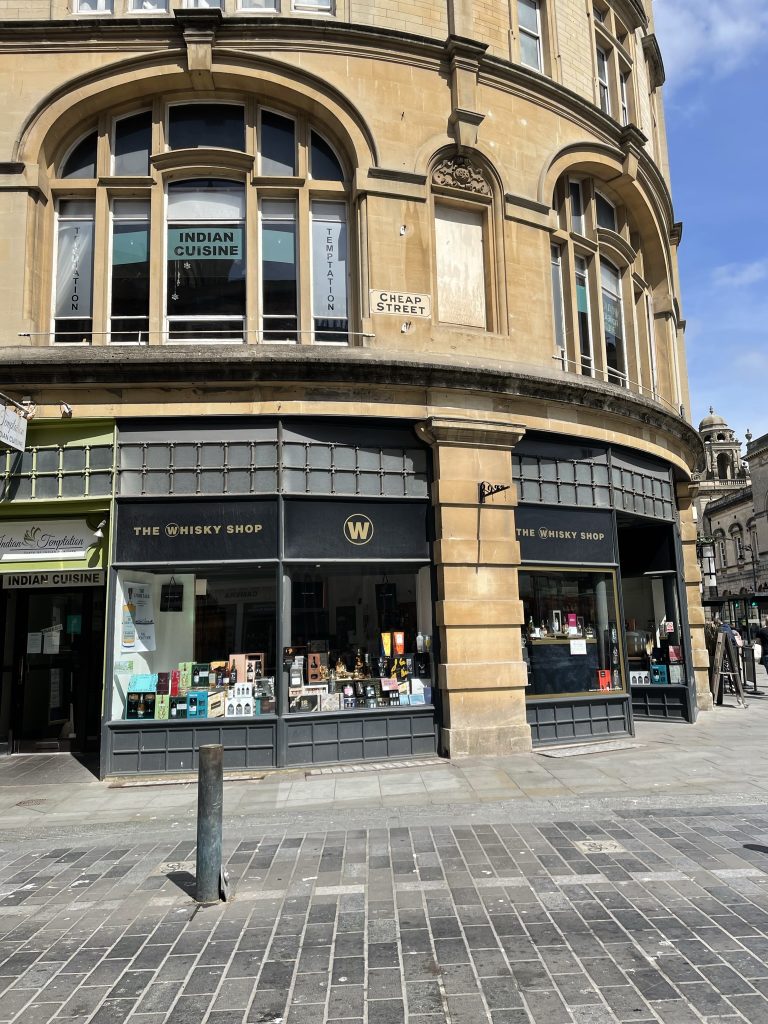
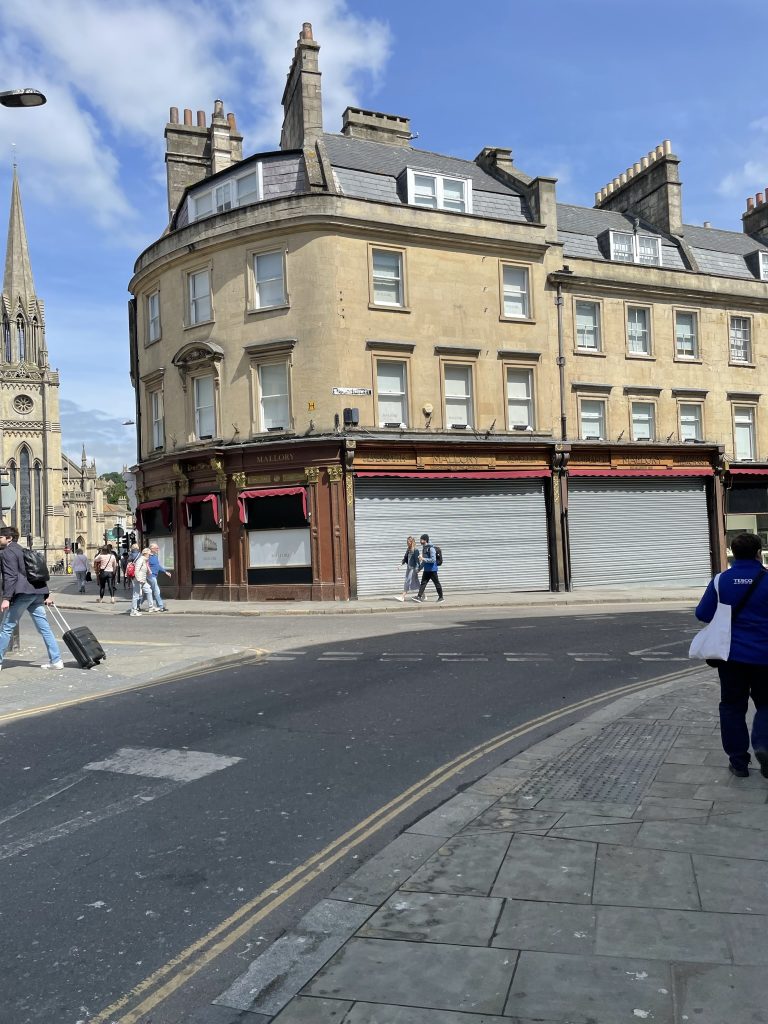
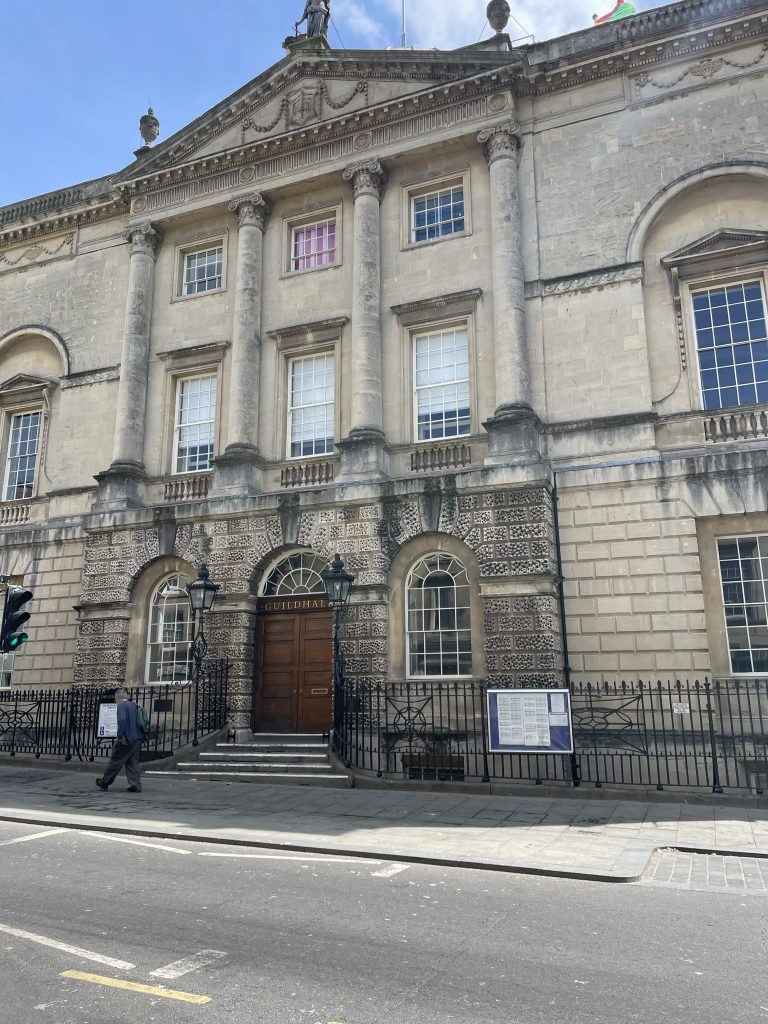
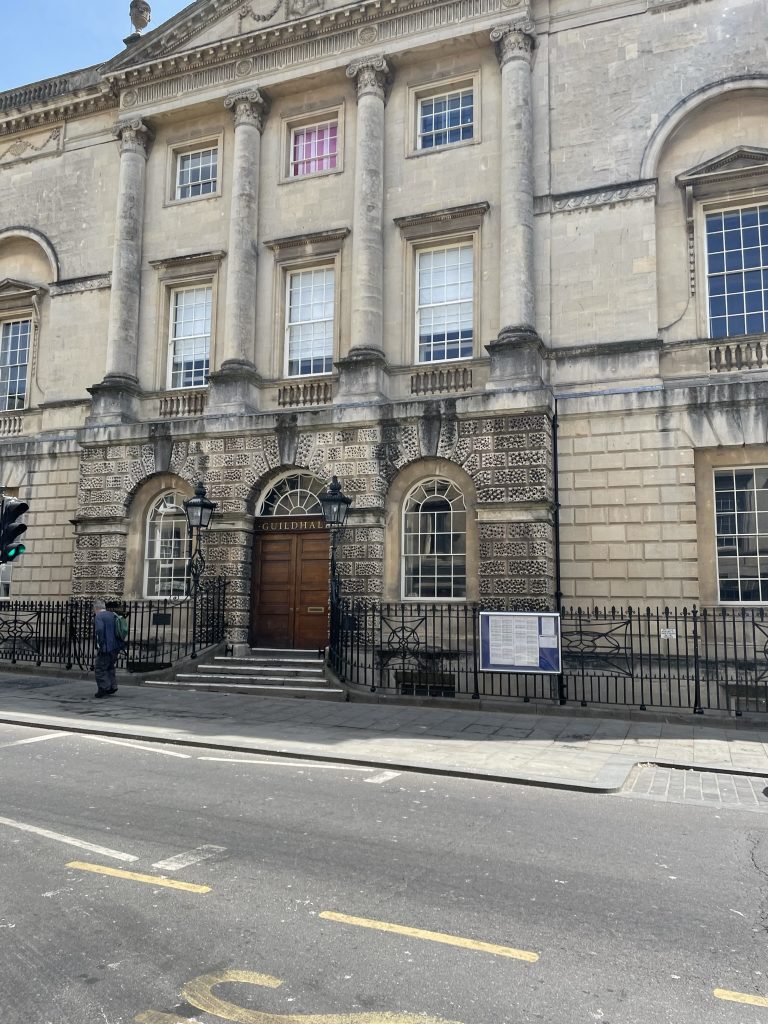
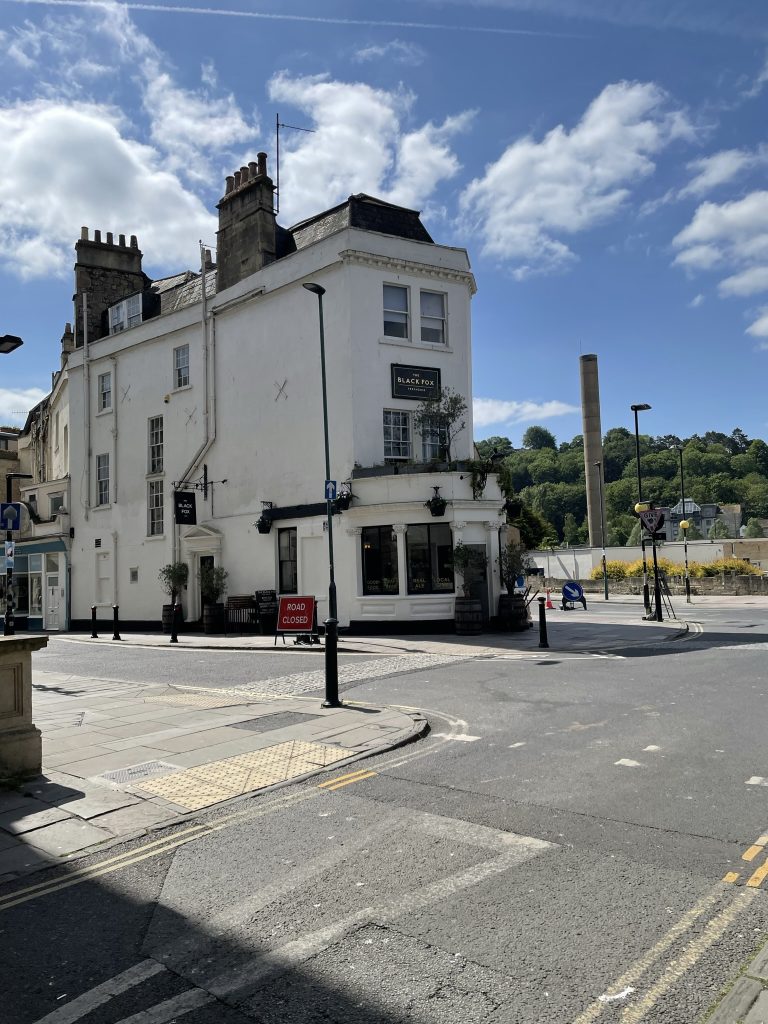
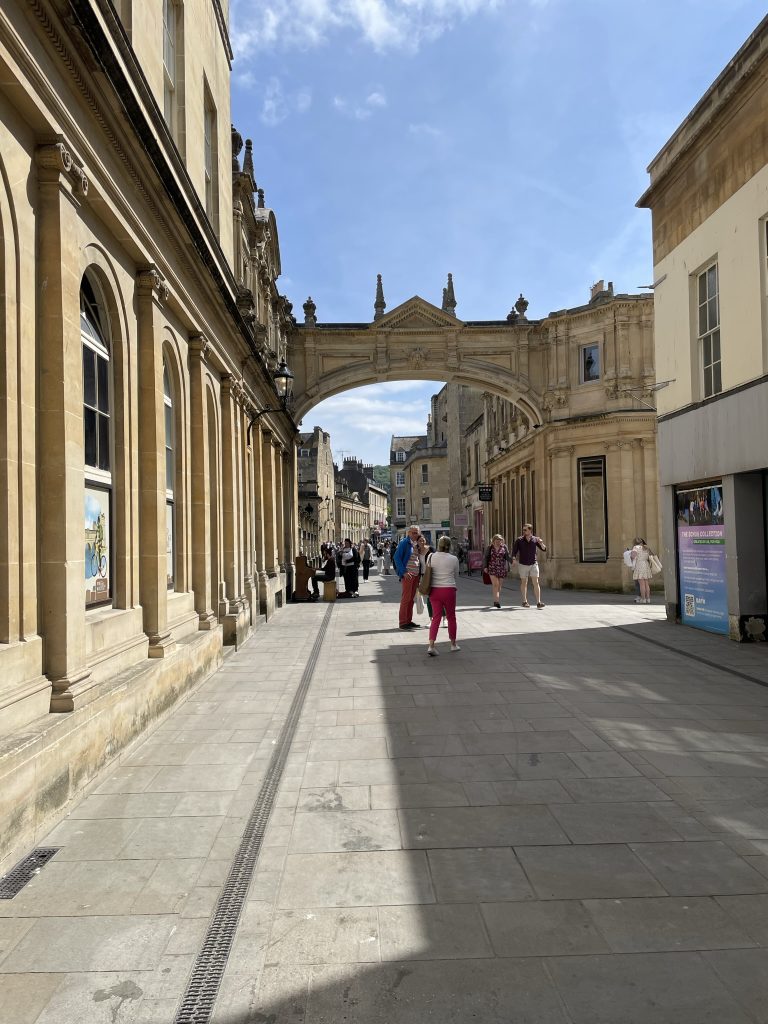
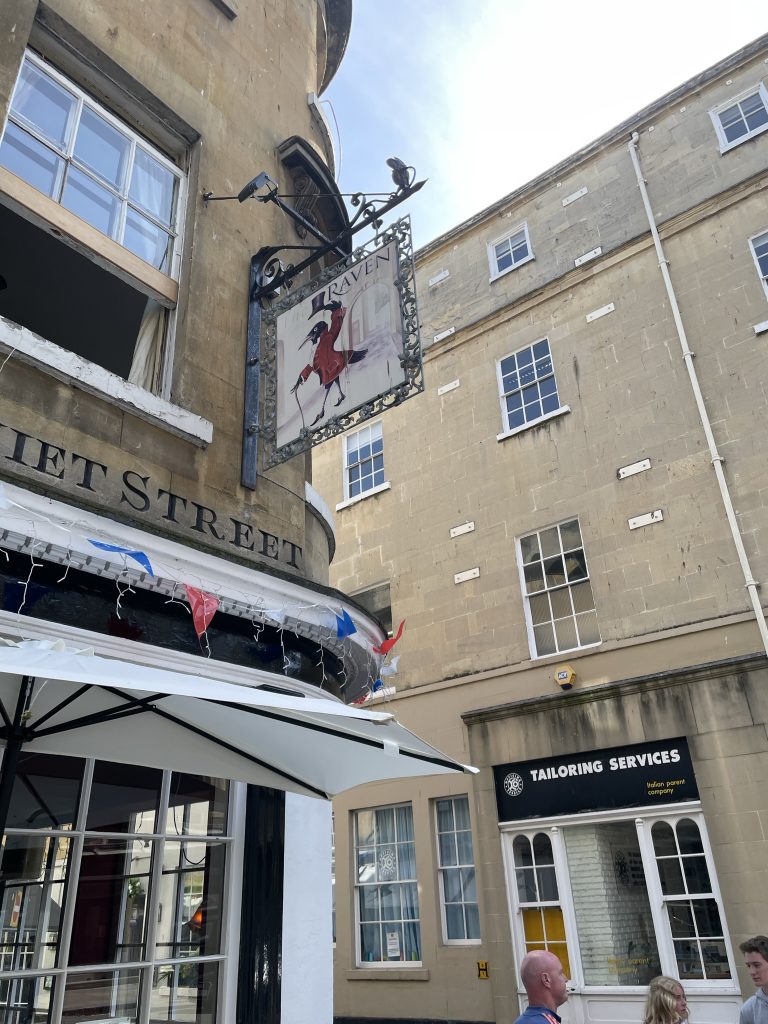
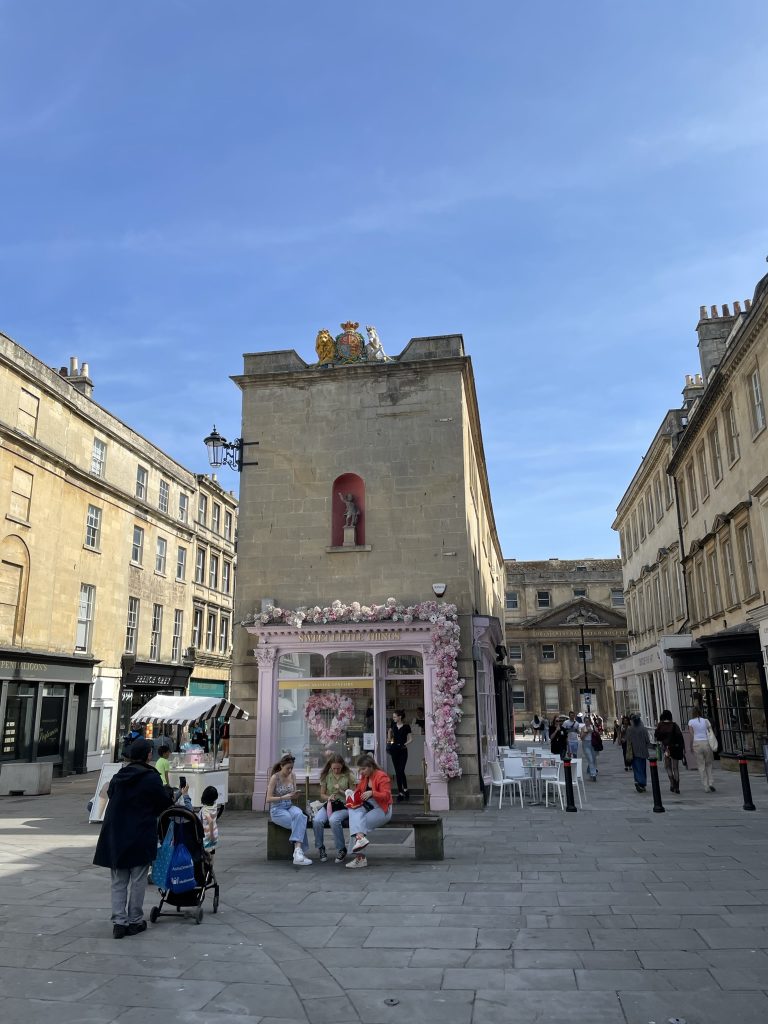
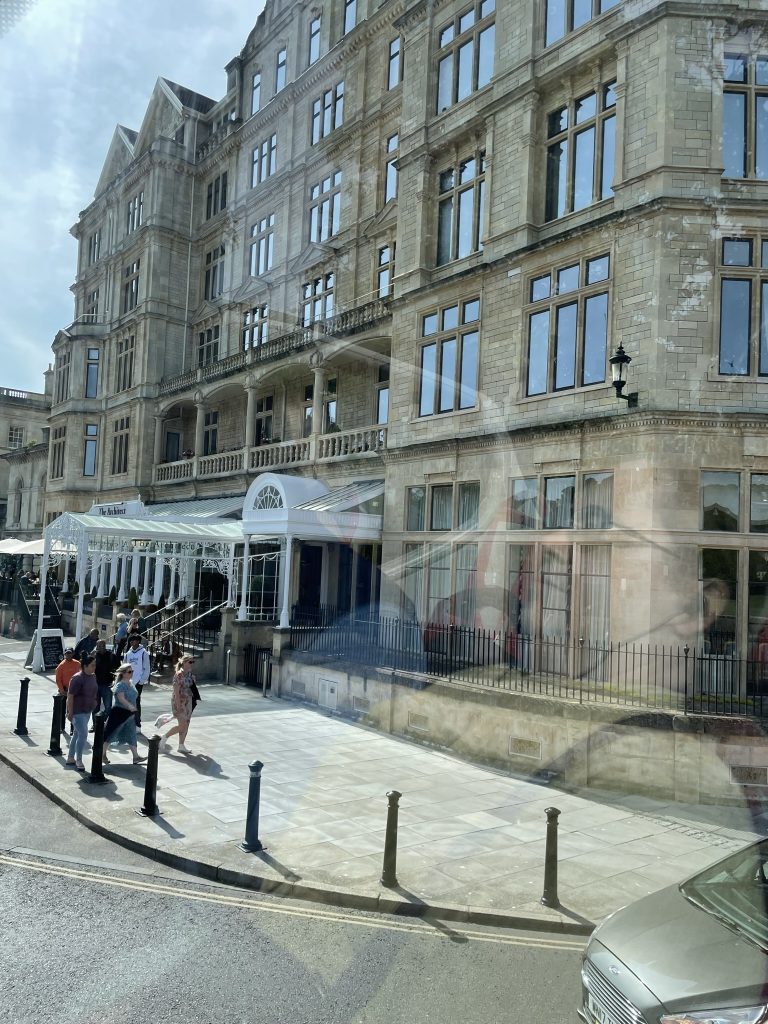
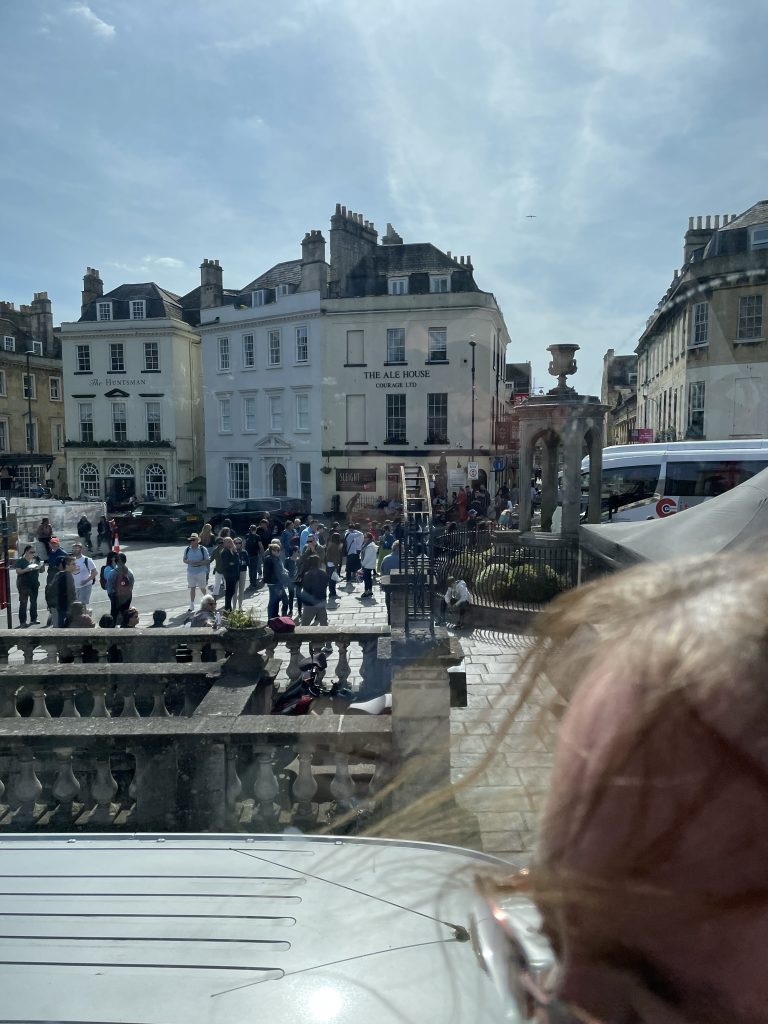
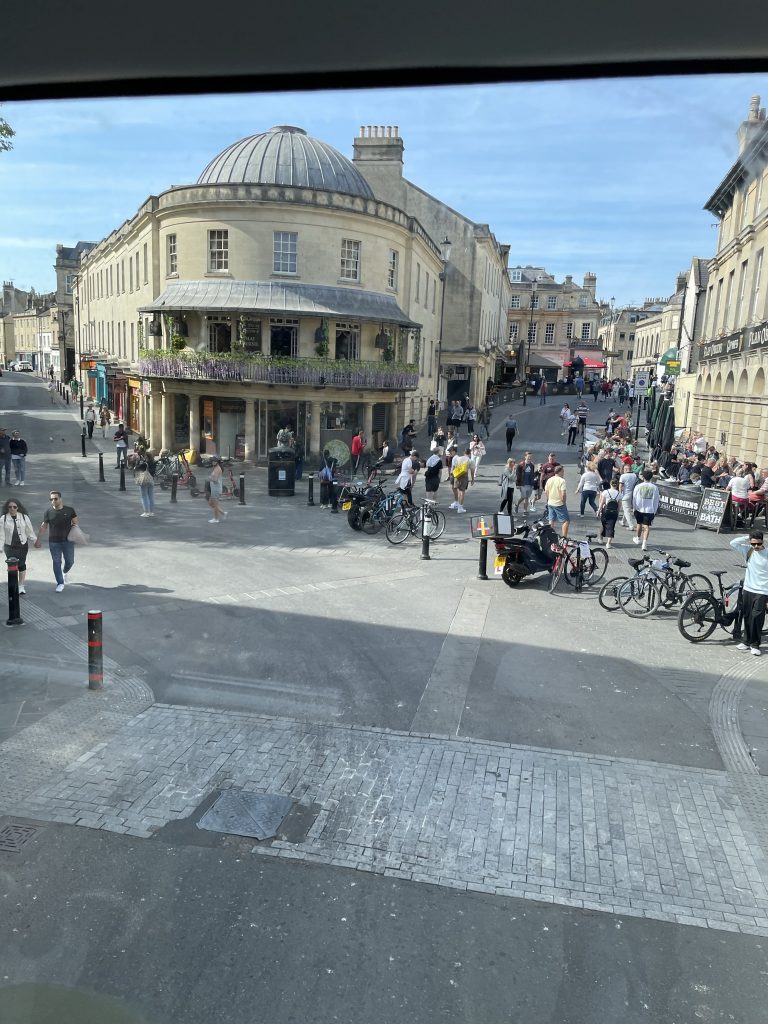
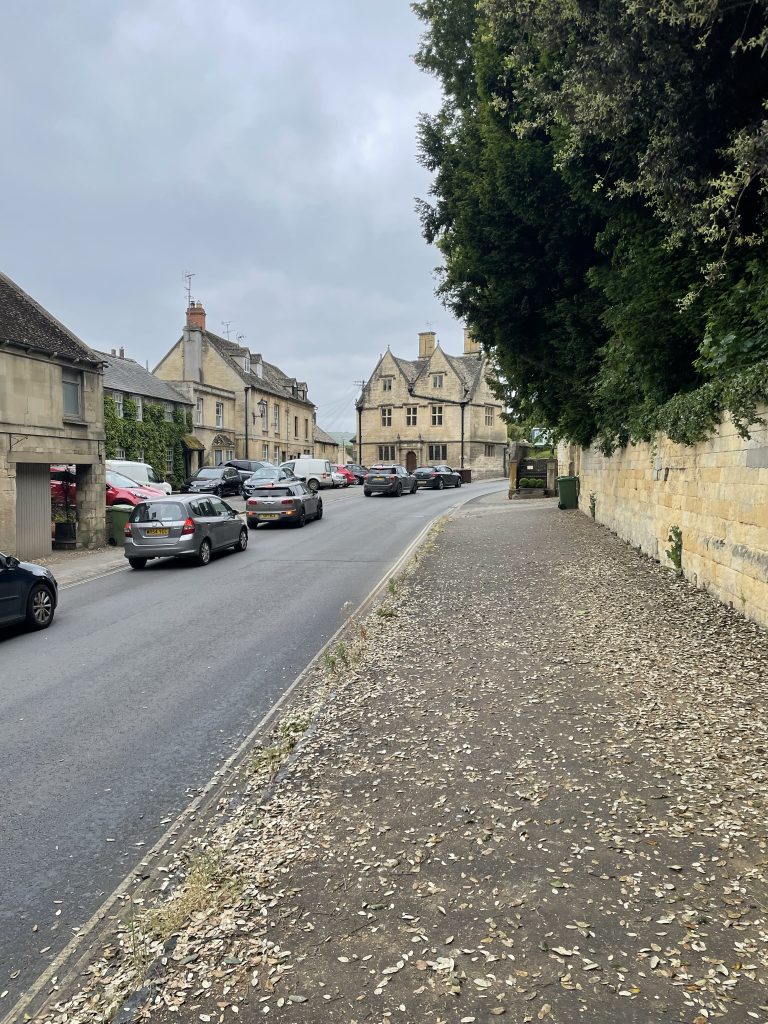
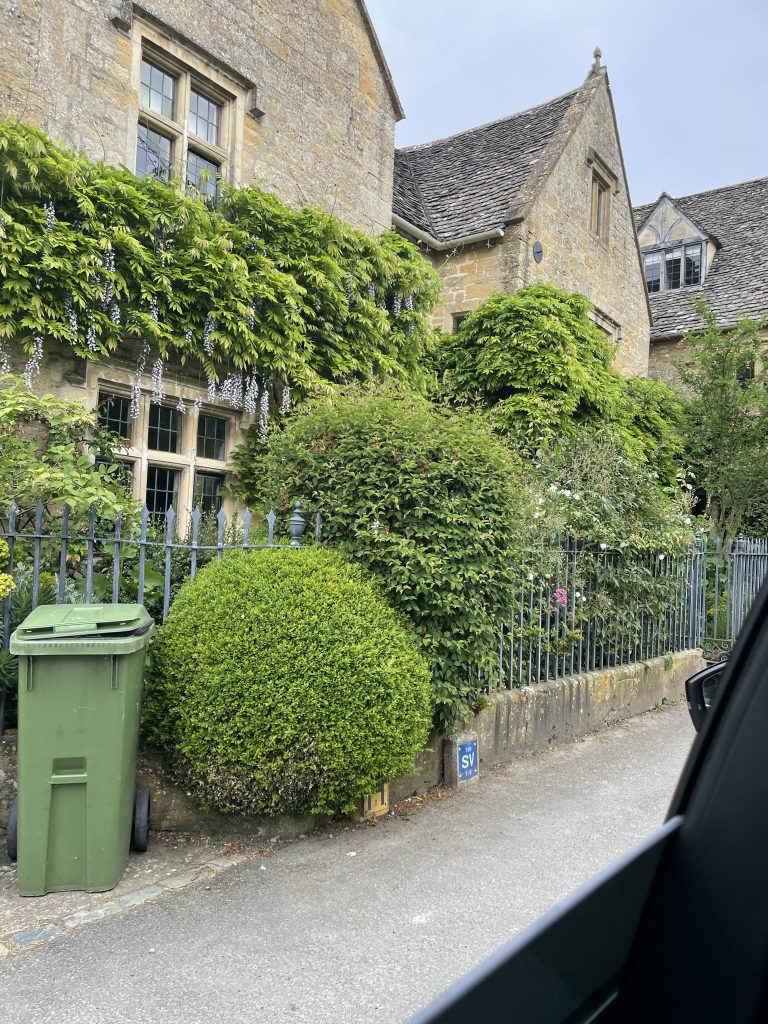
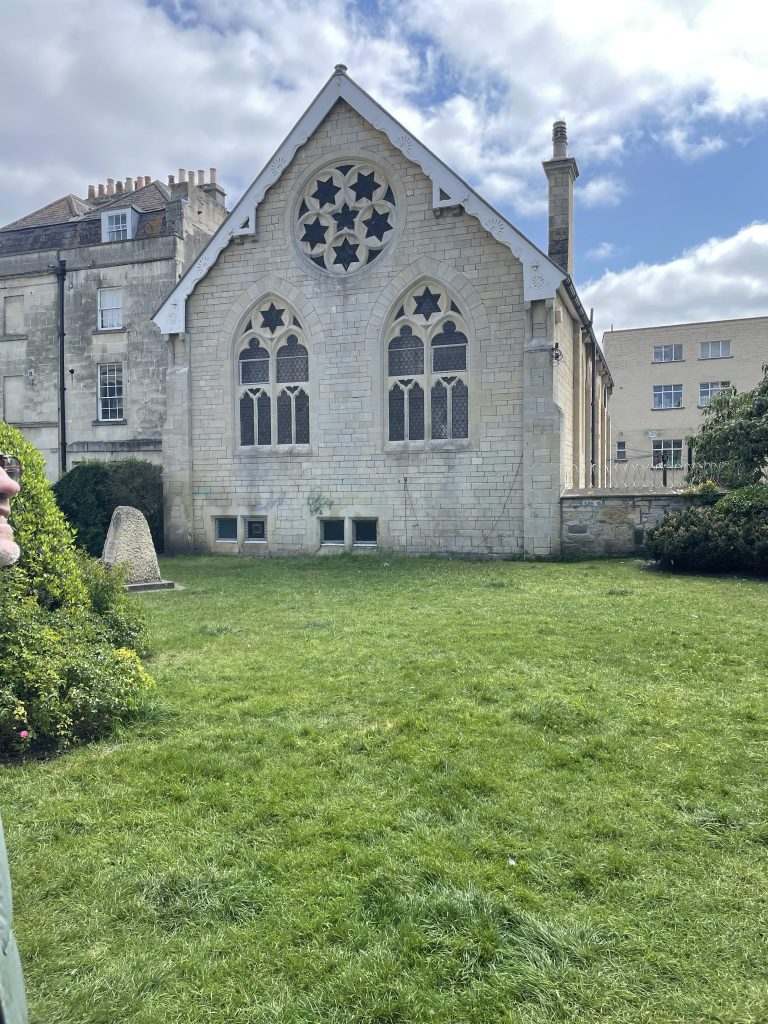
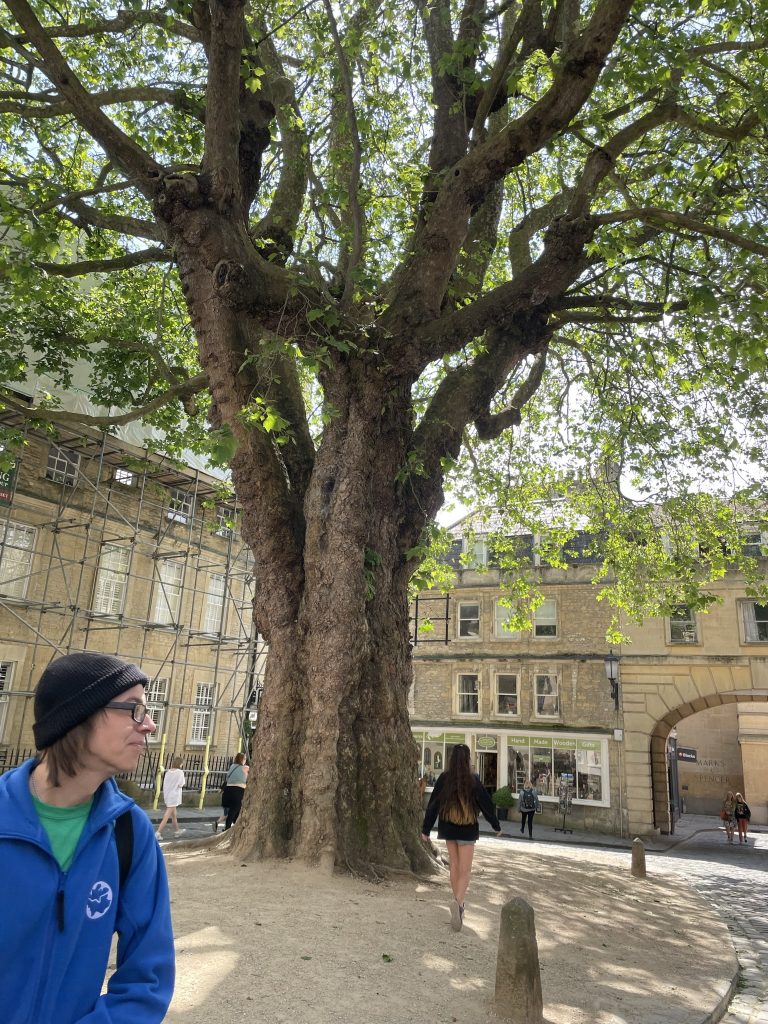
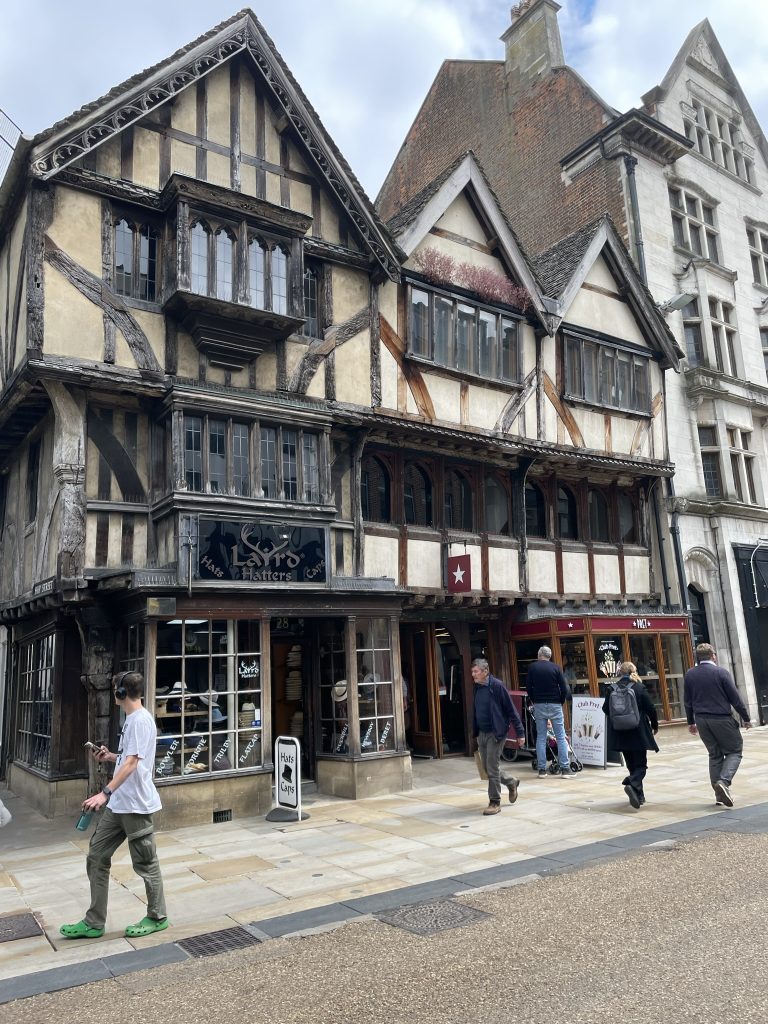
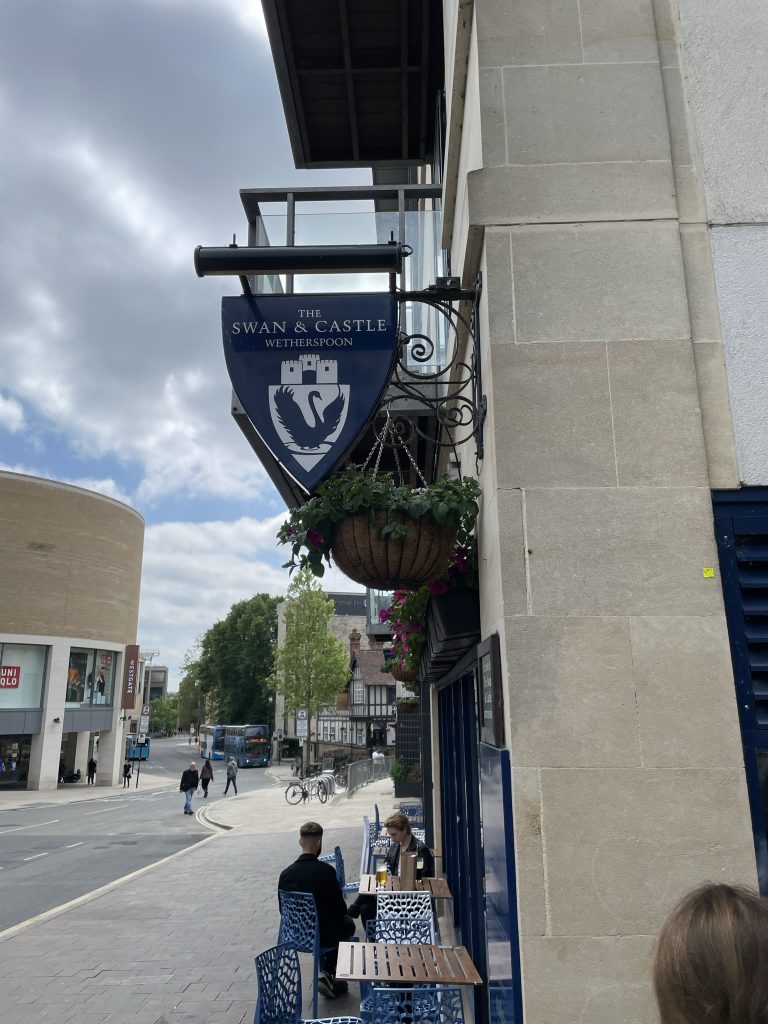
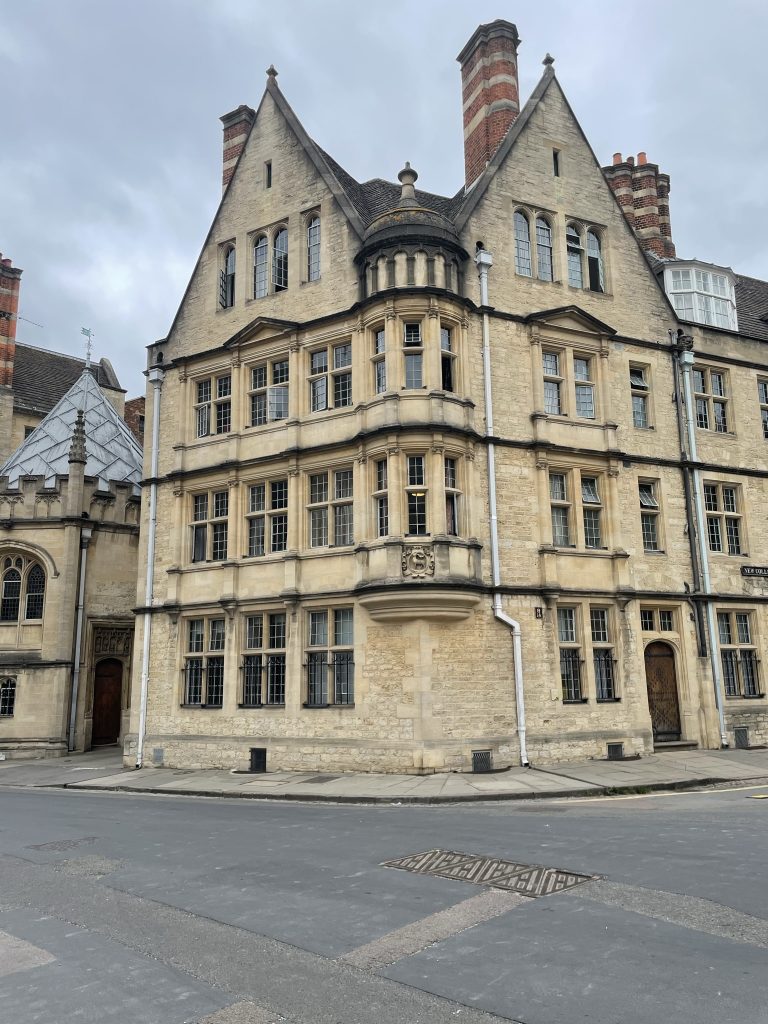
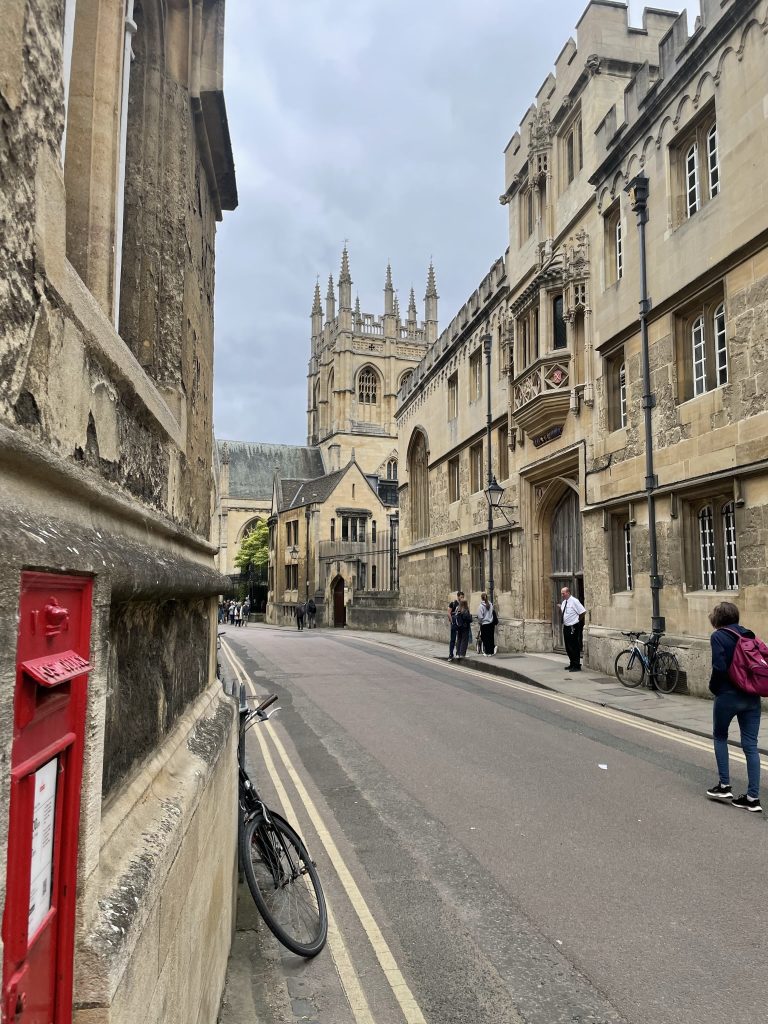
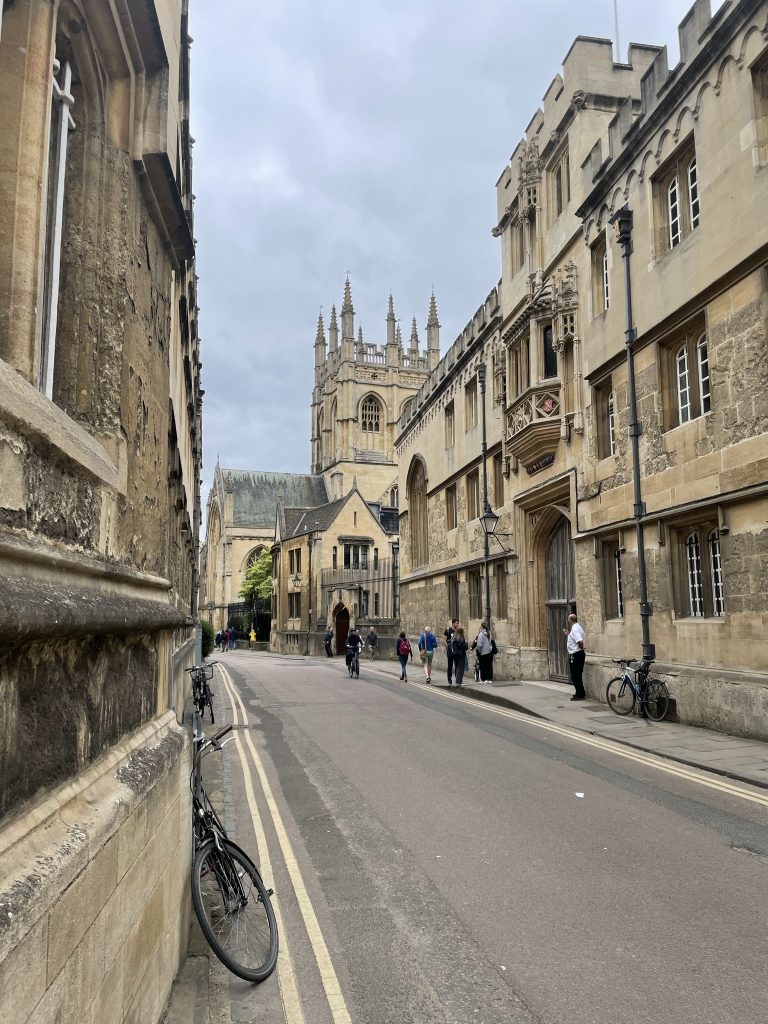
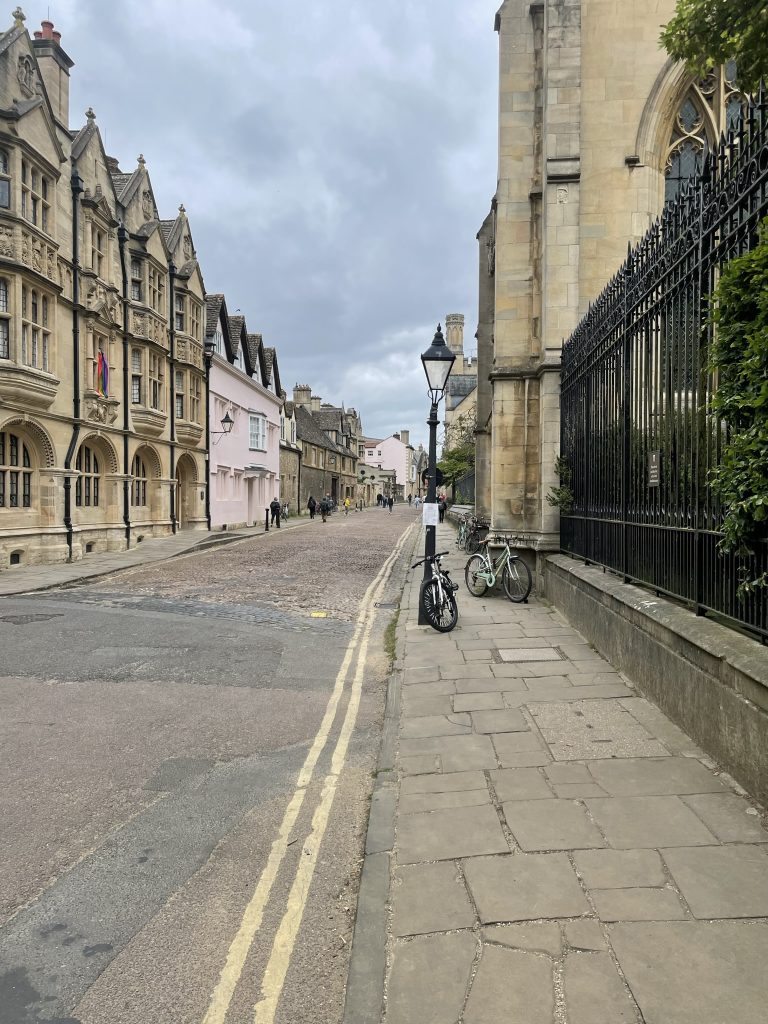
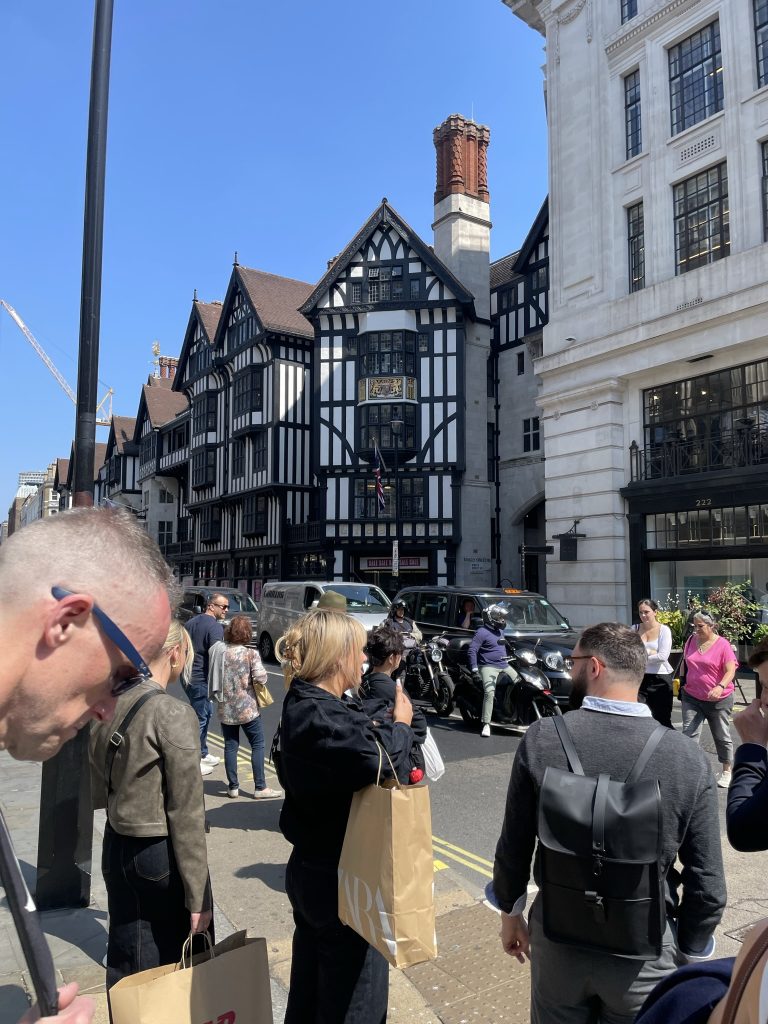
Also Oswyn note: while wandering the city, I was trying to decide where the Blue Swan would have been. I opted for the location of photo number 3, the corner of Cheap and High Street, right across from the Guild Hall!
We had lunch at the Black Fox, which we ran into while walking around. The Black Fox was recommended to us by friends who said it had good pub food and beer; and it did. Sean had a Cotswold (west-country) cider and I had a couple of local beers; unfortunately my notes just read as “good”. We ate fried halloumi sticks (good, non-melty cheese); fried calamari (not as good as Florence Arms or Robun); I had a fish finger sandwich with chips (quite good) and Sean had a chicken caesar salad, which he said was very decent and had an entire breast of chicken on it.
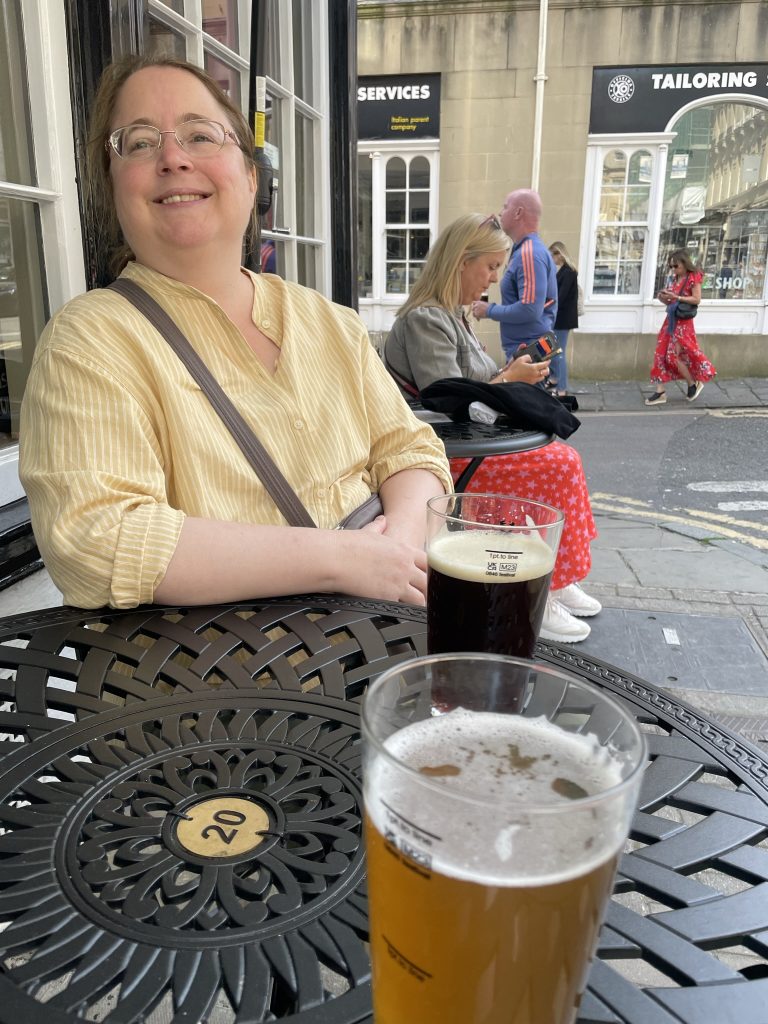
The staff at the Black Fox recommended a couple of other pubs to us– both of which were on the way back to our room. The Raven and Salamander. We didn’t eat at The Raven but it had a number of interesting savory pies on its menu and the beer was really superb. I had a porter and Sean had a golden pilsner. We ended our day by having supper at the Salamander– and ended up chatting with a few locals who gave us food and beer recommendations.
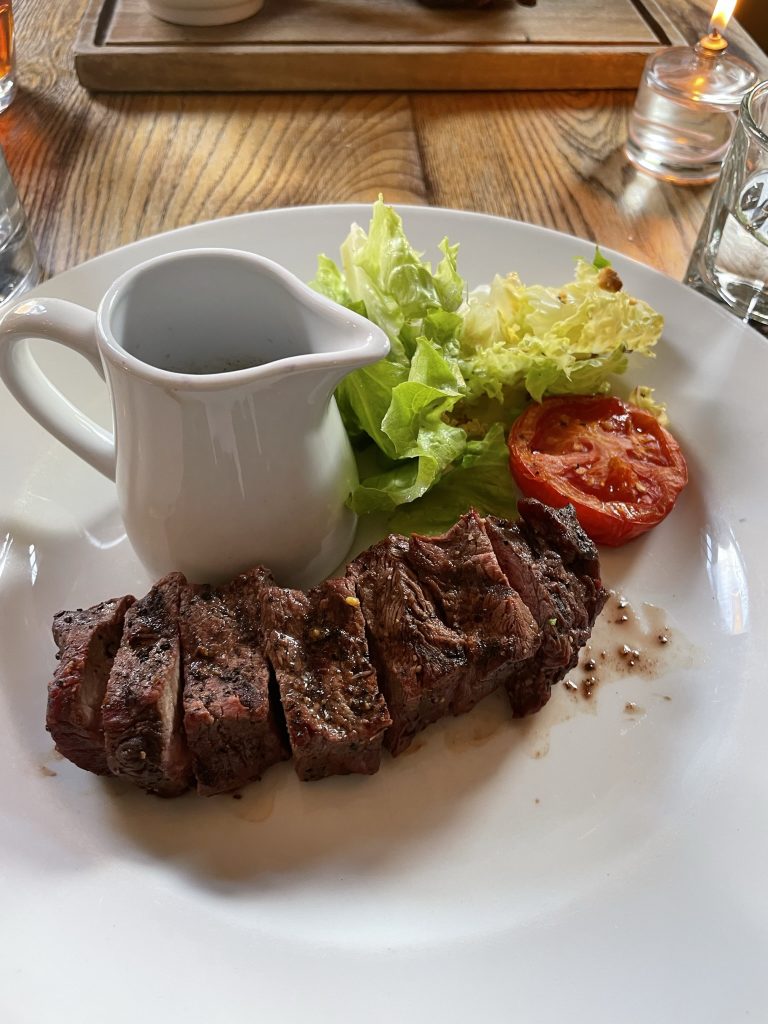
At the Salamander, I had portobello mushroom soup (which came out very late and which I could barely eat, but it was good); and hake fillet with a parmesan crust (i think pan-fried, lightly) crushed cranberry potatoes (this was actually new potatoes with a few scattered cranberries, unusual but good), romesco sauce, and haricot vert. Sean had the 6 oz bavette steak, which came with chips and a rocket-and-tomato salad (lightly dressed with vinegar and oil); he got a peppercorn sauce which was amazing. Dessert looked good too but we had had enough. For drinks, I had a Mild Mild West by St Austell brewery from Cornwell and Bath Ale’s Gem, both awesome. Sean had Orchard Thieves’ cider. All of this was under 75 usd.
We did a little shopping– at 1:40 pm we went to the Edinburgh Woolen Mill and I bought a sweater. Sean bought a hat, and we got scarves for ourselves and for a present. 135 pounds.
We took a Bath Discovery Bus tour which covered the in-town attractions, and it was good. We got a two-day pass and so were able to go on the more extensive bus tour the next day. At about 50 pounds for two, it was very much worth it for the hop-on hop-off convenience.
5-30
Our entry to Thermae Bath Spa was scheduled for 2:30 and we had a lot of things we wanted to do, so we moved pretty fast this morning. I had a crumpet and Sean had another bacon sandwich. Crumpets need accompaniment, so I was hungry again fairly quickly.
First, we went down to Mailboxes Etc to send the first of many parcels home. We sent the Mary Rose and Roman Bath souvenirs home as they were bulky, keeping only the prints and posters to carry in our luggage.
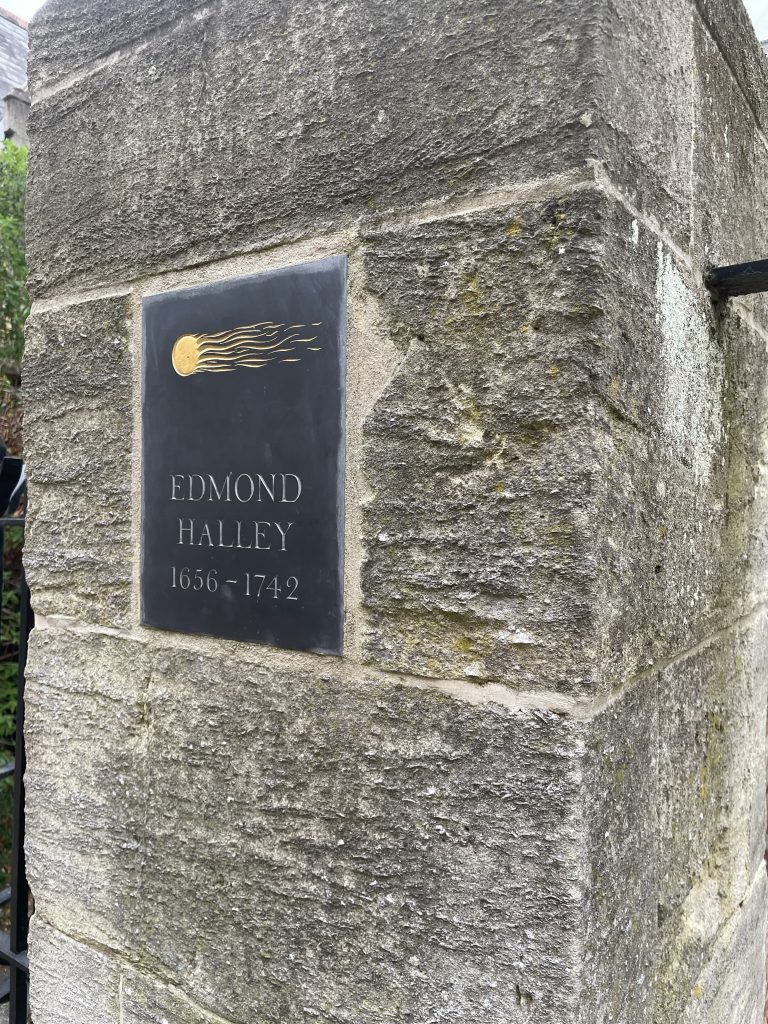
Next, we walked down to the Herschel museum, not far from where we were staying. This is a very nice little museum with a narrated movie or three, and lots of interesting displays relating to astronomy and music. The accomplishments of Herschel’s family members, especially his sister, were also lauded. Scientific accomplishments were the vogue of the day, and it was interesting to see how that interacted with high society. I forgot completely to buy some of the pamphlets available there, and regret it.
After that, we stopped in at the Jane Austen museum, which was crowded, but have a live (and costumed, poor man) docent who gave us a whole lecture about the time period and the writings; then we got to explore some period-decorated rooms in one of the houses she had lived in. The Regency-dressed ladies running the gift shop looked vastly more comfortable as they had only two light layers. I bought a few things in the gift shop.
We were ravenous but a bit worried about time, so we grabbed a quick pasty at one of the many Cornish bakeries and ate them on the square. This took about ten minutes as opposed to the hour or so lunch would have taken. Pasties plus water/soda was about 15 pounds, and the portions were mammoth. We could easily have split one, but ended up not finishing. The pasties themselves were loaded with vegetables. Mine was lamb mince with mint; it also had carrot, potato, and parsnip in it. Sean had a traditional beef pasty which had all of the root vegetables plus peas.
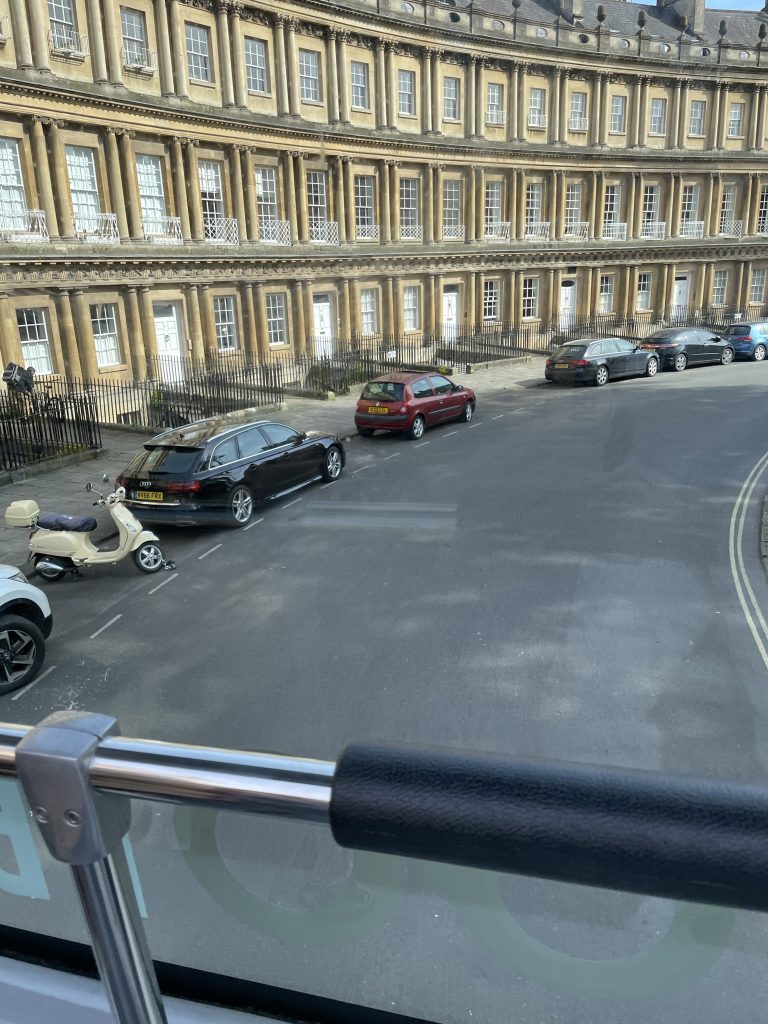
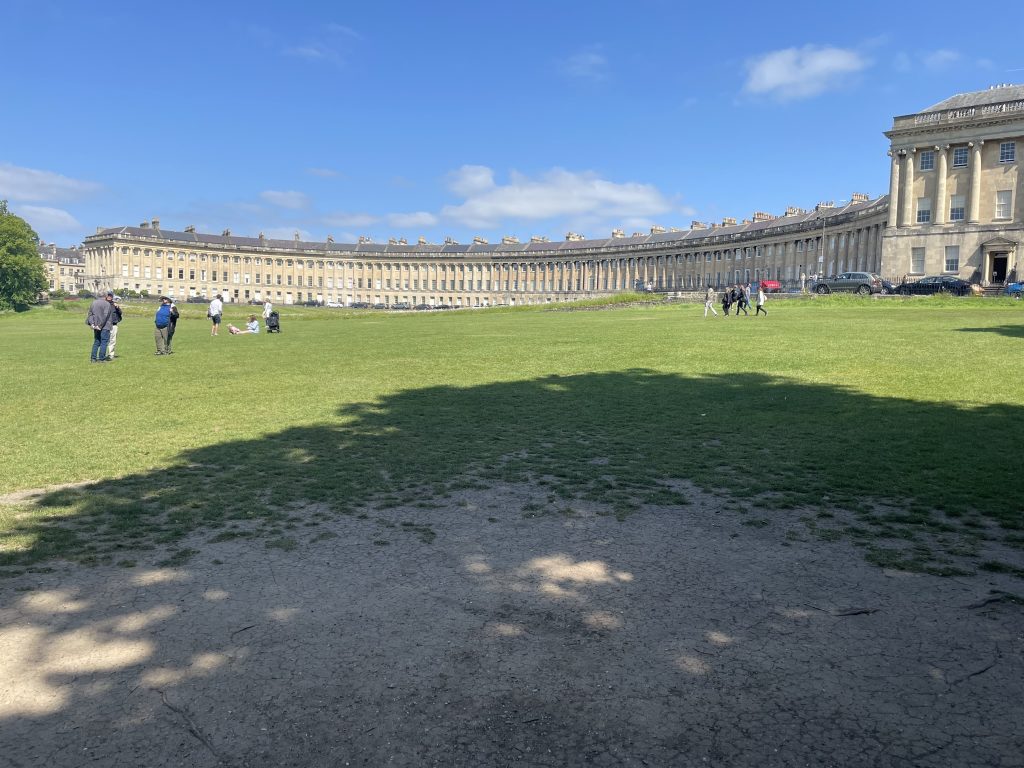
We then had a little time left so went to Number One Royal Crescent, a preserved Georgian townhouse– and there were video exhibits as well as a number of period-decorated rooms here, including both family rooms and servants’ quarters, so that was interesting. The family’s rooms were elegant and modern but the servants’ quarters looked medieval and rough. Each room had a video playing that was projected on the walls or surfaces– I had a hard time seeing these, but my phone picked them up in a couple of shots. It was a bright and sunny day, so that might have been the issue.
We did not go to the Assembly Rooms as the Costume Museum was moving and we were not sure whether they were closed too, but i feel like between the Austen museum and Number One that we got a good sense of the time period.
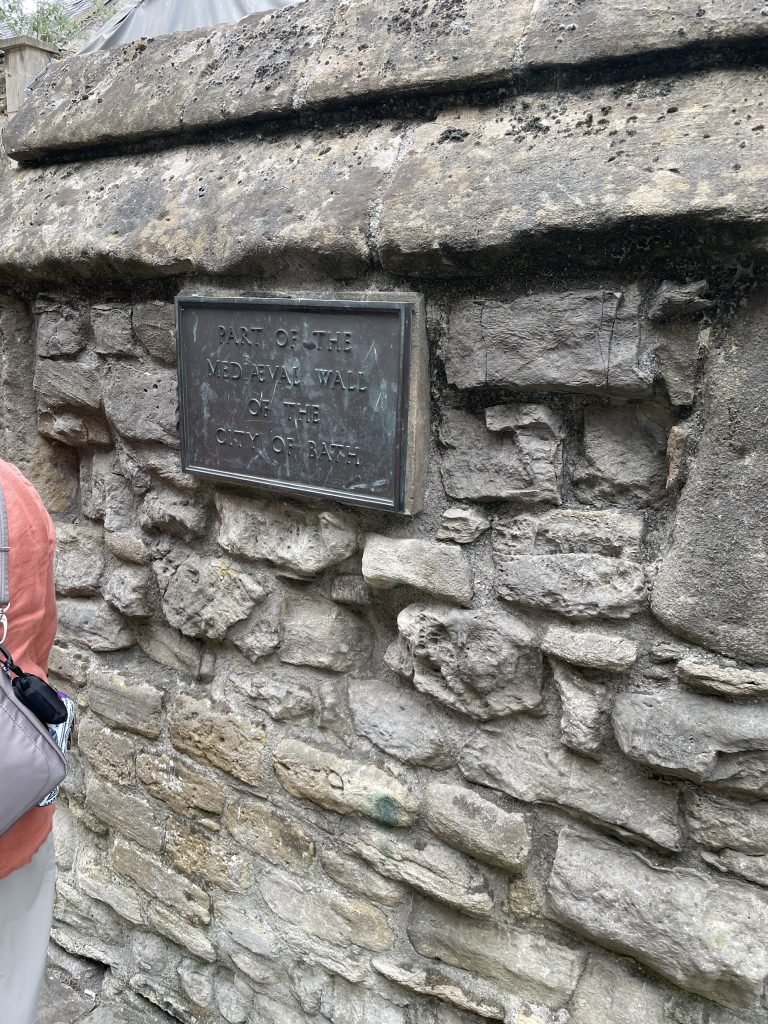
After Number One, we took our Skyline bus tour (as the tickets would expire in the afternoon), which was lengthy and worthwhile. You can see the old walls around Bath from a distance. That bus also drives by a number of other tourist attractions that’re worthwhile but we didn’t have time for, like the Victoria Gardens and the Holburne Museum.
It was now time for Thermae Bath Spa. We had booked a spa treatment; so we got admitted two hours prior to our treatment to enjoy the facilities of the spa. This would have been a relaxing experience had it not been about as crowded as the park district pool on the hottest day in August– it was crammed full of visitors. They also mandate bathing suits and I had chosen mine poorly– it retained water so was heavy and drippy.
First we climbed all of the stairs to get to the rooftop pool, which was warm– thankfully as there was a sharp breeze that day. We had really good views all around of Bath, especially because it was a clear sky. After that we went down to the treatment rooms– they say there are 29 but there are actually about six that’re accessible– the shower room (hot and cold versions, they’re just waterfall showers); the sauna room (ripping hot; very appreciated); two aromatic steam rooms (one lavender-and-herb, the other some kind of asian herbs); and an ice room, which has cool benches and walls and a trough of ice to assist in cooling down quickly after the sauna. There is also a smaller room with warm recliners and a starry movie/sounds but it only had six recliners and was never available due to the crowds.
We went for a quick drink/snack in the cafe, which was decidedly not worth it and somewhat messy– this was probably due to the extremely heavy usage that day.
In the basement is the actual waters of Bath pool, and I wish we had gone there first because we only had about 20 minutes in it. It’s warm– but not artificially warmed; it’s cooled very slightly from the temperature that it emerges from the rock at. It’s one of the three natural springs in Bath– it shares the main one at the Roman Bath; the other is the Cross Baths and has a window in it so that passerbys can look into it from the street (if it’s not being used)– and that’s rentable by groups,Kings’ Bath uses the third spring.
We had our spa treatment– a salt scrub followed by a massage. I should have thought better of this as I have very sensitive skin and the salt scrub gave me stinging abrasions on my legs. I did notify the staff, but there wasn’t a whole lot to do about it at that point. (I had thought about changing it to a facial but I was sunburned, so that didn’t seem wise either.) The staff was very pleasant and did everything they could to make it a good experience. In retrospect, if it’s possible to do the treatment and then use the facilities, that’s preferable. Hanging around in a wet bathing suit wasn’t much fun, and the treatment areas were much cooler than the other portions of the spa. It is definitely possible to visit the spa and not get a treatment; and it is about 40 pounds for two hours.
After our treatment, we thankfully were allowed to wear just our robes back to the changing area. The spa has bathing-suit driers, which are pretty cool, and much appreciated. I had brought wet bags for the suits, but it was nice to be able to simply take them back to the room without having to worry about hanging them to dry.
We asked about laundry; and the Bath House staff told us that they could do our laundry for 10 pounds per load; we got them started immediately.
The temperature dropped abruptly in the evening. It was about 7 pm and we were scouting for restaurants as we were a bit late to pull our usual midwestern trick of eating dinner so early that all tables were empty. We were wandering by a place we’d had to walk by on previous nights because it was so full, but this time we just happened to ask if there was room. There was. There was one table left, right now– at the outside edge of their outdoor room, not-coincidentally right in the path of that cold wind.
We then watched about six other couples get turned away due to lack of room at this place and heard later that it was a five-star restaurant and much in demand– we had just got lucky and chanced upon someone’s cancellation.
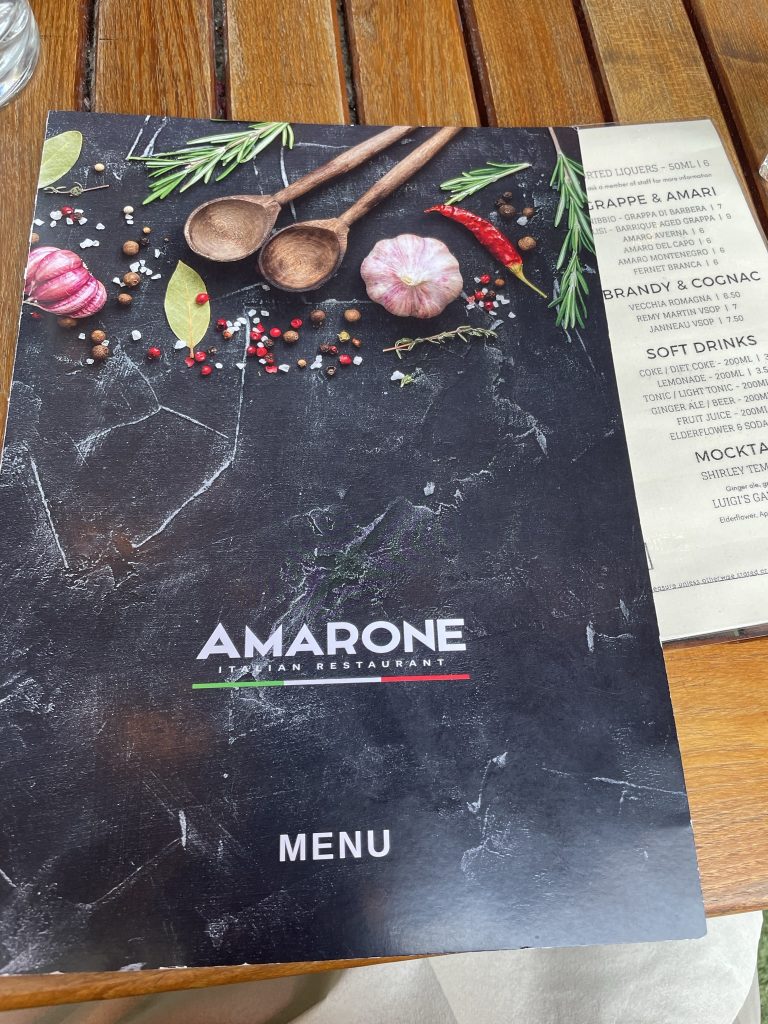
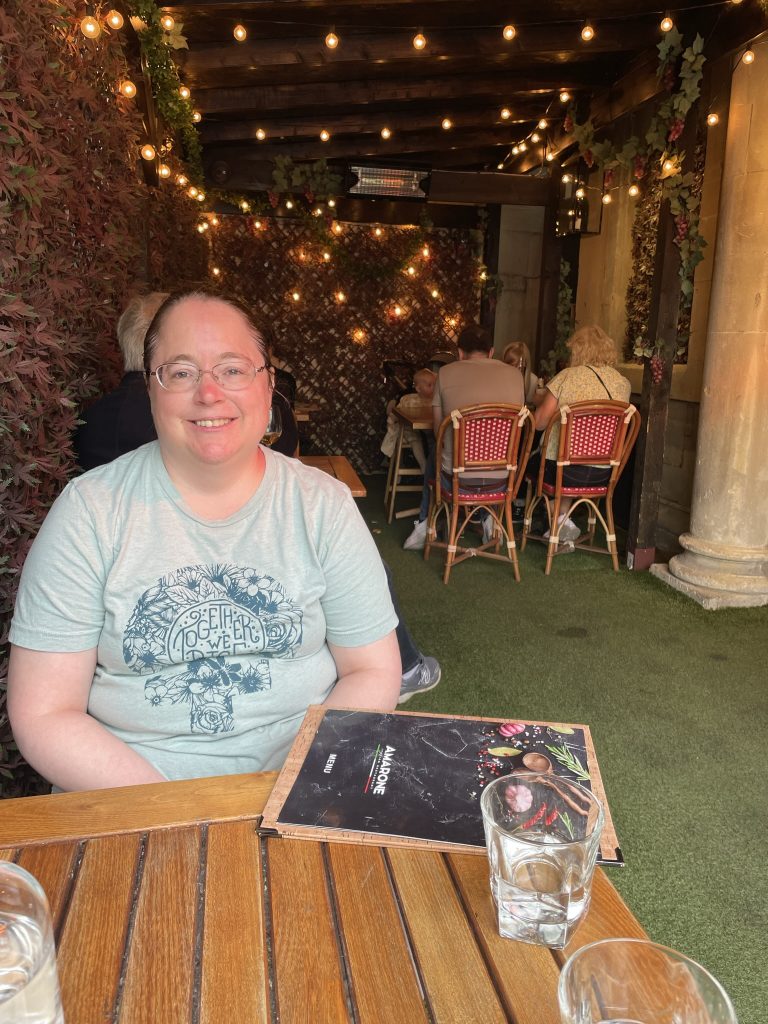
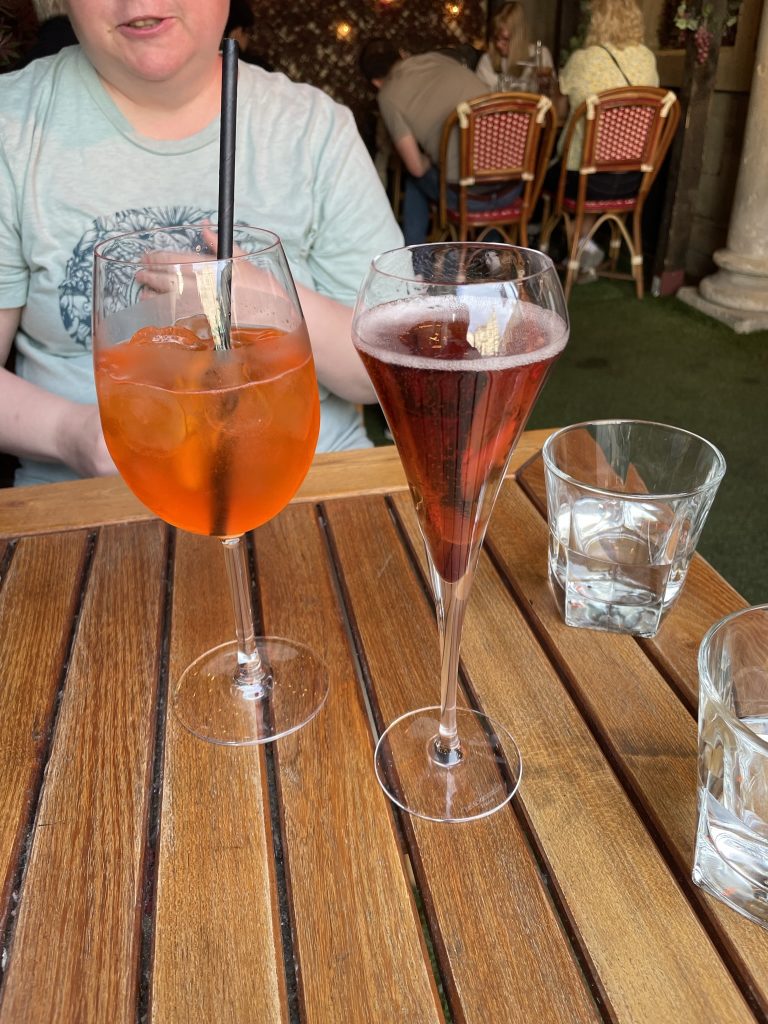
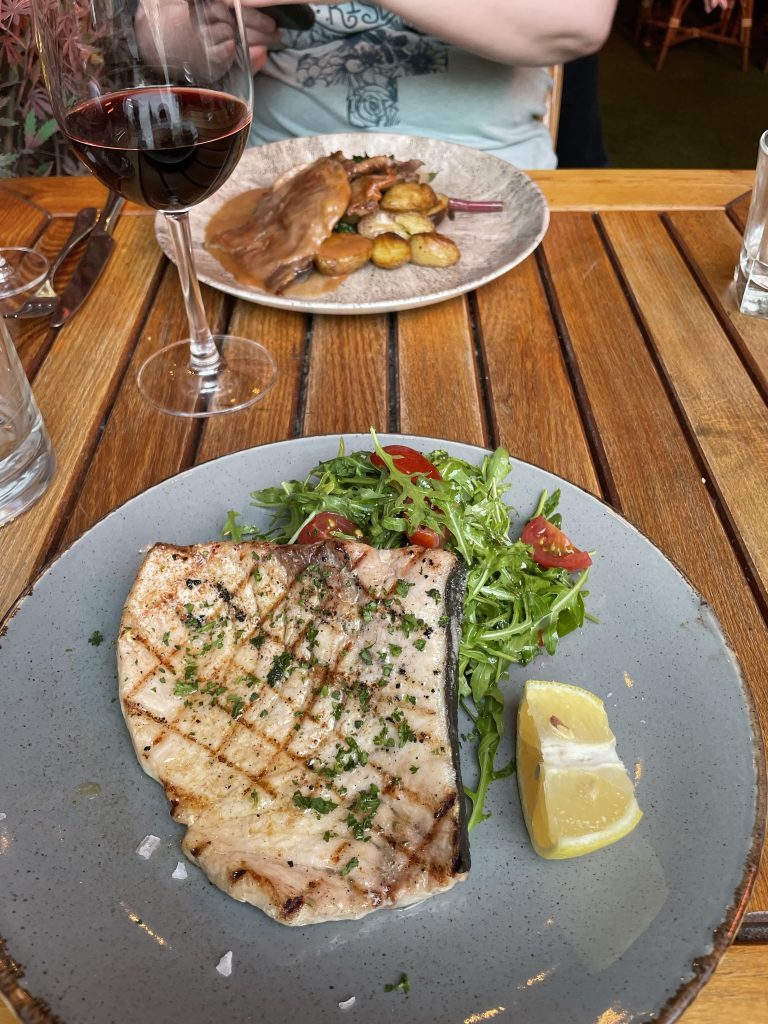
The restaurant was Amarone. We started with kir royale (him) and Aperol spritz (me) to go with our fritto misto, which was a special. I had a Amarone della Valpolicella, which is a light Italian red to go with my saltimbocca alla romana (baby beef cutlets, parma ham, sage in brown butter sauce); roast potatoes and greens. Sean asked our waiter (who we think was the owner) what to drink with his swordfish pesce spada grigliato, which came with a rocket-and-tomato salad; the owner suggested a white wine from his own stock– I believe this was some kind of Trebbiano but neither of us recalls.
5-31
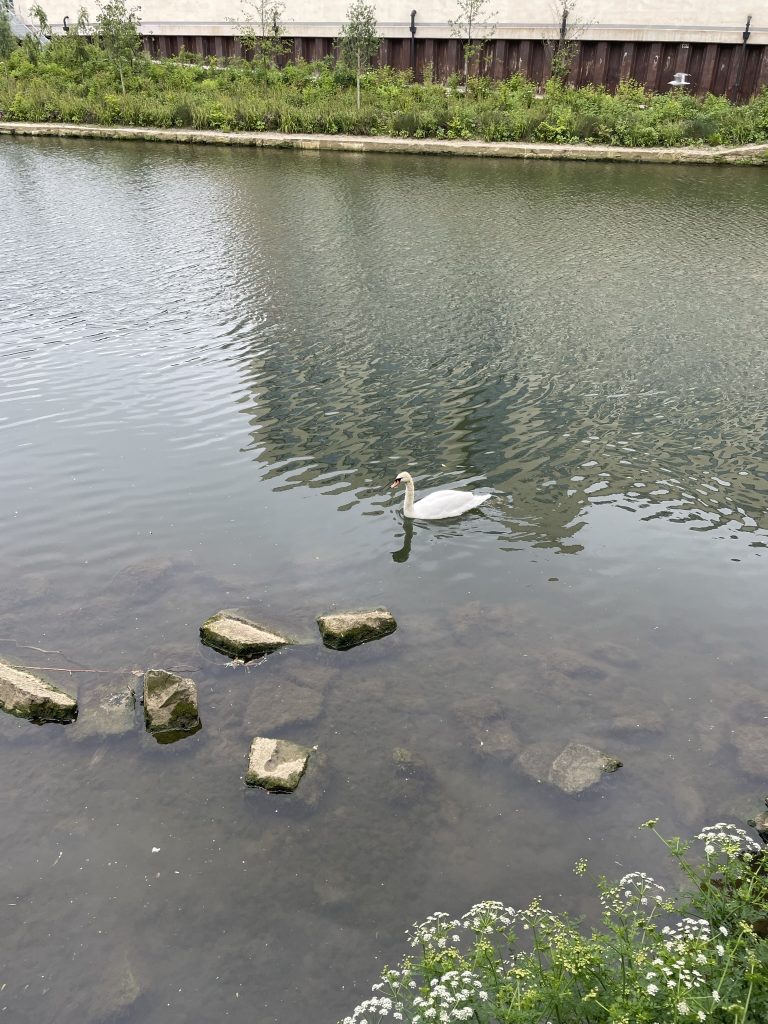
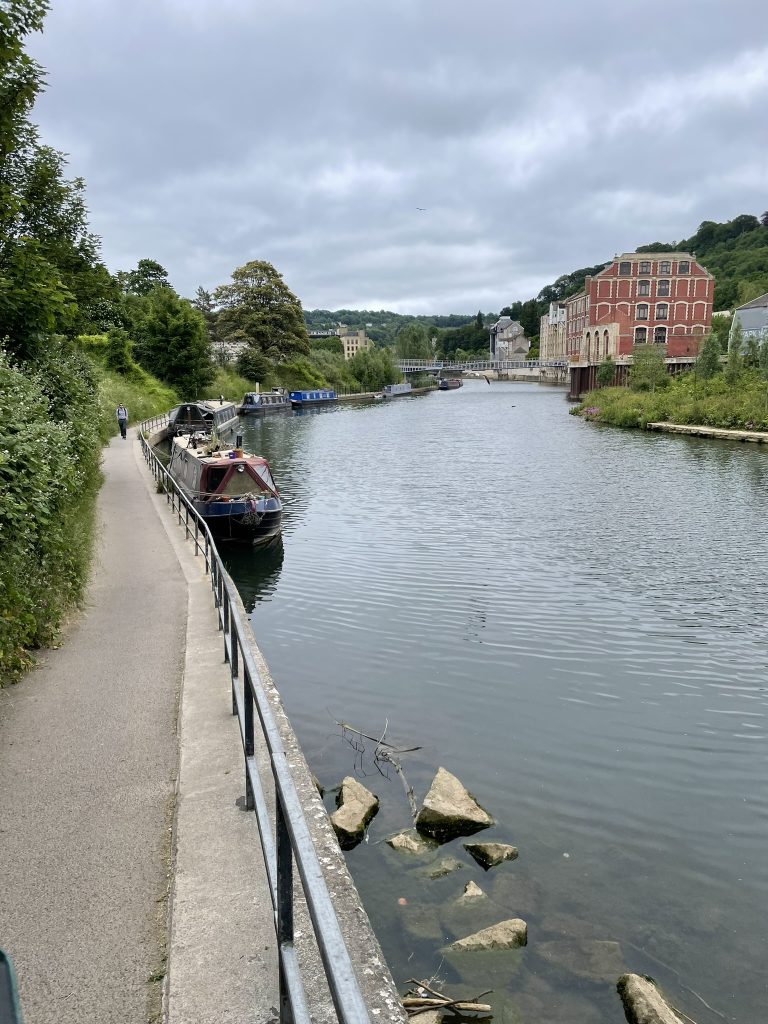
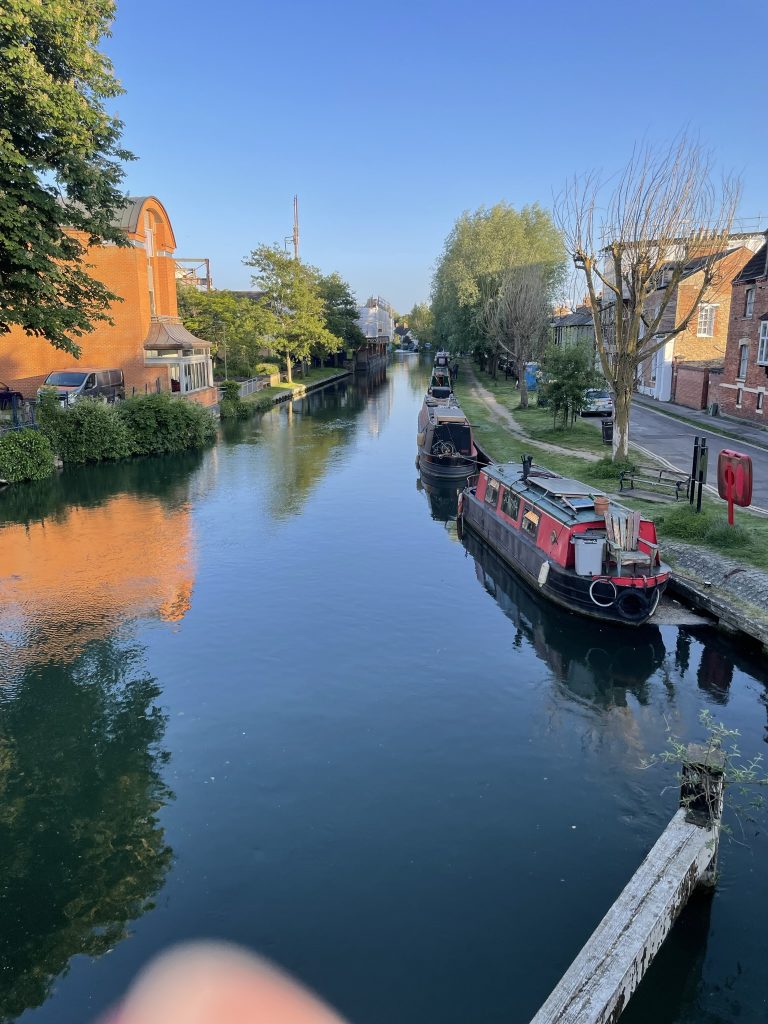
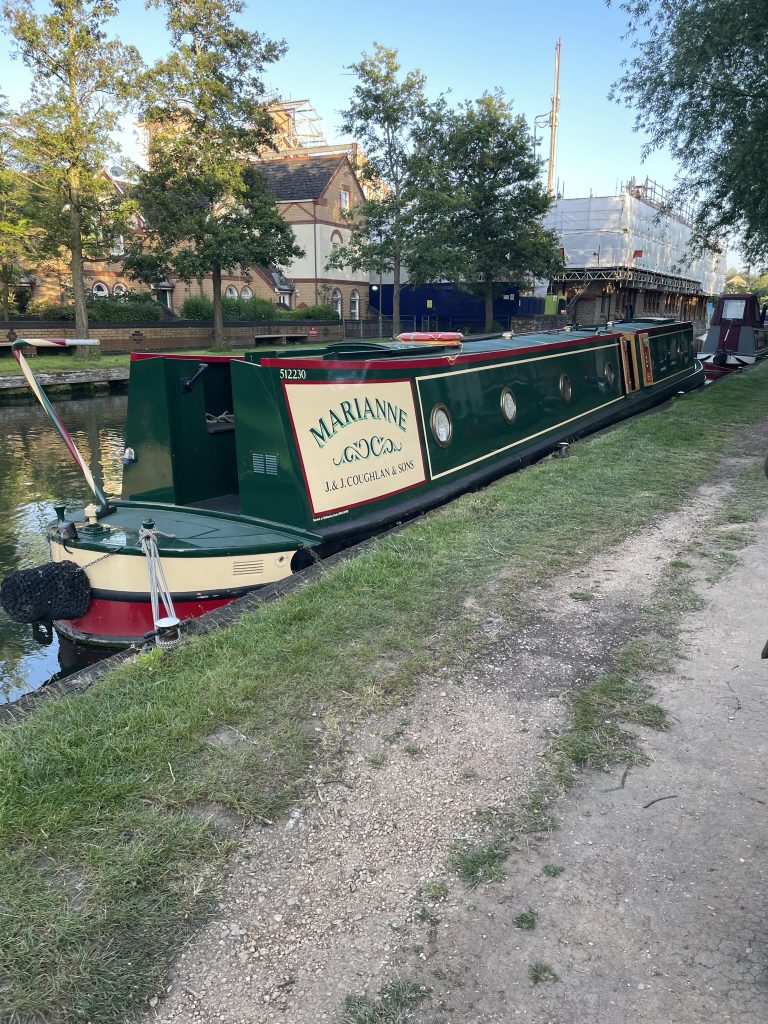
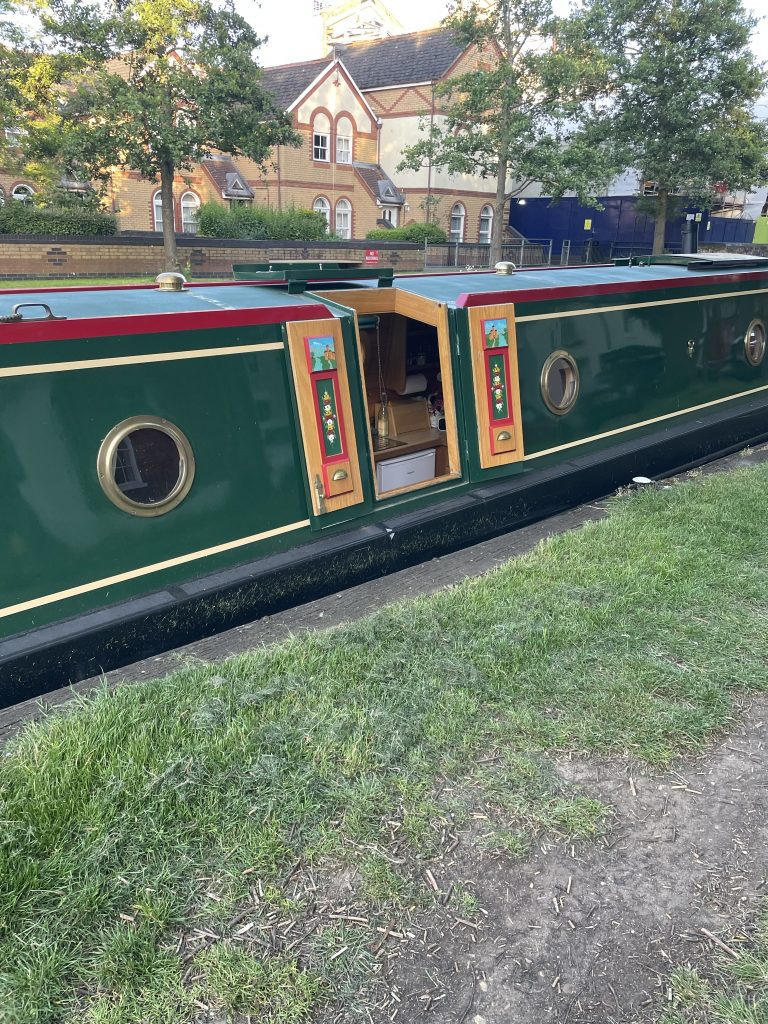
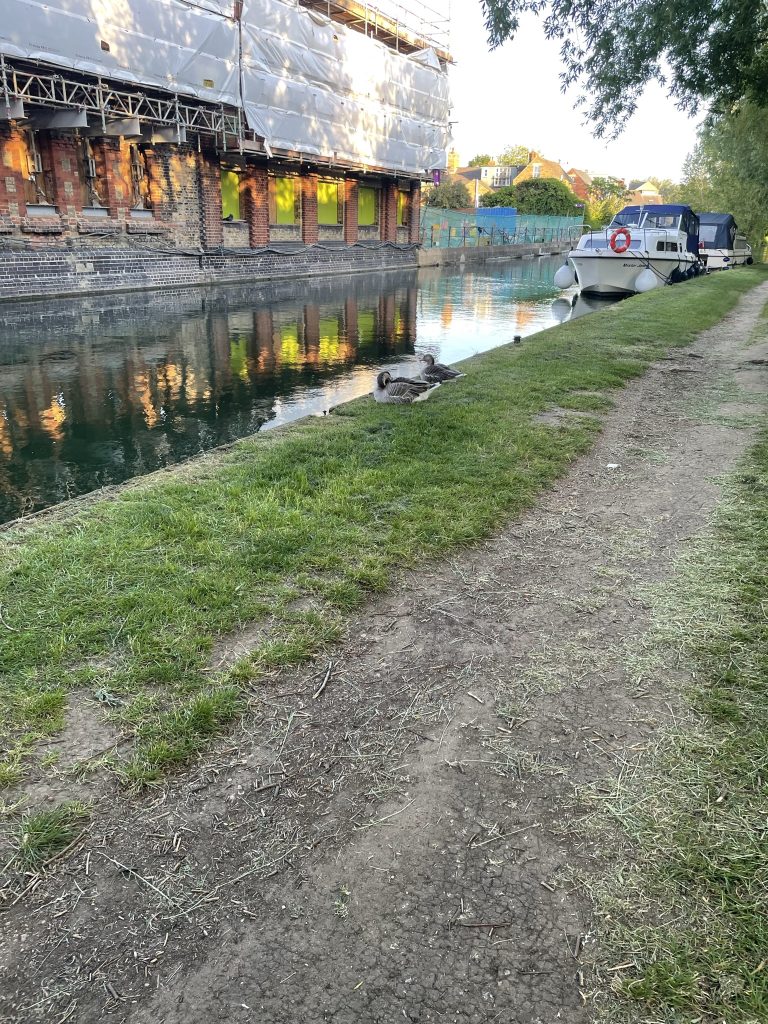
We had scheduled this day for the Savoring Bath food tour, so had a very light breakfast– mainly just tea– and headed out. By now I had purchased a fold-out map and noticed that there was a walkway along the canal just a few blocks from our room– and it led all the way down to the train station. As we knew we had to take an early train the next day to the Cotswolds, we decided to walk down the canal path to see if it was an easy route to the train. And it was! I wish we had found it earlier because it was an easy walk with no traffic and few passersby; much more serene compared to the streets of Bath in the morning; and there were narrowboats moored along the banks. We saw ducks and geese and swans, and the morning was lovely and misty and cool.
We did a bit of window shopping waiting for our tour guide, and found a vegetarian Indian restaurant that looked interesting.
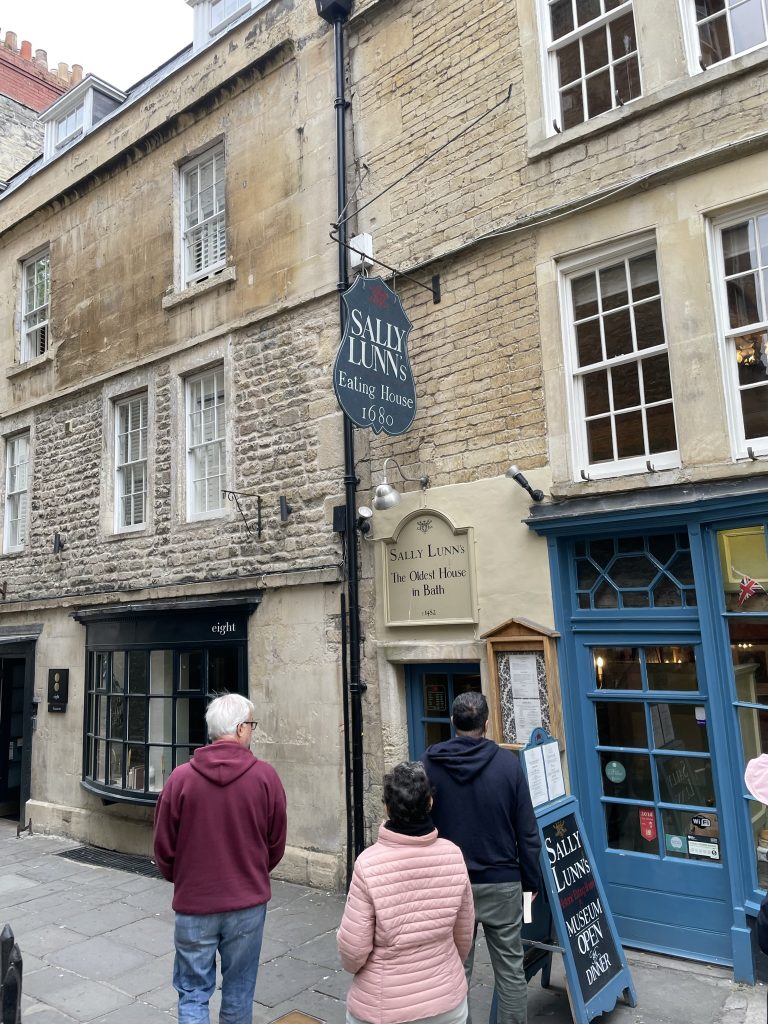
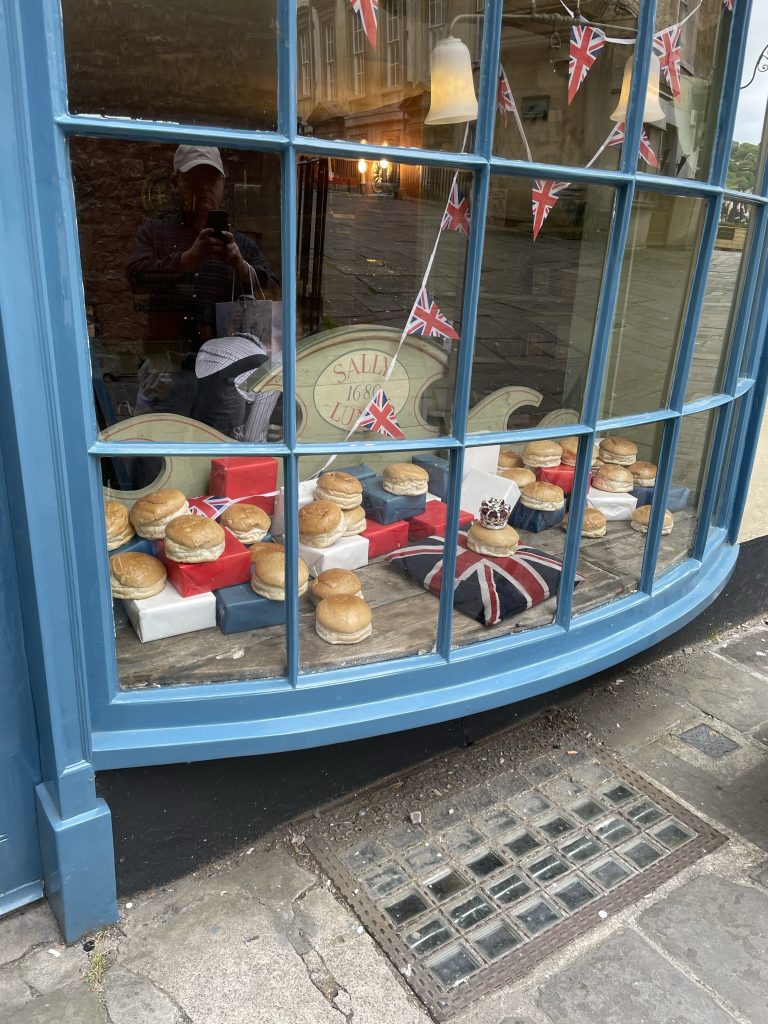
Our guide met us near the Rebecca fountain close to Bath Abbey; and we set out. Our first stop was to the Sally Lunn eating-house and museum and we got to hear the famous stories of the Hugenot lady who allegedly opened a bakeshop. We got to go inside and order a bun (I got tea because by now we were freezing); and it came toasted with butter and jam. It was not especially compelling– it was some sort of brioche, baked kind of like a large hamburger bun. We were given two kinds of flavored butter, which we ended up giving to our hosts at the Bath House, as it had a very short use-by date and we weren’t sure how it would travel.
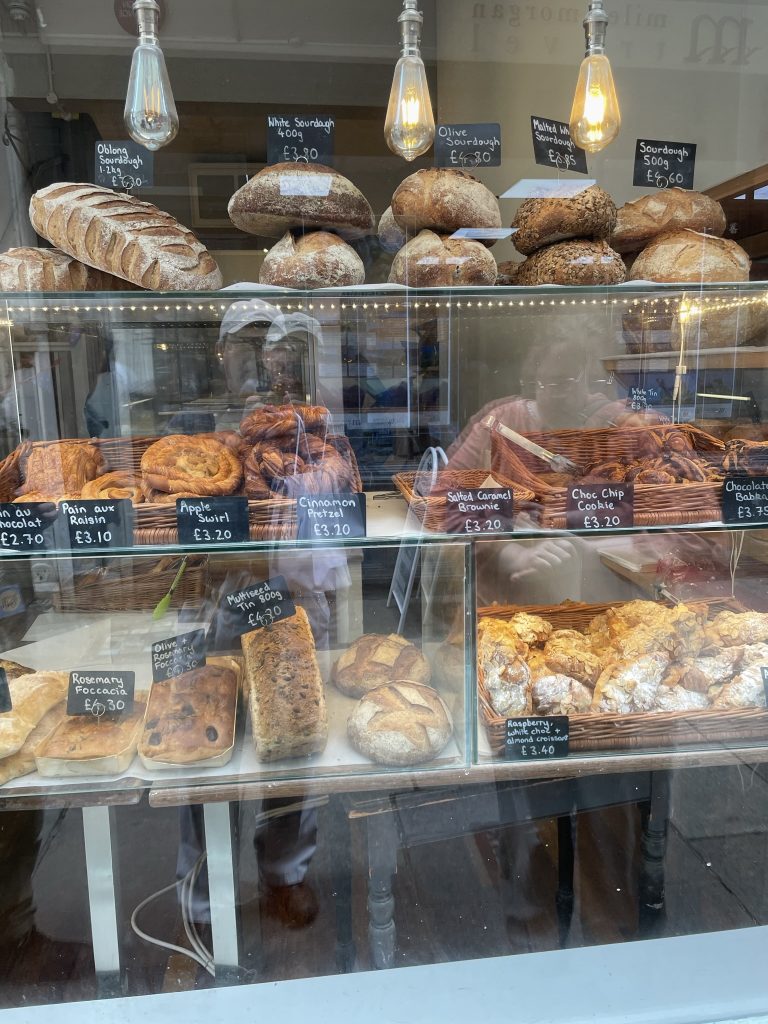
We stopped by a French baker, who told us about his wares and gave us a big loaf of cumin-and-garlic cheese bread. We should have got pastries, because his were amazing. Sadly we got American-style cookies instead of pastries, which i guess would’ve been more interesting to the locals.
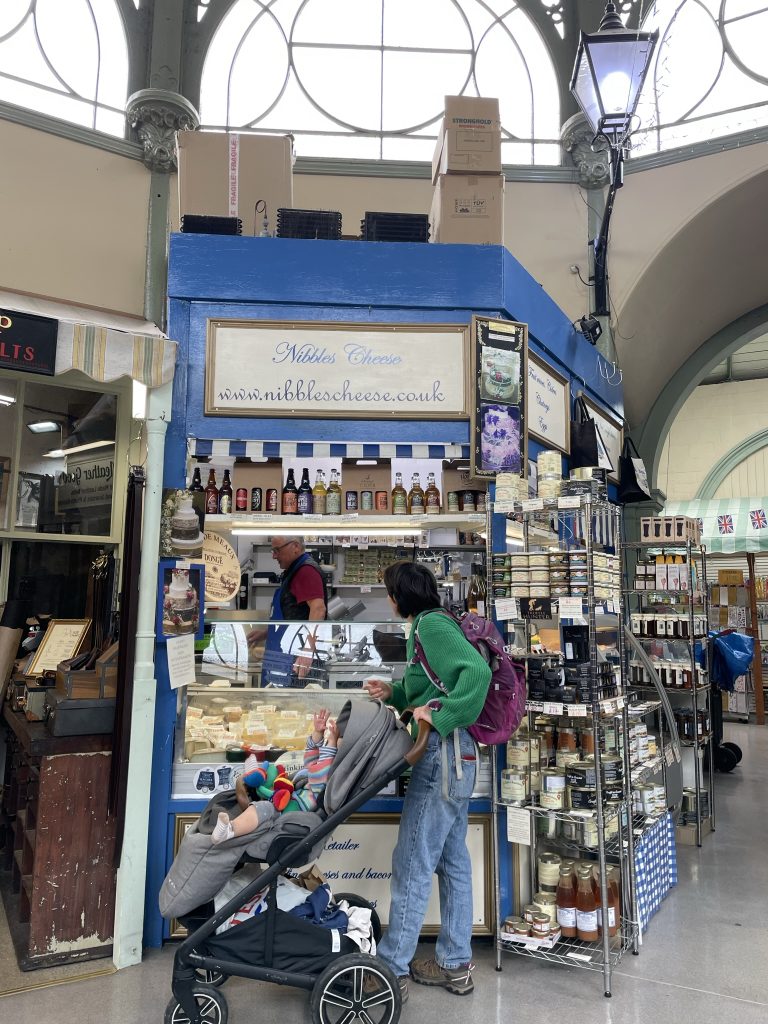
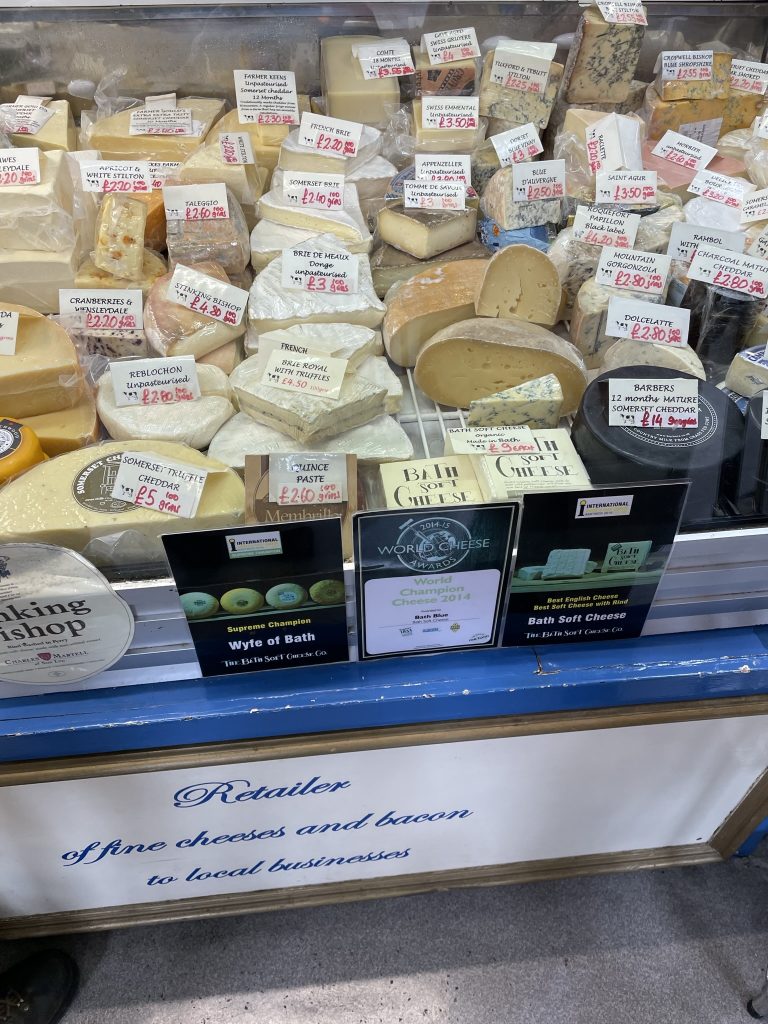
We went to an indoor market, which was amazing. We stopped by a cheesemonger (A Breton!) (Nibbles cheese) who had us sample various of his wares and gave us a couple of chunks of cheese to take with us– a Wife of Bath (mead bathed cheddar) and a Somerset Brie.
There was a deli counter next to the cheese counter– Our guide’s mum was running the deli counter, so we said hello. She had an interesting variety of scotch eggs for sale as well as many other quick bites. She gave us a couple of chutney jars.
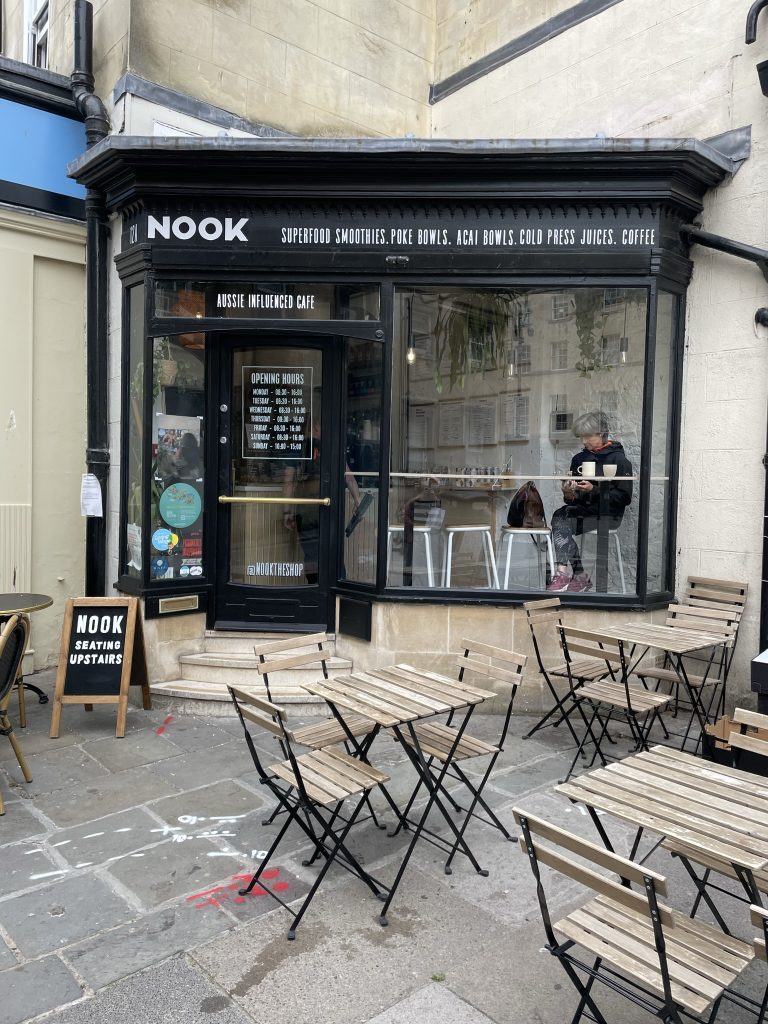
We stopped at a place called Nook, which normally sells poke during the day. As it was morning, we got a breakfast bowl– some kind of grain softened with almond milk with fruit.
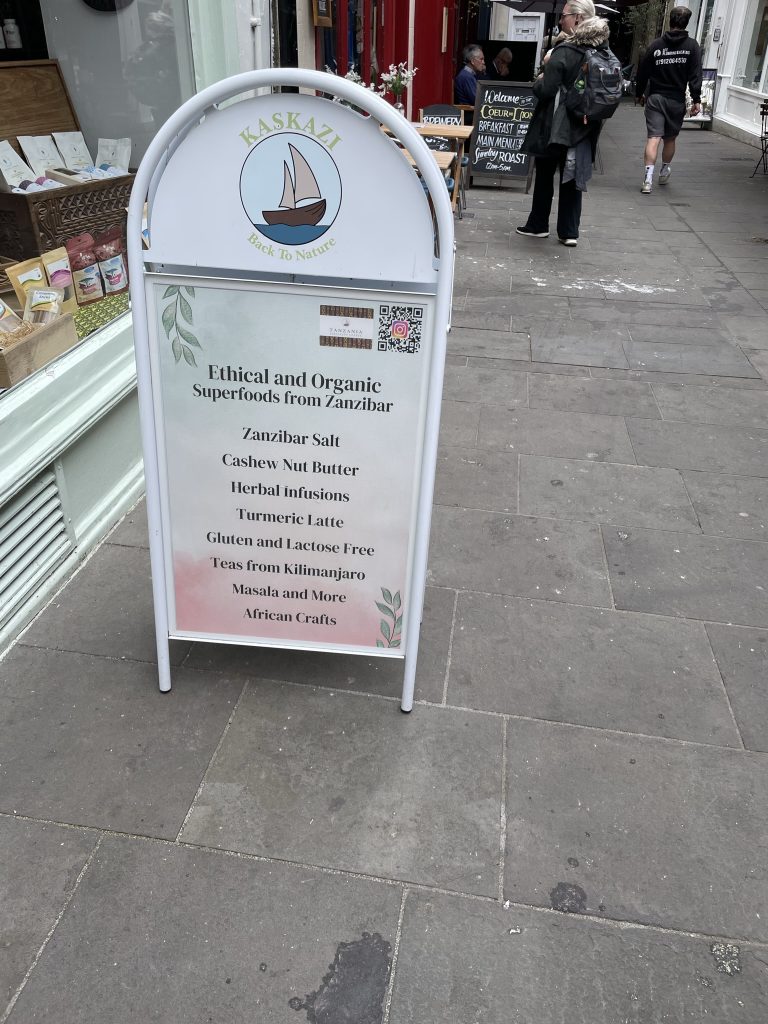
An African lady from Zanzibar showed us her stock– teas and coffees and other products humanely produced in Africa. She gave us cashews and dried dragonfruit, as well as a couple of small packets of tea. We bought some teas from her as well.
We went to a premier coffee place that had an expert in mixing coffees; his coffee was clear-tasting and excellent. And Gertie blew the coffee guy away by actually know what she likes, unlike most coffee drinkers.
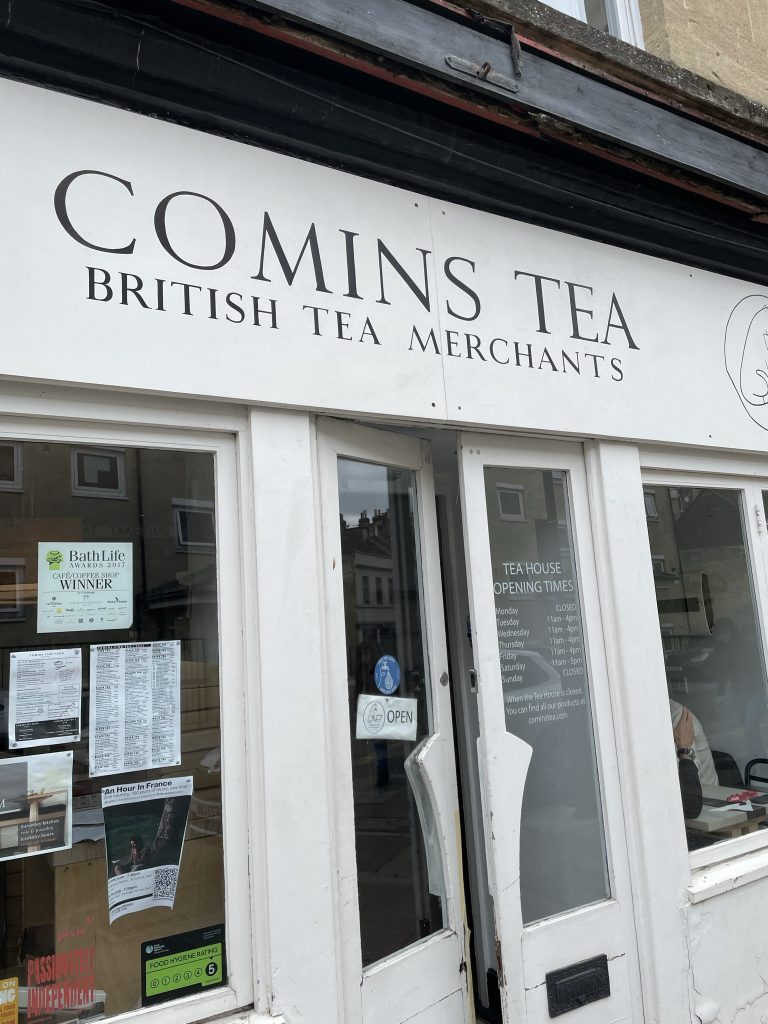
The last stop was a tea tasting, where the tea master showed us various single-origin teas and talked at length about brewing length and other factors in making a good cup. We didn’t get to try all the teas, but we did sample the white tea and one of the green teas, the gunpowder. We forgot to buy tea here, unfortunately.
After the tour was over we stopped back at the central market– located inside of an old stone medieval market structure, associated with the abbey– and visited the leatherworker and had belts made (I had noticed him cutting strips off full hides as we toured the cheese shop earlier, and figured he would have a good product.) 330 pm, 85 pounds.
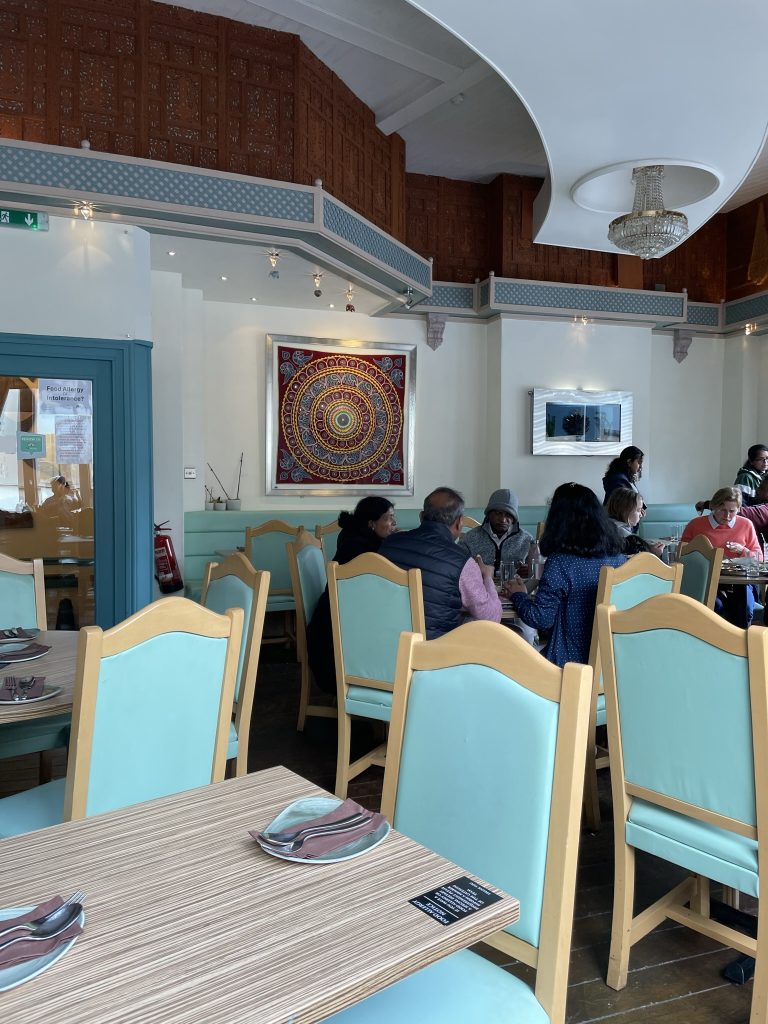
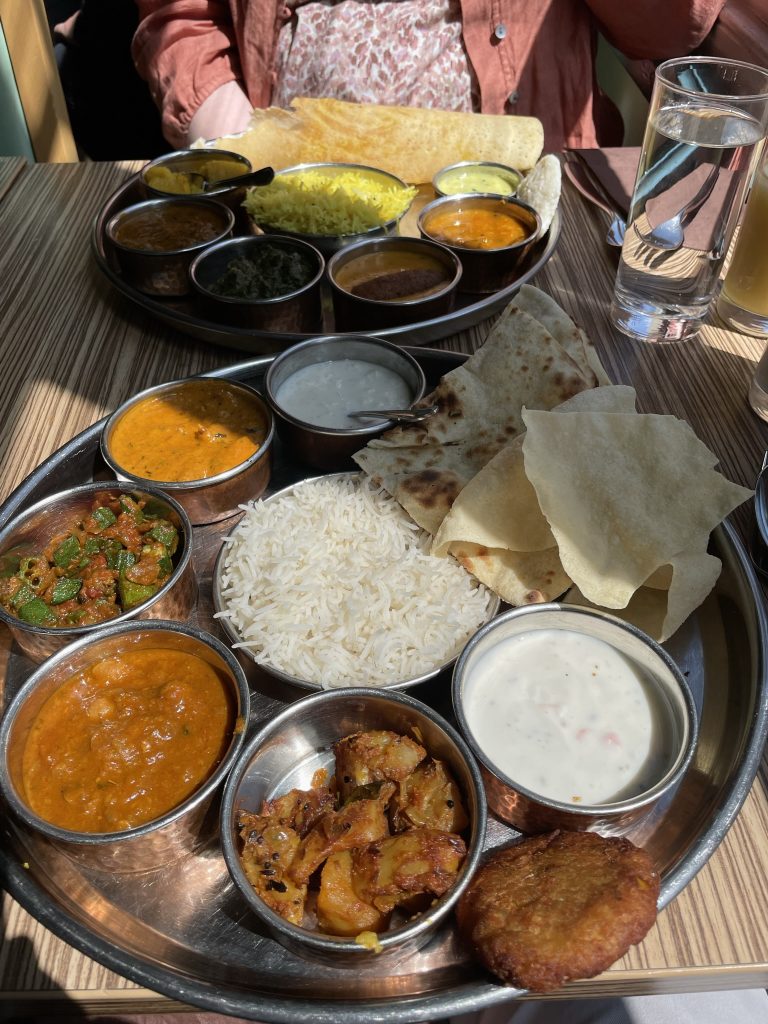
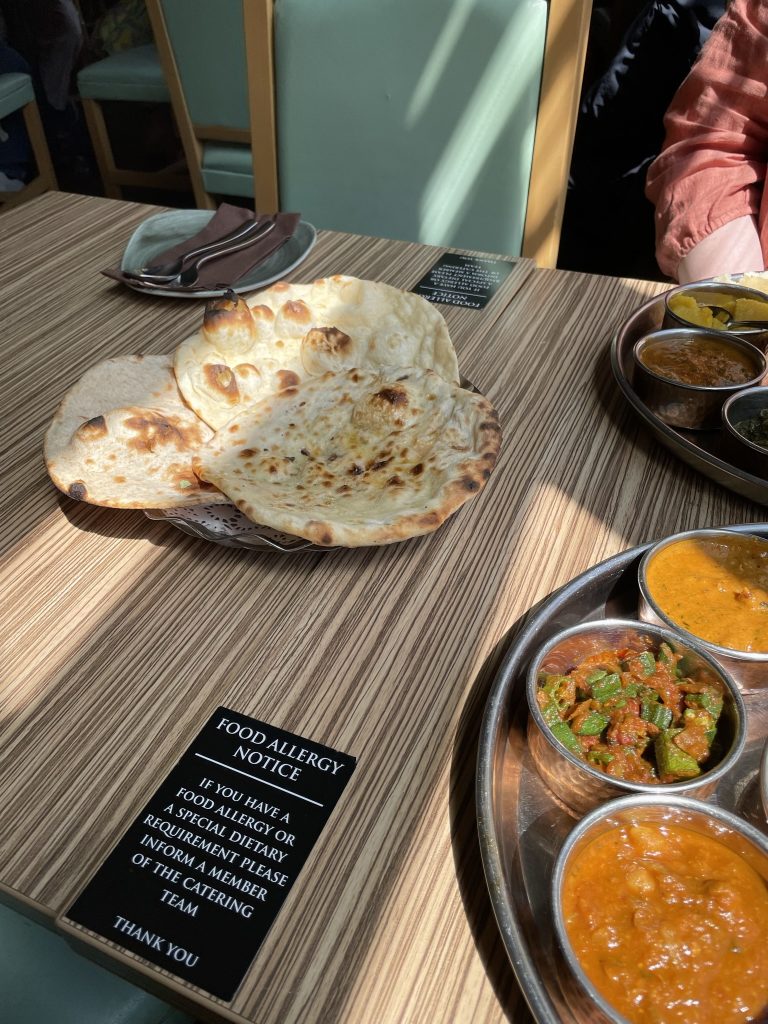
We then circled back to the southern indian place– which was basically no more of a sign than the menu posted near a doorway. We went into the door and up the stairwell, and were immediately headed off by the manager, who explained to us very courteously that they did not serve meat. We advised we were more than happy to eat their food; got seated, and ordered thali’s. Their thali’s were huge– I had masala dosa with aloo; idli and sambar; coconut chutney; a saag curry; a kofta curry; an eggplant tomato curry; lemon rice, and a semolina dessert. Sean had poppadums and naan; basmati rice; raita, an aloo patty; aloo gobi, butter paneer, bhindi curry, chana masala, and rice pudding.
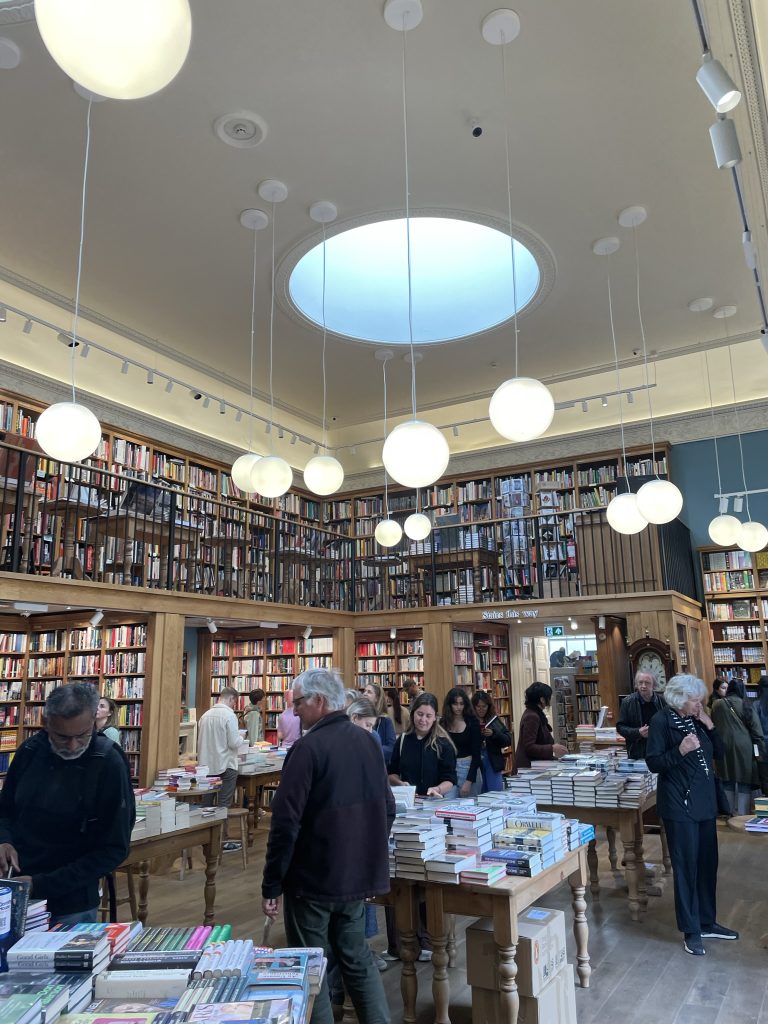
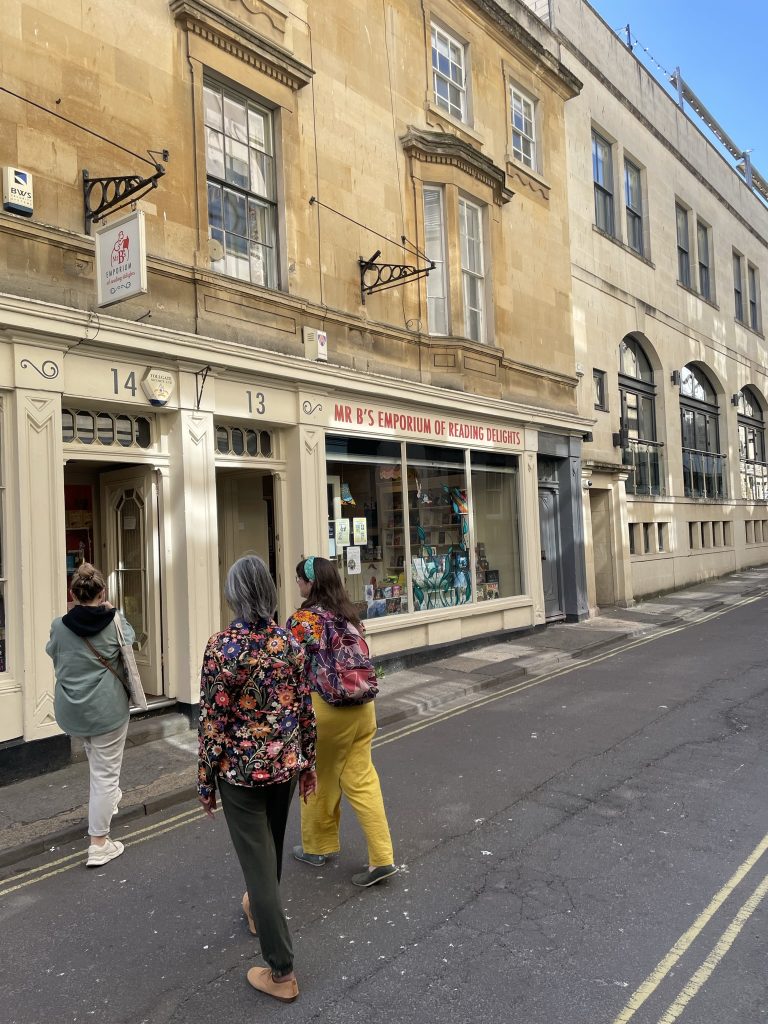
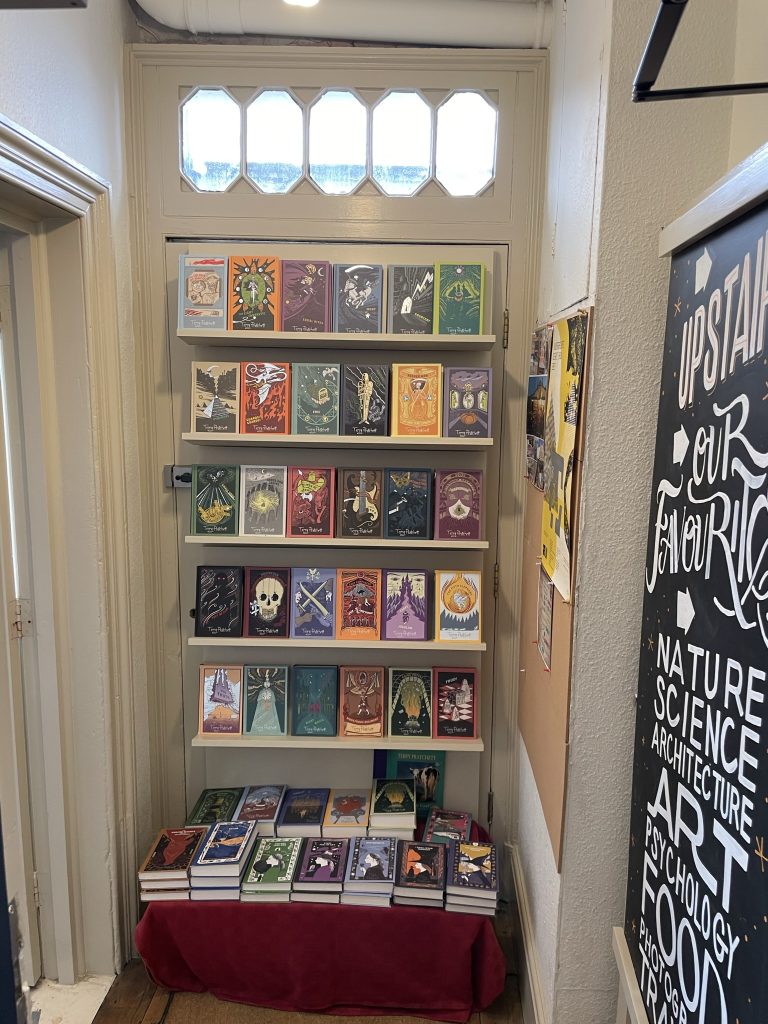
After that, we went book shopping, because we were running out of time in Bath. We returned to the market to go to Skoob’s books. (335 pm, 14 pounds) We went to Topper’s Bookstore, which was very nice and archaic looking (about 3 pm, 32 pounds); stopped back at Salamander for a quick pint; and then off to Mr. B’s bookstore, which we had noticed as being across the street from the Salamander (but had not been open at that time). At Mr. B’s, Sean found that they stocked the entire fancy-cover edition of Discworld. We ordered the entire thing and had it shipped. 710 pounds as there was a substantial bulk discount. I bought a few small things as well.
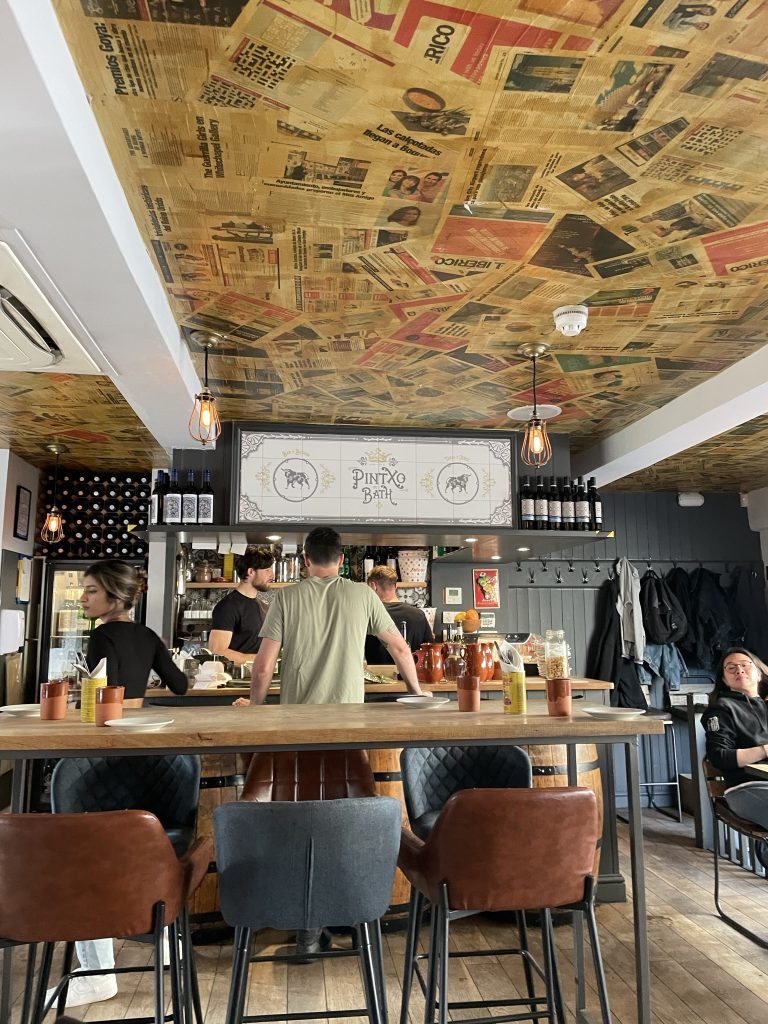
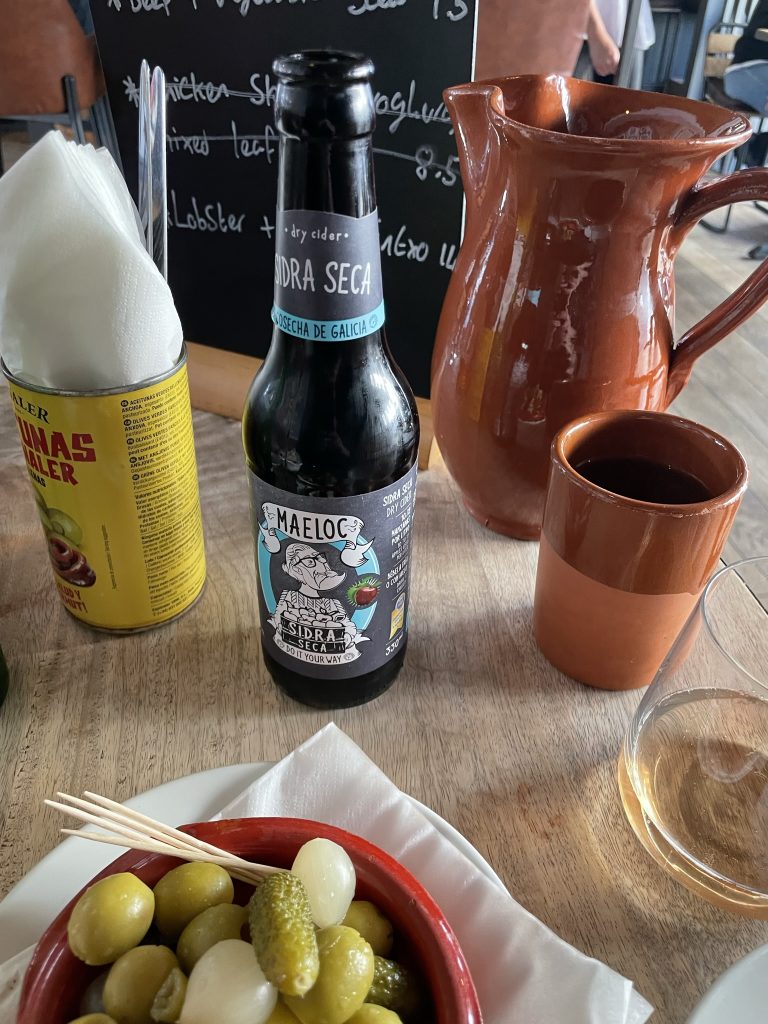
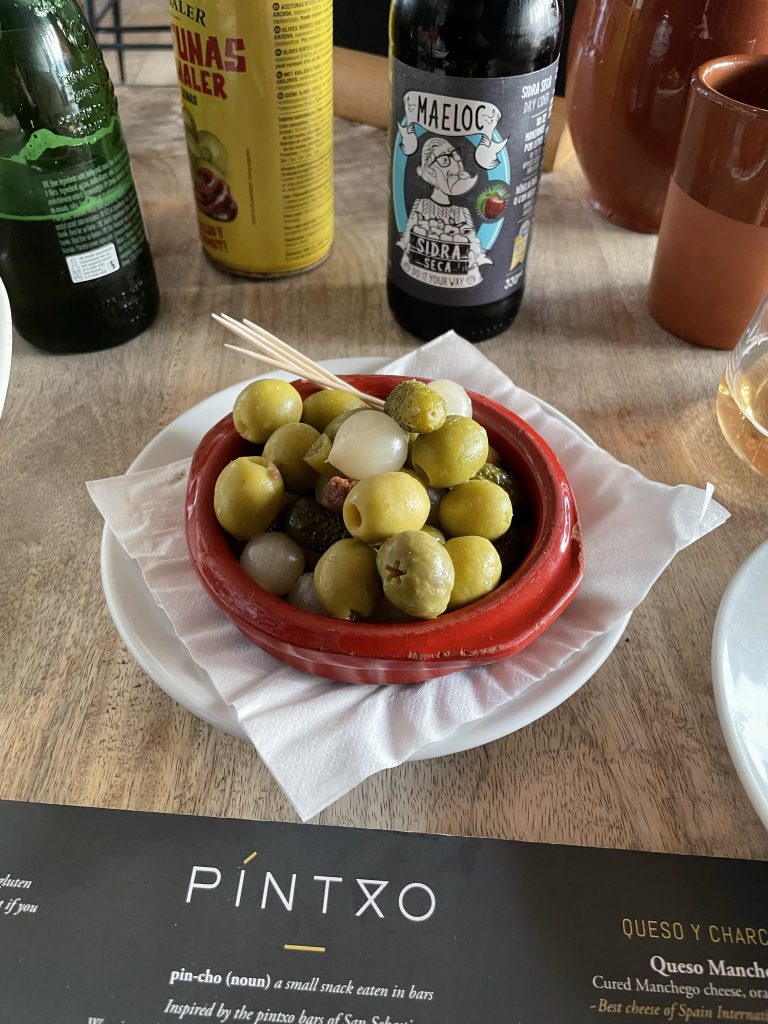
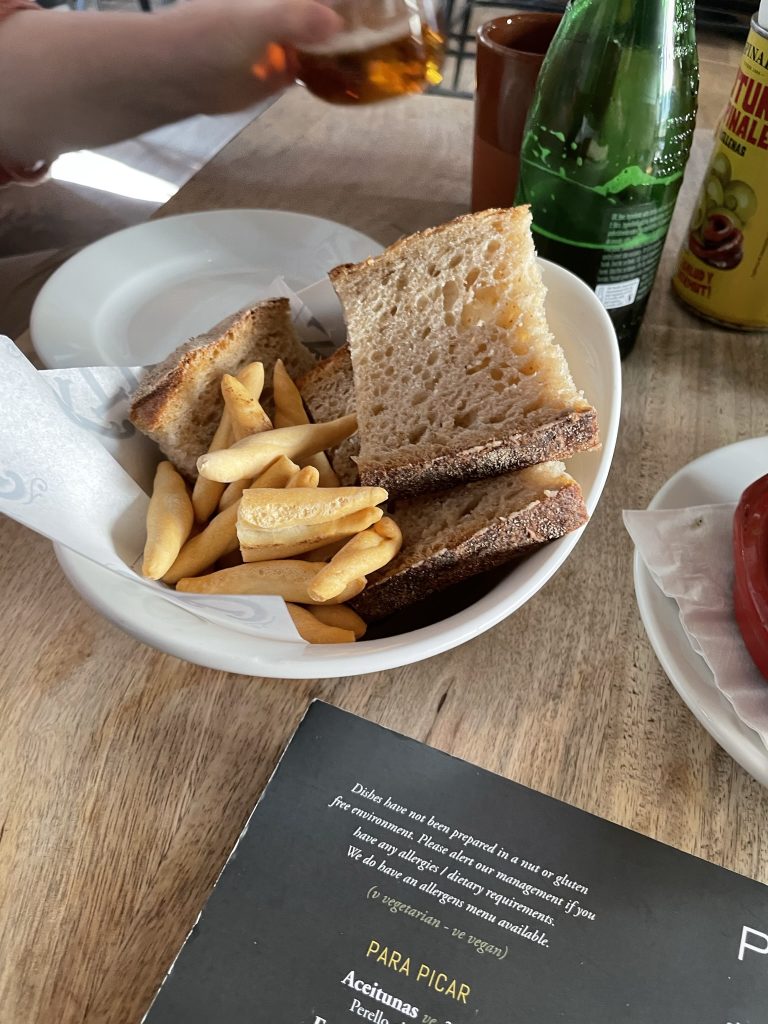
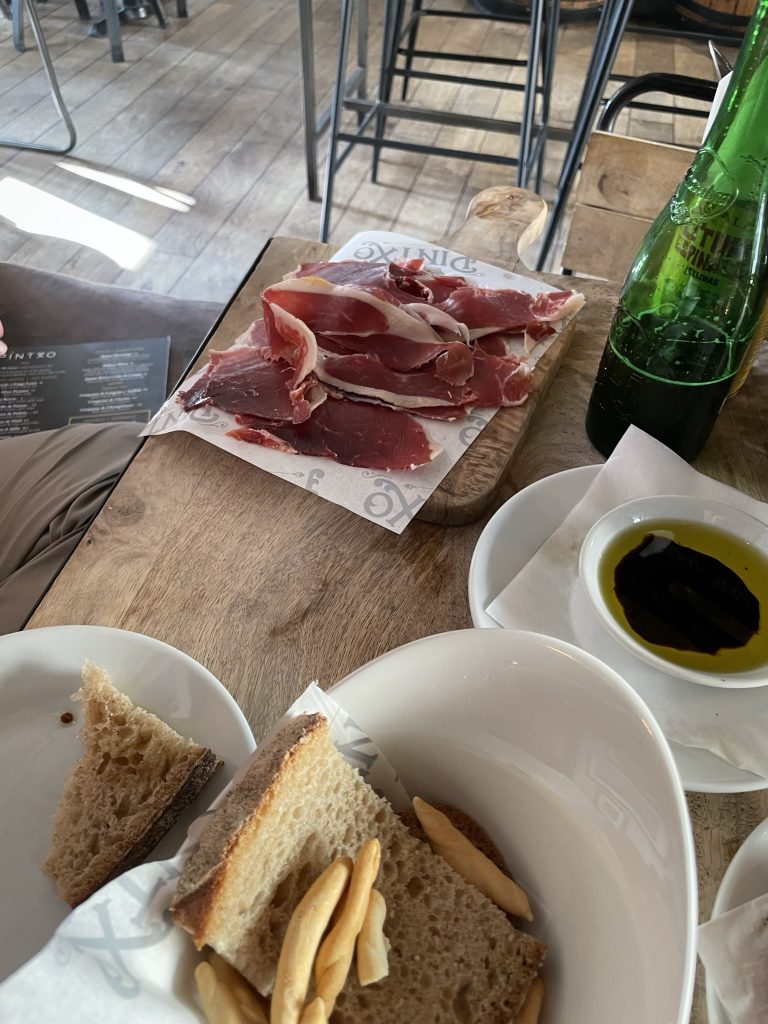
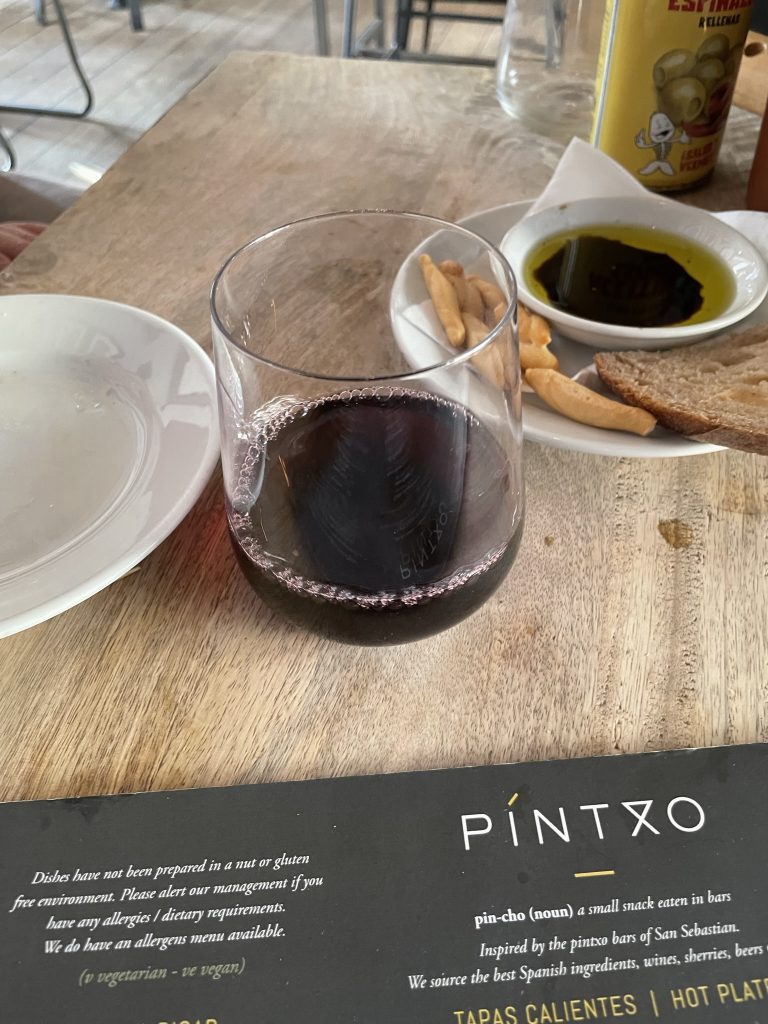
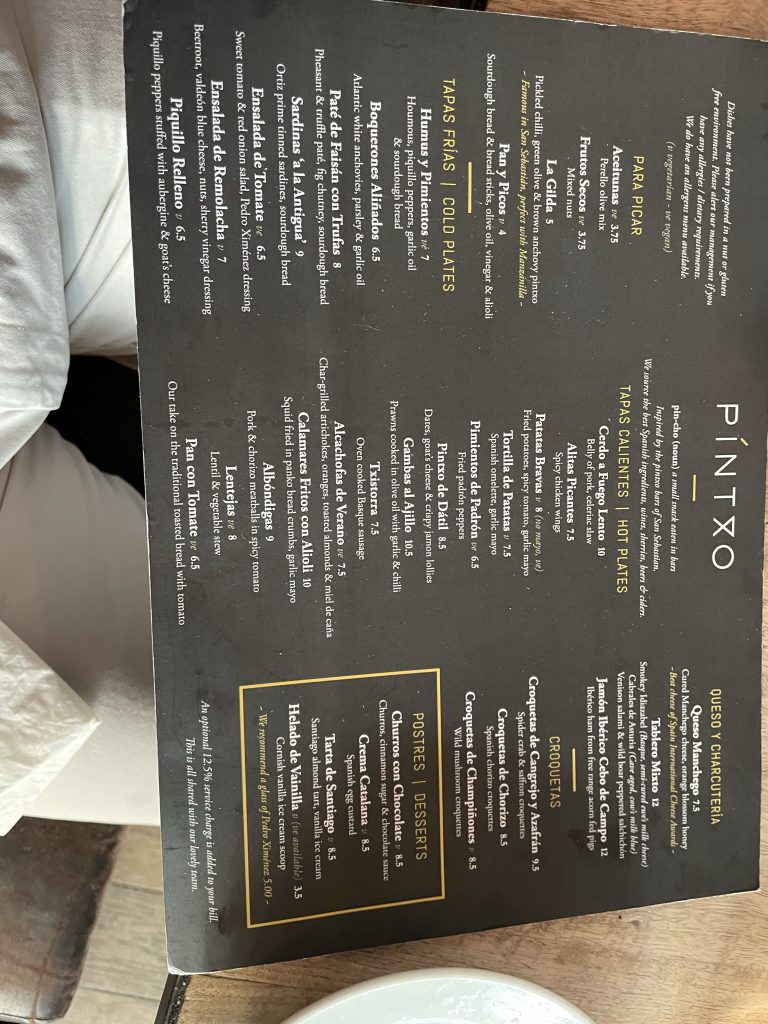
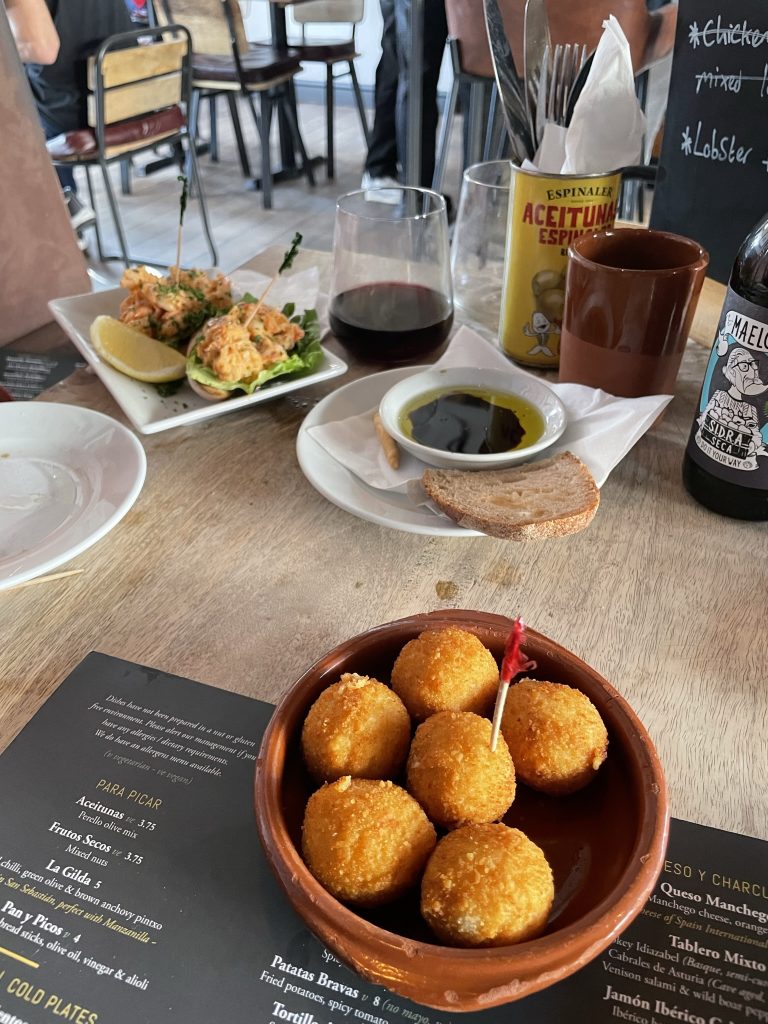
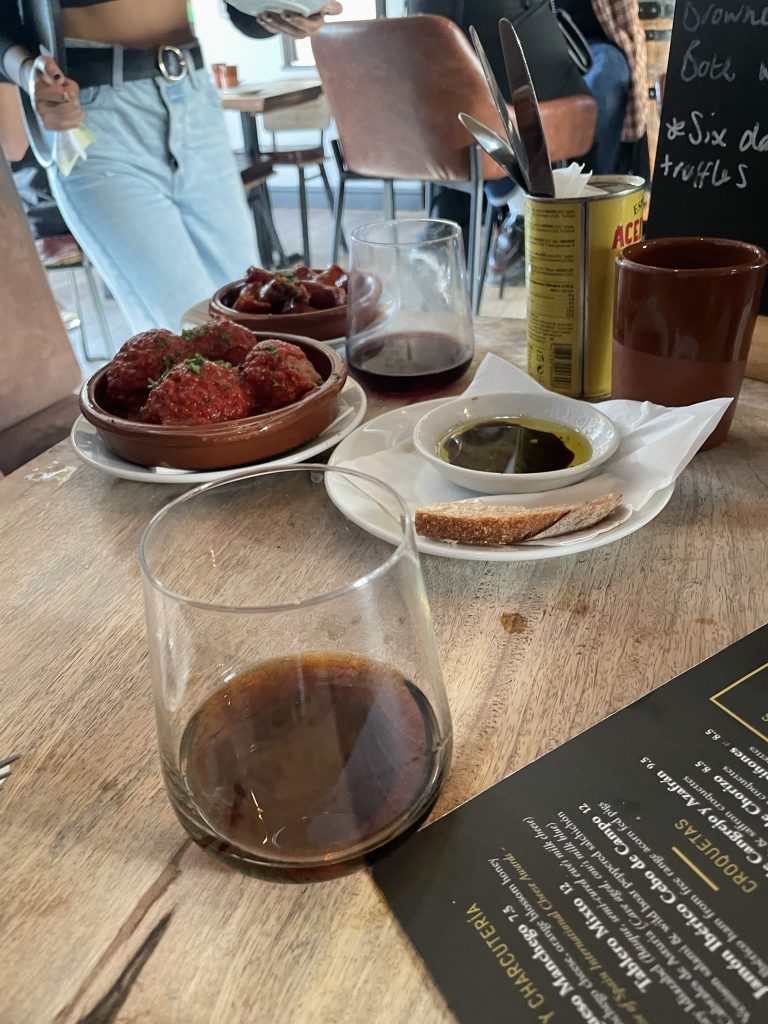
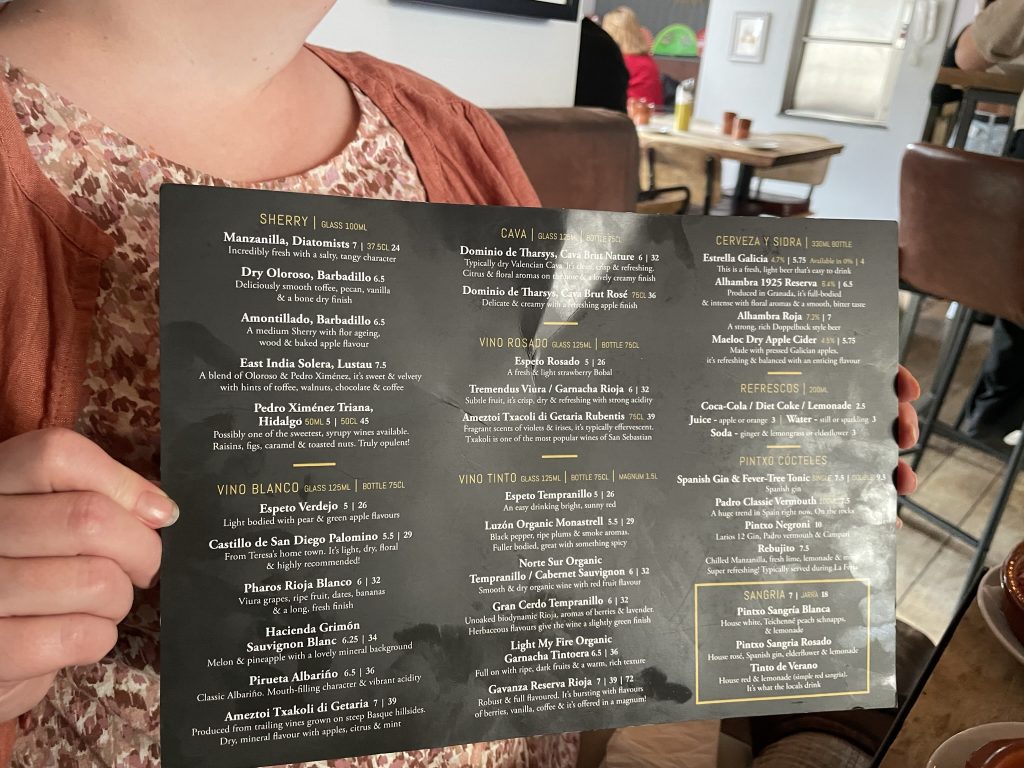
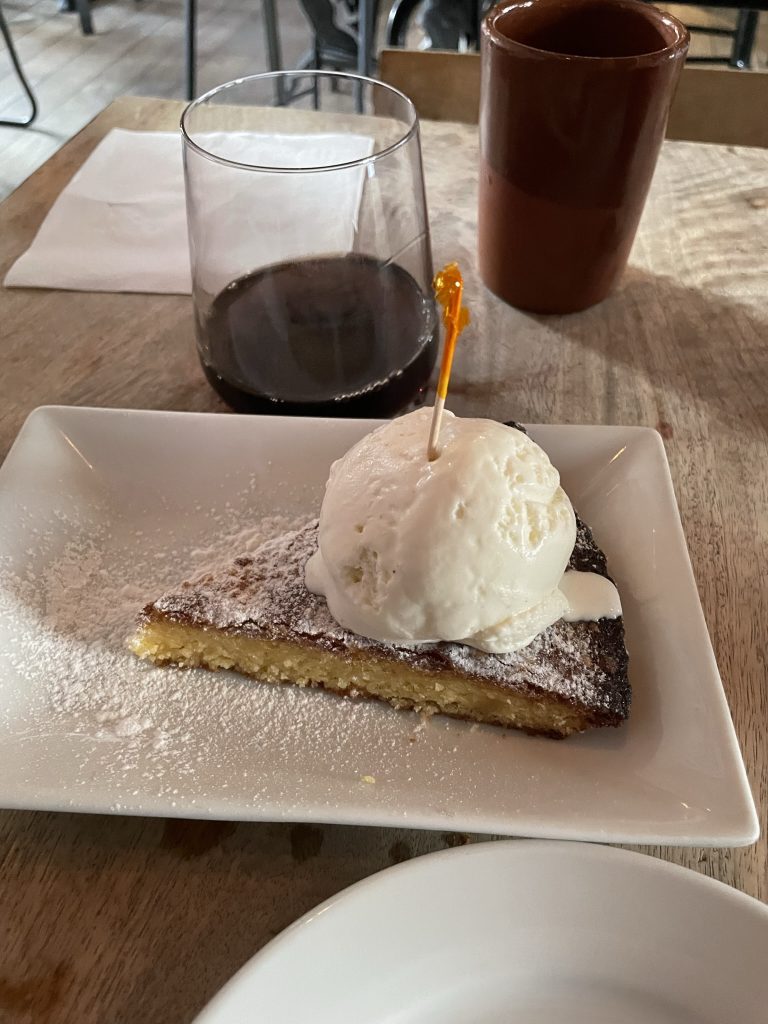
We did a fair amount more wandering around and looking at shops. There was some debate about what to get for dinner, but we were getting hungry again so we ended up at Pinxto de Bath, a tapas place. I had Alhambra beer and Sean had Maeloc cider. We had bread/breadsticks/olives; jamon iberico (insanely cheap by our standards and magnificently good); I had a house red Rioja and he had a sweet ximenez dessert sherry. We had chicken croquettes, lobster-and-shrimp salad on bread (good but we had made an error and didn’t really want it); albondigas and Basque sausage (good though perhaps half the quantity would’ve been better as we didn’t finish.) I had a santiago almond tarrt w/ ice cream and we split it; I had a olorosa sherry. This was under 140 usd.
6-1
We had to get up very early and skip breakfast due to needing to catch the train to Cheltenham Spa for our Cotswolds tour. So we ate our bread, cookies, and cheese and made our own tea, and left early down the canal path to get to the train.
We met up with tour guide Trevor at his Land Rover. Trevor was an interesting fellow– he’d been a musician in the military/Royal Marines; was currently part-time working at a brewery giving tours; and after the military had been a police officer; and was one of the volunteers to come and work in New York after 9/11. He told us about how they recovered remains and how they processed them; did the final religious rites; and notified families for funerals– there was mass DNA testing done to try to identify victims so families could have closure, and religious leaders were presiding over large-scale blessings over what was often very small amounts of remains.
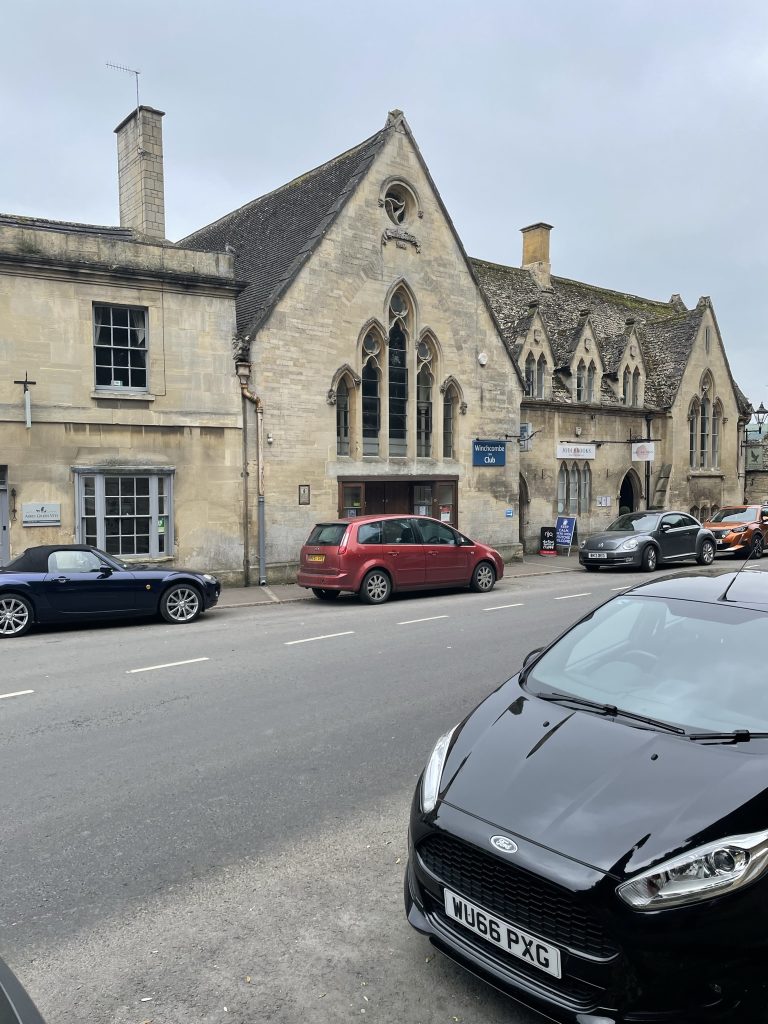
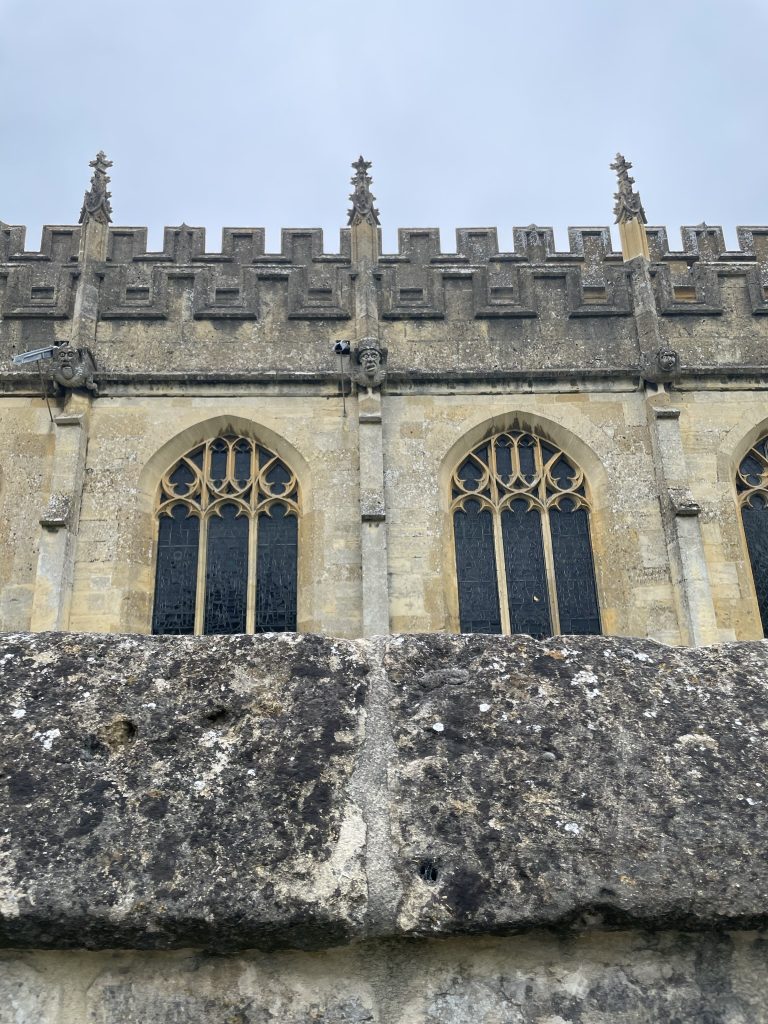
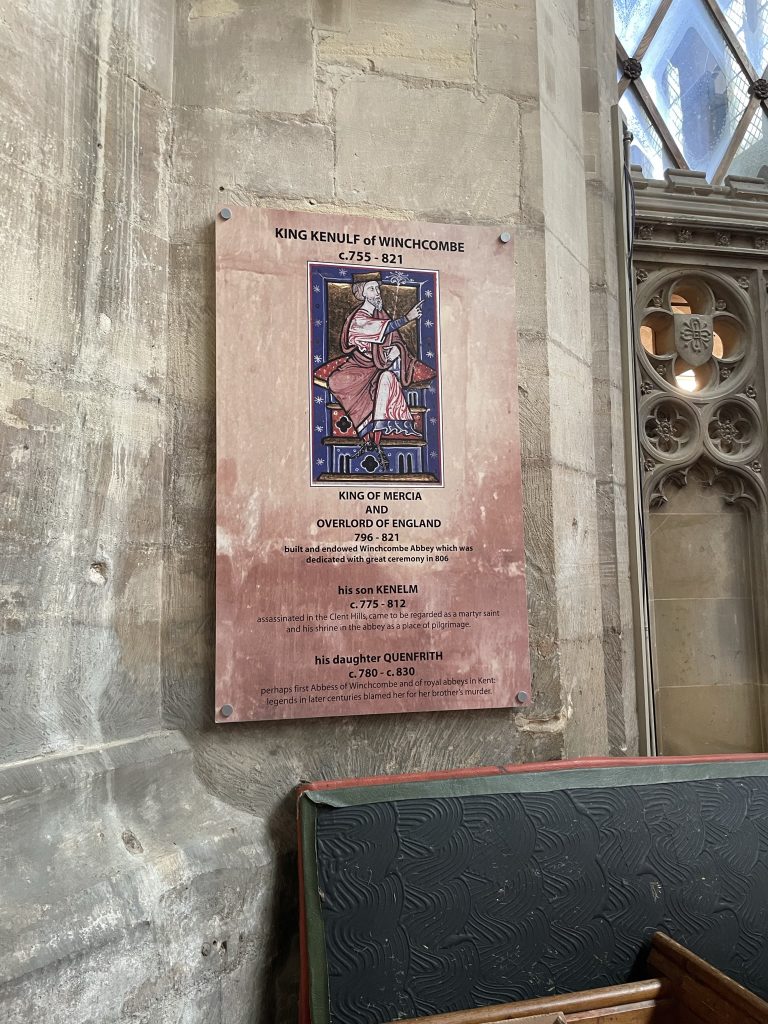
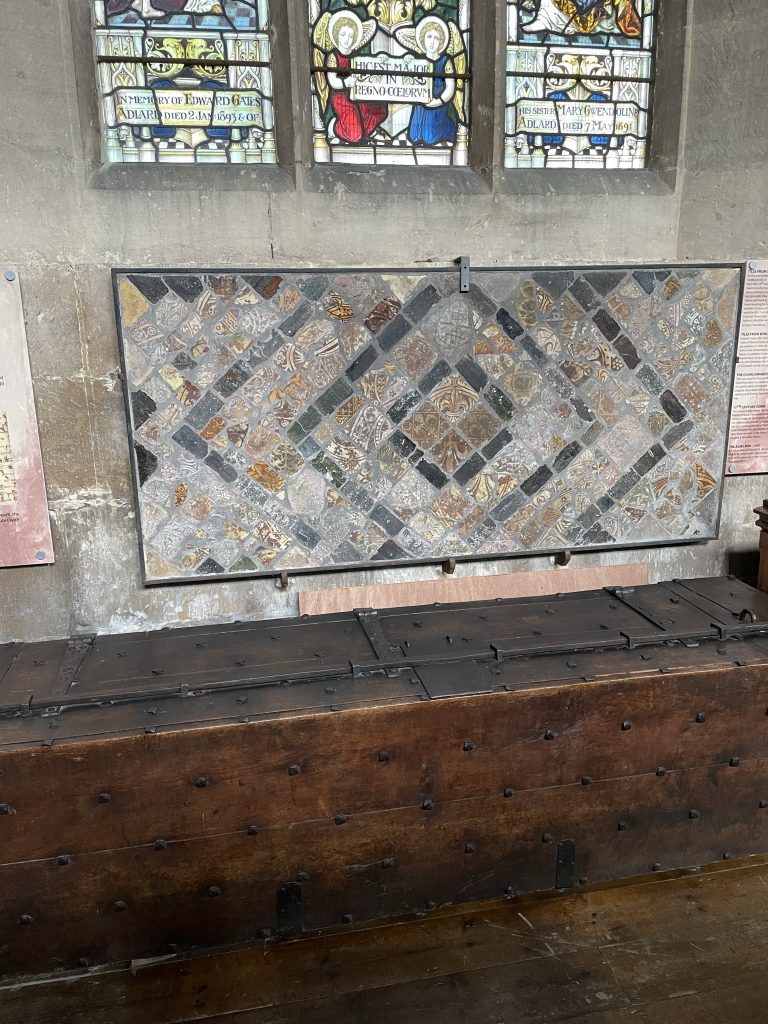
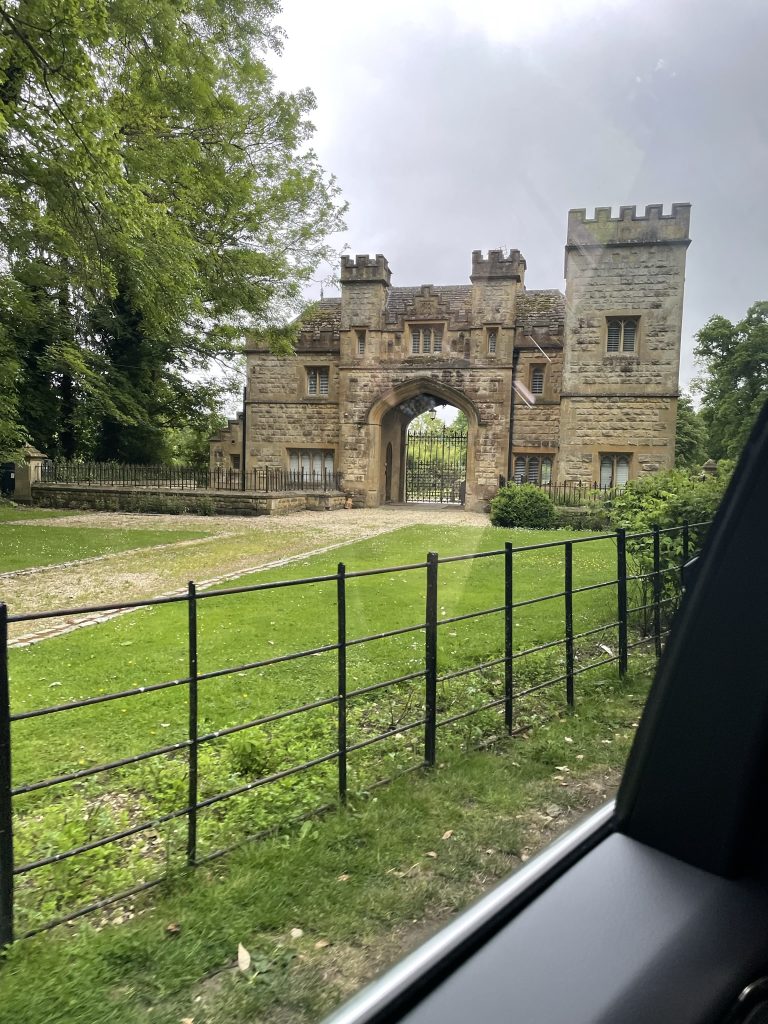
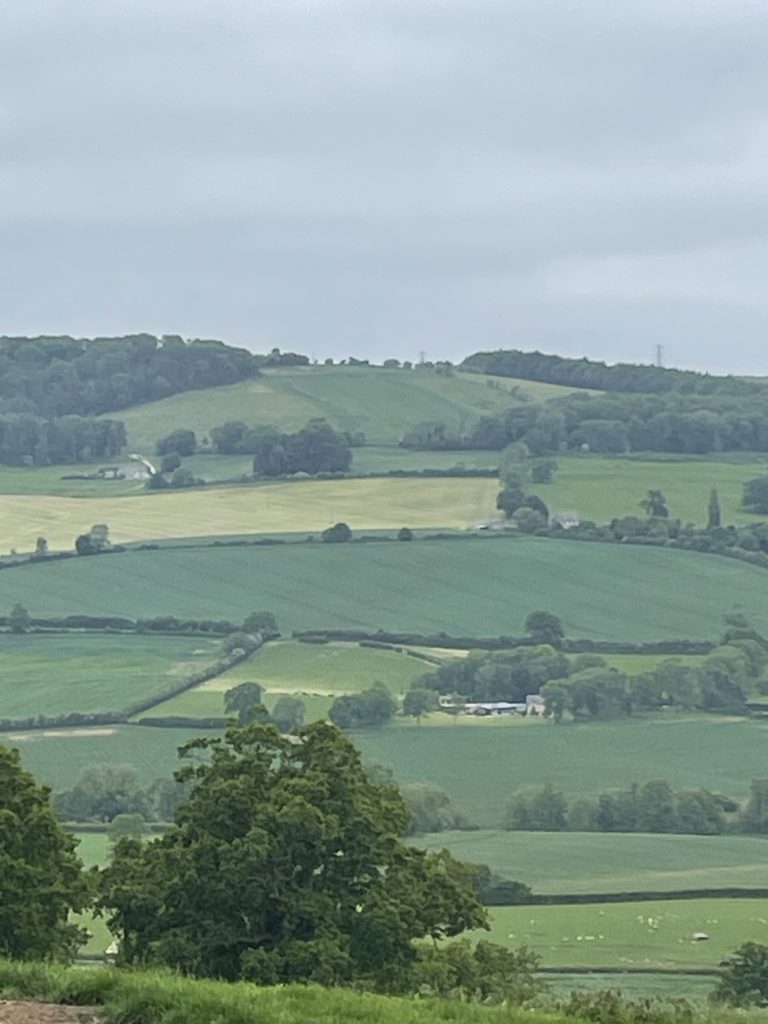
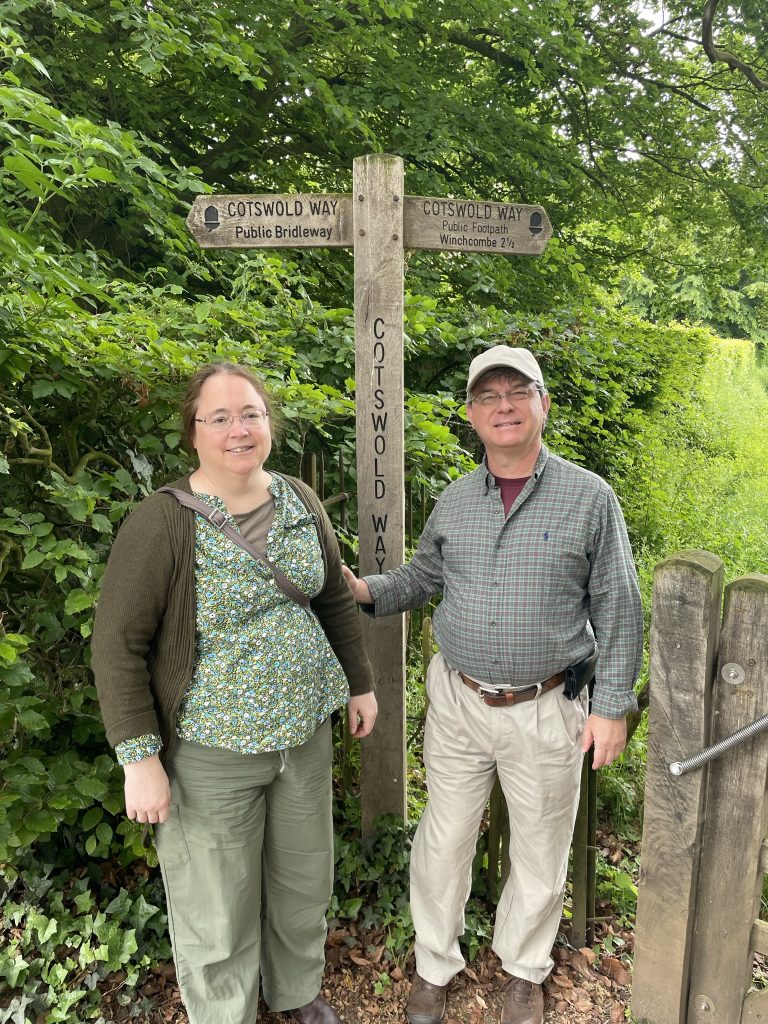
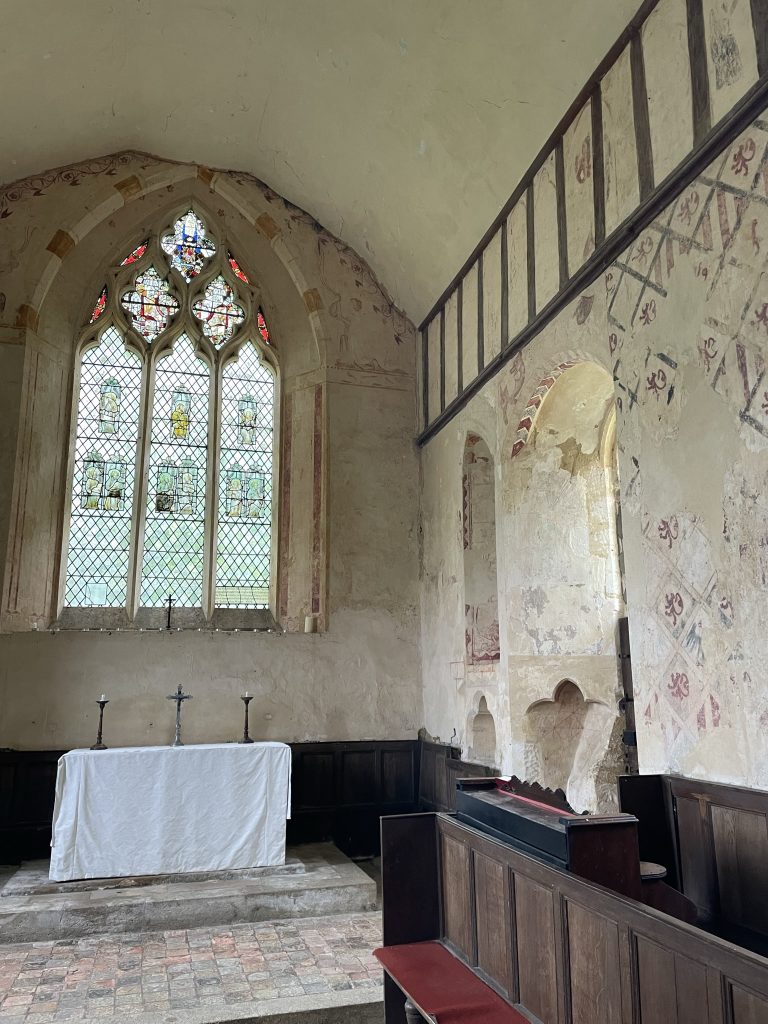
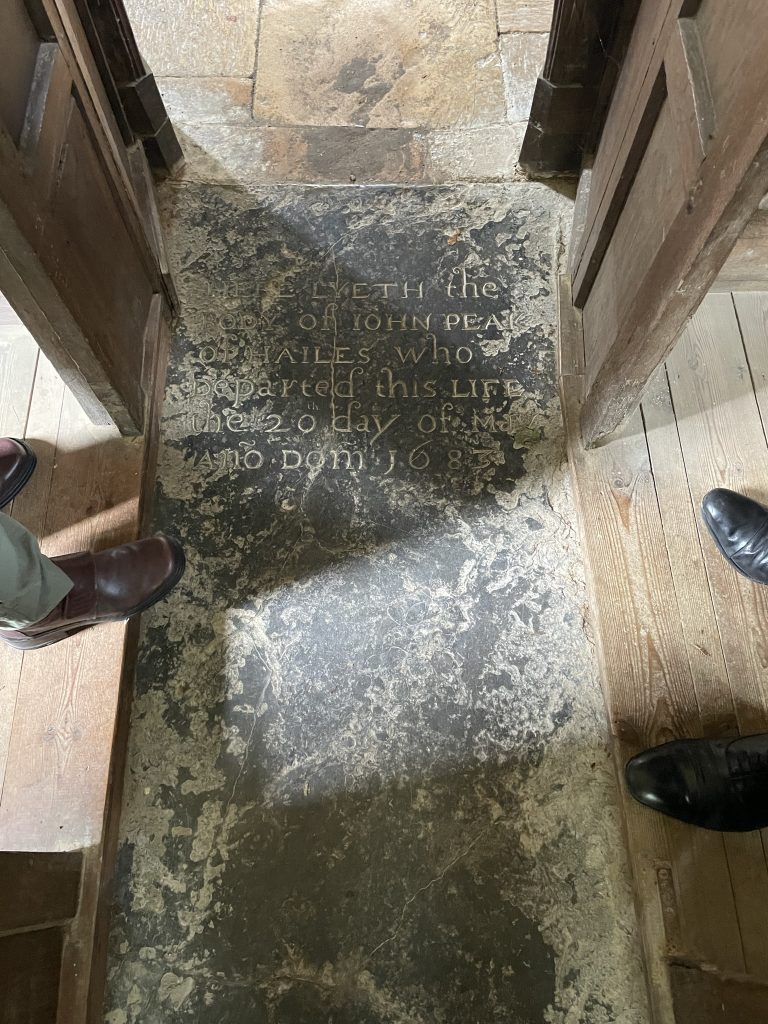
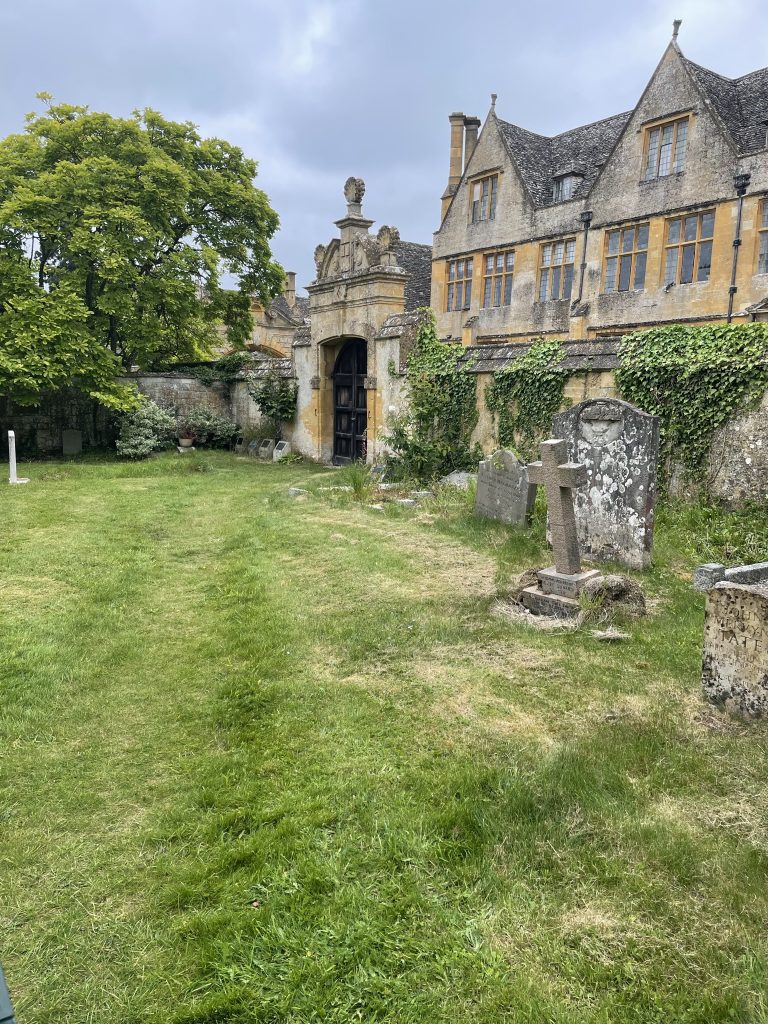
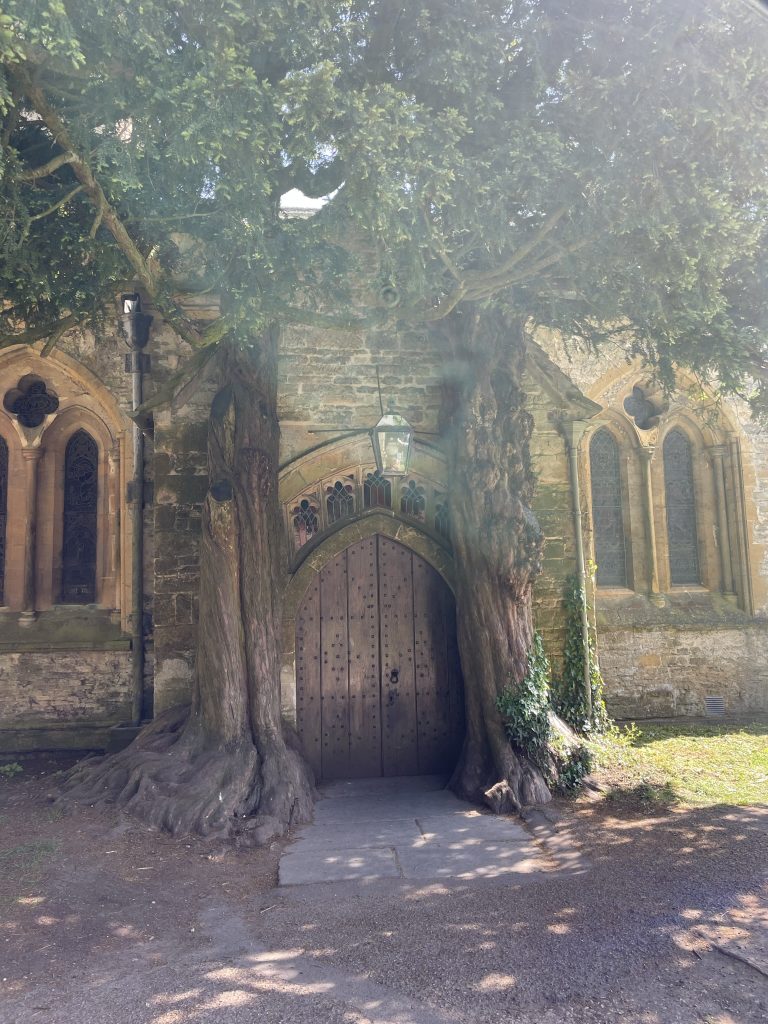
Trevor took us around to a number of small towns. Cheltenham, Winchcombe (a cathedral with an altar-cloth sewn by Catherine of Aragon), Stanway, Broadway and Stanton, including a Victoria Regina mailbox; Snowshill, Guiting Power (lunch at the no-frills pub here, quite good), Lower Slaughter and Upper Slaughter, St Edward’s Church (the Doors of Durin). We took about 20 steps on the Cotswolds Way to see the back side of a ruined abbey– and saw the re-surfacing old Anglo-Norman paintings emerging from underneath a Tudor coat of plaster in the nearby chapel. (list of cities maybe not accurate– Winchcombe, Sudeley Castle, Hailey Abbey (back side), Hailes Church, Didbrook, Stamway (church), Temple Guiting, Guiting Power, Upper and Lower Slaughter, Stow-on-the-Wolde.
As this was a Thursday, we didn’t run into the same crowds as we did on a later tour on a Sunday.
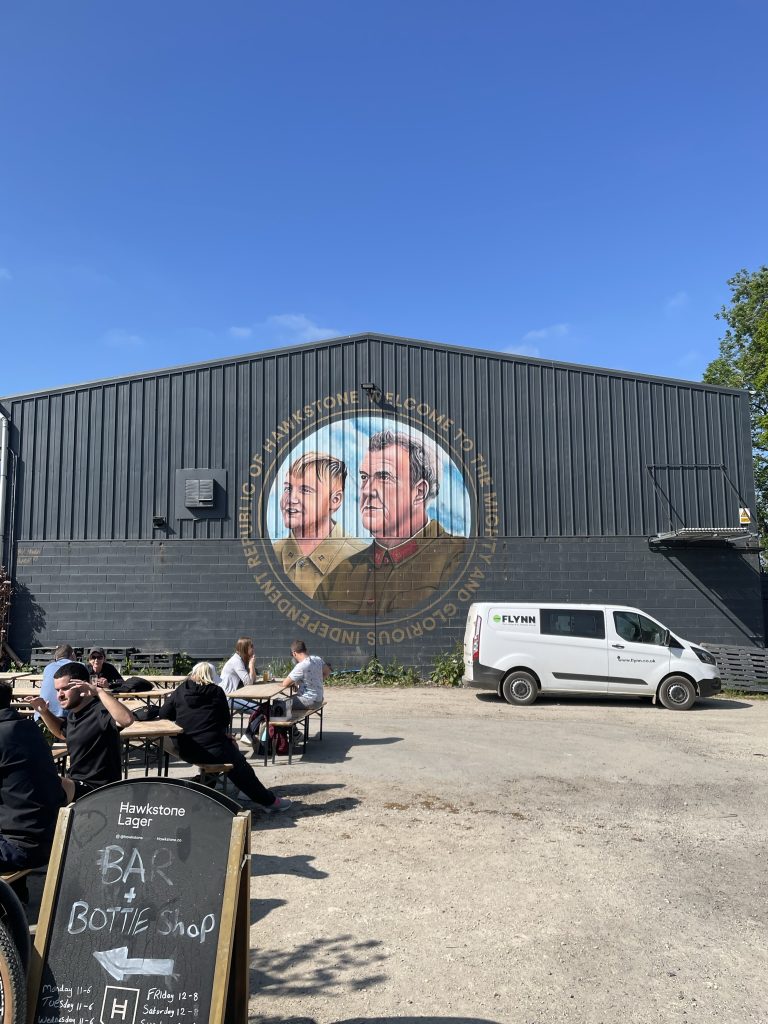
We had lunch at a pub, the Hollow Bottom (appropriate since we were famished); and ate 2 beers, lamb chops, venison sausage rolls, beef cheek croquettes, and lamb pie. We bought some small gifts at a shop called Lambswold in Stow-on-the-Wold. (2:24 pm and 67 pounds, socks and stuffed animals). The town lived up to its name and was very windy there. Our tour ended at Hawkstone Brewery, owned in part by some annoying British celebrity (Jeremy Clarkson). The beer was good, though.
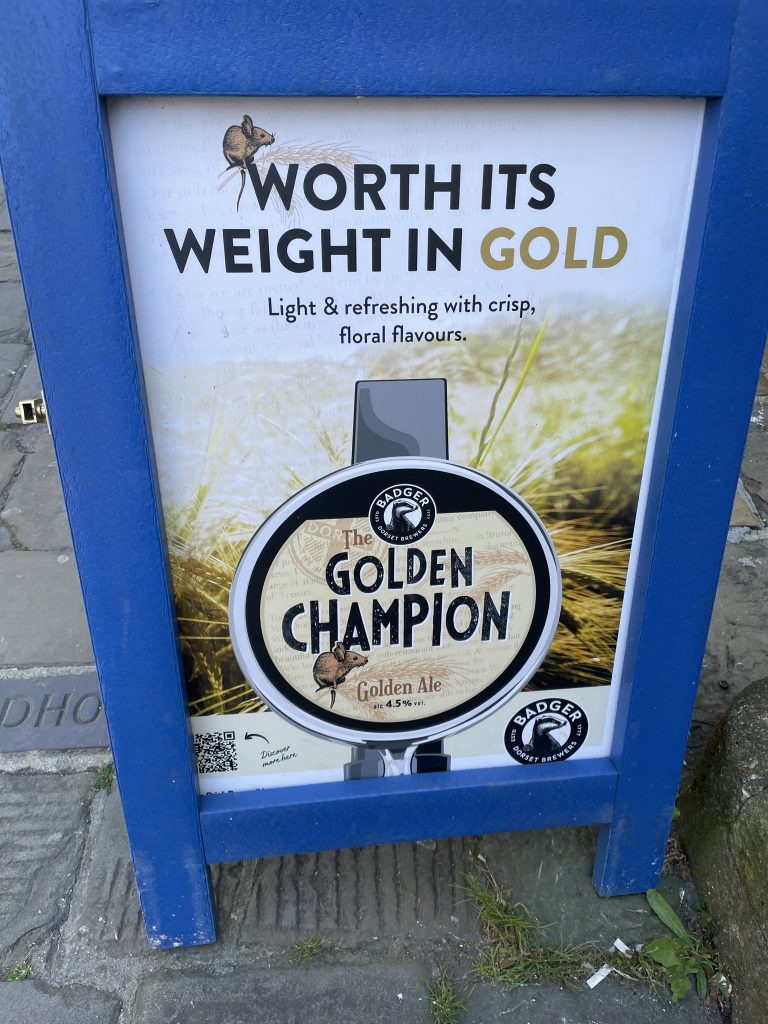
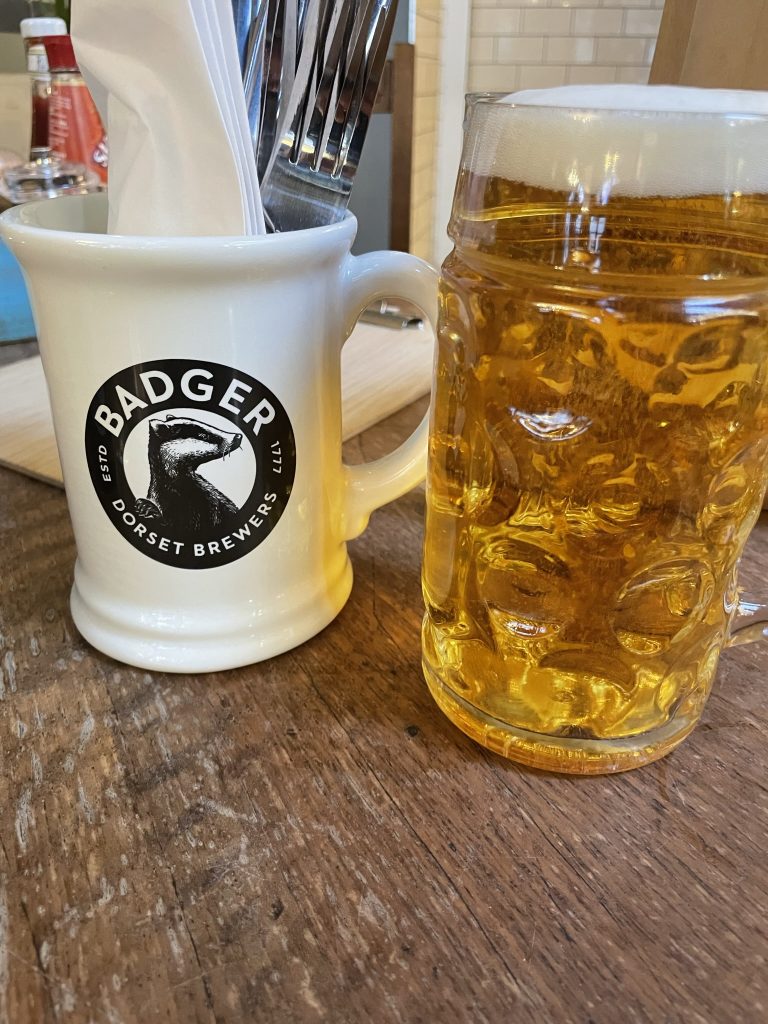
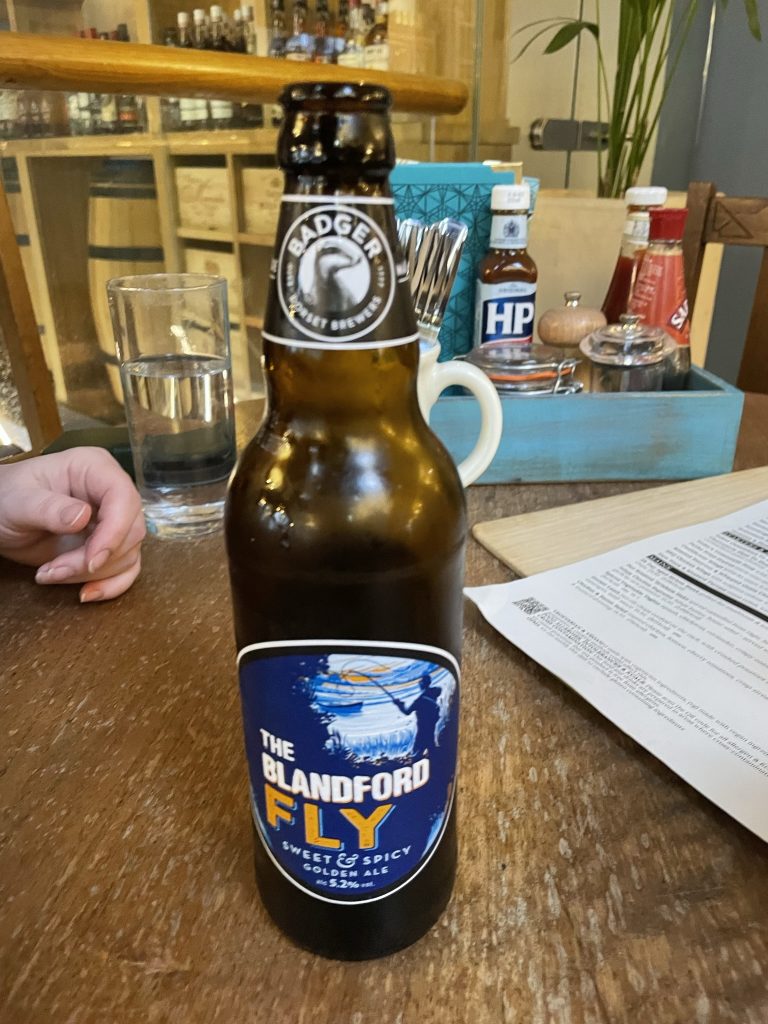
It was a very long day and we were tired; when we ate dinner that night it was at House and Woodhall and not especially good– an overcooked chicken kiev for me and lamb chops for Sean; but the beer (the Blandford Fly, a ginger-infused lager) and cider (or was it beer? Badger from Dorset?) was extremely good as was their charcuterie plate. It took us a long time to get entrees, so we figured the kitchen had misplaced and then microwaved them.
6-2
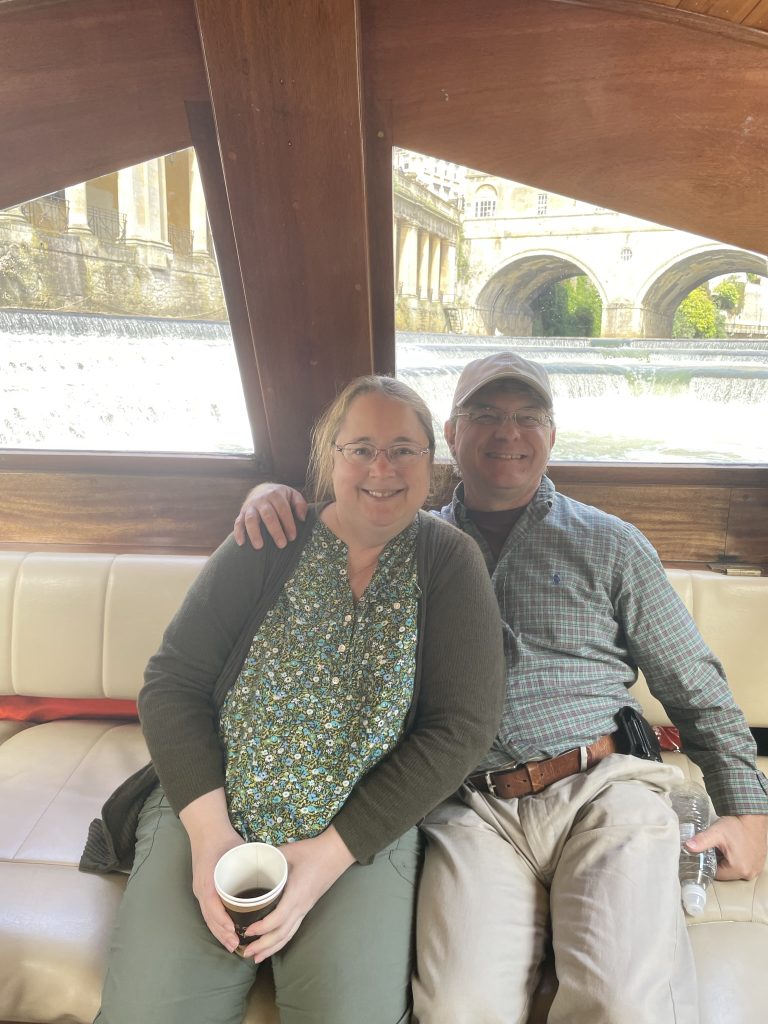
The next morning we said goodbye to Bath with a combination boat-walking tour, which we learned about while walking on the canal and signed up for last-minute.
The boat portion lasted about 20 minutes but it was fun going along the canal.
Our walking tour guide was excellent and I wished we’d had him on the first day, not the last. We walked to many different places and ended up not far from the abbey.
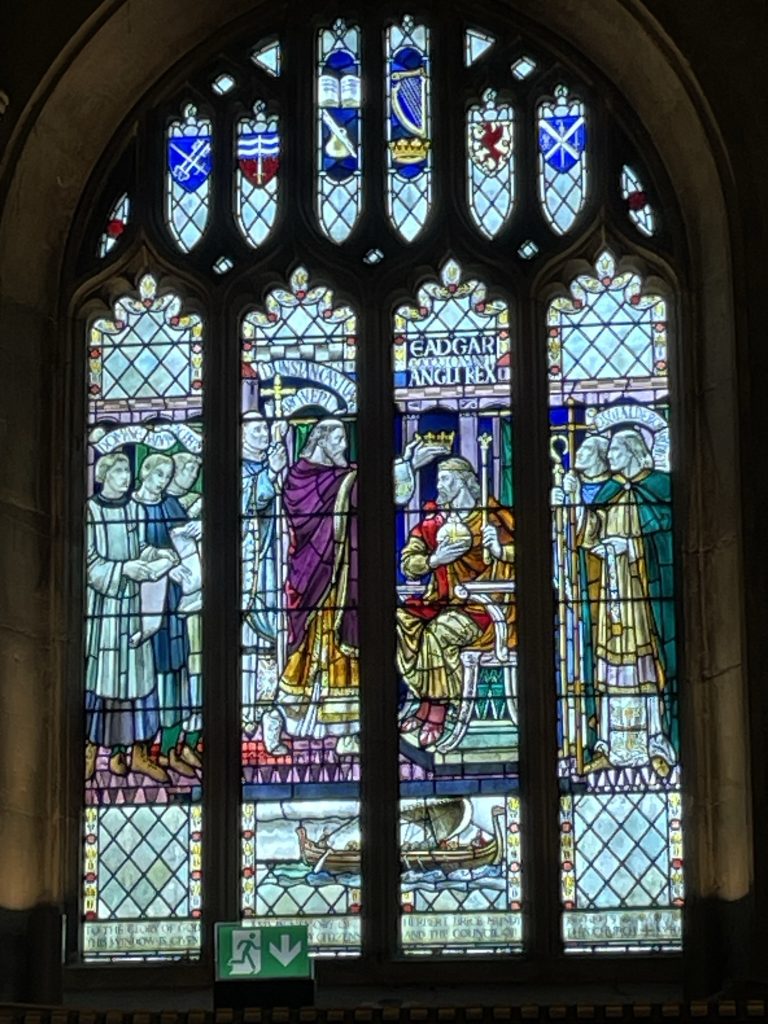
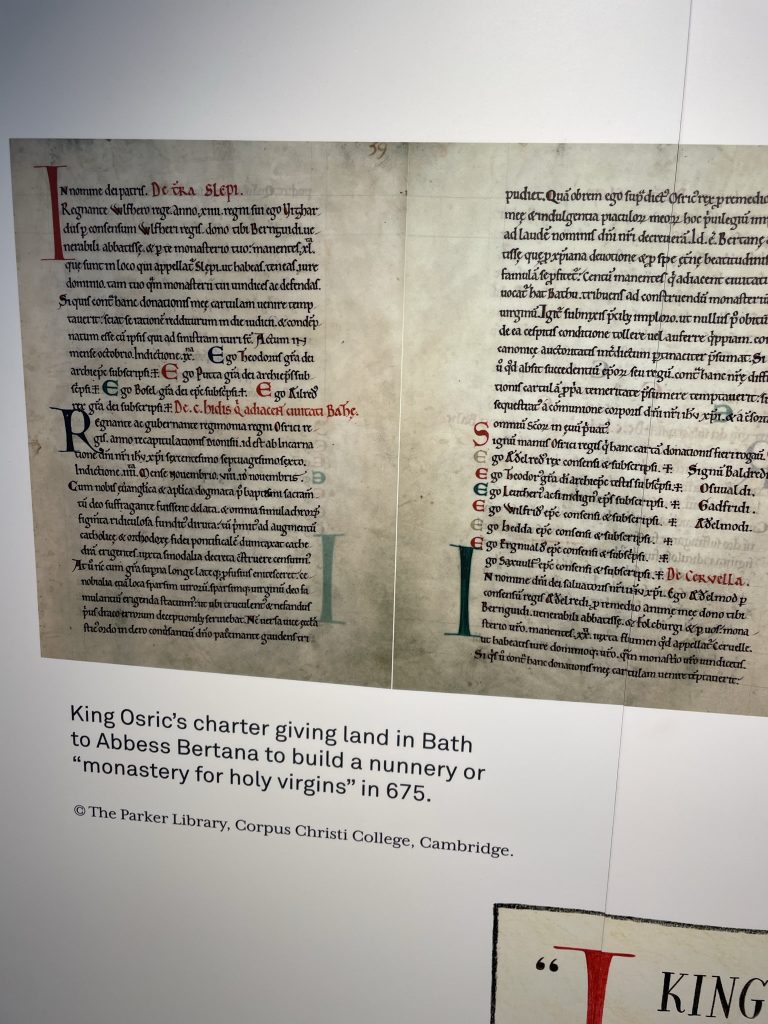
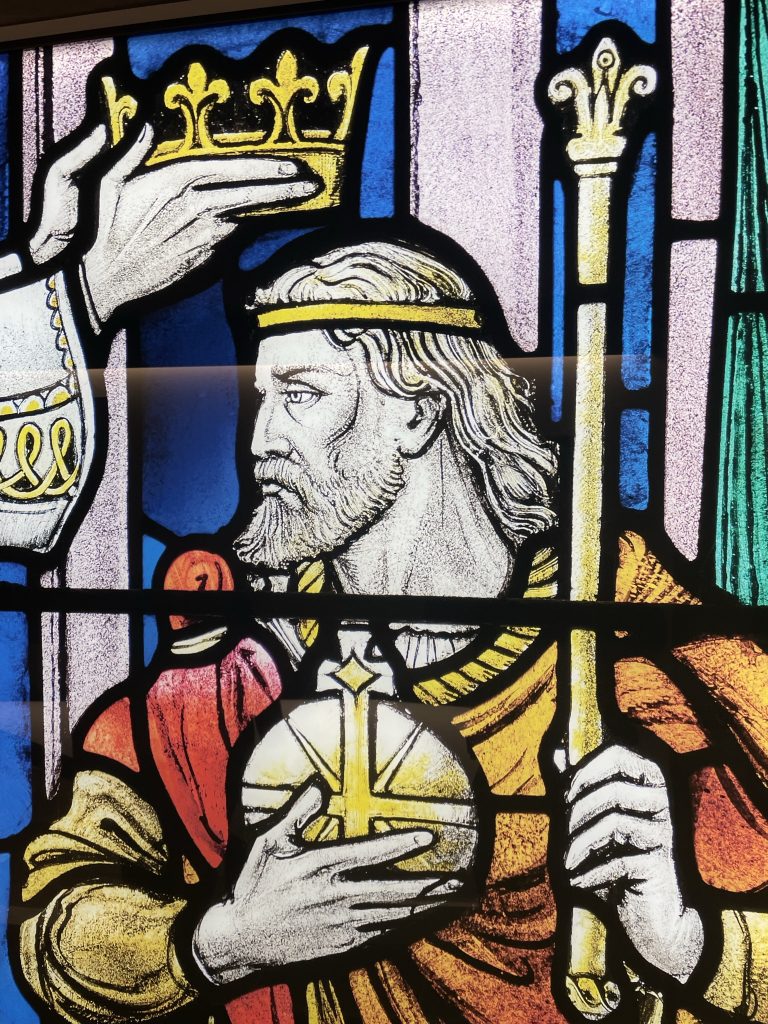
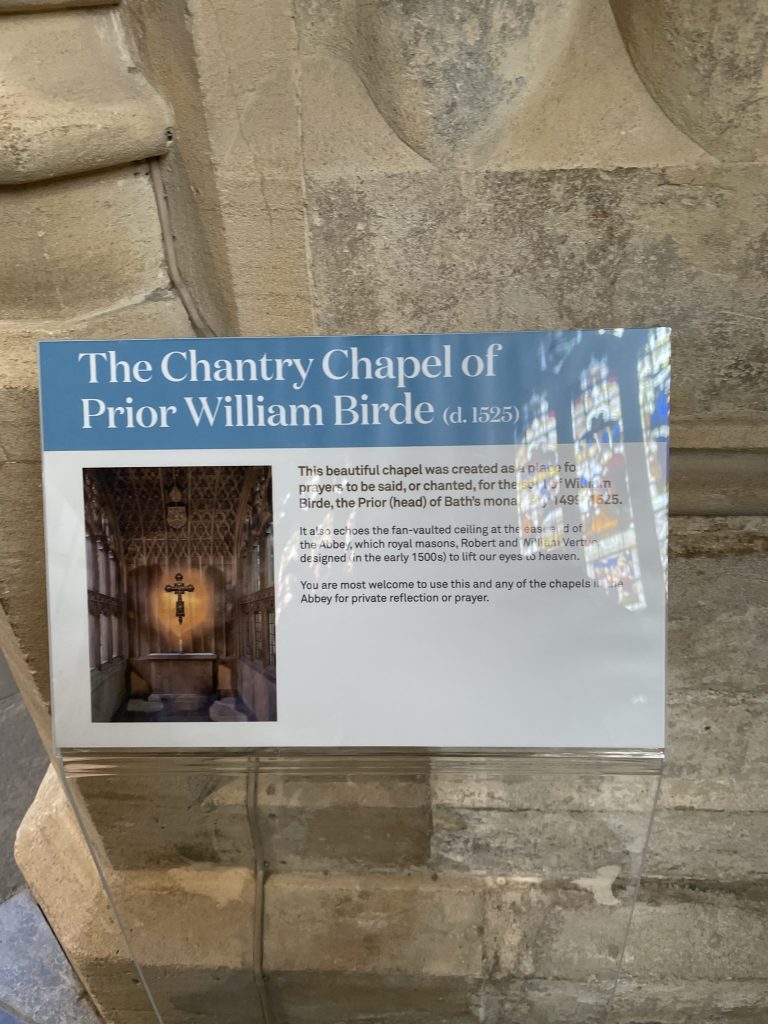
You can’t leave Bath without seeing Bath Abbey, so we did, and it was just as magnificent as remembered. We didn’t join a tour of it; we just viewed the cathedral and King Edgar’s window; then went through the museum in the basement, which is very worthwhile. It was only about 7 pounds to get into the cathedral/museum, so it was very worthwhile. 1:48 pm we went in.
Either before or after the trip to the cathedral– I think after, we went to Portofino, not far away, and had italian seafood. We had mineral water– very necessary after all the walking; Sean had a Trebbiano blanco and I had a Montepulciano, one of my favorite reds. Appetizer was grilled octopus. Sean had halibut with olives and potatoes and vegetables. I had a scallop and shrimp linguine with pink sauce, all magnificent.
We then collected the luggage and cabbed to the train station, where we fought our way to Oxford, having to contend with both a major railway strike and the main railway line to Oxford being under construction. We had to take the train to Didcot Station; the bus from Didcot to Oxford. Then, not knowing, we took a cab from Oxford Station to our hotel. On foot, the journey would have been about ten minutes even with luggage. Via car, it was half an hour, making it a very expensive cab ride, because the driver had to circumnavigate the city in the other direction to get to where we were staying.
We got situated at the Porterhouse. Of all the places I researched to stay, this one was the one I knew the least about, because the others had emailed us back (especially the Bath House) with tourist info and so on. I was a little concerned that we would end up smelling like beef smoke or that the rooms would not be good. The room was very clean and neat, there’s a connecting fire door shutting it off from the restaurant smells, and we had a desk and two great big windows.
The staff was great– personable and helpful, and we were always welcome to sit at the bar, even though it was rather an upscale restaurant.
We booked in for a 7:30 dinner and went upstairs and decompressed.
The Porterhouse has a tiny menu: steak (many kinds); one chicken dish, one fish dish; one pork dish; and one sop to the vegetarians who most definitely would be unhappy here. They have a small but fine-tuned wine list; single origin coffee/espresso, and the list goes on. All food is cooked to order on a purpose-built cast-iron stove, heated white-hot with custom-made-for-them charcoal.
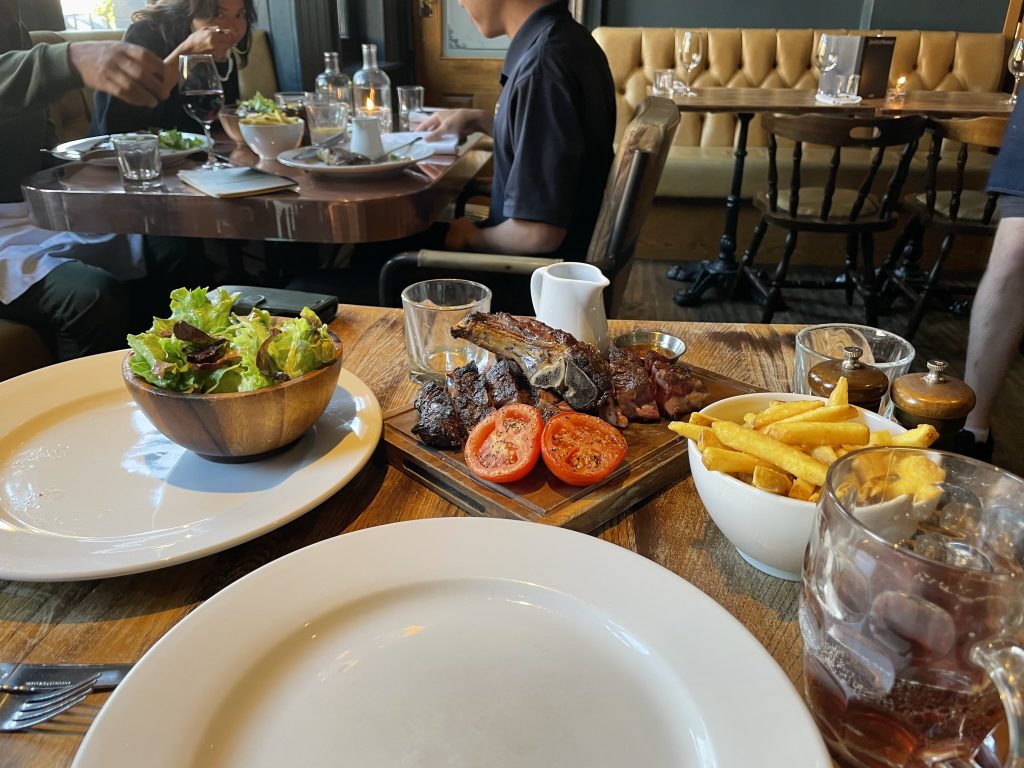
Dinner was amazing–we had an excellent 35-day aged cote de boef, a ribeye type cut with the bone removed and roasted up together with the meat. I got the burnt crunchy bits. We got peppercorn sauce and another sauce made with anchovies and some other ingredients. The peppercorn sauce was outstanding. The anchovy sauce would’ve been better with a fillet; it was kind of lost in the robustly beefy cote. It came with rocket-and-tomato salad; and chips with house-made mayonnaise on the side.
We ended up defaulting to the Porterhouse for dinner more than we’d intended.
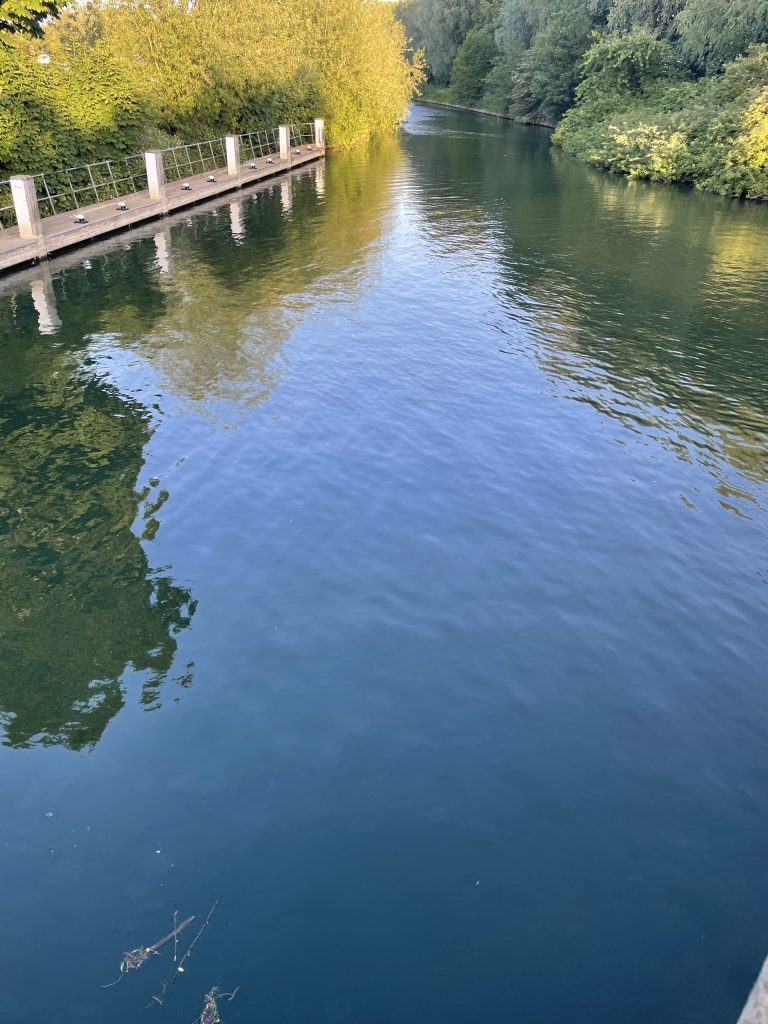
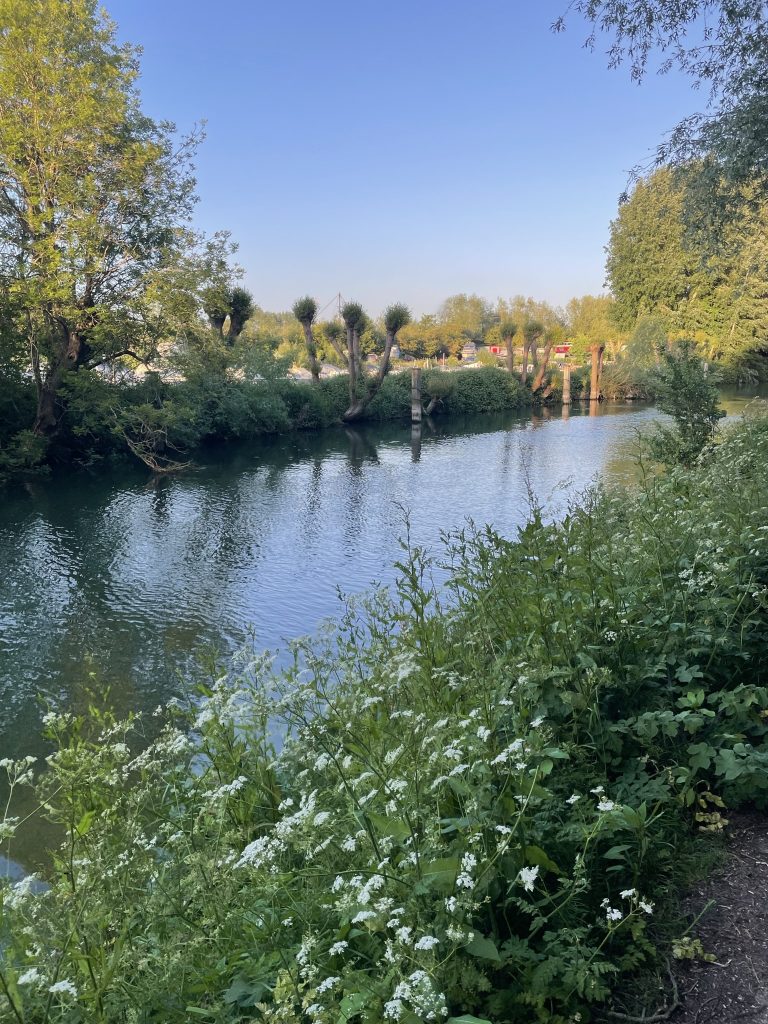
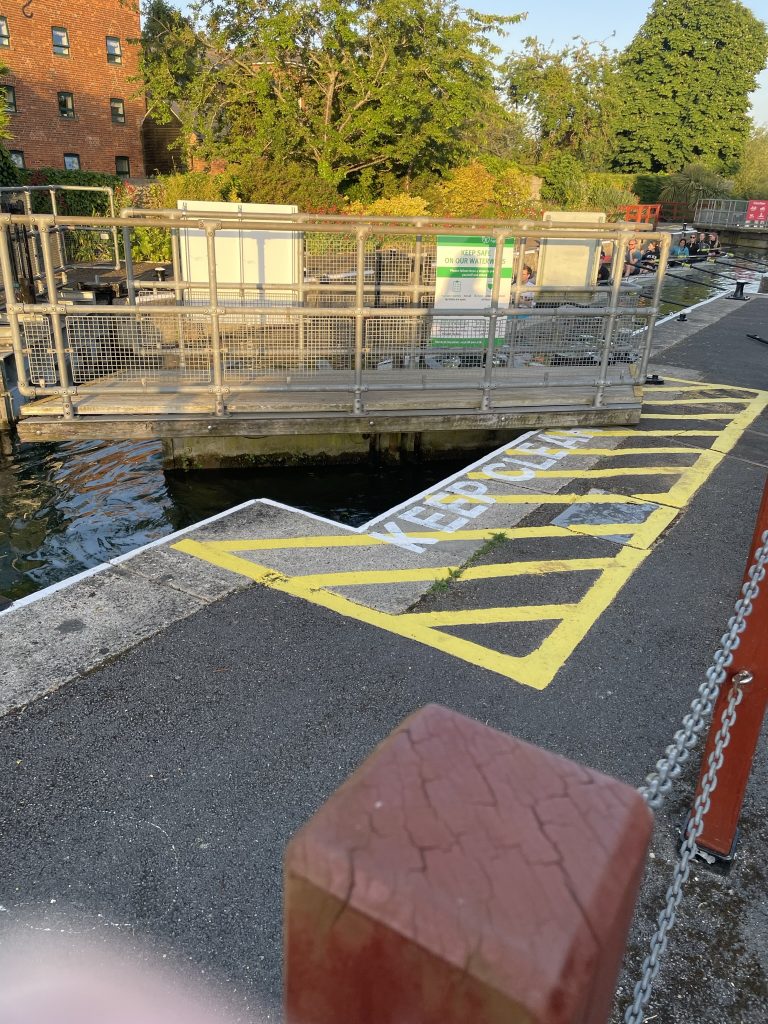
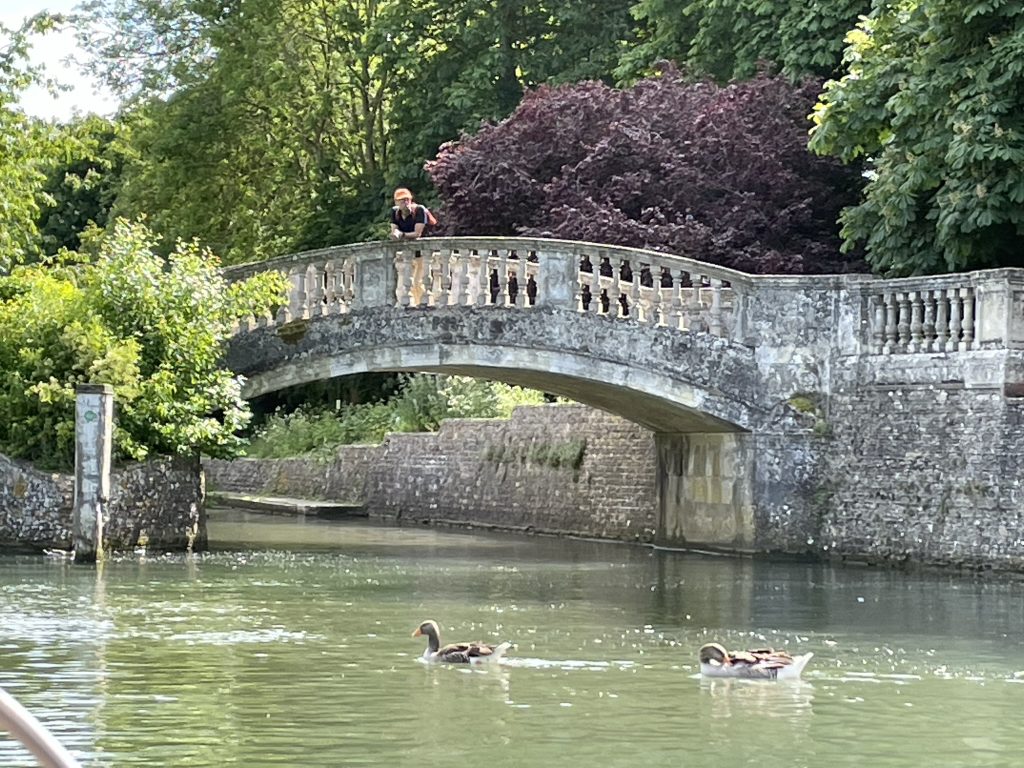
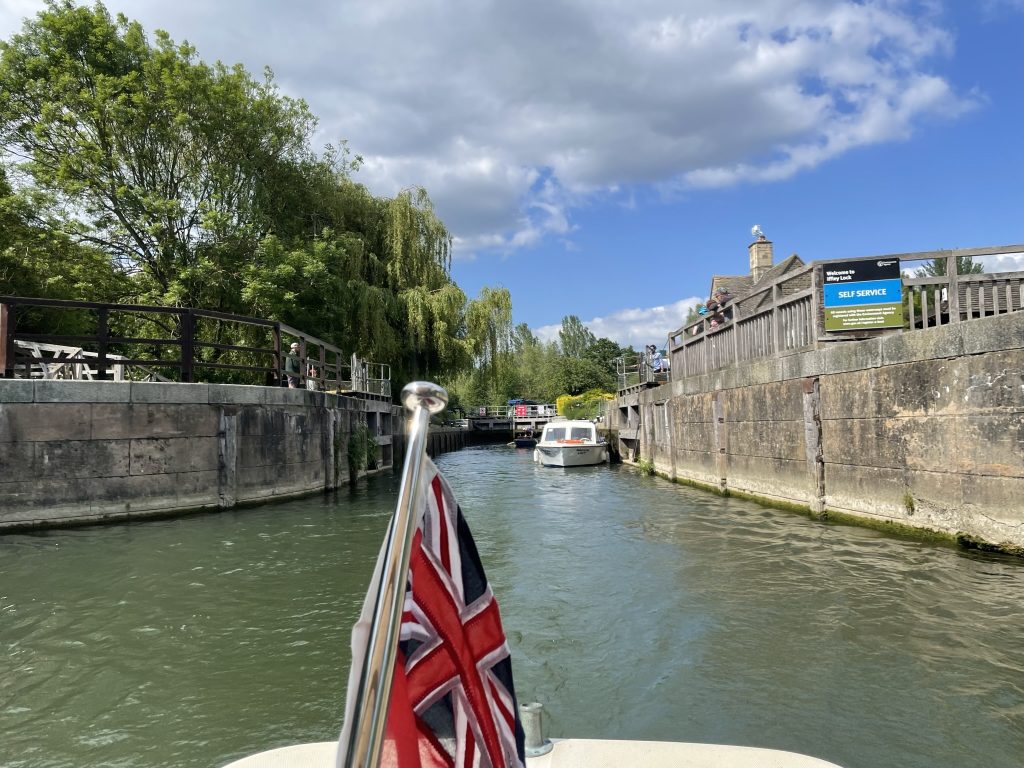
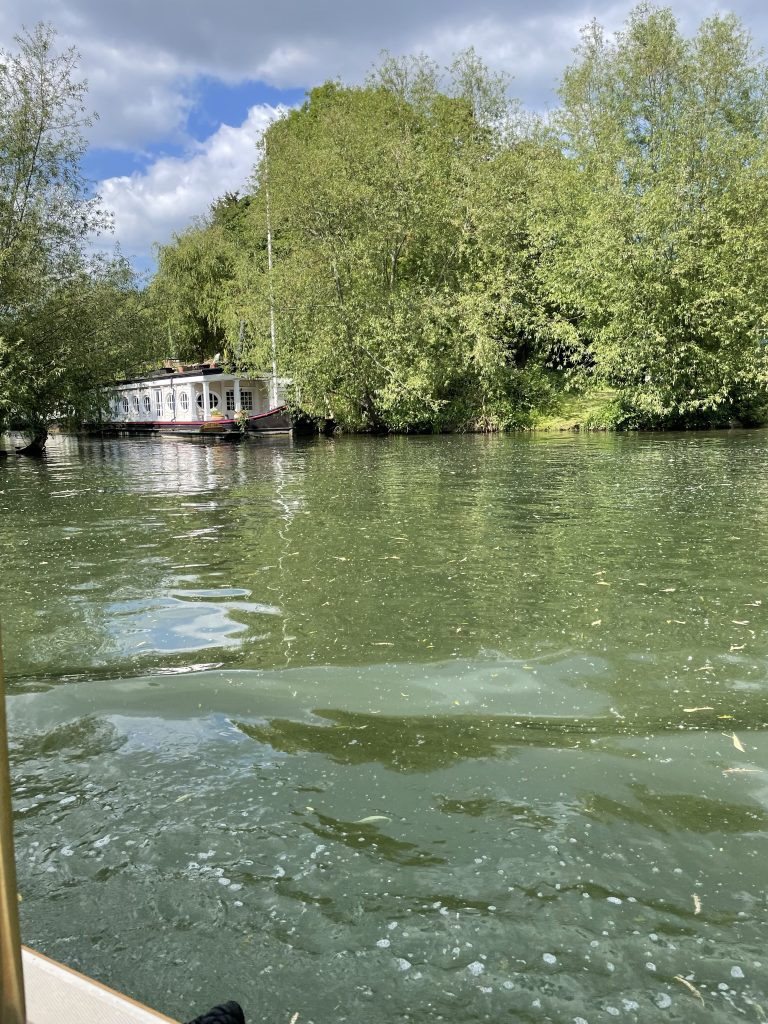
The staff told us about a stairway a block or two away that lead down to the canal path. We walked until sunset, along the canal and over the lock; through woods and past some of the university gardens; it was lovely. We watched several boats go thru the lock. We also saw a water bird– a crane or an ibis or something- just as we first came down from the bridge. There were lots of narrowboats and even a pub along the canal, which seemed very popular. A couple of punting teams were on the canal being bossed by no-nonsense older ladies– one was trying to get through the lock. Once it started getting dark, we had to go back. One advantage of being in England– no mosquito bites.
6-3
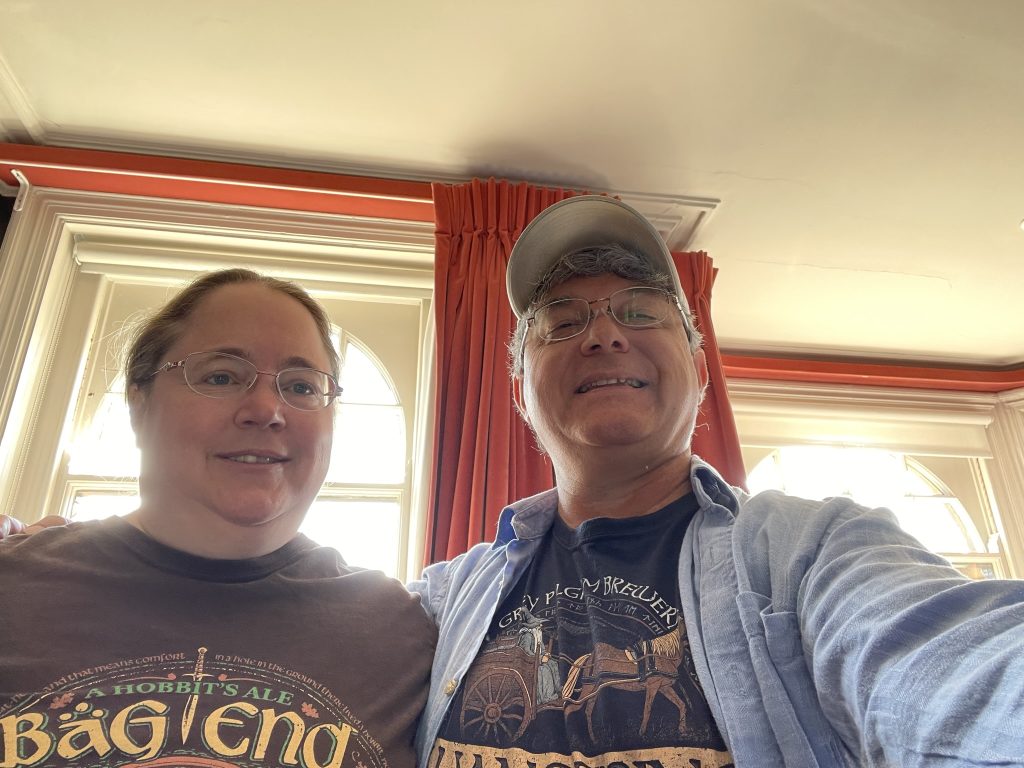
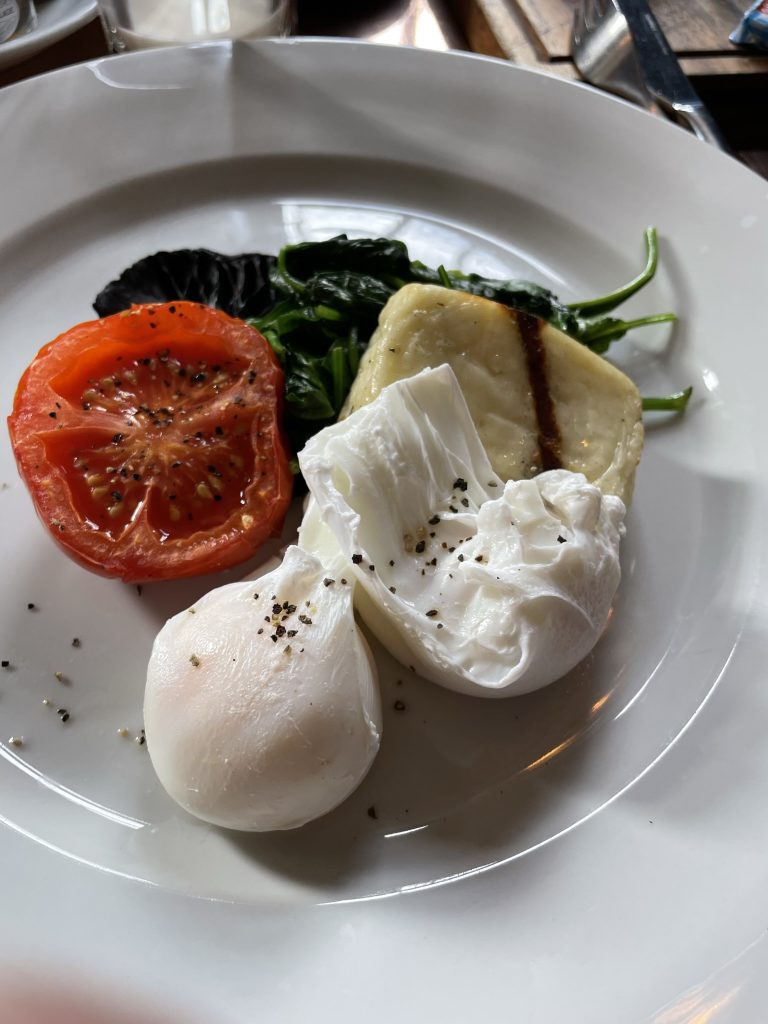
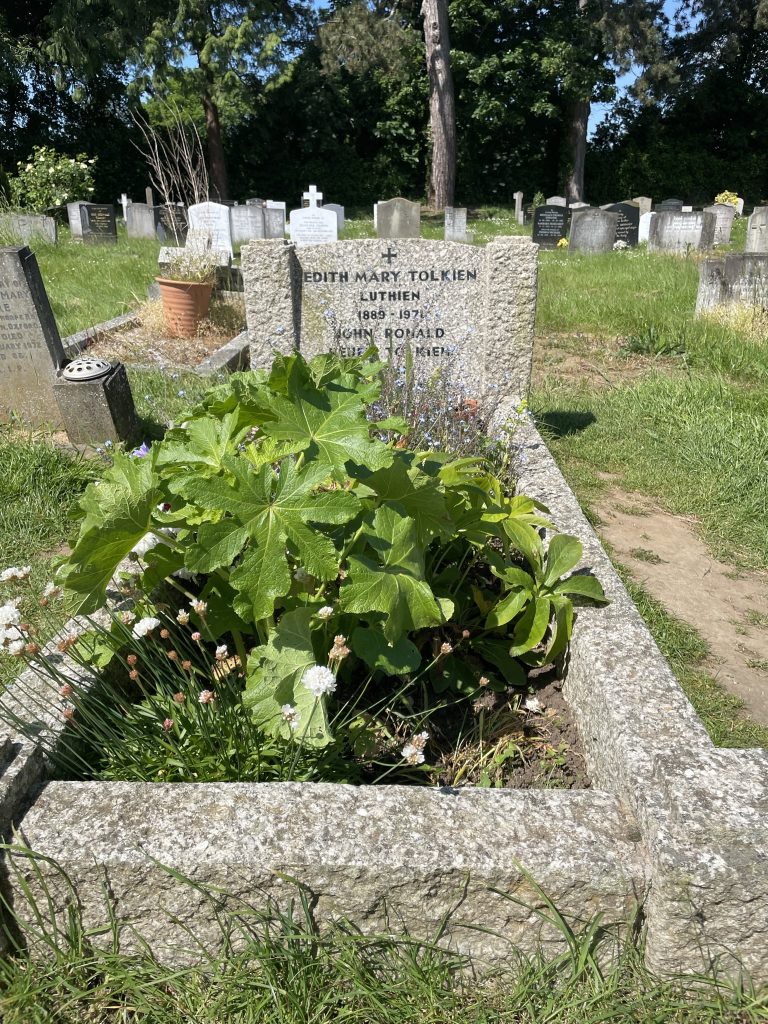
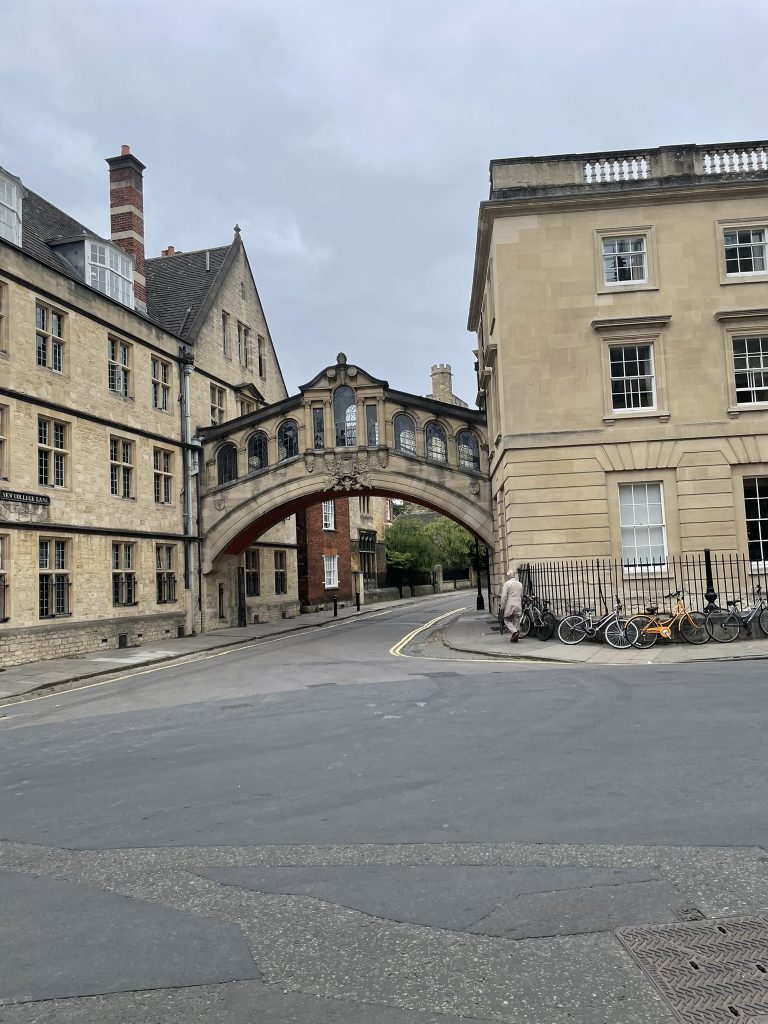
We got dressed up in our Tolkien pub t-shirts and went out to navigate the bus system to go to Wolvercote Cemetery, to view the Professor’s grave. It is right off the bus stop and there are helpful markers pointing you to the modest and pretty gravesite. Theres’ a small wildflower garden planted over the grave. We’d had a vegetarian English breakfast to fortify us– poached egg, seared halloumi, spinach, portobello, grilled tomato, toast– and wandered into a street market which had an amazing selection of food vendors. Sadly, we were not hungry, but I did buy a wall hanging and two pillow covers from a Kasmiri gentleman. He gave me a free silk scarf. Sean bought two prints of Oxford college buildings and the lady threw in a charcoal print that had a little damage on it but is still salvageable. (total 100 pounds, 50 for the weavings and 50 in cash for the prints as her card machine did not work.)
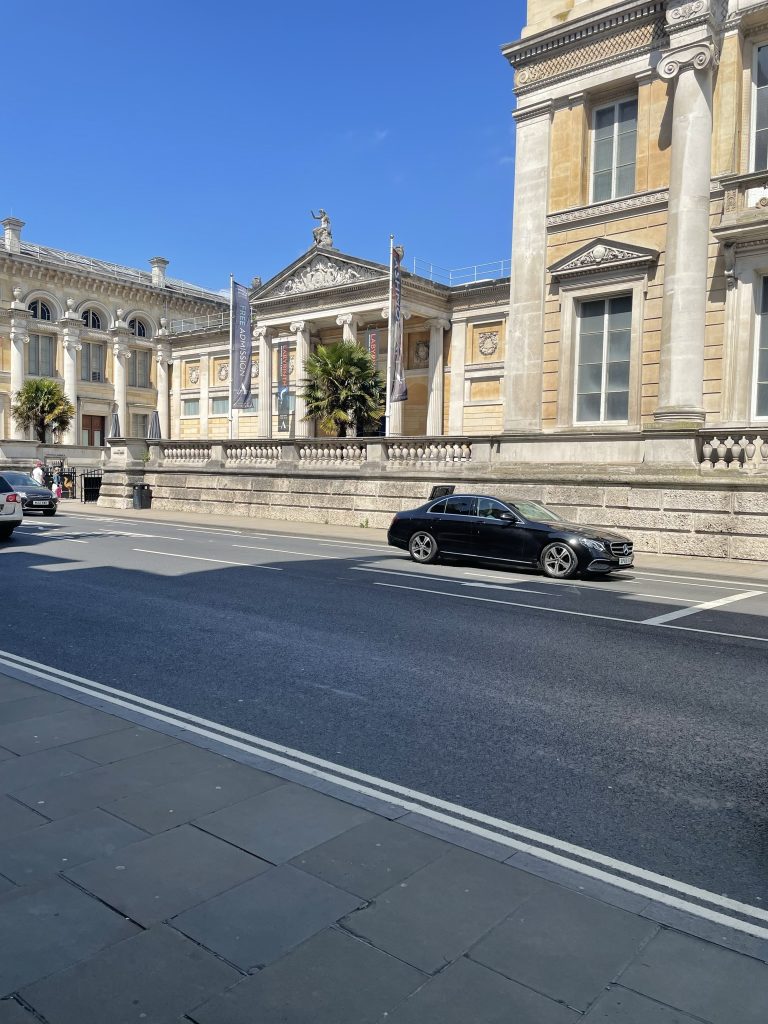
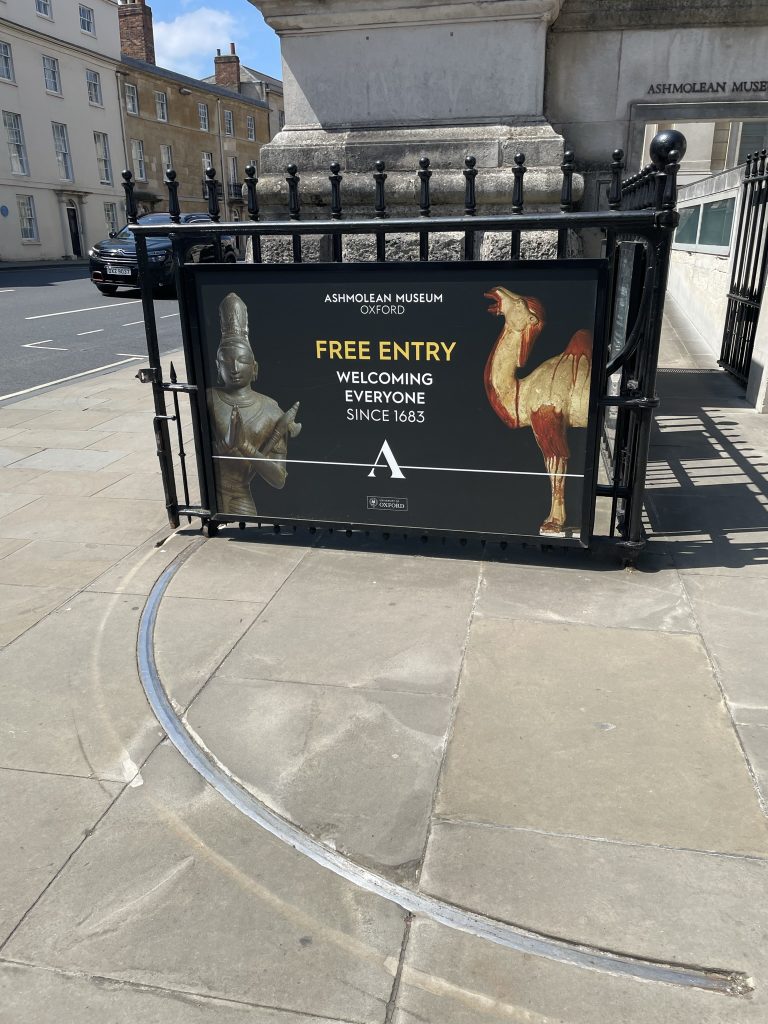
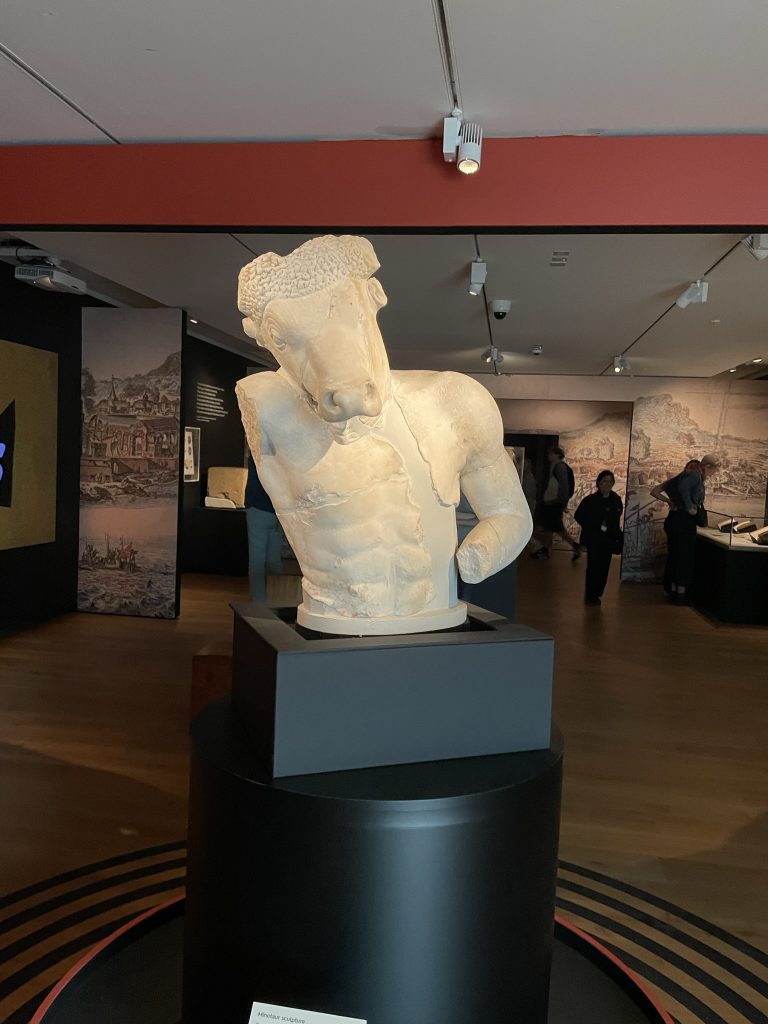
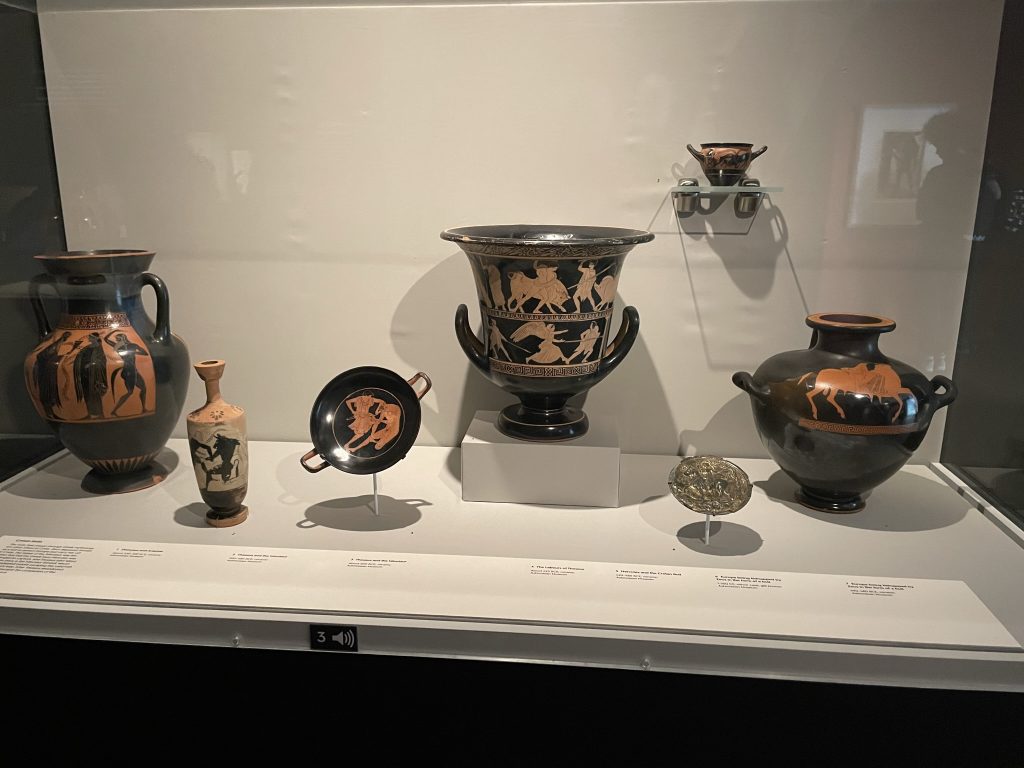
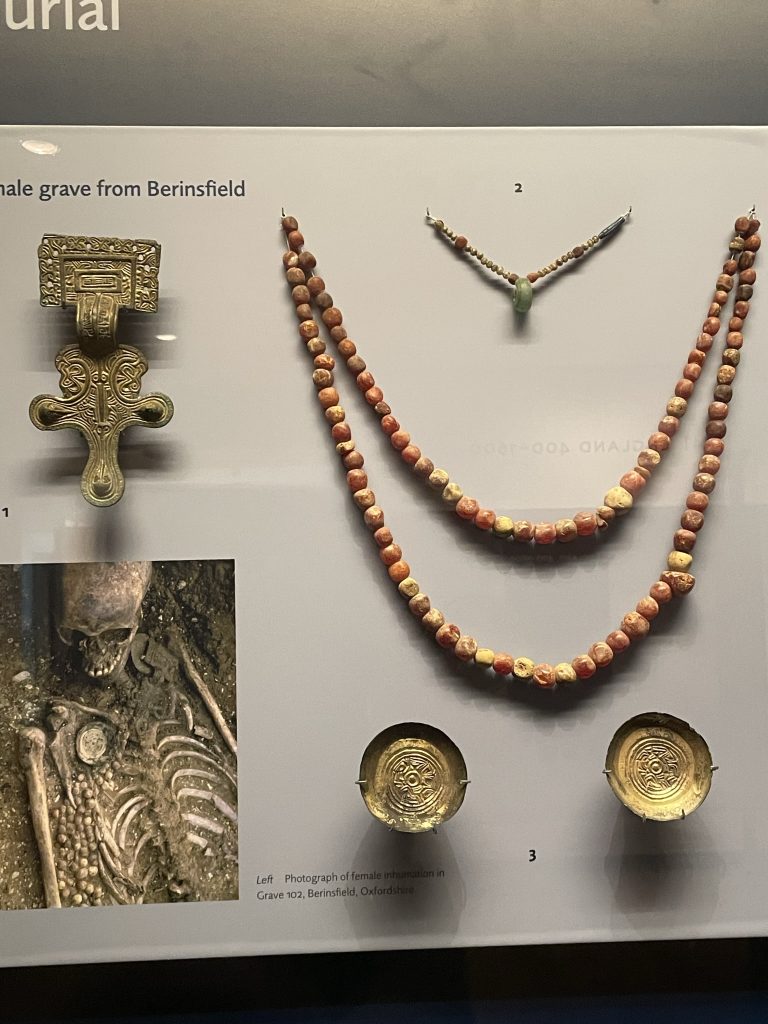
We went on to hit the Ashmolean, seeing the Knossos exhibit as well as the Anglo- Saxon collection. Someone’s collection of demon children made that exhibit a bit hard to concentrate on– it would’ve been much nicer without their screeching and banging on things– but it was still very worthwhile. The Ashmolean is very ornate on the outside. We didn’t make it to every gallery– it would’ve been a few days– but even so we wondered at the size of it because physically it is not as big as we would have thought. I am guessing they have ten times in storage what they have on display.
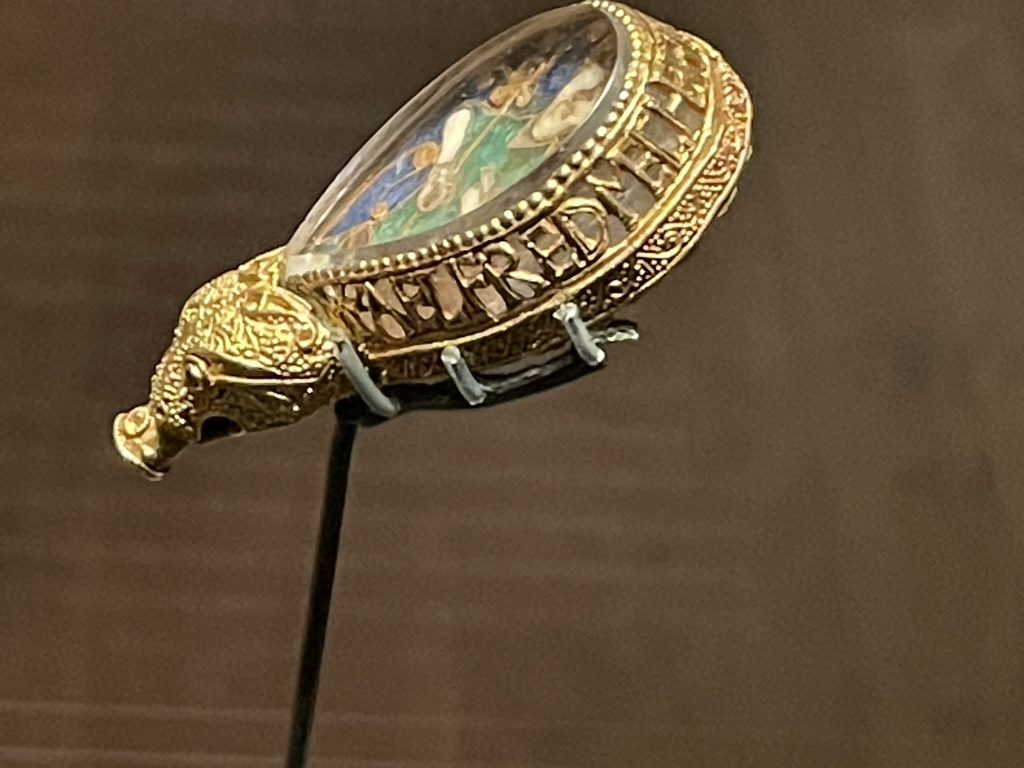
Technically the museum is free, but we paid for the special exhibit and also donated to the museum. As usual we hit the gift shop hard, the best purchase being a replica Alfred Jewel for Sean and a Liberty print blouse for myself. I also got a William Morris print melamine plate and a small book and a magnet. We left at about 1:15 as we had to get ready for our afternoon cruise.
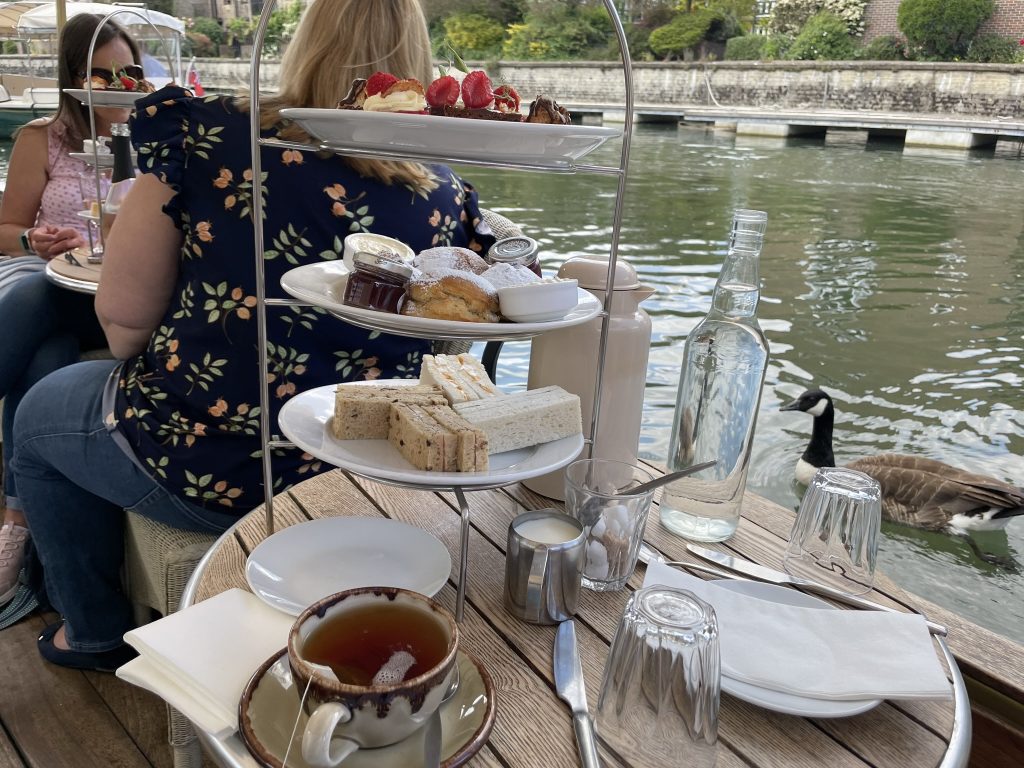
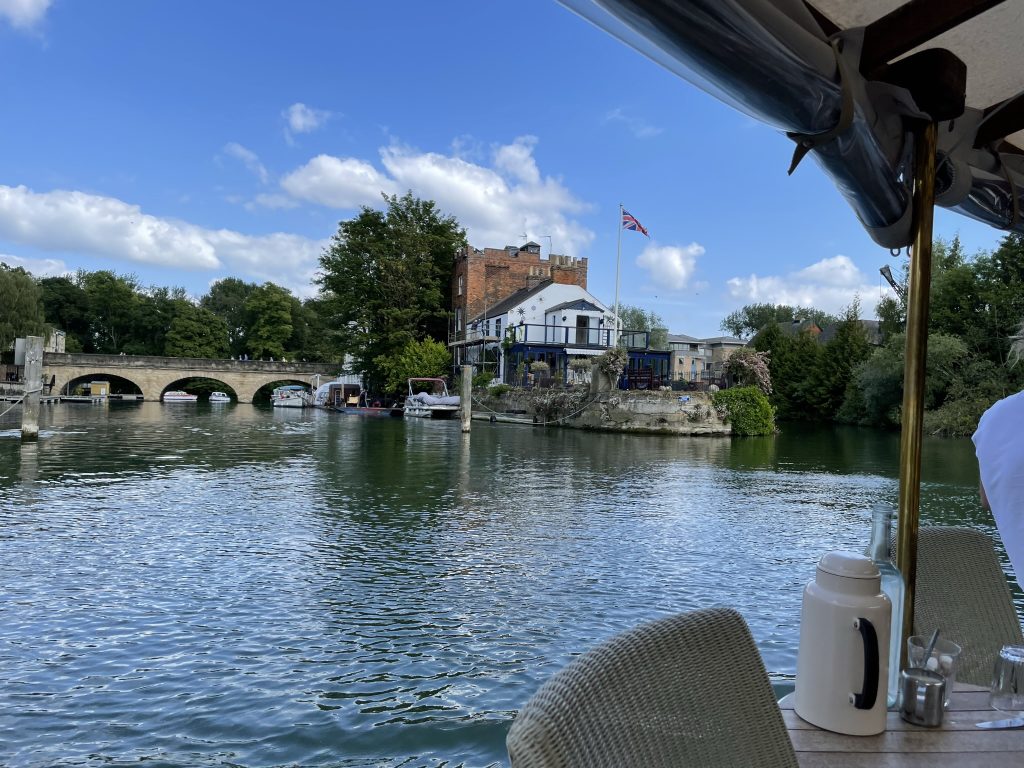
We went to the Folly Bridge to the restaurant there where our tea cruise was scheduled. The Folly restaurant caters the tea cruises. Other passengers had ordered prosecco with their cruise, so they were pretty merry. We sat in the far back of the boat on a padded bench and ate our giant tea. There were two scones apiece with clotted cream and strawberry jam (having learned, I ate mine first so they were still warm and good); there were four kinds of sandwiches– egg salad, salmon and butter, cucumber and watercress, and some sort of chutney thing. For sweets, there were cream puffs, chocolate-dipped macaroons. And the ubiquitous brownies, which again I skipped. The geese were incredibly bold and came up to within inches of the boat looking for crumbs.
We caught a bus up to the city center and wandered through the Christchurch gardens, as the front part of the gardens was open to the public then. At around 5 pm, We went to St Phillips bookstore– an archetypal antiquarian bookshop– and got some things and had them shipped. Then we popped into a tourist shop and got a couple of Oxford tshirts.
We had dinner at the Porterhouse quite late after another walk along the canal– I had char-grilled sea bream with a fennel slaw and tossed salad and smoked potatoes; he had steak and chips. I had a smoked sticky toffee pudding with ice cream and a cappuccino; he had a chocolate lava cake. The whole fish and the sticky toffee pudding were outstanding. I had an Aperol spritz and he had a Rioja Blanc.
6-4
Cotswolds Tour with Jonathan Sayers
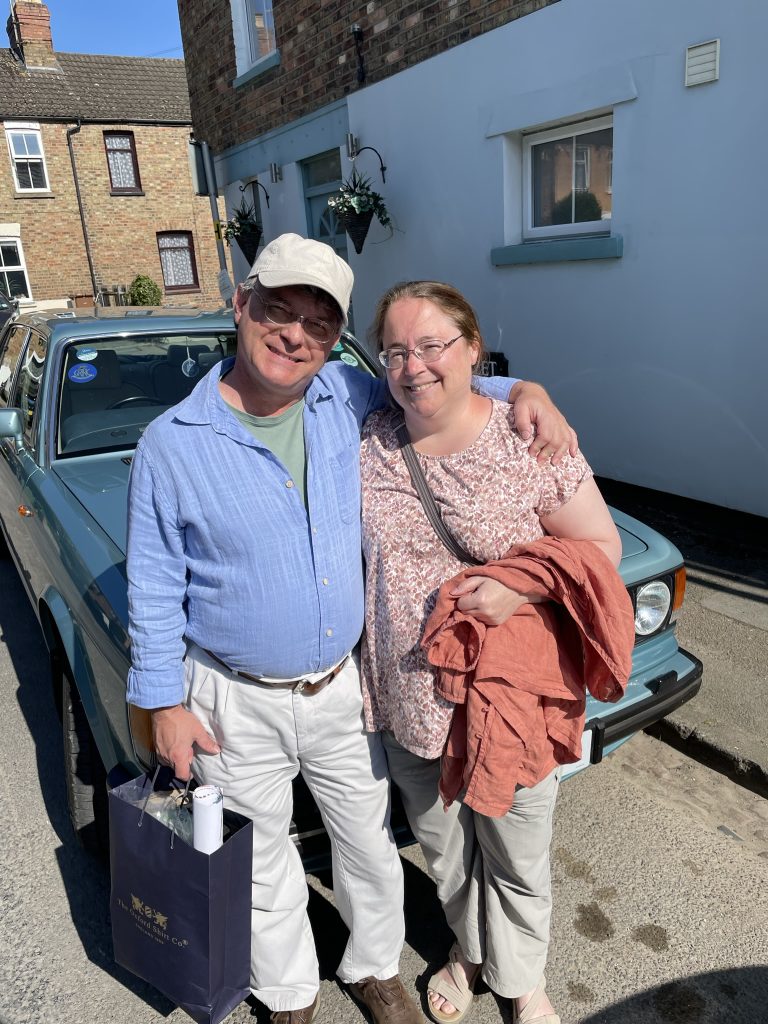
Jonathan was our tour driver and he picked us up at our location; he drove an early 1980 Bentley. Unfortunately I did not get a good picture of it. He was a former schoolteacher at a public school and had a friend/relative who was a ?? at Windsor, so had run into royalty on a few occasions and gave us his point of view on the coronation. Apparently King Charles is genial and low-key in person when behind-the-scenes and has a sense of humor. Queen Camilla likes to play jokes. Jonathan was very appreciative of the new King’s longstanding efforts to maintain historic English buildings and countryside. He (like our other driver) complained quietly about the huge cut taken by the booking service.
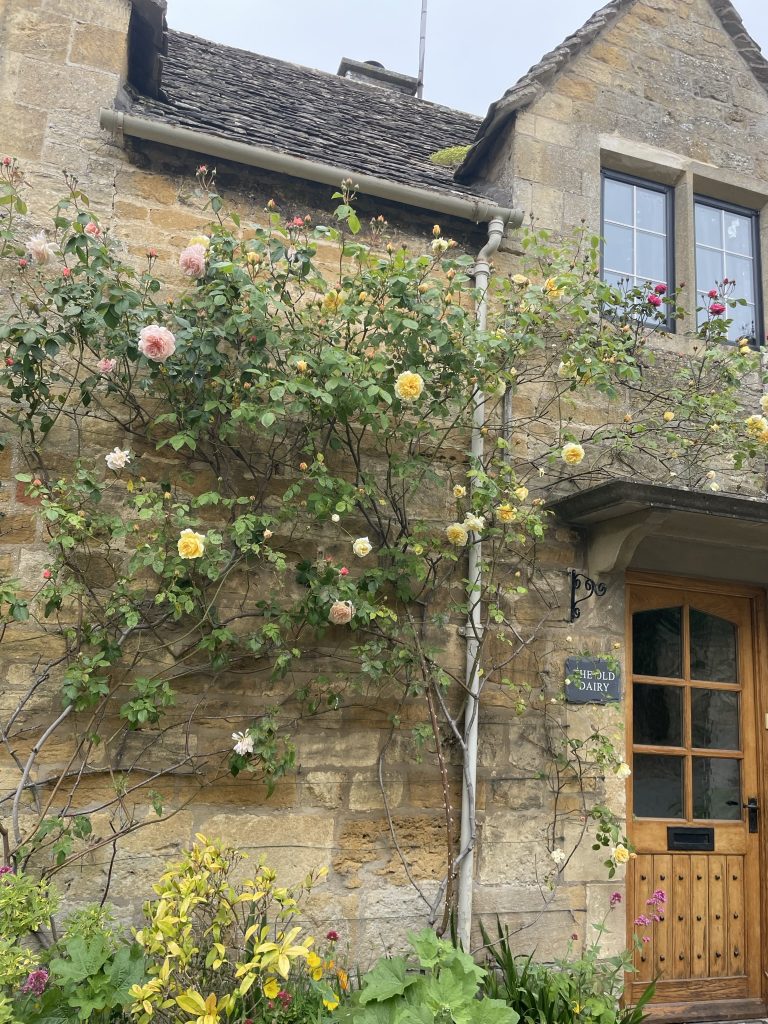
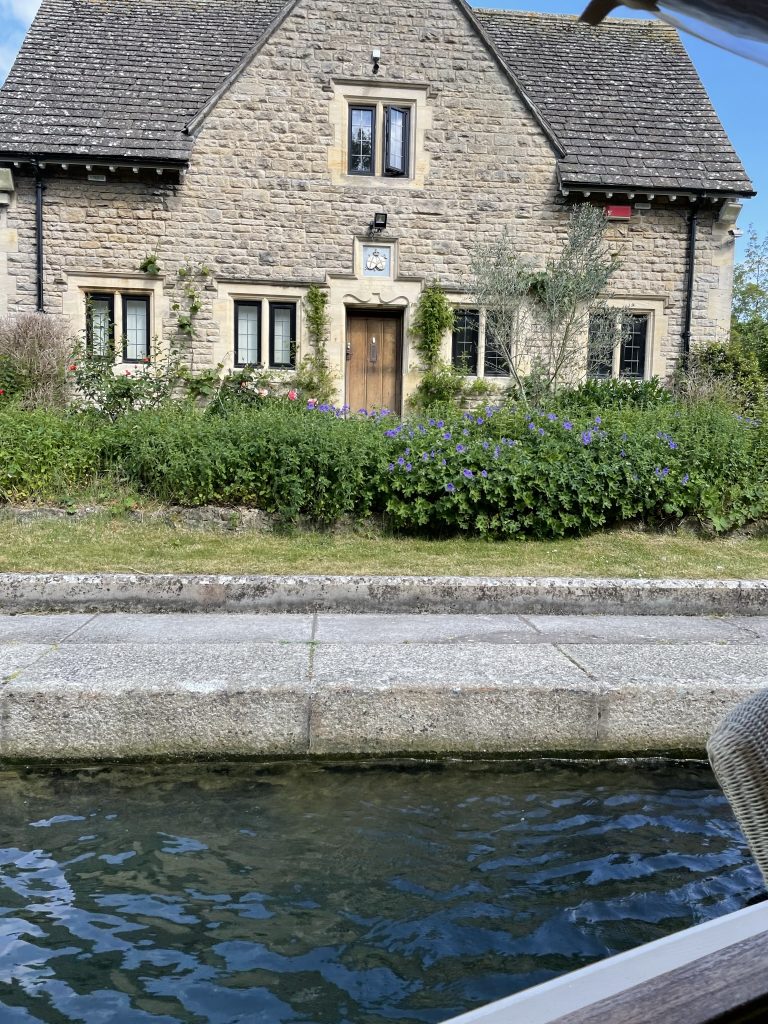
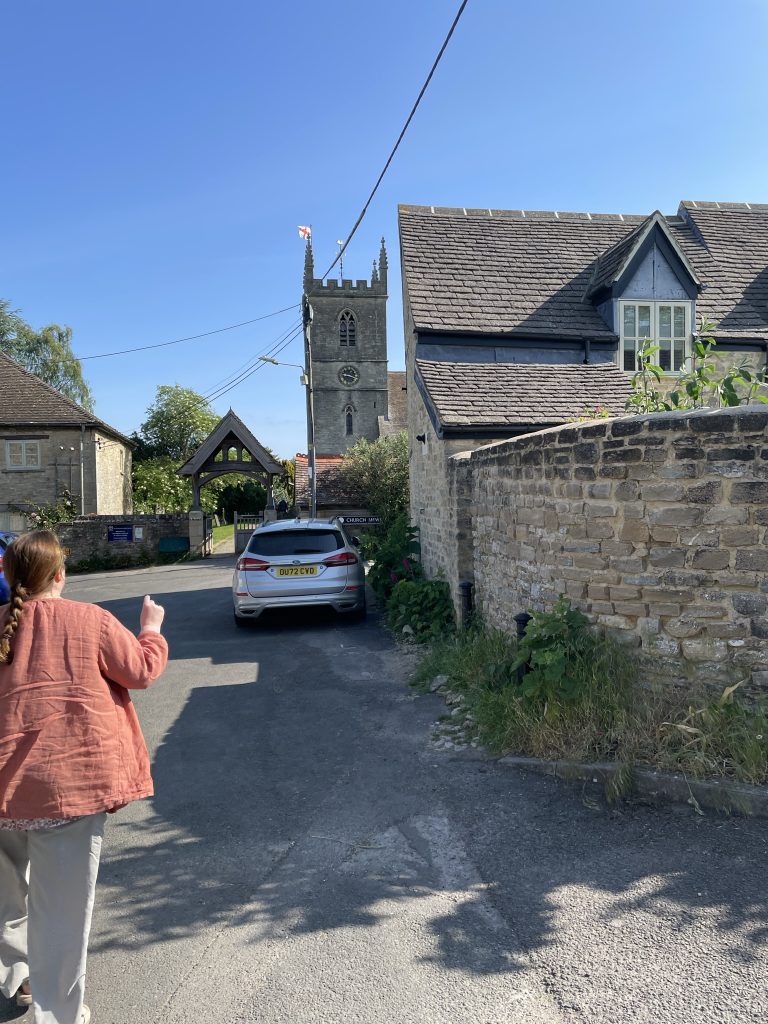
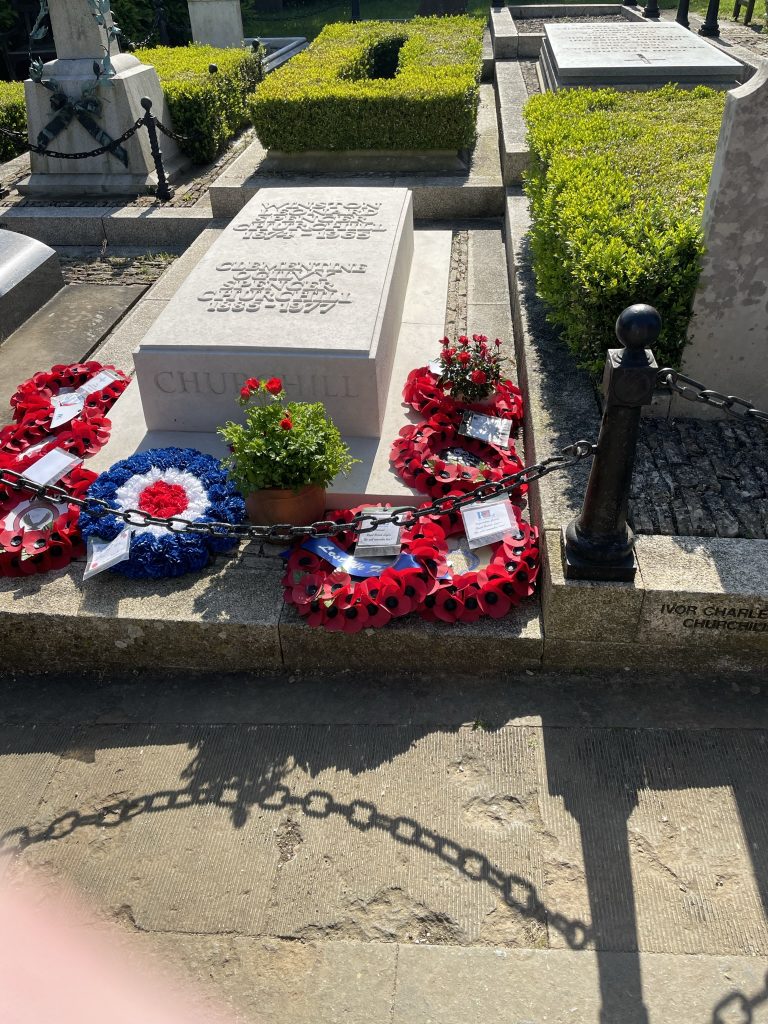
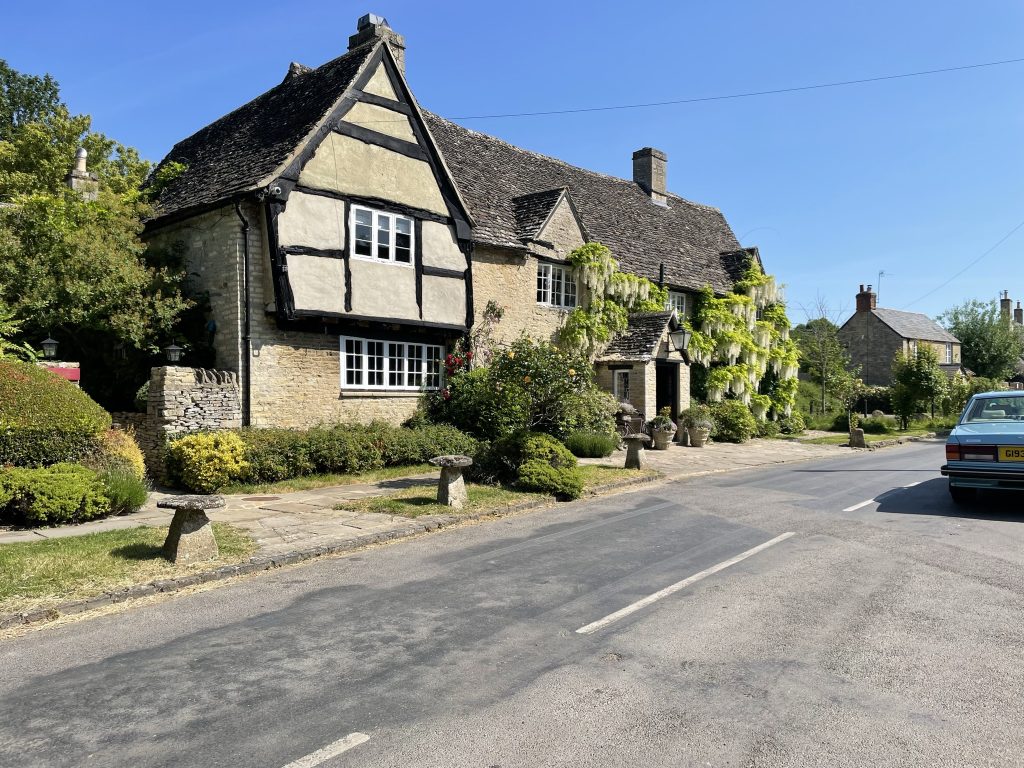
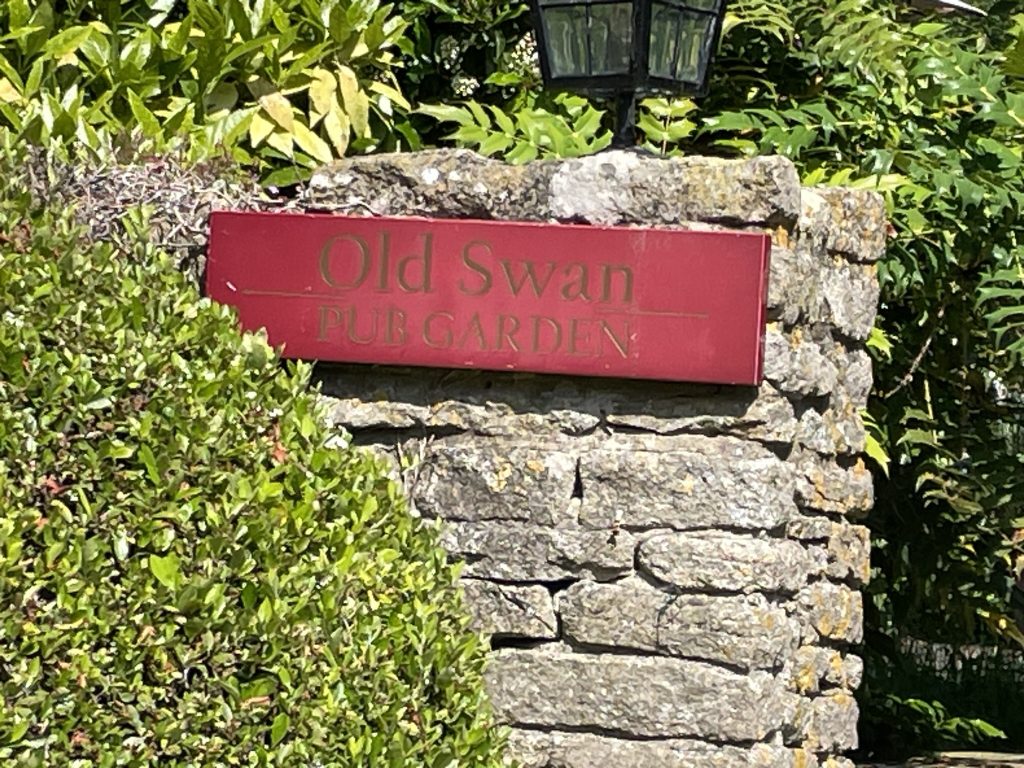
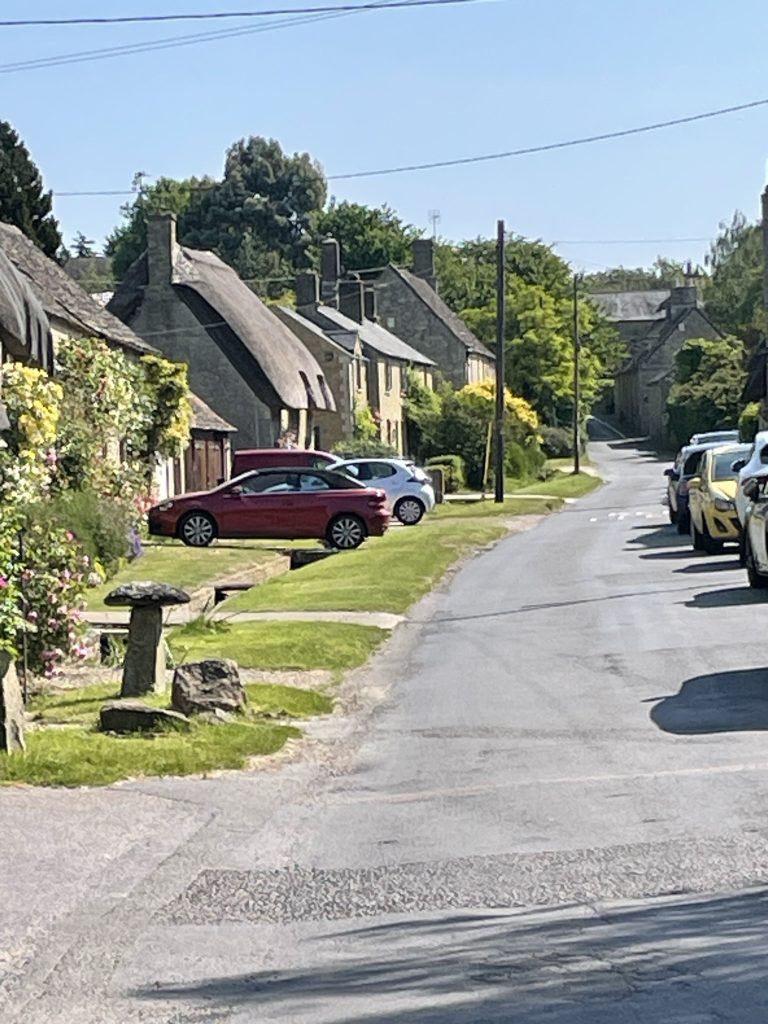
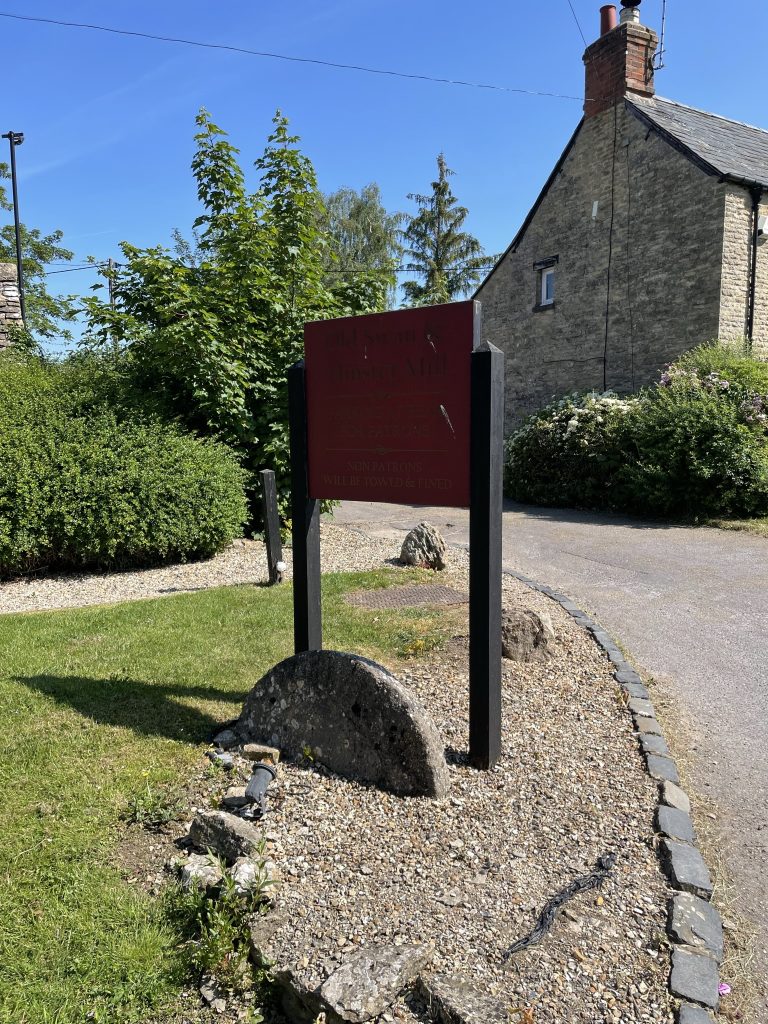
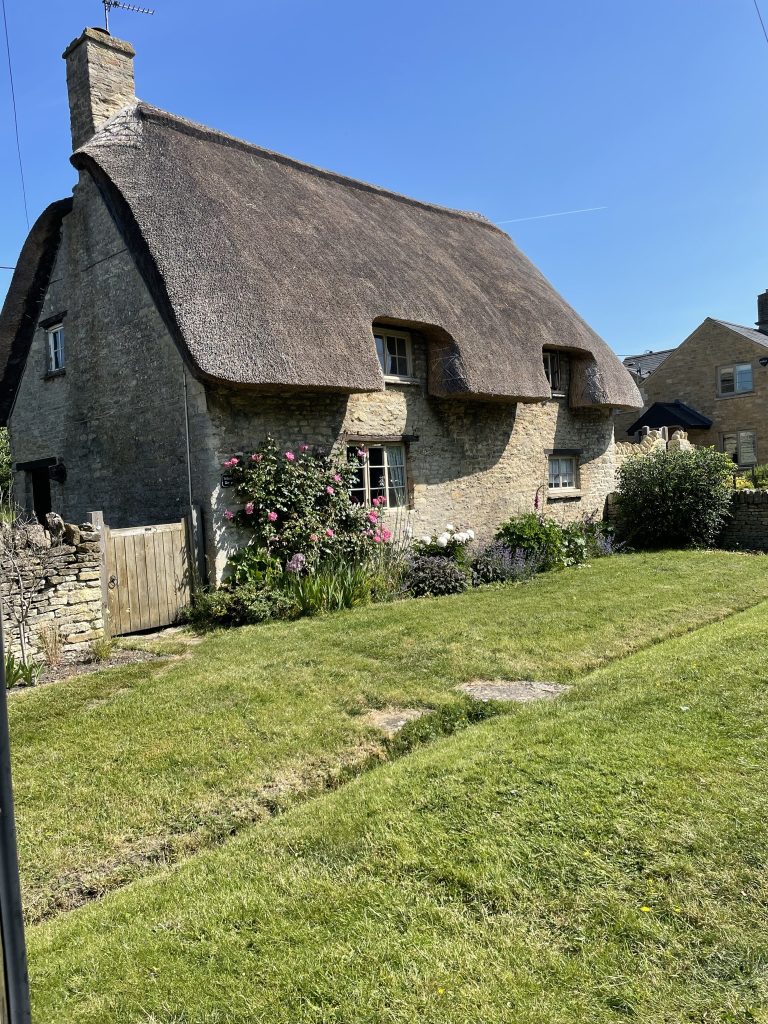
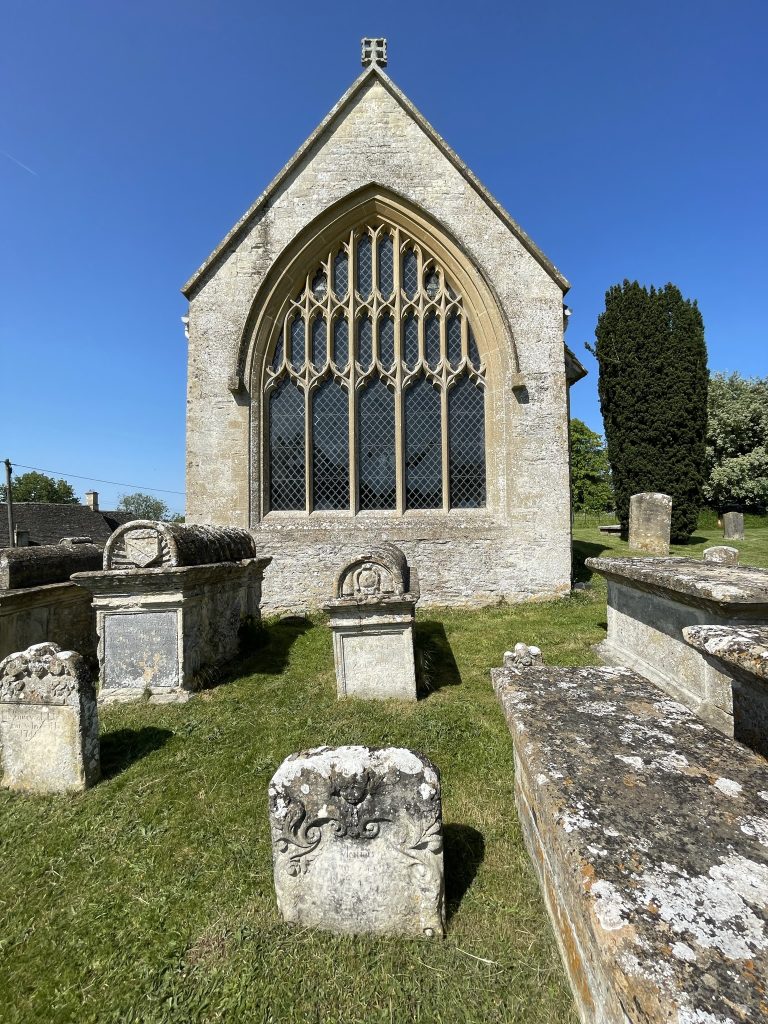
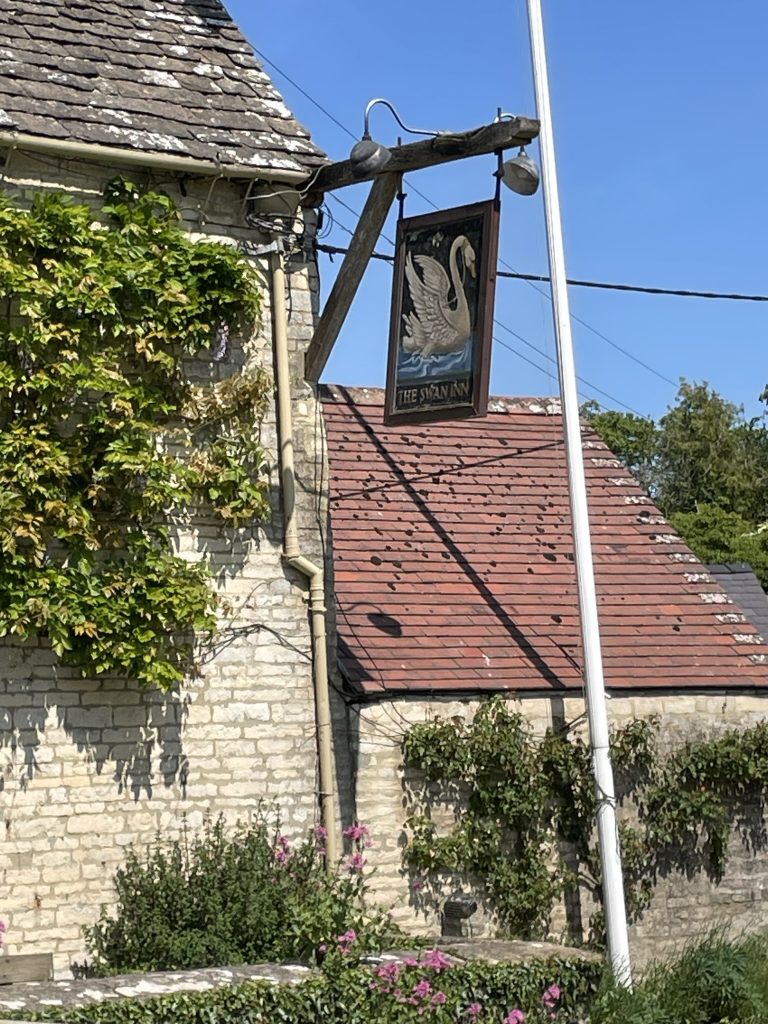
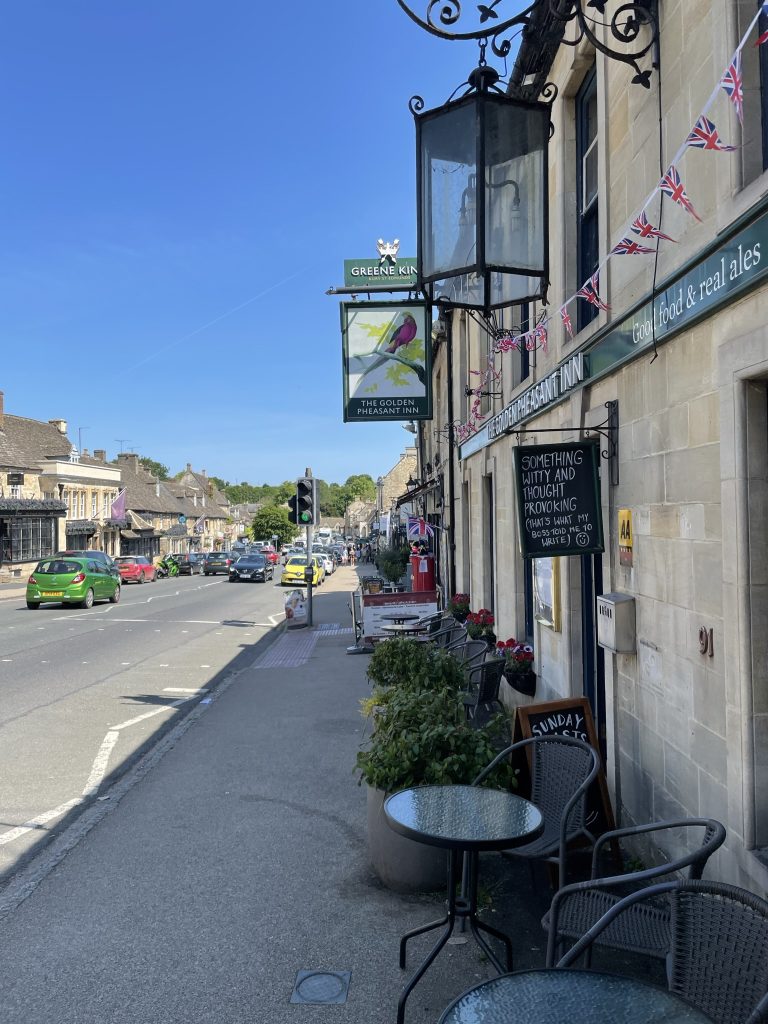
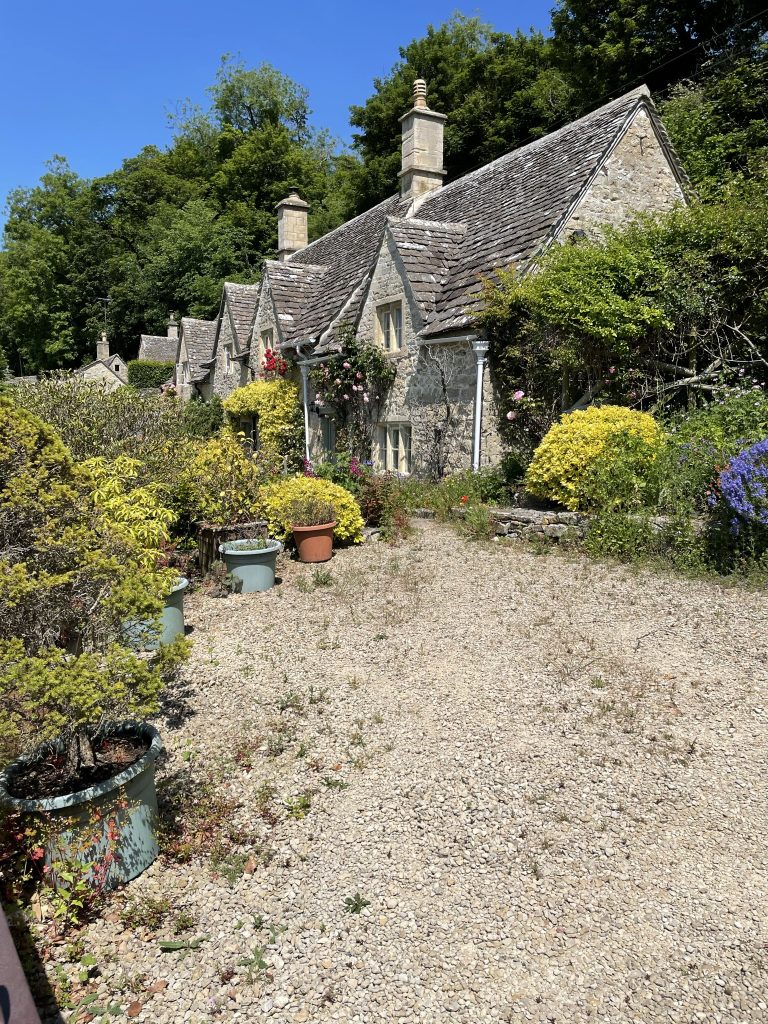
We visited Bladon (church where Winston Churchill is buried, lovely cemetery, fairly modest; grave was *covered* in red poppy wreaths including one signed by the head of the Navy. We went to Minster Lovell, which was quiet and lovely and had a number of thatched-roof cottages. He dropped us off and we walked down the row of houses to take pictures of them and their gardens. We looked out at the view over the fields at Widford and then went to the church at Burford-Swinbrook, which is where the vicar let us in to take pictures. We did some shopping in Burford itself, which is a shopping town (noon, Oxford Shirt Co, 180 pounds). We ate in Bibury, at a fancy little inn, the Swan Inn. We finally got our Sunday Roast, though sadly it wasn’t all that, and this was one of the two indifferent meals we had there. It wasn’t bad, but my pork roast was too done for my taste and Sean reported that his roast beef was too fatty for him. The gravies and roasted vegetables and cauliflower cheese (just cauliflower with cheese sauce) were excellent. The yorkshire puddings were giant, tepid, and kind of greasy. The beer was good. Seafarer Ale. (12:30 pm 66 pounds) The floor had an interesting and original tile pattern.
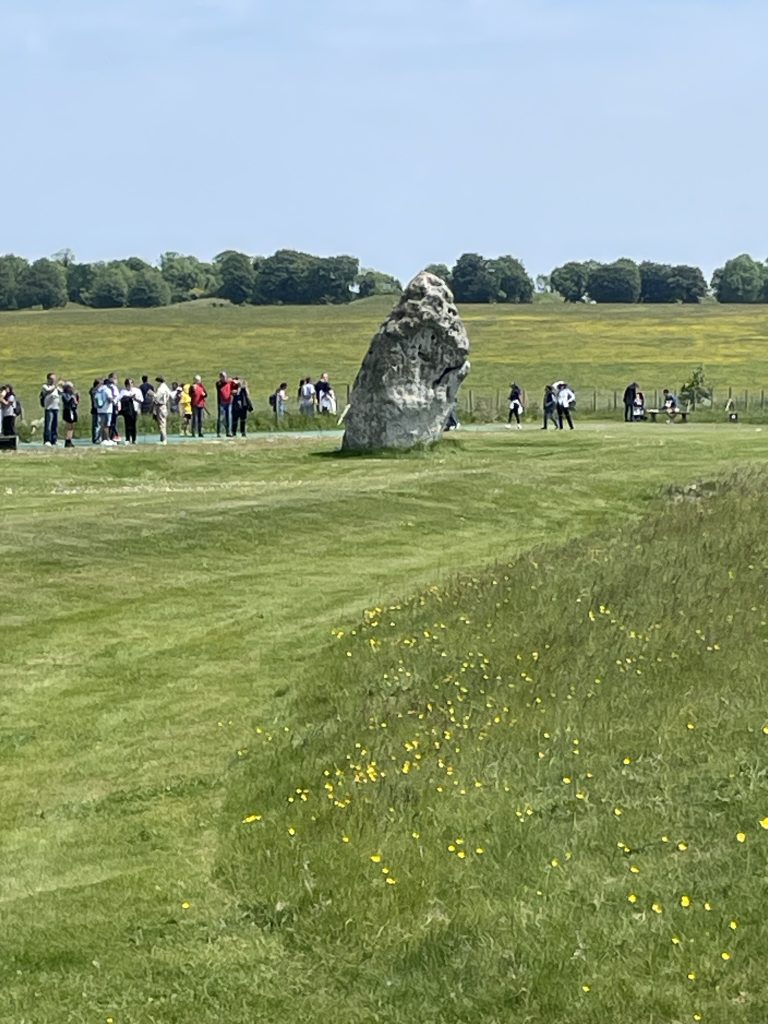
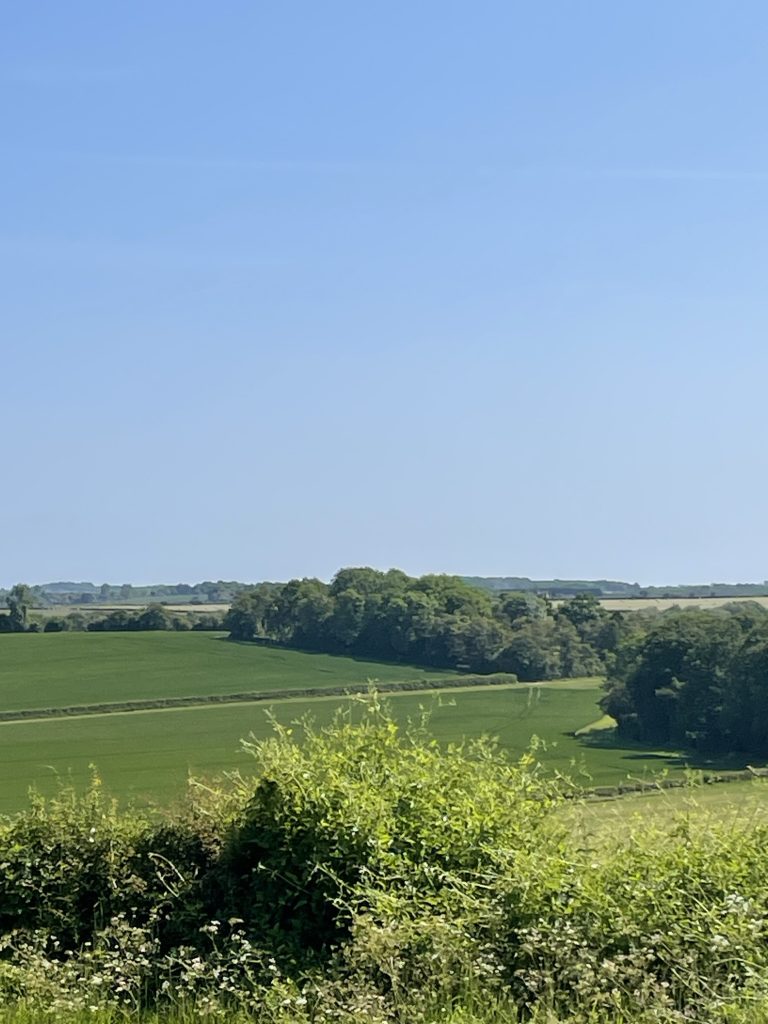
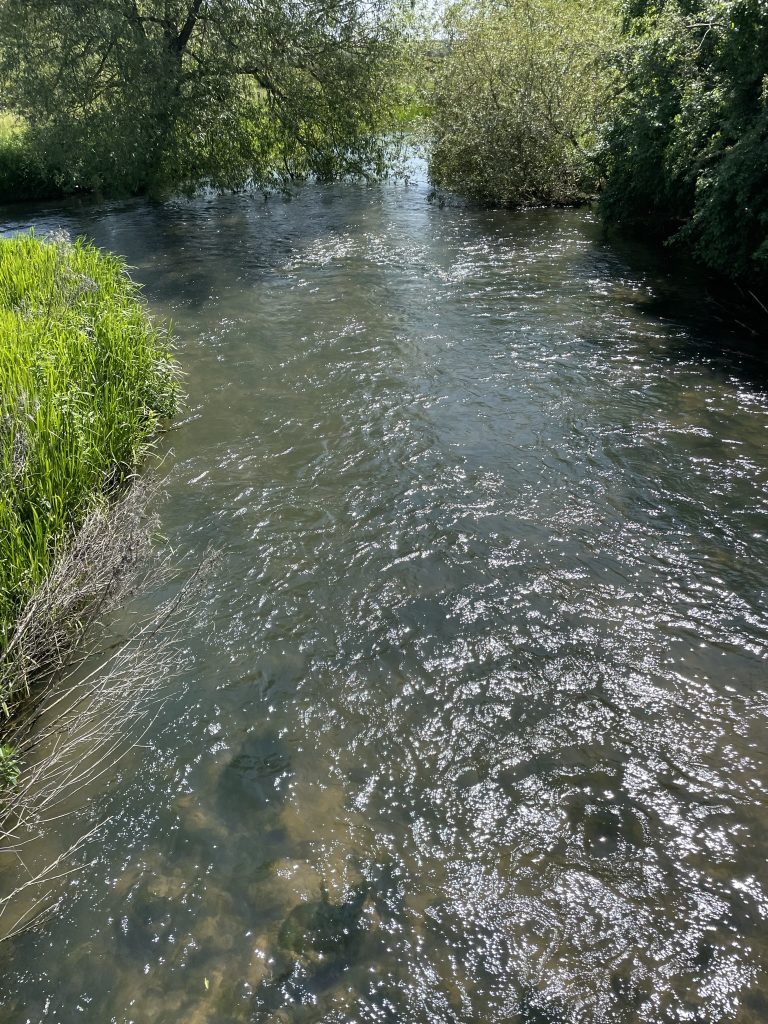
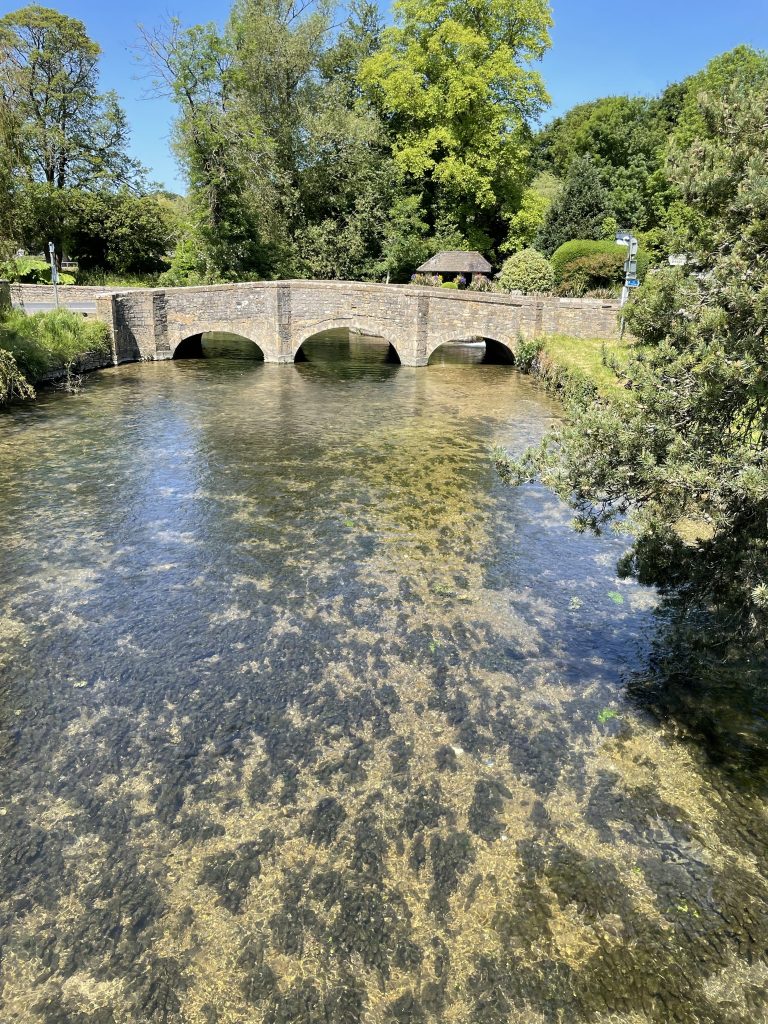
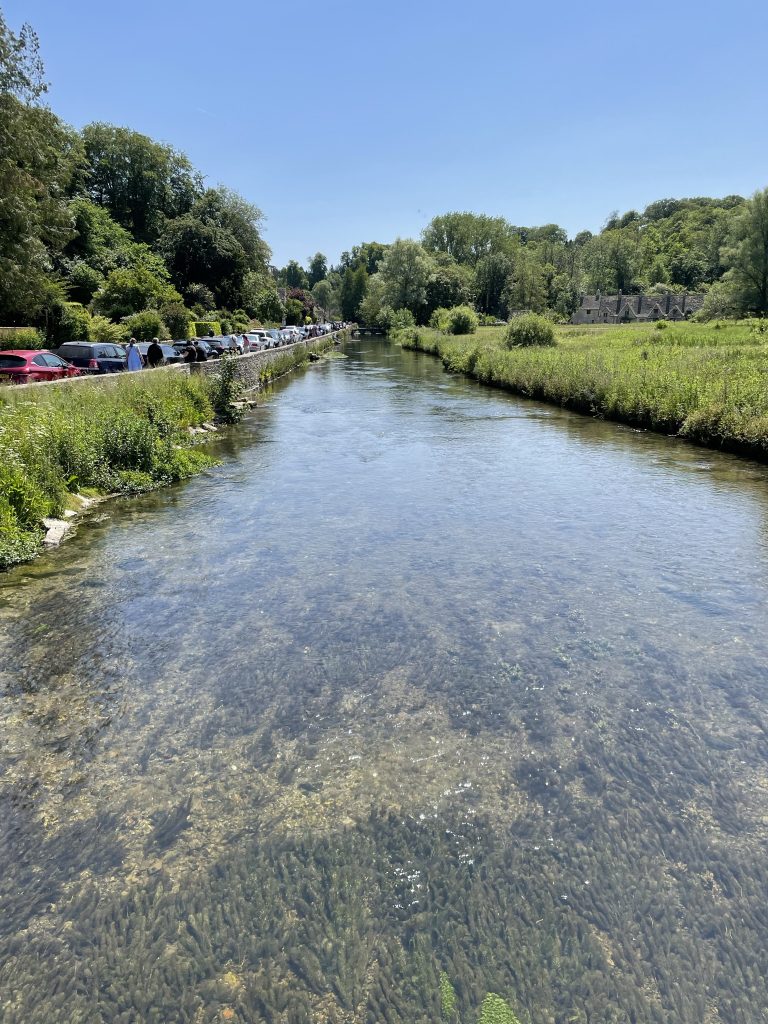
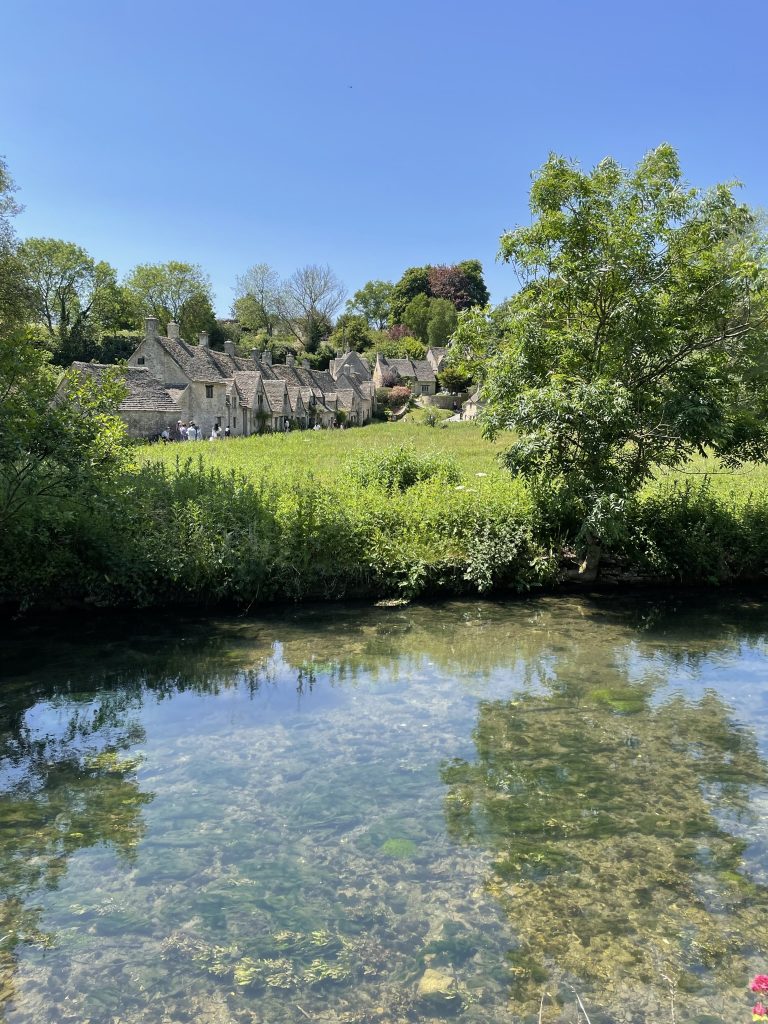
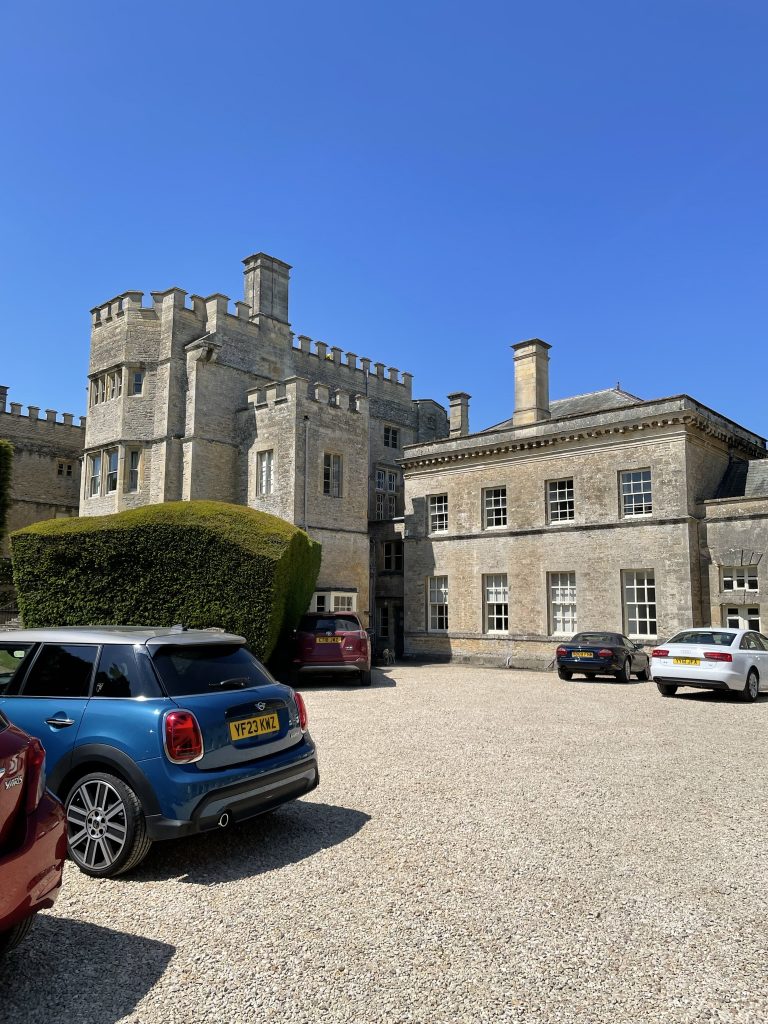
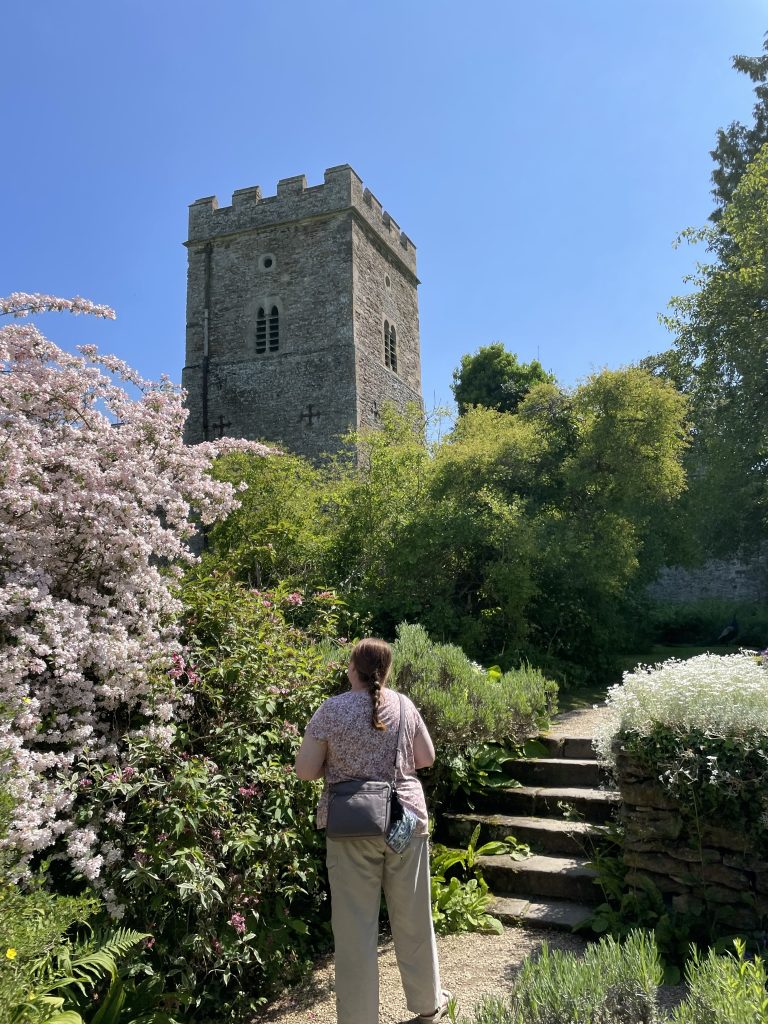
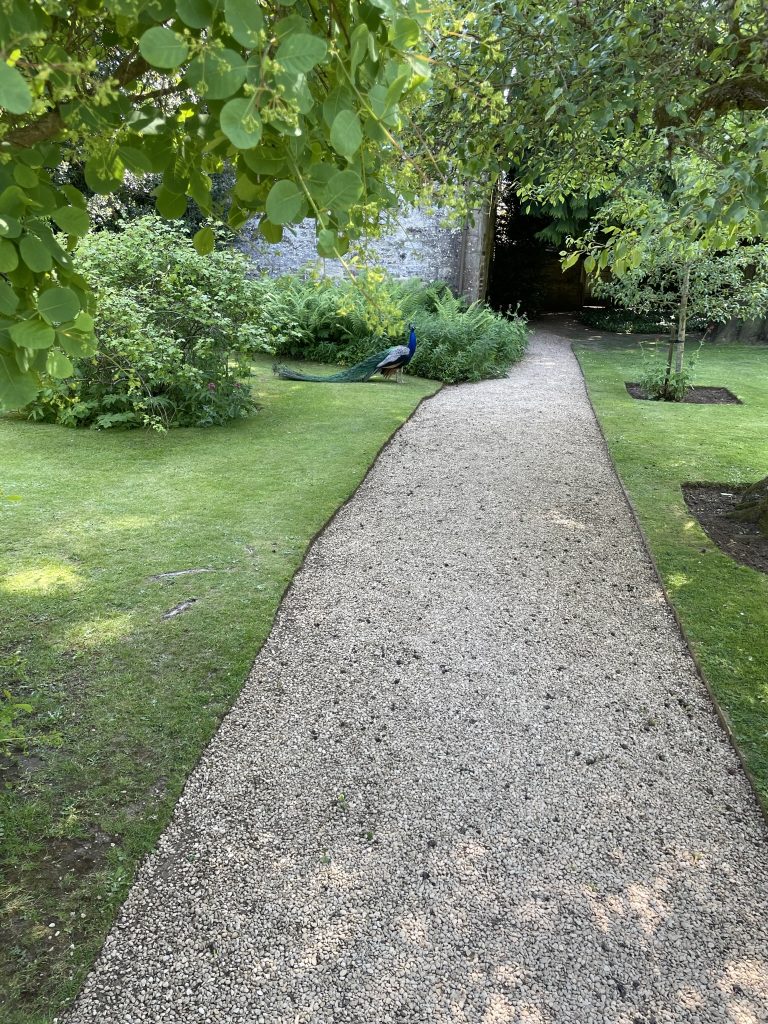
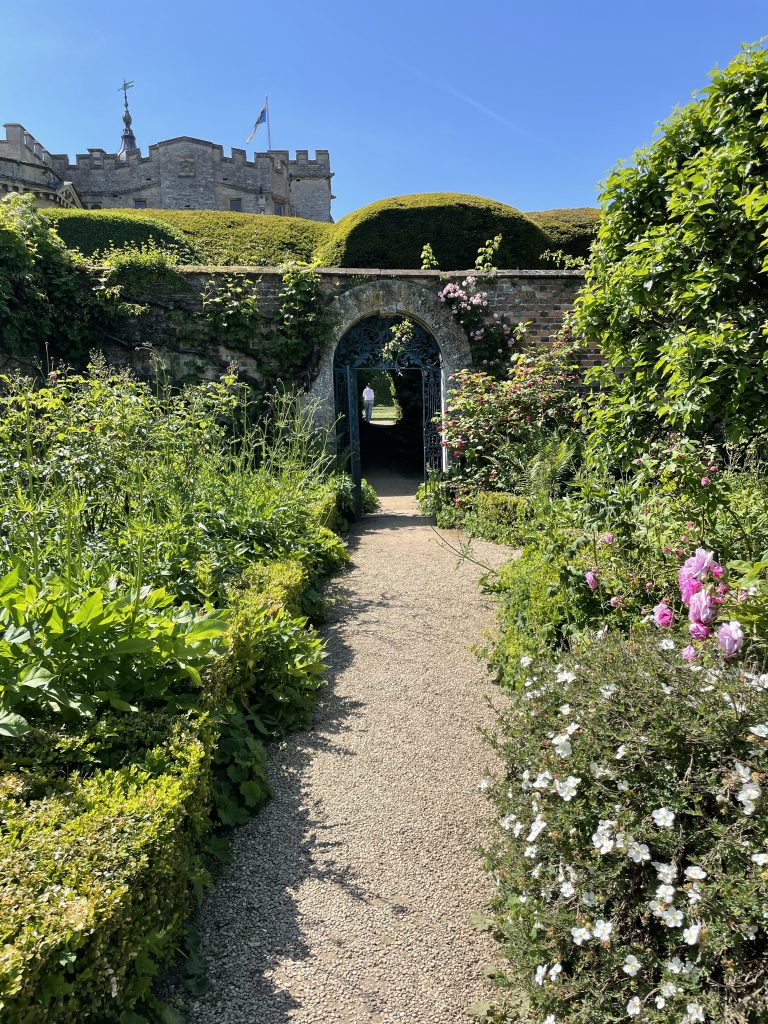
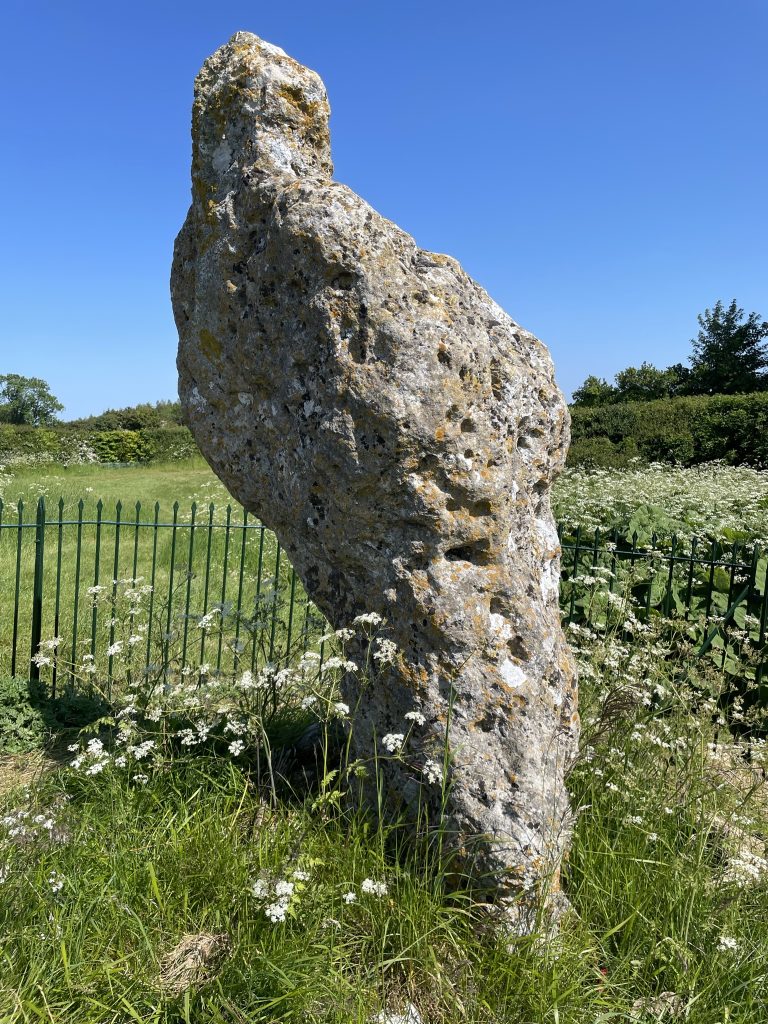
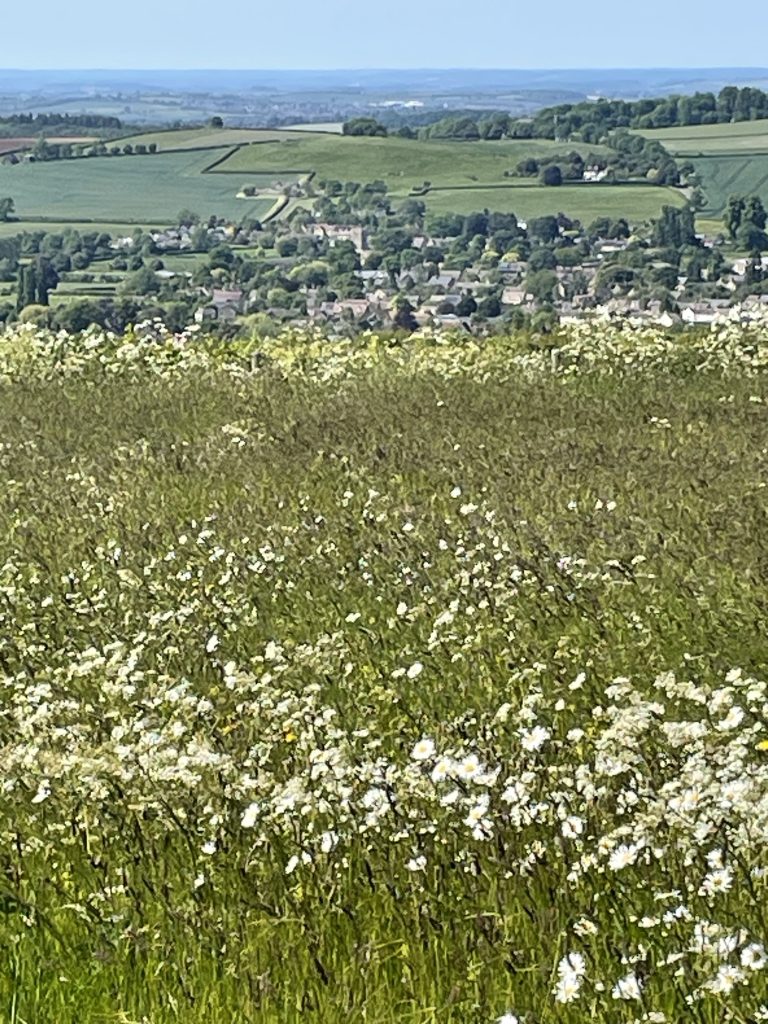
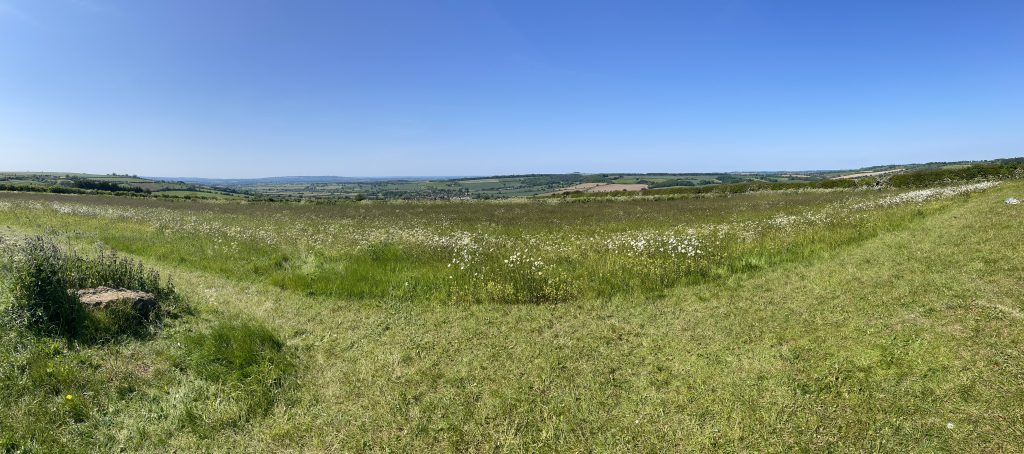
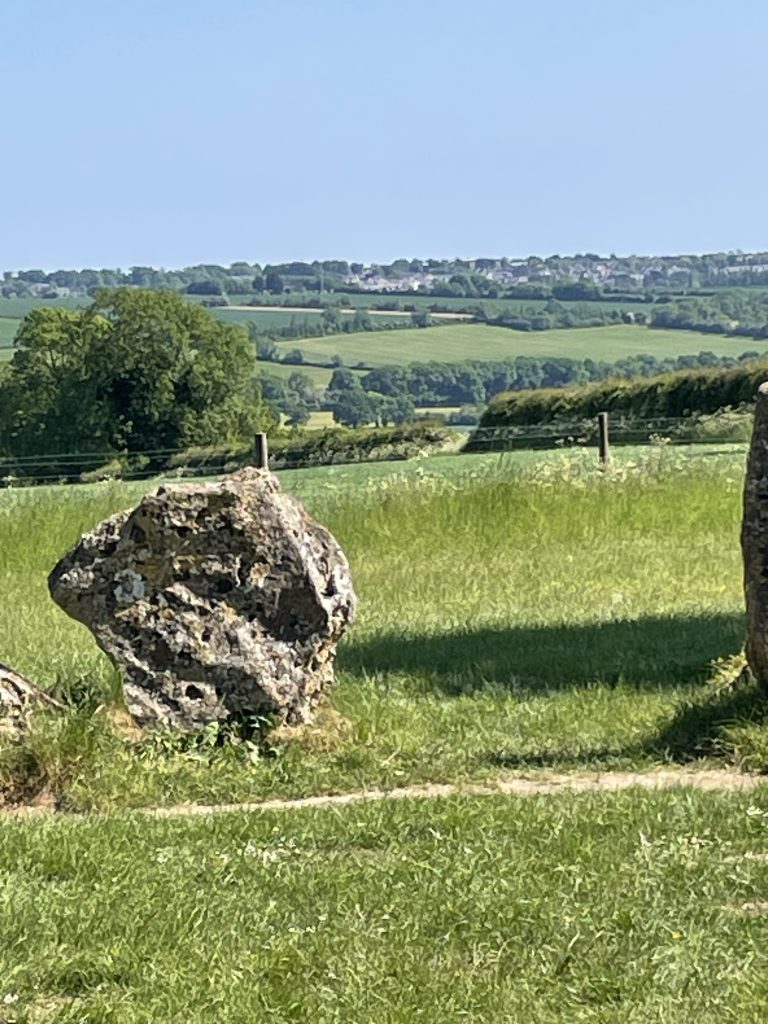
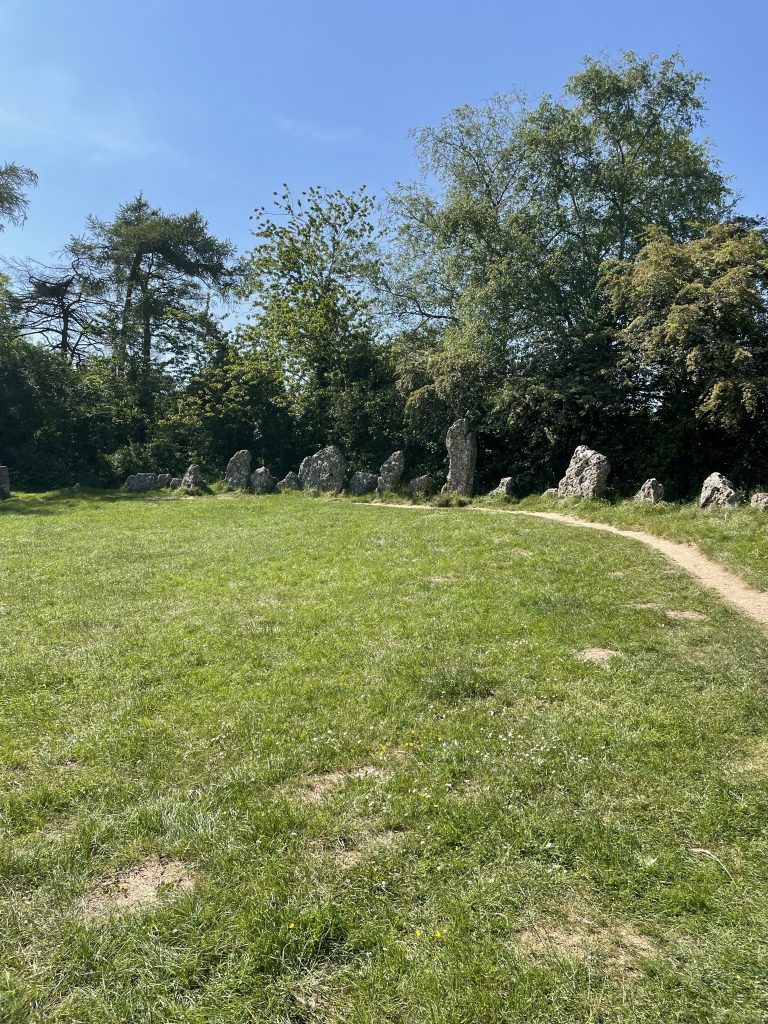
We stopped at the Bibury Trout farm to buy souvenirs (27 pounds, 1pm) and walked along the river, which comes right up to the park lawn… and tried to take pictures of the artists’ colony cottages… but there were a ton of tourists. Jonathan explained that the Japanese visitors came there because Emperor Hirohito had vacationed there and said it was a very peaceful place. We went to the Rousham House Gardens near Lower Hayford, which are a transitional garden halfway between formal-style manicured hedge gardens and the later Victorian gardens that are bursting with flowers. There were many espaliered fruit trees (that were clearly very very old) and we looked at them closely as we now have several apple trees. We went into the chapel, which was still decorated from a wedding from the day before. After that we ended our tour by going to the Rollright Stones, a Neolithic stone circle that is so out of the way that the fee for seeing them is 2 pounds, which is paid via dropping coins into a coinbox. There is no gate or attendant. You can walk up to, sit on, etc the stones. On the other side of the road is the king stone– and you can look out over the countryside from it for hundreds of miles. The signs there noted that the stones themselves originally formed a stone wall with no gaps except for one, enclosing a circle. It was a truly amazing site, just us one other small group and some guy sitting on one of the stones playing with his phone. We were surprised at how cavalier people were about them. The stones were placed sometime around 3500 bce.
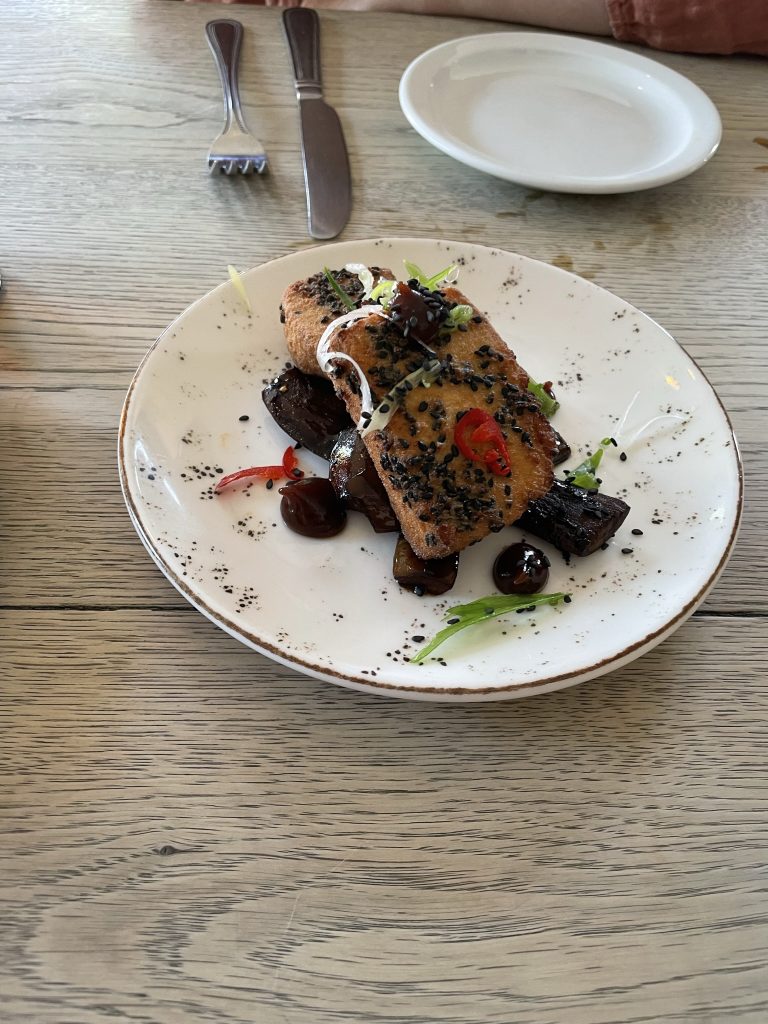
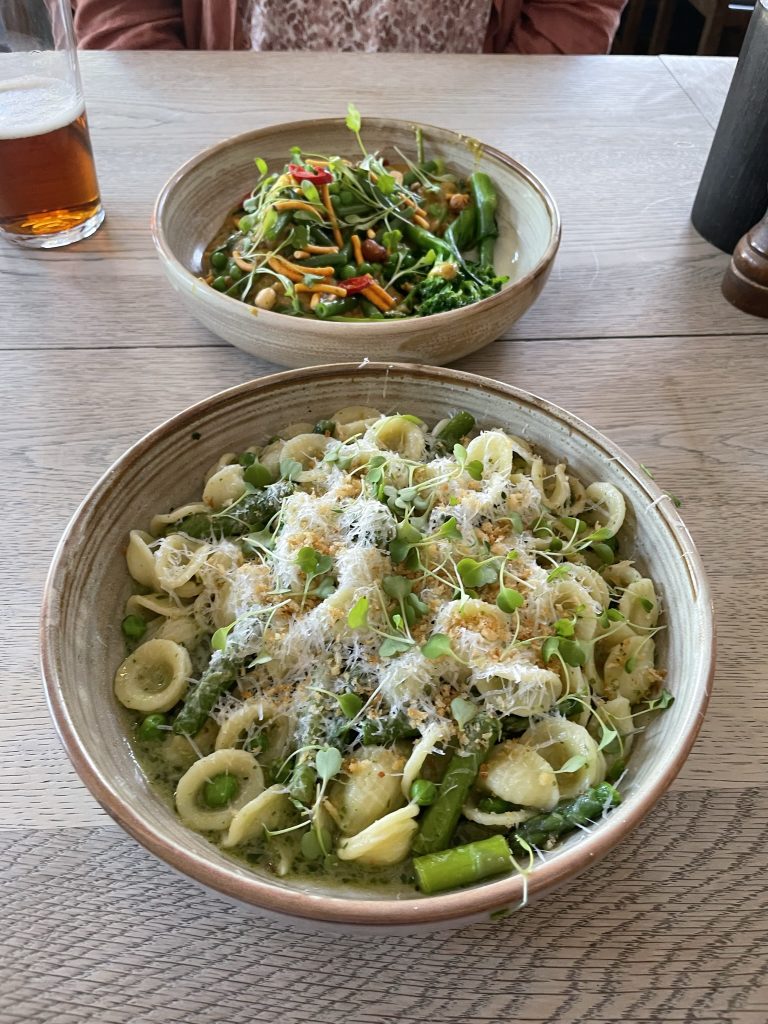
Jonathan dropped us off at the Porterhouse. We rested for a little while and then went out for a walk on the canal, and ended up at the Punter, the vegetarian pub we had seen earlier. We had a Miso aubergine w/fried tofui as an appetizer; and for dinner Sean had an Orichette Genovese, like a primavera, which was spring-like. I had a Satay Paneer, which was grilled halloumi in a peanut curry sauce with many different vegetables and chickpeas. It was excellent but so filling that I could not finish it. Perhaps tofu would’ve been less filling and they did a good job with it there. I drank Morland beer and Sean drank Aspell’s Cider. Sadly we were too full for dessert, which looked really good.
6-5
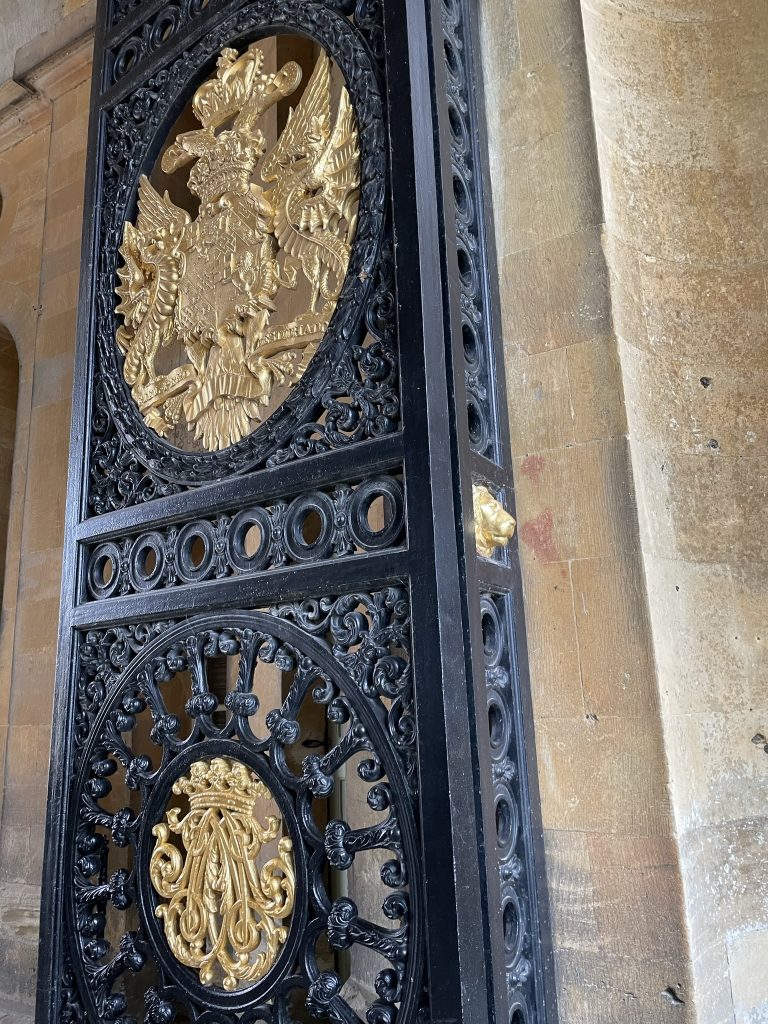
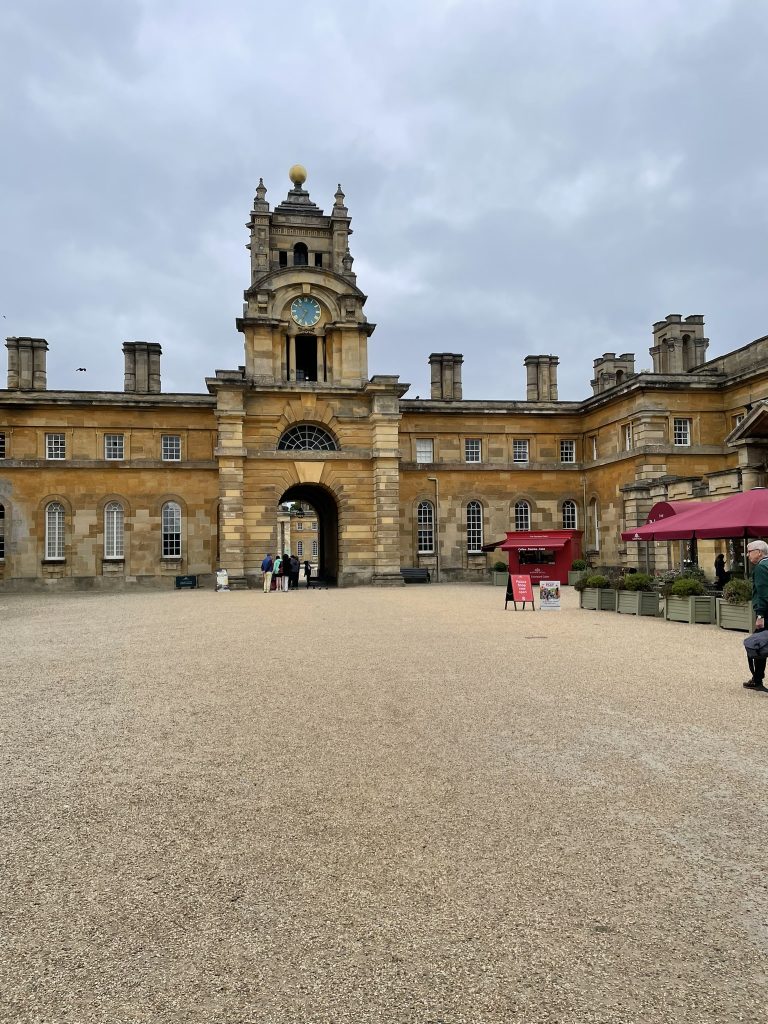
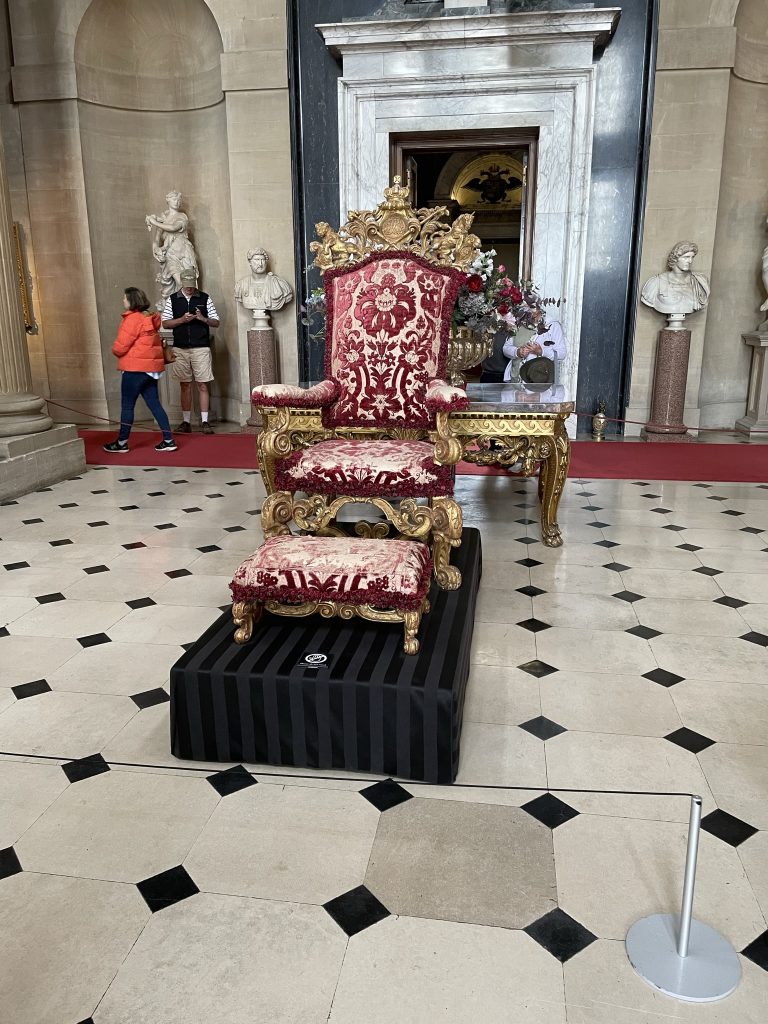
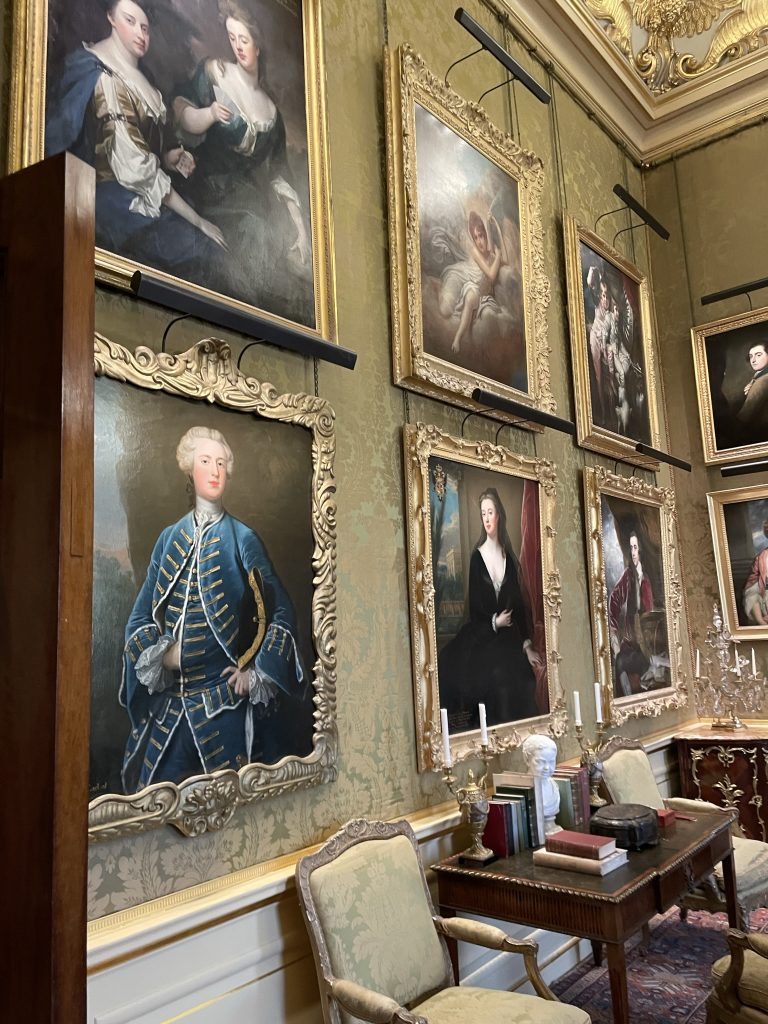
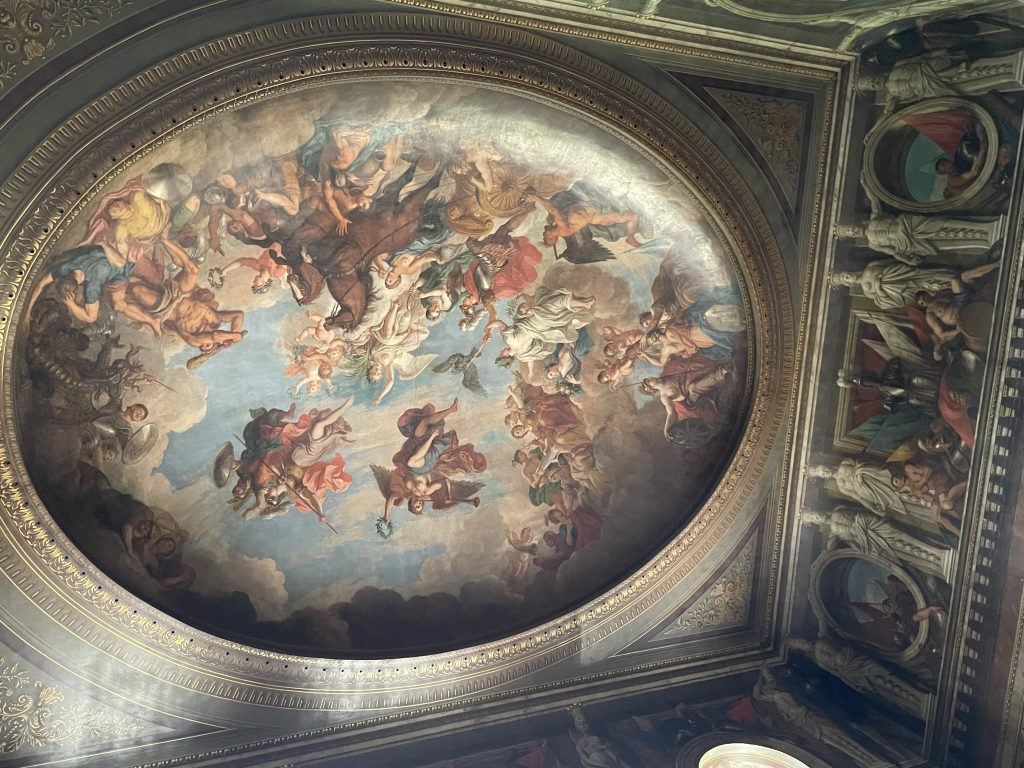
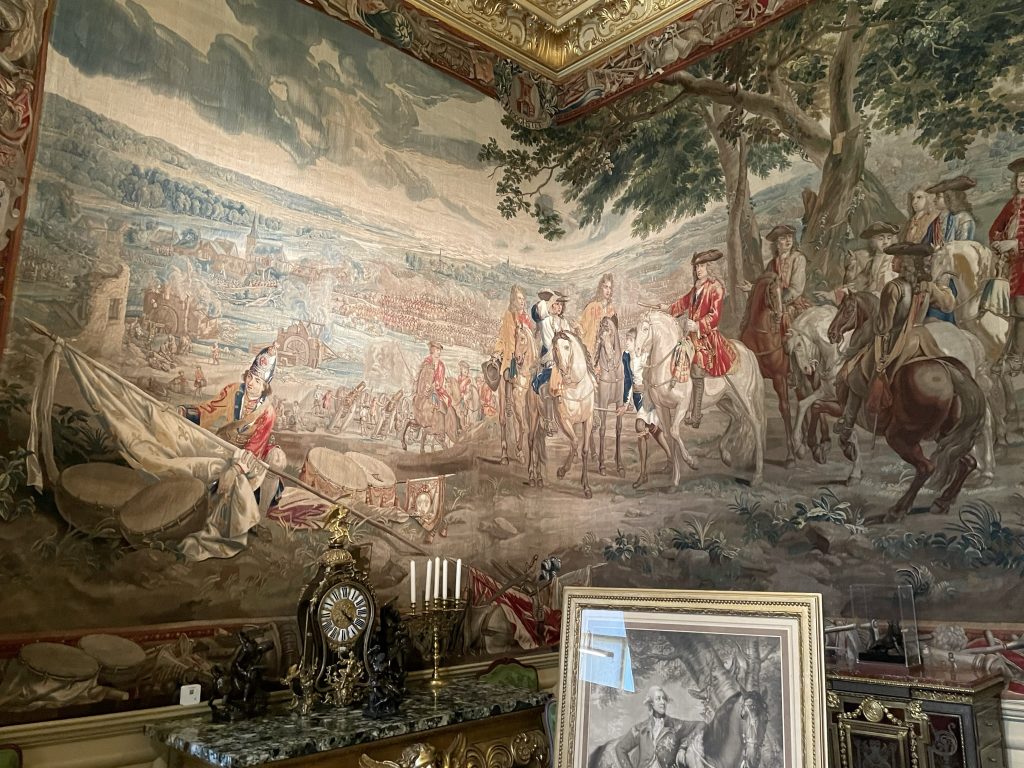
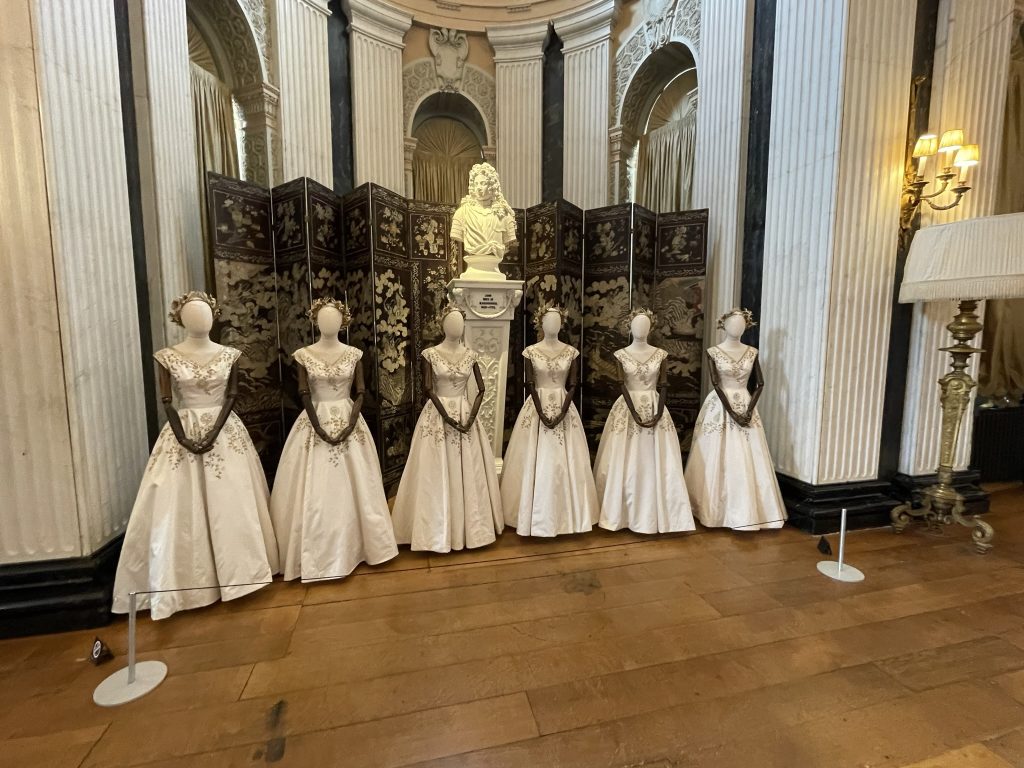
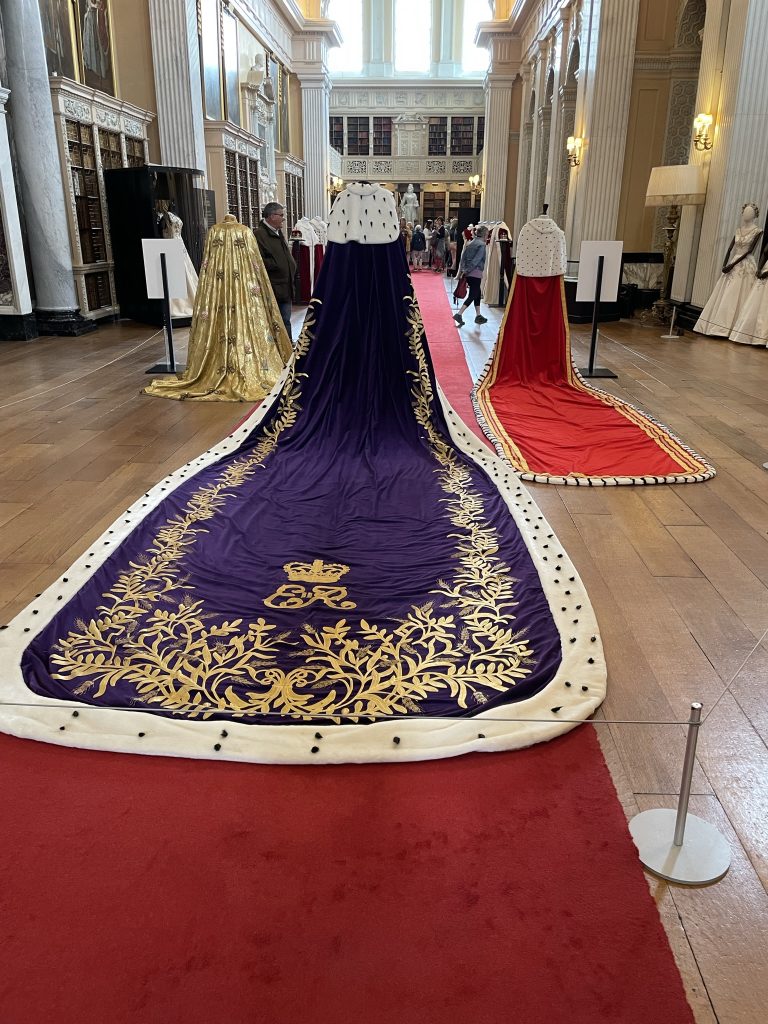
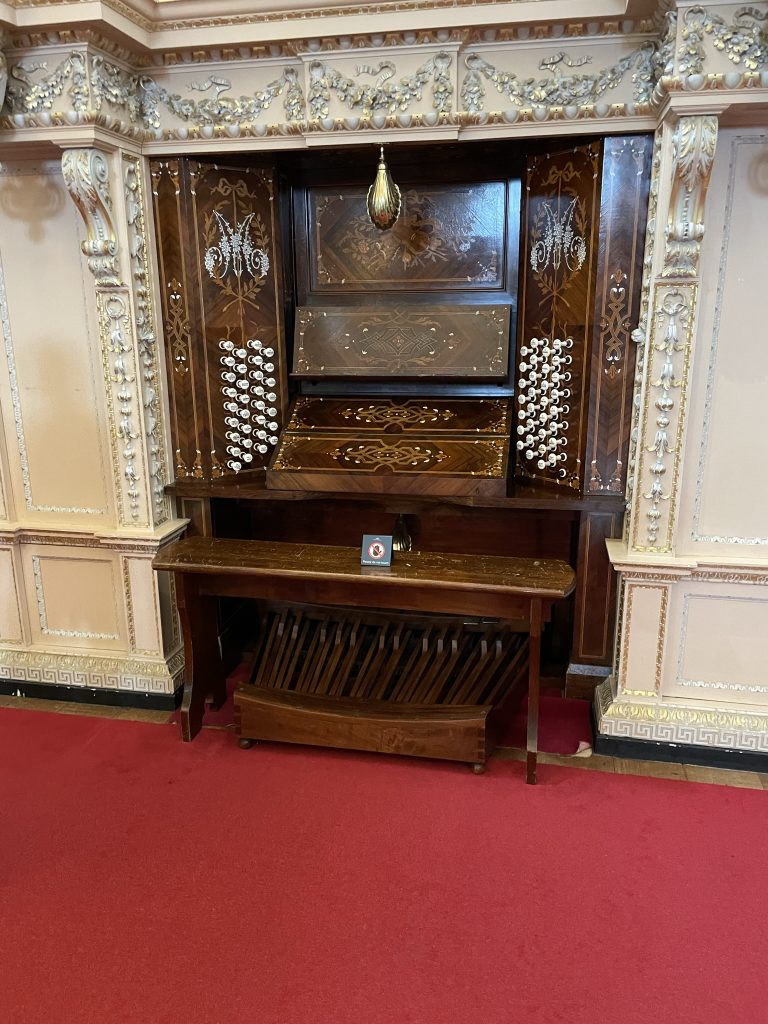
In the morning we debated whether we really wanted to go out to Blenheim, because we felt like we really had not seen a whole lot of Oxford and neither of us is into Georgian etc architecture. Still, we’d pre-paid and it was expensive so we decided to go right at 10 am when it opened. There was not a shuttle bus– just an ordinary city bus, which dropped us off at the stop about a quarter mile from the gate. From the gate, it was at least a third to half a mile to this palace, which had a large number of surrounding courtyards and gates– marred a little bit because at least half of it was wrapped in scaffolding and plastic, being repaired. It was also quite crowded. We went in and kind of moved past a lot of guided tour groups. Unfortunately not a lot of rooms were open to the public. We saw the great hall, and then the Churchill birthplace bedroom; a short series of reception rooms, too grand for comfort; and a library that ran the full breadth of the house, ending in a pipe organ. We were somewhat amazed when we found out that was the end of the tour; we could hear other people complaining, too. We walked outside to look at the gardens, which were the symmetrical lawn-and-yew bushes, not very exciting. The fun gardens were about another half-mile walk and at that point we gave up.
We stopped in the giftshop around 11:40, 7 pounds for a guidebook.
After Blenheim we went book shopping:
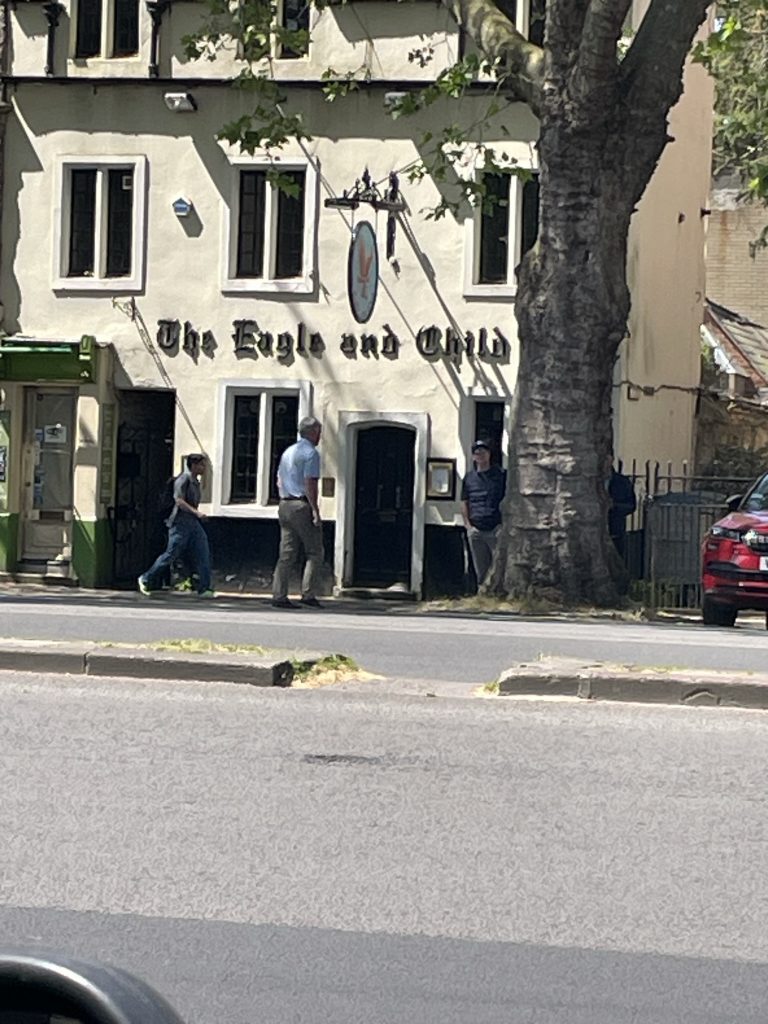
Oxfam books, 1250 pm, 45 pounds– this was a charity shop but had an amazing book collection and I could easily have found more, but we had to carry what we bought. We were nearby the Eagle and Child so stopped to take pictures of the sign. It is currently closed (since 2019) but we learned later that someone has bought it, so it may be re-opening soon. We then went to 5 pound books down the street 1:15 pm, 43 pounds and bought at least seven books.
We looked around for someplace interesting to eat. Chiang Mai Kitchen, Thai restaurant, had been recommended to us, so we stopped there. We had fancy herbal teas (the expanding flower kind) in large stemmed wineglasses. We ordered mieng gai, a minced chicken dish with ginger that came on spinach leaves. We found this nearly impossible to eat, as the chicken spilled out of the leaves and was crumbly and somewhat dry. I had gang jued woon sen, a chicken soup with thin clear noodles, and tofu. I put the mieng gai into my soup and it became much easier to eat. Sean had chicken pad thai, which was not at all like the pad thai we are used to. Instead of a sweet thick peanutty sauce, it was in a thin, sweet-and-sour tomato-based sauce. He didn’t like it as much. Still, we were glad to have had a somewhat light meal after some of the meals that we’d had. 1:45 pm.
We continued to wander in and out of shops till we found our way to the Westgate Mall area– this is a multi story open concept mall, built like a standard inside mall but with only a roof– no actual sides, so it is open to the weather. There are a number of restaurants inside and a restaurant court up on the roof, so we went up to look over Oxford. There were some interesting clothing shops, so we bought some clothes and looked at all of the other things. We had been wondering why we’d been told that Oxford was a ‘good shopping town’ but this showed us there was a good bit we had been missing. Most of the areas we’d seen near the university were small shops and restaurants/pubs.
5Uniglo (westgate mall) 330 pounds 320
Seasalt Cornwall (the westgate mall) 196 pounds 420
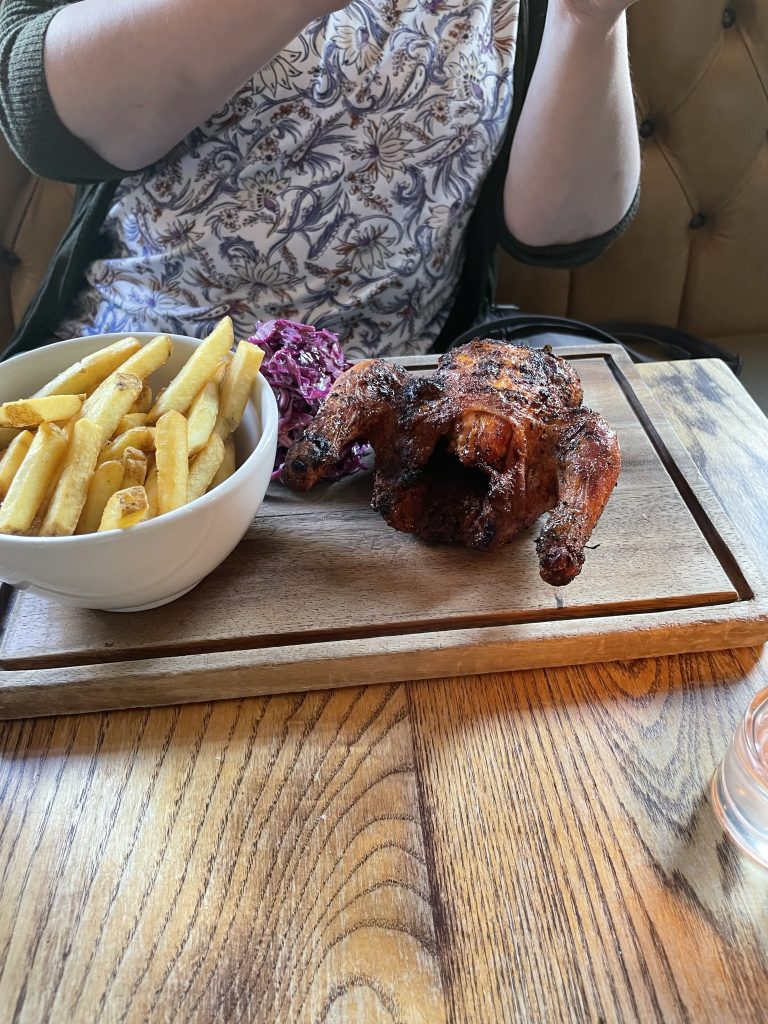
We then went back to the Porterhouse to take all of our ill-gotten gains to a shipping firm that was conveniently a block away; and shipped them. Somehow this reinvigorated our appetites and by 6:30 we were eating supper at the Porterhouse again– we shared a cheeseboard; then decided we were actually hungry. I had a roast chicken, which was brown and crispy on all surrounding sides (a cornish hen, around 1 pound); red cabbage slaw which was amazing, and chips, which I mainly used as a vehicle for the slaw dressing. Sean had his steak and chips again because it was so good.
6-6
This was the day slated for our Tolkien walking tour.
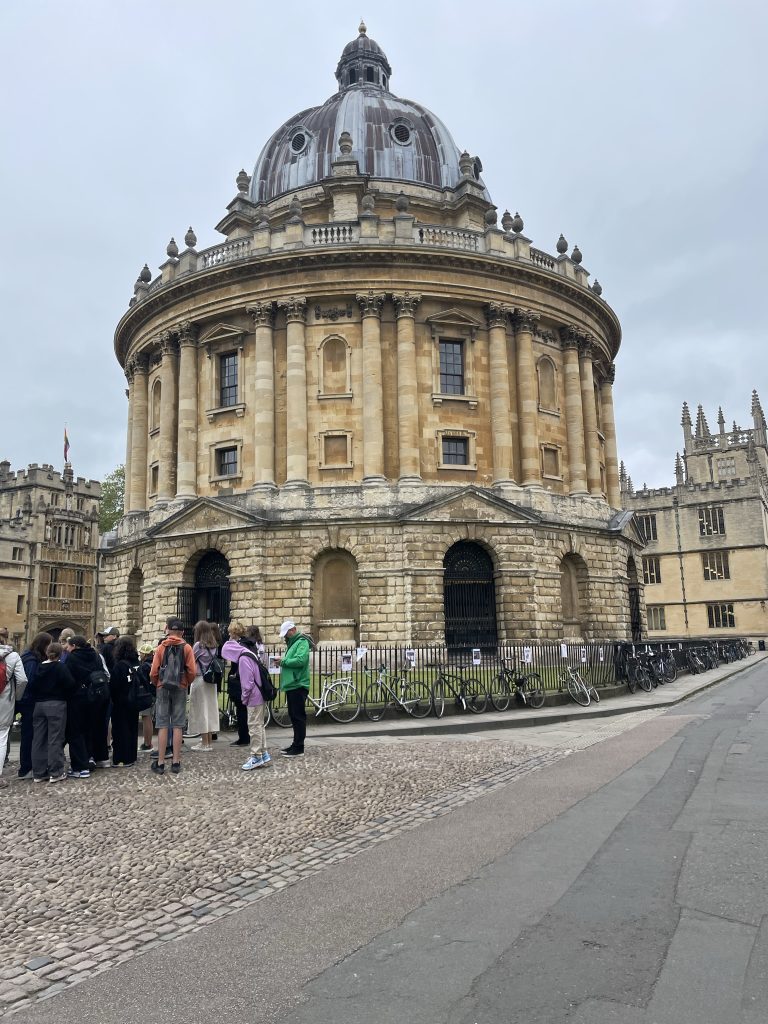
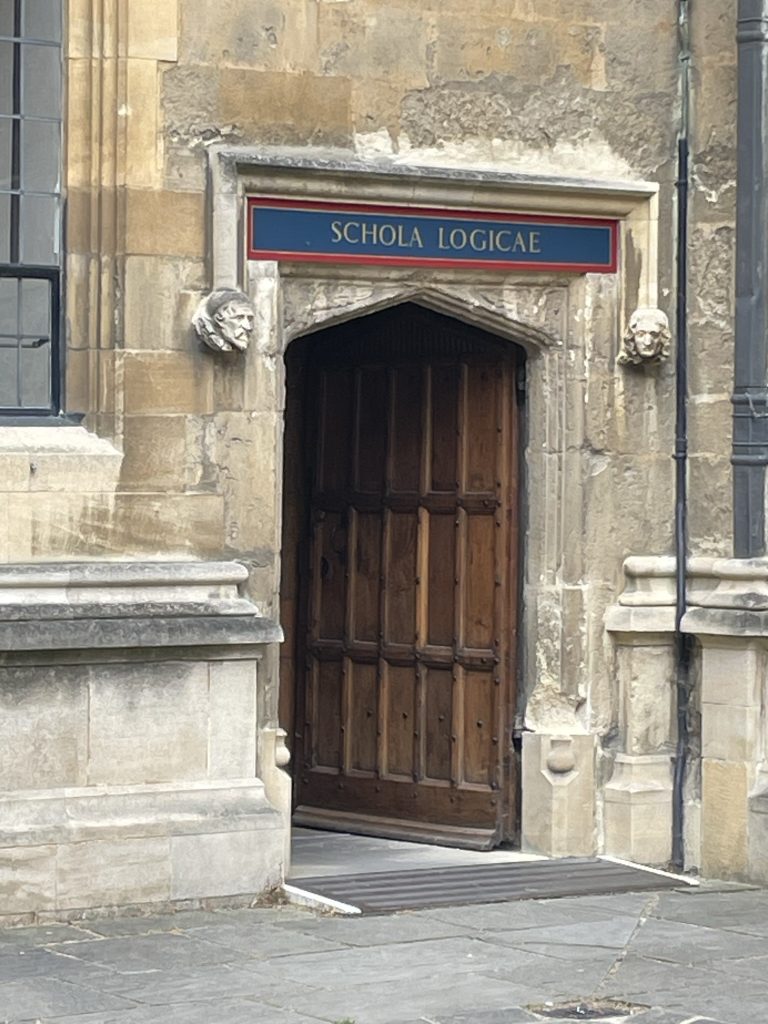
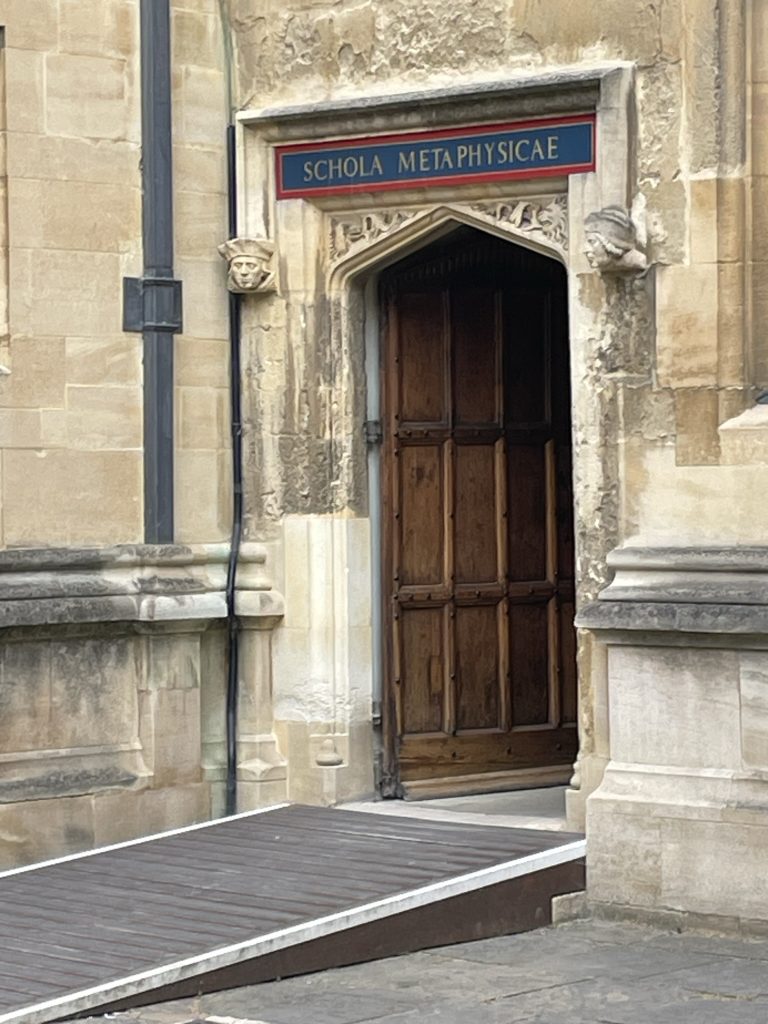
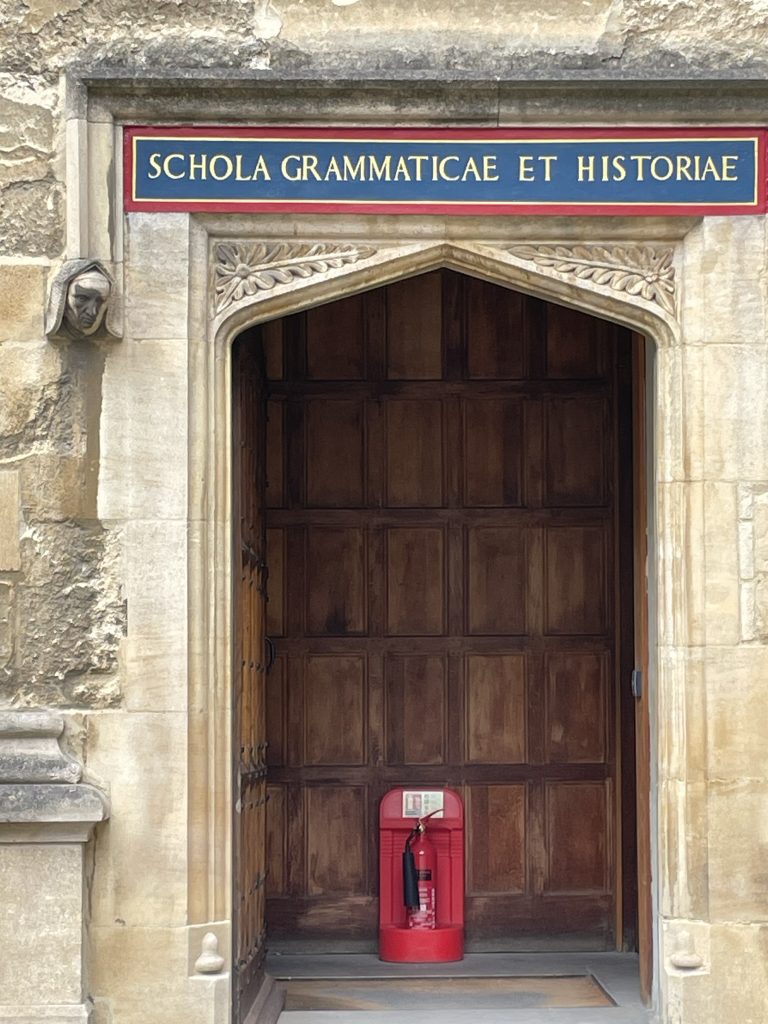
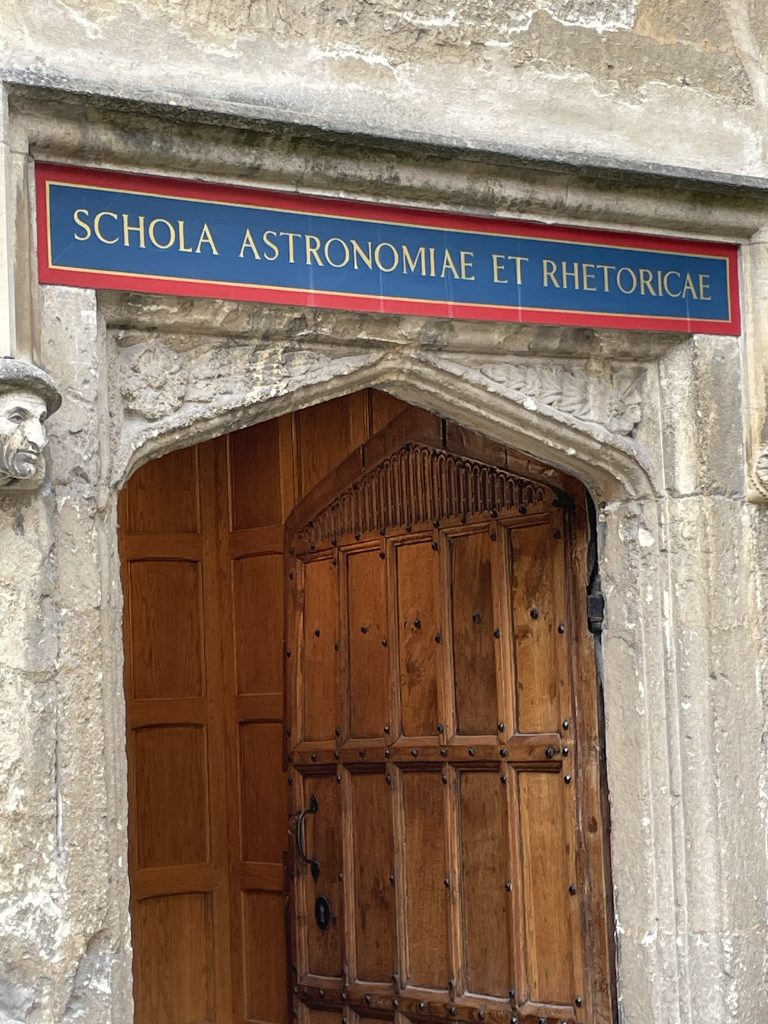
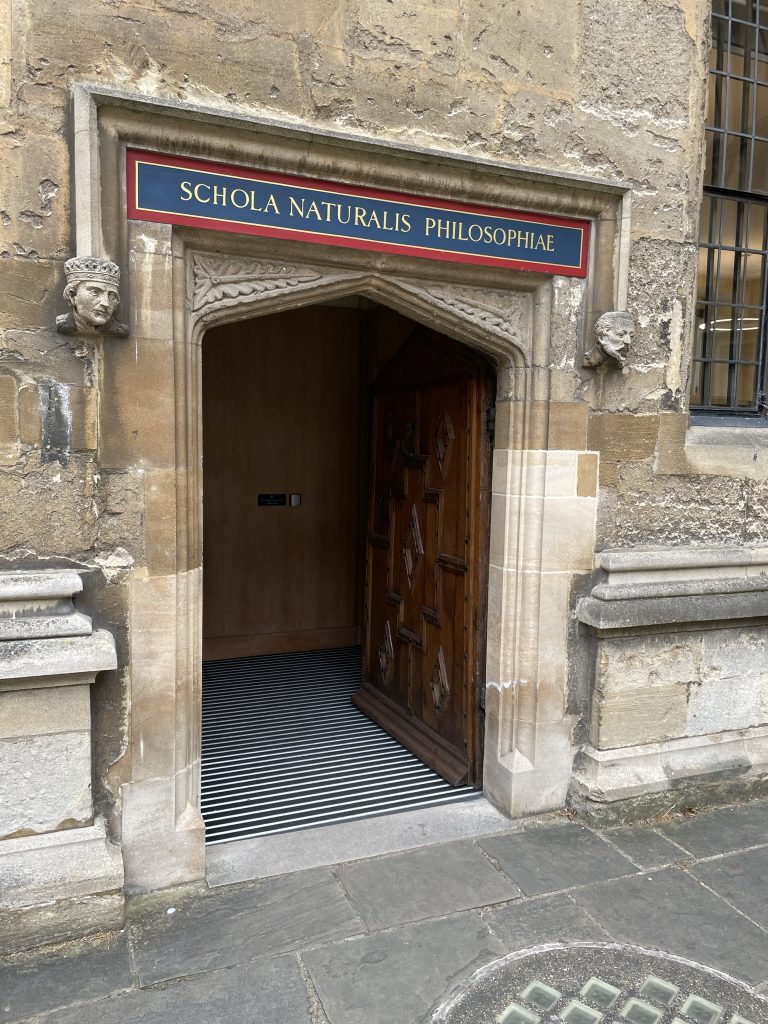
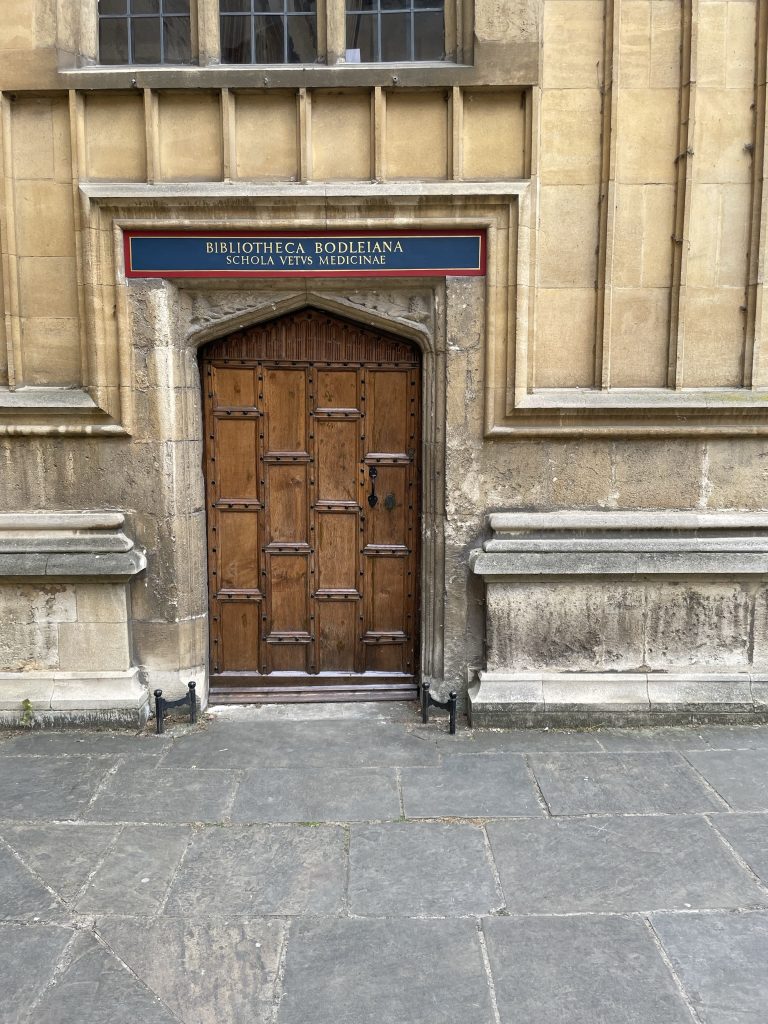
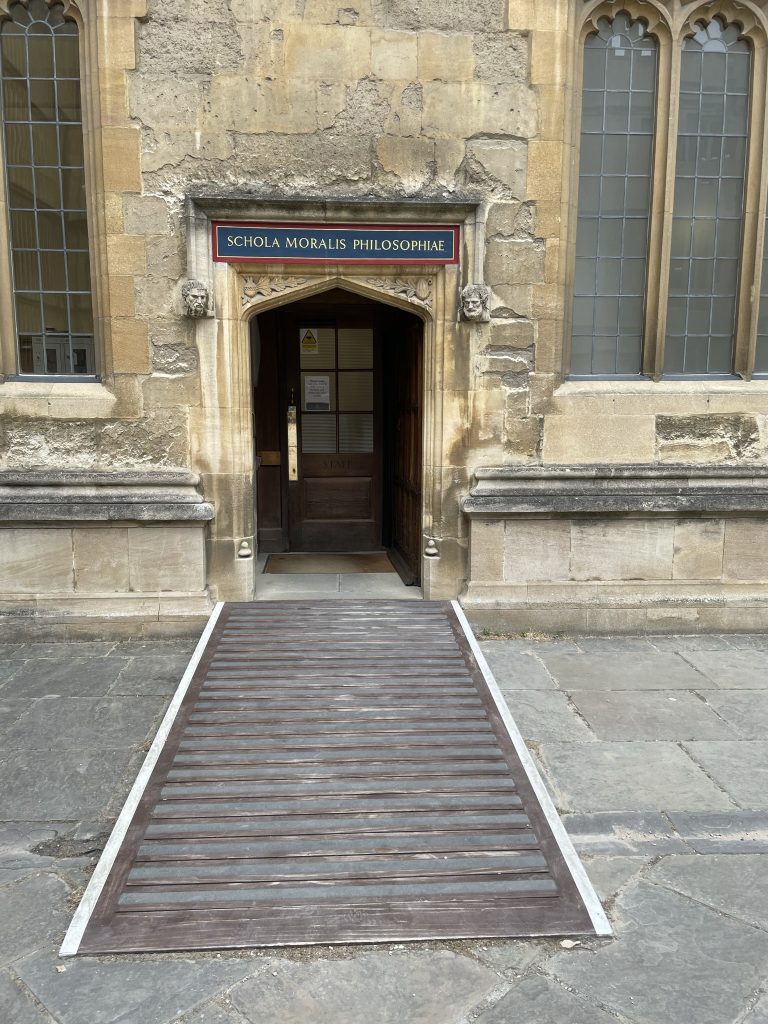
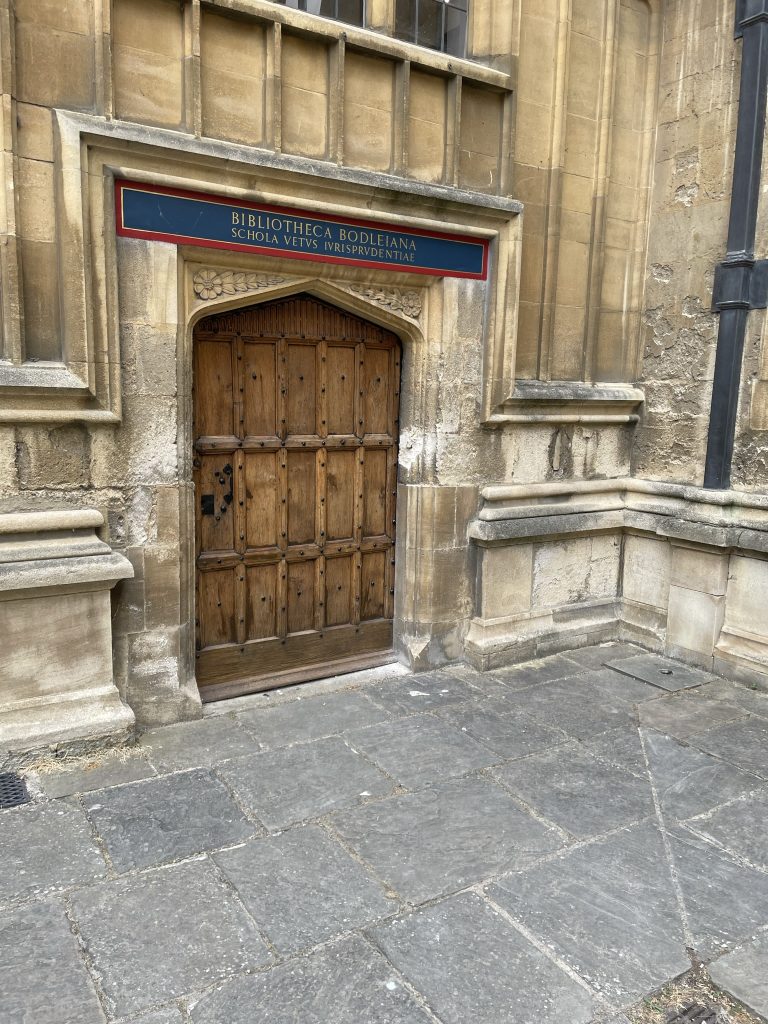
Undaunted by the portioning, we ate another vegetarian English breakfast late, around 9 am. After that, we took a bus tour of Oxford, and then went down to the Bodleian Library to see if we could get inside. Sadly, we could only get into the two areas open to the public– Blackwell Hall and its cafe/bookstore, and the main gift/bookstore across the courtyard. We did get good pictures of the courtyard and its doors for each of the traditional medieval studies– the trivium (grammar, logic, rhetoric): the quadrivium (arithmetic, geometry, music, and astronomy); several different kinds of philosophy; medicine, and law. Probably others we didn’t catch. Between the two gift shops, we spent about 290 pounds. 11:50 am
We then hurried back to make it for our tour, and as far as I can tell, did not eat lunch.
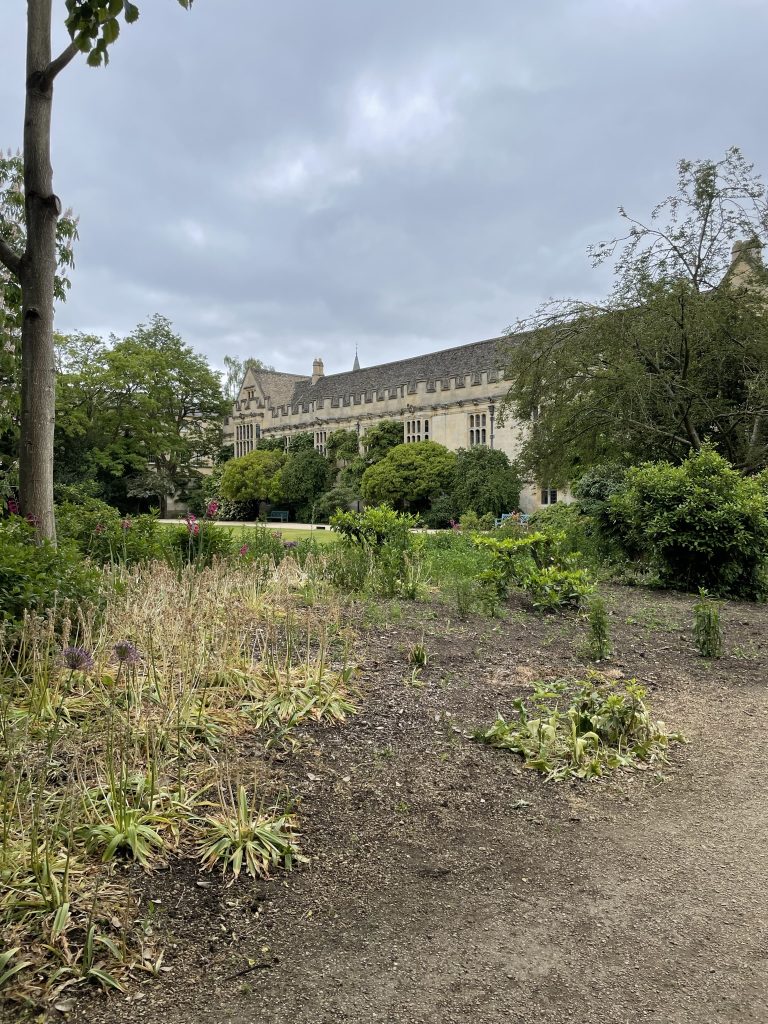
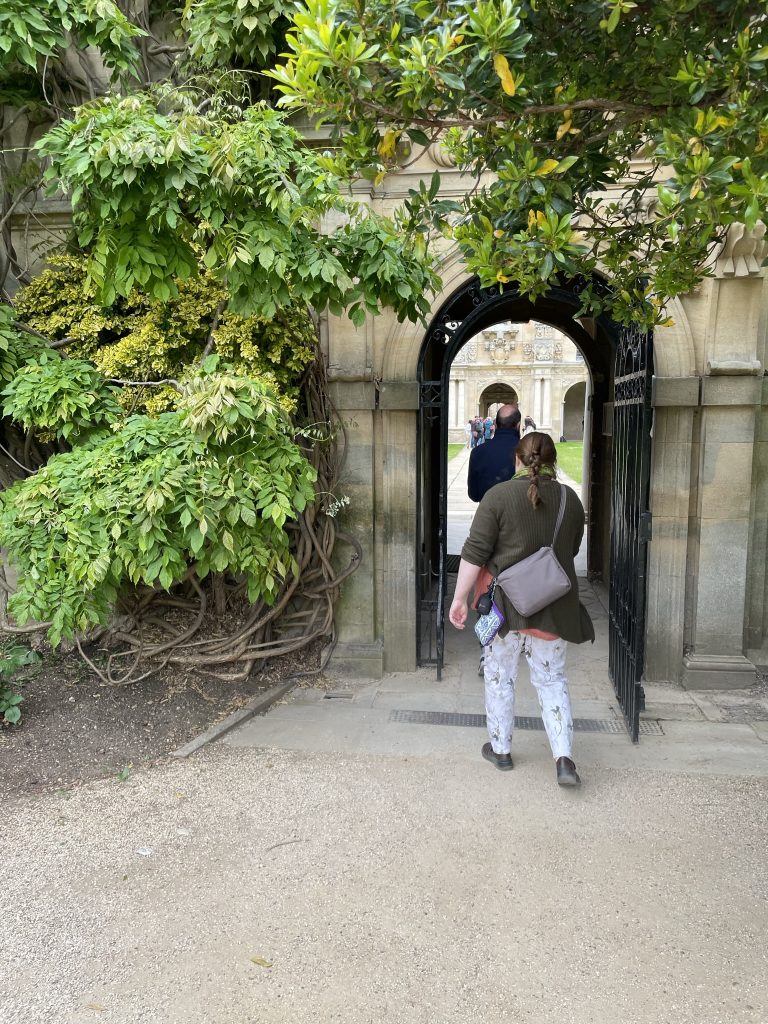
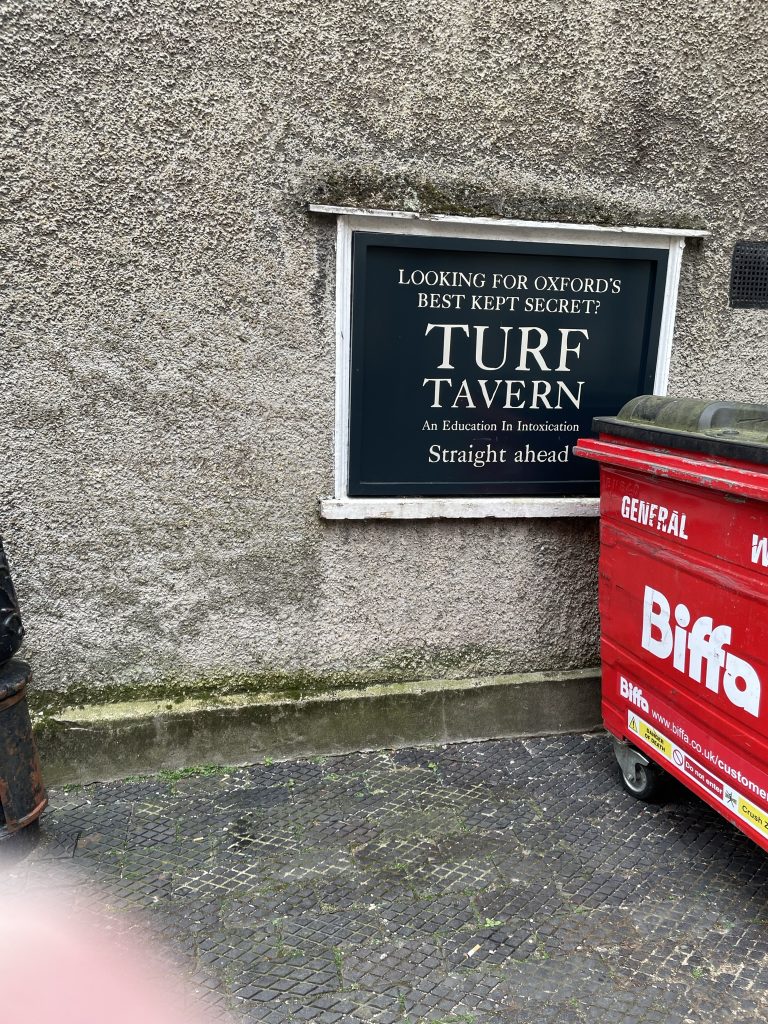
John Self met us at the Porterhouse and we went on our Tolkien/CS Lewis tour. This was impressive and took us all over Oxford– he was very knowledgeable about all the buildings we saw and the various interactions between the Inklings. He took us to the Turf Tavern, and told us Tolkein used to hide from his students there. He also got special permission to take us inside St John’s College, which does not have any association with the two professors but is not far away from the other two. It was a profoundly peaceful place, the stone walls cutting off all of the street noise. We also got to see the interior of the chapel and look through the gates at the actual garden, which is on the back side of the buildings between them and (either the canal or the Isis). We got a peek at Blackwell’s main bookshop, which was not at all in the location we had previously spotted, and we were amazed at how huge it was.
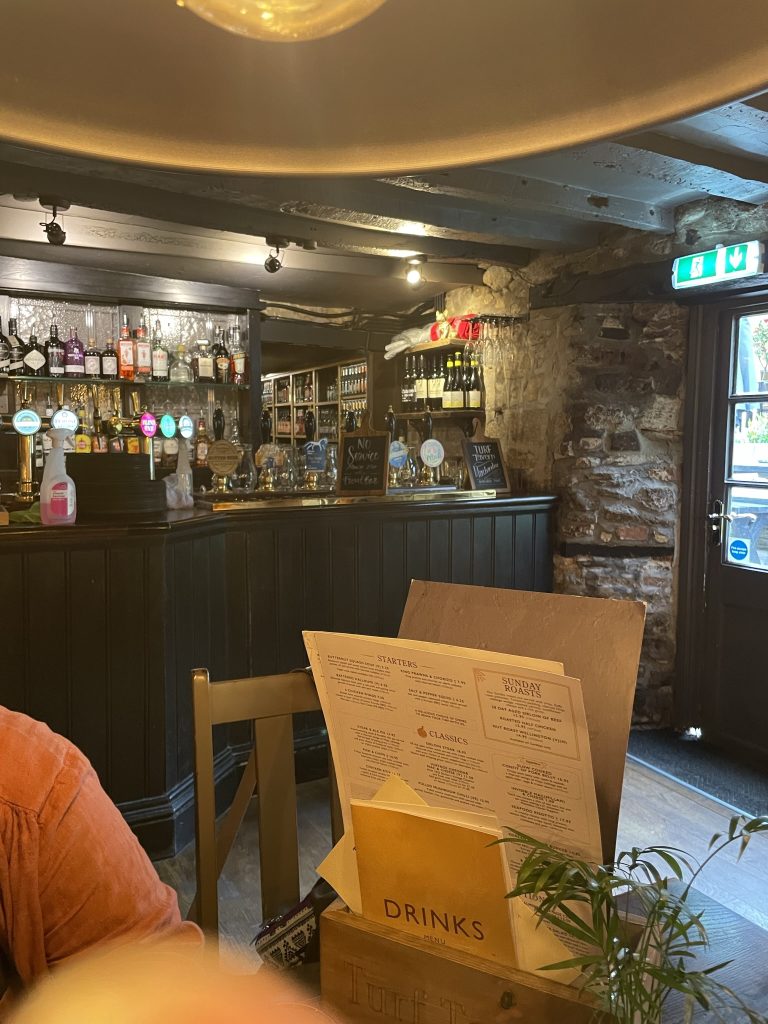
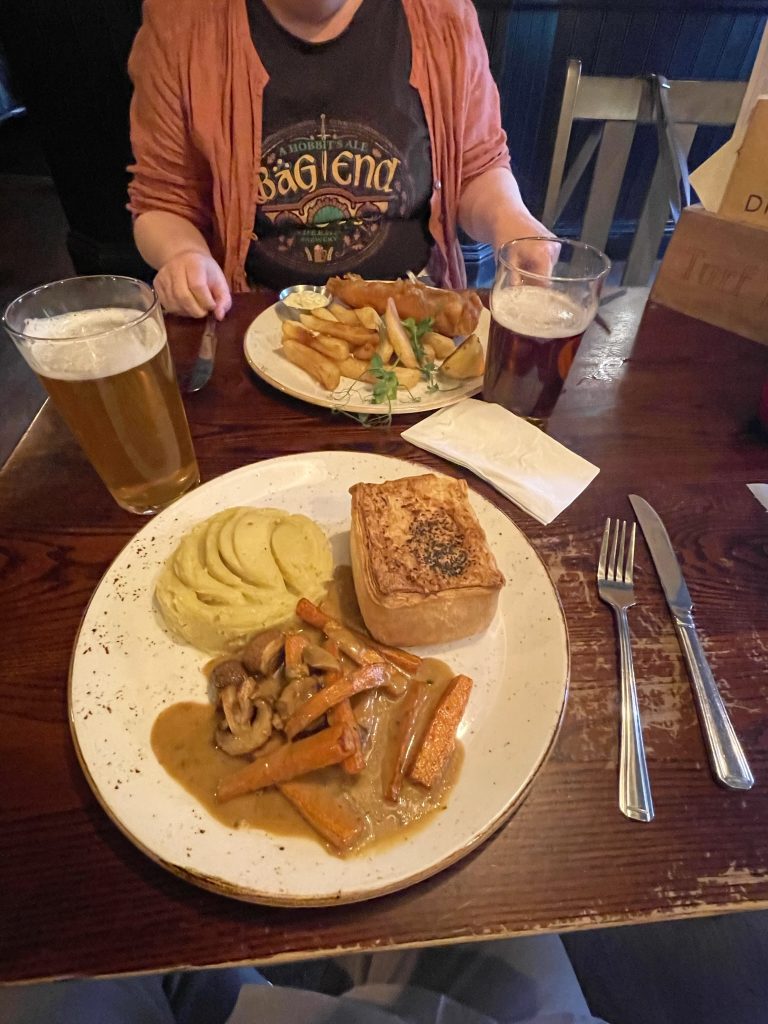
After our tour ended around 3pm, we ate our lunch at the Turf– I had fish and chips (none of those nasty peas) and Sean had a chicken and mushroom pie. I drank a really good bitter, and he drank a blonde ale.
We then returned to the Holy Grail of Blackwells, and spent about 250 pounds on books and arranged for them to ship. This took some time as the clerk didn’t know the procedure, so we did not get out of there until 5 pm. We then walked very quickly to the Folly Bridge.
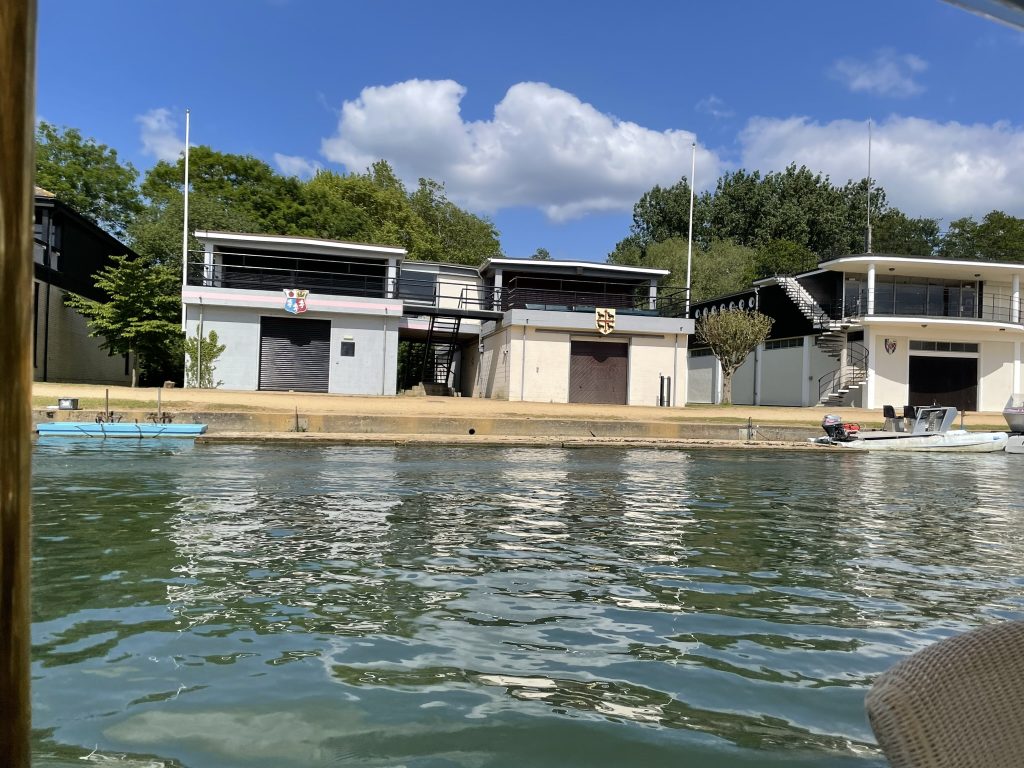
I really enjoyed our tea cruise, so we had signed up for a drinks cruise at 5:30. We just barely made it. We sat on the boat, relaxed and drank our drinks. Sean had a raspberry drink that was too sweet. I had a blood orange bellini, which was all right. Our group was pretty sedate compared to the tea cruise, which was good as we got to relax and enjoy the river. We took a different route than the tea cruise, not going through any locks, and went along the river which is behind the college grounds, and the guide talked about the buildings and the infamous nude swimming hole. We saw dozens of punters and several rowing teams, all of them better at it than the unfortunate boaters we’d seen earlier; though one group almost managed to capsize a shell– all the rowers had to scramble as we watched.
We were done at a little after 6:30, so we walked back to Westgate Mall as we’d seen a Lebanese restaurant that looked interesting– Comptoir Lebanais. Sean had a kufta lamb platter with salad and ordered a side of vermicelli rice. I had a fattoush salad and an appetizer-size kibbeh; and a Membrea blonde beer. Sean had given up at that point and just drank water. Total was 47 pounds, very reasonable. (Seans’ entree was only 15 pounds and my salad and kibbehf ran about that in total.)
6-7
On our last day in Oxford, we went back to the Gloucester Green Market to have breakfast. It opens at 9 am. While we were there, the food vendors were just getting started and the crafting vendors were not all set up yet. Not all the vendors were the same ones that we had seen on Saturday.
We started at the Hungarian food stall, and we talked a bit to the owner. He recommended the chicken crepe and said that no one else made them in the UK. It was an eggy crepe, which he filled with a pulled/chopped chicken that was seasoned; wrapped up and then moistened with a paprika cream gravy; then topped with sour cream and more paprika. We split it, and it probably would have made a full meal for one person. It was the most delicious thing there. We next had pot stickers from the Chinese stall- the older gentleman had showed me the browning pot stickers on our first visit so I just had to try them. We had beef-and-pork, chicken-and-cabbage, and vegetable pot stickers. After that I found a South African vendor selling koeksisters, which are a fried donut dipped into a spiced sugar syrup and served cold, reminding us of gulab jamun. Sean tapped out at this point, but I got Korean kim bap (vegetarian sushi roll with nori). I wanted to try the Korean corn dog but their frying oil was not yet up to temp. I then stopped by the Japanese booth and had inari sushi (bean curd skin stuffed with sushi rice– mom food); takoyaki (fried rice flour dough with octopus in it); and my favorite, sesame balls stuffed with red bean paste.
After all of this fun, we returned to pick up our baggage and settle our food and drink bill at the Porterhouse. We decided to save ourselves much aggravation with a cab and just haul our suitcases through the pedestrian underpass through the construction area. We walked all the way around looking for the bus to Didcot and only then realized that there was a gate by the bus stop that could have saved us 400 difficult yards.
As there was no railway strike on, the bus to Didcot was uneventful (other than filling up to uncomfortable levels and having no room for our luggage) and we got onto the Didcot-to-Paddington train. Then we had to change platforms to transfer to the Elizabeth line to Heathrow Terminal 4 where our hotel room was– and this was stressful. Even more stressful was knowing that our departure terminal was now Terminal 3, not 4, meaning we would have to take this incredibly crowded train again. I couldn’t stand any longer and had to sit down– next to the only open seat, a lady with a baby. Thankfully the baby was pretty well-taken-care of. Mother was from China but now resident in London. Her mother and aunt had come to visit and been driven to the airport; she and the baby were coming down to see them off. I had the sense it was a completely unavoidable family obligation. Apparently there had not been room in the car for mom, stroller, and baby. Baby was unconcerned about the crowd and did just fine.
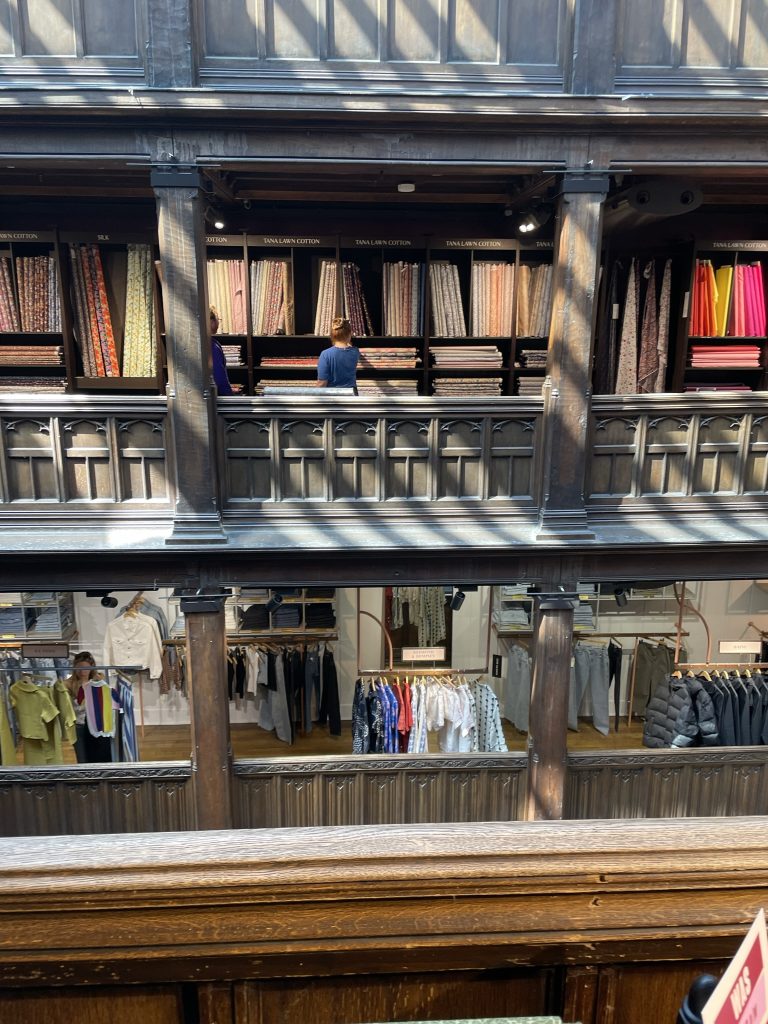
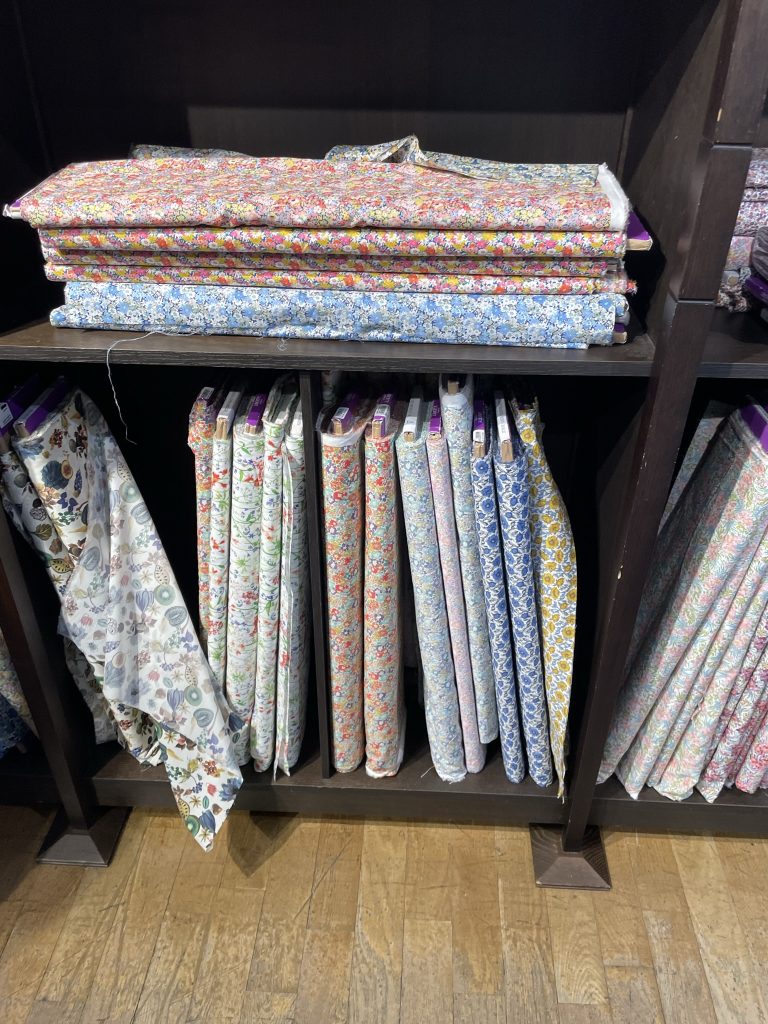
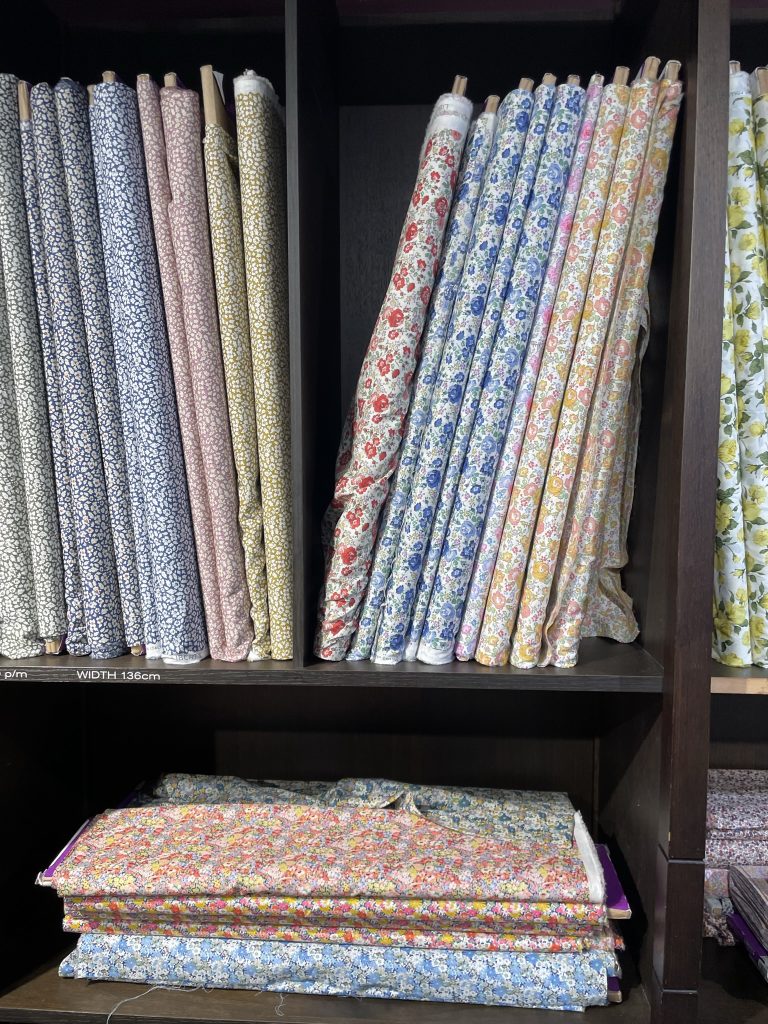
We got out at Terminal 4 and sought out our hotel room. The Crowne Plaza at Heathrow is functional but charmless and there is no outside air and the lobby is open for many stories but is still claustrophobic. We checked into our room and left almost immediately, to go to Liberty.
We took the Elizabeth line out a bit too far and had to backtrack to Bond Street. GPS led us a bit astray for awhile, but then we found it– a Tudor-esque building attached to a rococo fantasy building. We went in, and looked around at the fabric and then the various housewares and clothing. I selected some fabric and notions for purchase and we had that wrapped up and shipped, for a fairly nominal feel. We spent about 500 pounds all told. It could have been worse– the housewares were really good, and the furniture was better, all in a very English country house kind of style. The clothing was… amazing but not in a good way, and very very expensive. I looked at a few of the less alarming things– the Liberty print shirts and pajamas. They were well made, but the shirts were 370 pounds, about 300 pounds more than my Oxford Liberty print shirts made from the same cotton. I would cheerfully have brought home any of the furniture or home decor items but most of the clothing I would not have taken for free– it was just too out there and not-useful for any conceivable circumstance.
After we were done at Liberty, we went to a Carribean restaurant, which we had trouble locating till we realized it was in the very center of the block, in a little hidden food court type area called Kingly Court. We went to The Rum Kitchen. It took quite some time to get served as they were very busy in their upper level. We each ordered a jerk bowl and fried plantains, and a couple of tropical drinks. He had a rumbustion and I had a mai tai to start. The jerk bowls had chicken, rice and beans, and slaw. The slaw was easily the best part of the meal. The beans and rice and chicken weren’t bad, but they weren’t seasoned at all. Our server, who obviously was Caribbean, thought it was pretty funny when I asked for hot sauce, because apparently she shared the same opinion of the food being too mile. The hot sauce was a sweet and savory scotch bonnet sauce, and it definitely did the trick. As the restaurant was out of plantains, we got comped some drinks instead, so I had a rumbusion as well, which was kind of like a mini pina colada.
We got back on the Elizabeth line at Bond Street and it was just as crowded and annoying. When we got to the hotel we were restless, so went down to the restaurant/bar area to see if there was anything worth eating for dessert. There was not. I asked for an aperol spritz and the bartender said he could only do it by building it per ounce and it would cost like 18 pounds. I opted for beer from the Czech Republic (owned by Coors), since the only other beer was crappy American beer or Guiness. Sean had a pint of Aspall cider. This amounted to 13 pounds which was kind of ridiculous. Note that this Crowne Plaza shares space with the Holiday Inn Express, so it was not up to the standard that we usually find Crowne Plazas. The room was nice, but the restaurant and bar were substandard.
After our drink we walked down the very long and tedious hallway to the Hilton, which had a beautiful sunny reception area/restaurant because it had a glass ceiling and tall glass walls. I wish we had stayed there instead. I noted a sign that seemed to indicate that the UAE flight staff stays there. We looked over the menu, which was better but not stellar, glumly decided that we were not hungry, and headed back to the Crowne Plaza.
We stopped off at the convenience store there for pop and crisps as we got hungry again; and went up to our room to watch youtube and eat junk food, which seemed fitting. At least I drank a ginger beer and not a coke.
6-8
The Elizabeth line between Terminals 4 and 2-3 was just about as bad as the evening before; that is a very crowded, luggage rack-insufficent train. I was sad to leave England but not sad to leave London.
When we first got to the airport I didn’t realize that i forgot to vet my backpack bag. I ended up having to leave the security area and go back to bag check to put my chutneys in the checked baggage. I just checked my flimsy nylon backpack. Of course I had also forgot about my very expensive embroidery scissors that were in my purse… but thankfully the airline employee measured them and shrugged when they were about a millimeter too long– and put them back into my bag. The purse itself has RFID shielding, so it’s possible I would have been pulled out of line even if I didn’t have scissors. (I had packed a fingernail clipper to sub in for the scissors but forgot to move the scissors.)
We decided in the morning that literally anything at the airport would be better than what was available at the Crowne Plaza, We ended up eating at a Japanese conveyor belt sushi type restaurant. Different colored bowls would come down the way and you would grab whatever you liked; the staff would add up your price according to the number and color of the bowls you had. I probably should have realized that every single item on the conveyor that morning but one was a salmon sushi item; or a non-sushi type item. The more interesting items listed on the menu were nowhere in evidence on the conveyor, and the staff was very far behind in filling from-the-menu orders. So, I ate a tuna tartare, a couple salmon things, prawn crackers, a pancake stuffed with custard that had a strawberry dipping sauce; a raspberry mochi cream cheese thing. Sean put up with all this and ate his edamame and chocolate mochi balls. This was all at about 830 am.
We had gotten there very early (as we were bored) and cleared customs/luggage check immediately so wandered in the terminal for awhile. I got a book to look at as somehow I hadn’t really packed many.
Heathrow does not open gates until it is close to boarding time; so we couldn’t go to our gate until 9:30 am. If you’re at the gate area, your gate is closed off via glass doors and there are very limited seats outside it meant for the disabled… so you are left standing. We waited in the common area until our gate was announced open. We were boarded fairly quickly, well before the 11 am flight time. In fact, we actually were in the air by 10:58.
Water was passed out as the plane taxied towards takeoff; and as soon as we were in the air drinks and pretzels came out. We were fed a full lunch an hour later. This wasn’t as good as the previous meal we’d had. We got to sit together this time on the flight and both had the macaroni and cheese as we were dubious about the shrimp. One of the stewards told the people behind us that the shrimp was the best meal they had, so I guess we missed out. The salad was exactlgy the same as previous, but less fresh. The dessert was millionaire shortbread and too sweet for me to eat.
We had a lot of time to kill. Sean watched all the Jon Wick movies. I hadn’t actually watched (just listened to while frantically sewing for Pennsic) the Hobbit movies, so watched the first two. They’re so long that we landed about twenty minutes after the second one ended.
In the meantime we’d been given another snack– chocolate ice cream– and yet another meal tray, which was a marinated grilled vegetable pasta salad with some kind of sour cream dressing, a set of bread sticks, more bread, and a package dessert, some kind of chocolate mousse with caramel. None of it was all that great. The vegetables were actually good and I ate those, picked at a little pasta, and tasted the mousse, which tasted very artificially sweet.
We landed at least half an hour early, thanks to good weather and a reasonable tail wind. We had another plane pacing us for a long way, all the way from east of Greenland to Quebec. It was about a mile distant and was flying somewhat below us. We were at 34000 feet, so I would guess it was at 32000 or so. Another passenger saw it through the window and got a little alarmed, but I reassured him that it was totally normal and that any plane that we can actually see is not going to do us any harm and that it was like seeing a car in the other lane of a highway. I occasionally monitored the speed etc of the plane but due to the good weather it never varied from cruising speed and we very rarely changed our heading by more than a degree or so. We were extremely early for our landing, so had to divert out substantially over Northern Illinois before coming back in to land; at one point we crossed the Illinois River and I started wondering if perhaps he could set the plane down at WIllard to make it easier for us to get our bags home.
The landing was great; disembarking the plane was fine; and coming through re-entry was a total living nightmare. Global Entry people had just as long a wait as the rest of us– their line was a tenth as long, but they had a tenth of the personnel. I just read my book as we walked along and sure enough as soon as I did that everyone wanted to ask about whether the book was any good, so things got more entertaining after that. Scanning through was fine– as usual the biometric devices simply do not work on me; the tsa officer just shrugged and sent me through. We got our bags right away and then began the odyssey to get to the car, which involved at least one tram ride, and a lot of backtracking due to bad info and a lack of signage.
Eventually we found the car and the parking attendant (300 dollar plus parking fee! Amtrak plus hotel would be cheaper) and got onto the road, and didn’t stop at all till we reached Champaign. We stopped off at Martinelli’s Market to grab an early dinner and some milk and yogurt for the morning, went home, fed the cats, and went to sleep.
For those who have done my varietal v blend class or just want to know more about the apples I am using or hunting, please see below.
First off, there are few systems to classify apples. One of the more frequently used one is the LARS system (Long Ashton Research System). Imagine two axes, one for acid, and one for tannin. The prefix “bitter” means high in tannin. High in acid is sharp and high in sugar is sweet. Under this system, we get four types of apples, bittersharp, sharp, bittersweet, and sweet.
Different styles of cider want different apples but normally some of each is desired but the “best” ciders often use bittersharp apples.
Traditionally, true cider apples are hard to find in the US. While our colonial ancestors brought some cider apples, prohibition made them unfavorable. Then also most apples are used culinarily. Culinary apples are very different from cider apples. Modernly, most cider apples will be committed to cideries, making it difficult for hobbyists to get some but it is not impossible.
In my 2022 experiment, I was able to source apples local to me.
Fortunately a retired orchardist from the University of Illinois bought farm near me and sells his apples at the Farmer’s Market. I was able to get 1 bushel of these from him. Ashmead’s are reasonably high in acid. Tasters noted a bit of a “metallic” taste in the middle of palate.
Gertie’s favorite apple. Winesaps are generally sweet apples but firm. They have a lot of uses around the kitchen and are fairly aromatic. The cider however was just okay. Watery, but not much like cider.
Unrelated to the Winesap, the winecrisp is a modern hybrid. It stores well and has good aromatics. But like the winesap, the cider was virtually the same as the winesap and much like water.
That said, the blend of 25% of each was pretty good!
My next steps are to try to get actual cider apples. First, I will buy more from my local person. Ashmead, Roxbury, Sundance, and Winesaps I think.
I am looking for sources for Dabinett, Somerset Redstreak, Kingston Black, White Pearmains, Medaille d’or, Michelin, and any red fleshed apples I can find.
If I can find Somerset Redstreaks, this would be pretty darn close to what a late period cider would have been like. White Pearmains are the oldest English apple we have reference to. I will also be looking to do keeving and perhaps pet nat for sparkling.
Another experiment would be to try to find the terrior. The same apple from different places, can we taste the difference? Let’s find out.
This is general advice that many of us are told about our art. As artists, we see all of the flaws and our confidants assure us that no one else will notice. This is often not enough to fend off the brain weasels though. Anxiety just tells you that is wishful thinking. But I came to a revelation recently that will give the rational brain something to fight back with.
Our revelation starts with color, specifically, the color blue. Homer describes the Mediterranean Sea as “wine-dark.” Analysis of other classical texts around the time show that things that modern people would describe as “blue” are not described that way. Egyptian murals show fresh water as green. The day time sky is described as “light black.” Classical language had no word for the color “blue” until late and for most languages, this is true. Blue is one of the last colors to have a word.
Eventually, the Egyptian make a pigment from lapis lazuli and add a word for “blue” and nearby languages start adding a word for blue as well.
But surely, the physics didn’t change and it did not. The sky still scattered sunlight in the same way and would make a “blue” sky as we would understand it. The water would still reflect the sky in the same way and would be “blue.” Yet, these classical authors didn’t have a word for blue and don’t make one until much later. Why?
Some scientists tried an experiment . They found a tribe of people who didn’t have a word for blue in their language. They showed them a series of squares, 11 of which were green and 1 of which was light blue to my eyes. It took the people of this tribe significant time to identify the square that was not “green.” We are not talking a delay of milliseconds but many seconds to correctly find the square that was different. Yet to my Western eyes, it was immediately obvious.
They next showed the members of this tribe, 11 squares that were green, and 1 square that was a slight shade of green different. To my eyes, I could tell no difference between the 12 squares. This tribe however had dozens of words for different shades of green. They very quickly identified the different square.
What does this mean? It means that without the words to describe the difference and without the thought processes and neural pathways trained to understand the differences, they couldn’t see the blue square and I couldn’t see the slightly different green square. The difference didn’t exist for us. The brain ignores what it doesn’t understand in favor of what it does understands!
This may seem obvious but it is worth saying again. In general, the brain ignores what it doesn’t understand. You can’t see what you don’t know! It applies in a lot of ways, especially with some of our social issues but it applies to your art. Your audience can’t see the “flaws”; they don’t know anything about them so their brain ignores them.
This is a generalization. Some people are very observant. Some people know more things than that admit. But the vast majority of your audience isn’t lying to you. They don’t see the flaw you obsess about. It is the scientific net that I have been needing to corral my brain weasels. I will likely need reminders and you will too. But we have a way to fight back.
This past week (today is 2/4/2023 at the time of this writing), I attended CiderCon in Chicago. This is an industry focused convention for cider professionals by the American Cider Association (ACA). Here are my thoughts.
The event was heavily industry focused and I knew that going into it. While I was welcome to attend as an enthuasist and homebrewer, it was not going to be about either of those things. So I knew that and accepted it. Anytrhing I gleaned from it would be by me using my knowledge to distill it from the industry focused material given.
First up, it was clear that diversity was wanted and desired. Two prominent sessions were for a BiPOC meet and greet, and a Pride meet and greet. There were ribbons one could chose to indicate those statuses and the opening slide for the keynote speaker was “Cider is for Everyone.” The crowd skews mid 30s and the customer base is younger so it makes sense to stress this. The message was clear; this is a place for diverse peoples and you will be hurting yourself financially if you don’t embrace that.
While the SCA and ACA are born for different purposes and at different times, this is something the SCA could learn from the ACA (and other organizations), put diversity first. The SCA is not good at this. Sure it cherry picks its marketing photos to show diversity (minimally) but it hides from larger initiatives. The DEI scandal is a prime example. So, embrace diversity SCA. Stop making excuses for why or what; just do it. Make it a priority and in your face.
One thing the ACA could have done better is connecting its newer members. This is something they could learn from the SCA. I felt like an outsider the whole time. In part, because I am not part of the industry but in part because I was a new person and there was very little effort to connect me in. Some sort of ambassador program would be nice here. Get a group of volunteers that know a bunch of people and are willing to approach new comers. Many of us newcomers had ribbons to identify ourselves. Those volunteers would then approach the newcomers, learn a little about who they are, and make introductions to a variety of people for them. There was one newcomer session but it was heavily industry focused. It was like speed-dating but it was on business subject matter. A more socially oriented newcomers session would have been good for me.
I attended several sessions to expand my palate and knowledge. Again, I had to listen to find the information that would apply to me as a homebrewer. And I did find some. But more importantly, I think I learned that becoming a pommelier would be difficult for me. There were many characteristics for the ciders that I just didn’t get. It is a bit like the pope in the joke about art, “I make not know much about cider, but I know what I like.” Again, this was useful information to know. It will take a lot of time to train my palate to understand these flavors. I am not sure it is worthwhile.
Another thing that was prominent at CiderCon was the idea that cider is more akin to wine, or at least they want it to be. All of the cider was served in stemmed glasses. Much of the terminology about cider is borrowed from wines. Much of the processing is more like wine. But in true, cider currently occupies the middle space between beer and wine for consumers. Historically, it has moved all over the map; being cheap and fancy, wages earned and wages substituted, common and noble. At the moment, it is increasing in popularity. Making the producer and consumer associate it with wines is good for the industry because you can command a higher price point.
Personally, I prefer my cider in a pint glass or a pint can. I would rather see it as a fancy beer/ale and less of a diminished wine. I want it to be accessible and fun. I want it to be something to you enjoy with a bunch of friends eating burgers and wings. But the more consumers can see how versatile it is, the more market share it should command.
Was this worth it? No, not really. I made no lasting connection with anyone. I learned a few things so it was not worthless. But given what I gave in time and money, I didn’t get my value. If I were a small cidery, would I have gotten more value? I think so. There several sessions about the selling of cider that would have been of interest. Would I do it again? Not without being in the industry for some reason. I spent nearly $2000 for 4 days of this. With so little about the hobby side of this, I can’t justify that kind of money again. I am not sorry I went. but I don’t see going again.
I did taste some interesting ciders and got some inspiration for doing new things on my own. I accidently sat near the featured author at the convention for two sessions. So eavesdropping on his conversations gave me some interesting insights. I met someone from Angry Orchard and again, listening in on his conversations were interesting. I met someone from Bauman Century Farms (and Cidery) and tasted some excellent ciders from this 5th generation company. So it got something out of it.
One of the takeaways from Cidercon for me was using some historical techniques. The challenge with medieval ciders is while we know they existed (Palladius from ~400 AD, et al. forward tell us about them), we don’t know much about how they were made until nearly out of period. There is a French treatise about cider from the mid to late 1500s and the earliest English equivalent is Worlidge in the mid 1600s.
Sparkling cider is only documented in the mid 1700s. So what follows is a very modern cider but using late medieval technique.
The first technique I want to try is pet nat. Pétillant Naturel, pet nat for short, is a modern name for what is called the technique ancestrale, which the fancy French word for most of us call “bottle conditioning.” To any brewer, bottle conditioning is nothing new or unusual. However, there are some unique steps that pet nat uses. Pet nat can be traced to 1531 when the champagne technique was first documented. There is no evidence that cider used it then but cider does use it now. In most ciders, you ferment the cider dry, then add a few brix of fermenting must to the bottle, cap, and store. Cider actually does well to keep on the lees as the interaction of alcohol of lees produces some interesting flavors. The bottles are stored as tirage (tier-age), that is, on their sides for a few months to allow the carbonation to happen.
The other thing I might do is keeving. Keeving is an old French process for making cider. The cider is allowed to wild ferment and some of those microbes interact with the pectins to make a chapeaux brun, brown cap, that forms a barrier to the outside air. This is normally done as “low” temperatures, ~ 50 degrees F. The yeast ferment slowly and eventually run out of nutrients and die. They will therefore leave some sugar in the must. With enough knowledge of the sugars present and potentially added, you can calculate the pressure in the bottles. Keeving was definitely done medievally for many centuries in Normandy and Brittainy.
Where the two ever combined? Probably not. But I intend to 🙂 I will be adding a Norman to Oswyn’s family tree. Not unusual for any English person after the conquest. But that would bring some of these French techniques to Oswyn Swann’s manor.
The hardest part of this experiment will be getting ahead of the right apples. That might be impossible. But I think I can find a reasonable substitute. Assuming I can do this in the Fall, it might be ready for Better War or Chamfron in 2024.
Yesterday, I posted on facebook asking for resources about discovering one’s personal style. After a few replies that were on topic, it quickly became off topic so I deleted it. The off-topics weren’t bad; the people were trying to be helpful. But they were off-topic. I didn’t want suggestions of what I could do now. I wanted resources to learn what my style might be. Resources to learn what looks good on me. Throwing a blazer over what I normally wear doesn’t answer that question. It might still look bad on me. I do appreciate the attempts though.
I am writing this to answer why though. Why am I looking at this topic? In my normal work life, I wear khakis and a company polo shirt. 5 days per week. It is very functional and requires no thought other than adding a new colored shirt every other year. I mostly sit in my office, with little face-to-face contact every day. Therefore, I have 0 need to dress any differently in my day-to-day.
I want to do this for a few reasons. The biggest one is to deal with my own negative self-image. How would dressing stylishly do that? Ideally, I would look different and better in my own eyes. Once I discover what looks good on me, I hope to learn to like the look of the guy who looks back at me. I hope that others see that style and think it is interesting. For the most part, I don’t need to look at myself and I definitely don’t want to look at myself. I am near-sighted enough that my morning routine is largely a blur in the mirror. The times I do see myself clearly, I keep that to as short of a time as possible. The number of people who believe I look good (in whatever context that might be) can be counted on one hand. So I want to feel better about myself, at least occasionally.
I also want to further distinguish myself from my father. Given our recent relationship (okay last decade or so), I want to ensure I don’t look like him. And I do think I look like him. So I want to dress radically differently them him. The style I would like would be expensive so it would have to be slow.
Outside of work, my normal clothes are jeans and a t-shirt, maybe a sweatshirt if it is cold, and my ball cap. If it is some place semi-nice, I do have my khakis and I will wear a bold colored t-shirt under a button down. I do have a few suits for really nice occasions. But living in a college town, I can get away with a much more casual dress, even to some place nice.
One of the suggestions is look at people who you think are stylish and try to emulate them. The problem is the same as for many women; the male role-models are unrealistic for most body types. I don’t have the sleek, athletic build of a Hollywood superstar. I doubt a form-fitted suit would look good on me. But looking at GQ’s top 50 best dressed men of 2022, I would like to pull off the look of a Daniel Craig, Matt Smith, Josh O’Conner, or Taika Waititi (when dressed for the red carpet). But I don’t have their body shape.
I also look at what some of my friends do. I am envious of my Baronry of the Flame friends who dress up on occasion for the heck of it.
To the best of my ability to know, I believe I have a triangular shaped body. Not uncommon for an aging man. I like the look of tweed suits with bold waistcoats or shirts. I like suspenders. I like well pressed trousers with turned up hems. Becky thinks I look good in single-breasted jackets with double vents. I would love to wear interesting colored ties, tied with unusual knots. I don’t want to be a head-turner but someone that after the first glance, you go “he looks interesting.”
Anyway, the quest will be a look one, especially since there is no real need. But even men have body image issues so I wanted to share that.